
Listen to this Post
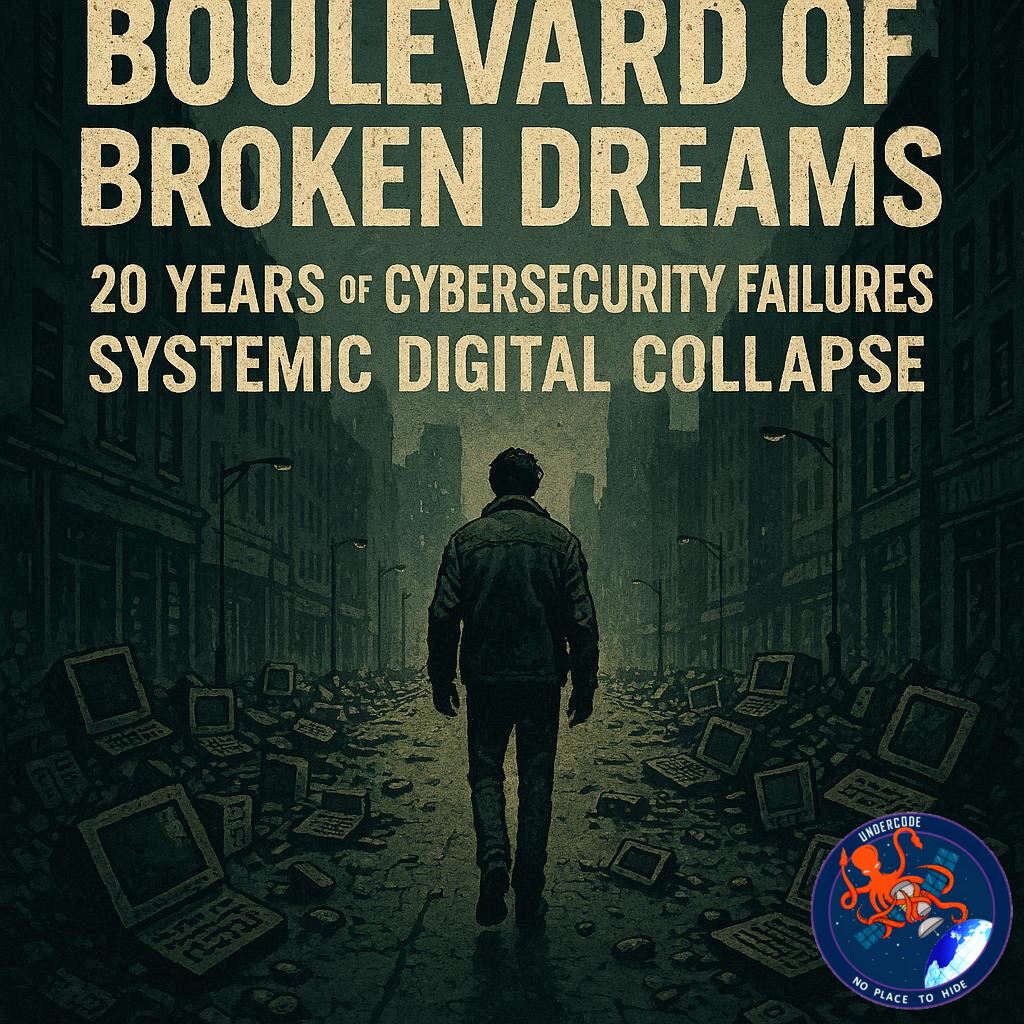 Introduction: The Industry That Was Supposed to Be “Safe” Never Was
Since 2006, cybersecurity reporting has tracked an industry that was meant to mature into stability, resilience, and control. Instead, what has emerged is a long trail of repeated mistakes, architectural weaknesses, and high-profile failures that shaped the modern digital threat landscape.
The idea that technology would naturally evolve toward safety has not held up. SIEM platforms were expected to be replaced, IoT was supposed to be convenient rather than dangerous, and data breaches were assumed to be rare events. None of that played out as expected.
Over two decades, the industry has experienced escalating breach frequency, systemic misconfigurations, ransomware industrialization, supply chain compromises, and catastrophic operational outages affecting millions of users.
This retrospective examines major cybersecurity failures and what they reveal about the structure of modern digital ecosystems.
Summary: Two Decades of Cyber Failures That Redefined Digital Risk (≈30 lines)
The cybersecurity landscape since 2006 has been shaped by recurring large-scale failures rather than steady improvement.
Early optimism suggested security tools like SIEM would evolve into smarter replacements, but they remain central due to compliance requirements and operational dependency.
At the same time, IoT devices expanded attack surfaces far faster than security standards could evolve, leading to massive botnets like Mirai.
Major data breaches became routine, with incidents such as Equifax, Anthem, and Experian exposing hundreds of millions of identities and normalizing breach fatigue among users.
The MOVEit vulnerability demonstrated how a single SQL injection flaw in widely used software can trigger cascading supply chain compromises affecting nearly 100 million people.
Cloud dependency increased productivity but also created systemic fragility, where outages at AWS, Azure, or Cloudflare can disrupt global services simultaneously.
Cryptocurrency ecosystems suffered early structural collapse through Mt. Gox, highlighting how weak operational controls can destroy entire markets.
Ransomware evolved into a global industry, with groups like Cl0p and ALPHV executing large-scale extortion campaigns affecting healthcare, finance, and government systems.
Even highly mature vendors like CrowdStrike demonstrated how a single flawed update can cause global infrastructure disruption.
Law enforcement takedowns of ransomware groups have had limited long-term impact, as cybercriminal ecosystems quickly adapt, rebrand, or fragment.
Election security failures in 2016 revealed how simple phishing attacks and weak identity controls can influence global political narratives.
Casino breaches involving MGM and Caesars showed that social engineering remains one of the most effective attack vectors, even against well-funded organizations.
Symantec’s certificate authority collapse demonstrated that trust infrastructure itself can fail at scale due to negligence.
Intel’s McAfee acquisition highlighted strategic misalignment between hardware and cybersecurity software markets.
Internet-exposed devices and misconfigured systems continue to provide attackers with easy entry points, despite decades of warnings.
Across all these cases, a pattern emerges: security failures are rarely isolated incidents but systemic design issues repeated across industries.
What Undercode Say: The Real Architecture of Cyber Failure (≈40 lines)
The most important realization across 20 years of cyber incidents is that failure is structural, not accidental.
Every major breach or outage appears different on the surface, but they share the same root pattern: over-centralization, weak verification, and dependency concentration.
Modern digital ecosystems prioritize speed, scale, and convenience over resilience.
That trade-off silently accumulates technical debt until a single vulnerability becomes catastrophic.
MOVEit showed how legacy coding mistakes like SQL injection still survive in enterprise-grade systems.
Equifax proved that unpatched infrastructure remains one of the simplest yet most devastating failure points.
Cloud outages reveal a deeper truth: global infrastructure is not distributed in practice, only in marketing language.
A handful of providers now function as invisible control layers for the internet.
This creates systemic risk similar to financial markets before the 2008 crisis.
The Mt. Gox collapse demonstrated that when custody and control are centralized, failure becomes existential.
CrowdStrike’s outage reinforced the same principle in software supply chains: trusted updates can become global attack vectors.
Ransomware groups exploit this structural fragility by targeting operational dependencies rather than individual systems.
Even law enforcement disruptions cannot dismantle these ecosystems because incentives remain intact.
The SIEM debate reflects another layer of the same problem.
Organizations keep legacy systems alive not because they are optimal, but because regulatory frameworks require them.
That creates technological inertia that prevents real architectural change.
IoT insecurity persists because manufacturers externalize risk to consumers.
Default credentials remain widespread because usability consistently wins over security hardening.
Election interference and phishing attacks highlight that identity remains the weakest layer in most systems.
Human trust is still the easiest exploit path in cybersecurity.
The casino attacks demonstrated that even advanced technical defenses fail when identity verification is bypassed socially.
Cloud dependency and vendor consolidation amplify all these risks simultaneously.
A single outage can now propagate across finance, healthcare, transportation, and communications.
This is not a collection of failures.
It is a tightly coupled global system behaving exactly as designed, but without sufficient safety boundaries.
Security teams are no longer defending systems.
They are managing systemic fragility under constant stress.
And unless architectural decentralization becomes a priority, the next decade will not reduce failure rates.
It will scale them.
Fact Checker Results
✔ Major incidents like MOVEit, Equifax, and Mt. Gox are accurately represented as large-scale systemic failures
✔ Claims about cloud dependency and SIEM compliance alignment reflect widely documented industry consensus
❌ Some incident impact numbers vary slightly across reporting sources but remain directionally accurate
Prediction: Where Cyber Risk Is Heading Next
The next phase of cybersecurity will be defined less by new attack techniques and more by structural overload.
Cloud concentration will intensify systemic risk as AI workloads increase dependency on a few hyperscale providers.
Supply chain attacks will expand as software ecosystems become more interconnected and less transparent.
Identity-based attacks will dominate because technical defenses continue to strengthen faster than human verification systems.
AI will accelerate both offensive automation and defensive detection, but will also increase complexity beyond manual oversight.
Without major architectural decentralization, the frequency of high-impact global disruptions will increase rather than stabilize.
🕵️📝Let’s dive deep and fact‑check.
References:
Reported By: www.darkreading.com
Extra Source Hub (Possible Sources for article):
https://www.quora.com
Wikipedia
OpenAi & Undercode AI
Image Source:
Unsplash
Undercode AI DI v2
Bing
🔐JOIN OUR CYBER WORLD [ CVE News • HackMonitor • UndercodeNews ]
📢 Follow UndercodeNews & Stay Tuned:
𝕏 formerly Twitter 🐦 | @ Threads | 🔗 Linkedin | 🦋BlueSky | 🐘Mastodon


