
Listen to this Post
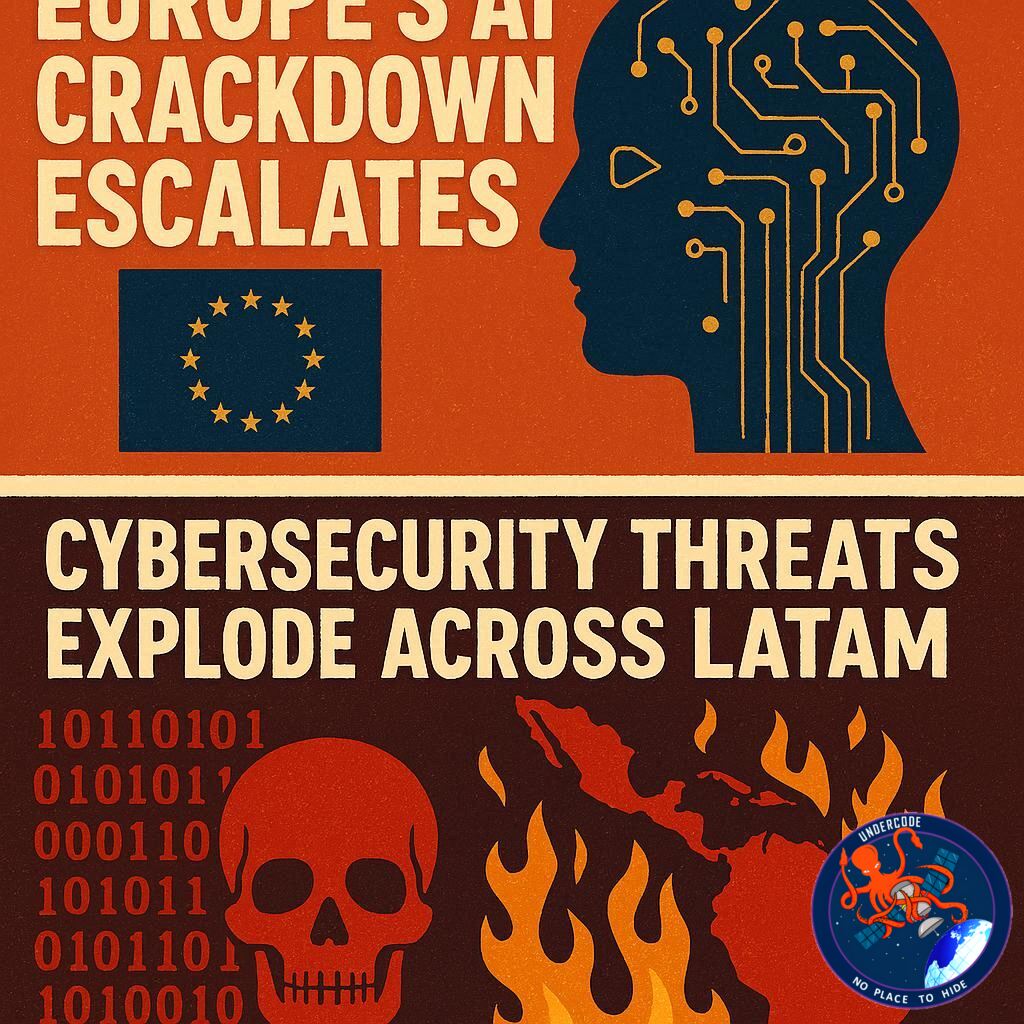 Introduction: Europe Tightens the Digital Rulebook While Cybercriminals Push Harder
European regulators are accelerating efforts to reshape the future of artificial intelligence, cloud infrastructure, and cybersecurity governance. New developments surrounding the EU AI Act are placing heavy pressure on companies developing generative AI systems, especially regarding transparency obligations, copyright protections, and operational accountability. At the same time, privacy regulators across Europe are updating guidance related to smart glasses, digital image removals, and personal data complaints.
While Europe focuses on tightening regulation, cybercriminal activity continues to intensify globally. One of the latest examples is an aggressive 18-month campaign targeting Chilean and Latin American enterprises using the notorious Agent Tesla malware. The campaign relied on phishing emails disguised as procurement communications, enabling attackers to steal credentials and exfiltrate sensitive information from compromised organizations.
The dual developments highlight a growing reality in the cybersecurity world: governments are racing to regulate advanced technology while attackers continue evolving faster than traditional defenses.
EU Regulators Push Forward With Tougher AI Transparency Rules
European authorities are continuing to expand the framework of the AI Act, one of the world’s most ambitious attempts to regulate artificial intelligence technologies. Regulators are now emphasizing stricter transparency requirements for generative AI systems, particularly those capable of creating text, images, code, and synthetic media.
The proposed rules focus heavily on copyright compliance and disclosure obligations. Developers may soon be required to clearly identify AI-generated content and provide documentation explaining how training datasets were collected and used. This directly impacts large AI companies that depend on massive internet-scale datasets to train models.
European officials argue that these measures are necessary to protect creators, publishers, and citizens from misinformation and unauthorized data exploitation. Critics, however, warn that excessive regulation could slow innovation and create barriers for smaller startups attempting to compete with dominant tech firms.
Connected Glasses and Privacy Concerns Enter Regulatory Spotlight
National regulators across Europe are also increasing scrutiny over connected wearable technologies such as smart glasses. Privacy agencies fear that always-on cameras and sensors may collect personal data without meaningful consent from nearby individuals.
Updated guidance now encourages companies manufacturing wearable devices to improve notification systems, data minimization practices, and user transparency. Regulators are especially concerned about facial recognition capabilities integrated into augmented reality systems.
The debate reflects broader fears surrounding surveillance technology becoming normalized in everyday public life. As AI and wearable devices merge together, privacy authorities are attempting to establish boundaries before adoption becomes too widespread to control effectively.
Cloud Infrastructure and Cybersecurity Risks Receive Greater Oversight
Another major focus of European regulators involves cloud providers and cybersecurity resilience. Authorities are warning that increasing dependency on centralized cloud platforms could create systemic risks if providers experience outages, breaches, or geopolitical disruptions.
New oversight initiatives aim to ensure cloud operators maintain stronger security standards, incident reporting procedures, and operational continuity plans. European officials are increasingly treating cloud infrastructure as critical national infrastructure rather than ordinary commercial services.
This shift is significant because cloud platforms now underpin banking systems, healthcare networks, government operations, and AI workloads across Europe. Any large-scale disruption could trigger cascading consequences across multiple industries simultaneously.
Agent Tesla Campaign Targets LATAM Enterprises
As Europe debates regulation, cybercriminal groups continue exploiting organizations with increasingly sophisticated malware operations. Researchers recently uncovered an extensive Agent Tesla campaign targeting Chilean and broader LATAM enterprises.
The operation reportedly lasted 18 months and focused heavily on procurement-themed phishing emails. Victims received fake business documents designed to trick employees into opening malicious attachments. Once activated, the malware deployed multi-stage loaders, process hollowing techniques, and stealthy credential theft mechanisms.
Attackers then used FTP-based exfiltration to steal usernames, passwords, and potentially sensitive corporate data. The campaign demonstrates how financially motivated threat actors continue relying on social engineering as one of the most effective attack vectors.
Why Procurement Departments Became Prime Targets
Procurement and purchasing departments are especially attractive to attackers because they regularly interact with external vendors, invoices, and attachments. Employees handling supplier communication often process large volumes of documents quickly, increasing the likelihood of accidental malware execution.
Threat actors understand this behavioral weakness and carefully tailor phishing lures to mimic legitimate procurement workflows. Fake invoices, purchase orders, and shipping confirmations remain among the most successful social engineering tactics worldwide.
The Agent Tesla campaign demonstrates that even mature enterprises remain vulnerable when attackers combine technical sophistication with realistic human deception.
What Undercode Says:
The AI Regulation War Has Officially Begun
Europe is no longer experimenting with AI governance. The continent is now aggressively positioning itself as the global referee for artificial intelligence compliance standards. The AI Act is rapidly transforming from a political concept into an operational nightmare for tech companies that built their business models around unrestricted data collection and opaque model training.
What makes this moment historically important is that regulators are targeting the very foundation of generative AI systems: training data, transparency, and accountability. This goes far beyond simple content moderation. Europe wants visibility into how AI models are constructed internally, which directly threatens the secrecy many AI companies depend on competitively.
Copyright Battles Could Reshape the Entire AI Industry
The copyright portion of the AI Act may become the most disruptive aspect of all. If companies are forced to disclose copyrighted materials used during training, massive legal battles could emerge between publishers, creators, and AI vendors.
The financial consequences could be enormous. Licensing costs for training data may skyrocket, forcing smaller AI startups out of the market entirely. Large corporations with billion-dollar reserves may survive, but independent developers could face devastating compliance expenses.
Ironically, regulations designed to democratize fairness may strengthen the dominance of already powerful AI corporations.
Europe’s Privacy Philosophy Is Expanding Beyond Traditional Data
The scrutiny surrounding connected glasses shows how regulators are evolving their understanding of privacy. Historically, privacy laws focused mainly on databases, cookies, and online tracking. Now regulators are recognizing that wearable devices transform physical public spaces into data collection zones.
This is a major philosophical shift. The question is no longer “Who owns online data?” but “Who owns observable reality itself?”
Smart glasses equipped with AI analysis create an environment where every interaction could theoretically become searchable, analyzable, and permanently archived. European regulators appear determined to prevent that scenario from developing unchecked.
Cloud Providers Are Becoming Strategic Assets
European concern over cloud infrastructure also reveals deeper geopolitical anxieties. Governments increasingly recognize that cloud providers are not merely technology vendors — they are strategic infrastructure operators controlling enormous portions of digital civilization.
A serious outage affecting a dominant cloud provider could cripple financial systems, hospitals, transportation networks, and emergency services simultaneously. Regulators now understand that cybersecurity failures inside cloud ecosystems can become national security crises overnight.
This explains why Europe is pushing for operational resilience requirements with far greater urgency than before.
Agent Tesla Proves Old Threats Still Work
One of the most striking aspects of the LATAM campaign is that attackers succeeded using techniques cybersecurity professionals have warned about for years. Phishing remains brutally effective because human psychology has not changed.
Despite expensive cybersecurity platforms, many organizations still fail at basic email security awareness and internal verification processes. Attackers know that convincing one employee to open one malicious file can bypass millions of dollars in technical defenses.
This reality continues humiliating enterprises that focus excessively on advanced cybersecurity buzzwords while neglecting employee behavior and operational discipline.
Latin America Is Facing Growing Cybersecurity Pressure
LATAM organizations are increasingly becoming preferred targets for cybercriminal groups. Several factors contribute to this trend, including uneven cybersecurity maturity, rapid digital transformation, and expanding cloud adoption.
Many companies across the region accelerated digitization faster than their security infrastructure could adapt. This created gaps that sophisticated malware operators now exploit aggressively.
The Agent Tesla campaign likely represents only a fraction of ongoing intrusion activity targeting the region.
The Future Will Be Defined by Regulation Versus Innovation
The deeper conflict emerging globally is not simply about cybersecurity or AI. It is about speed. Technology evolves exponentially, while regulation evolves politically and bureaucratically.
Governments fear losing control over AI systems capable of influencing economies, elections, information ecosystems, and public trust. Technology companies fear regulatory overreach that could suffocate innovation and competitiveness.
Neither side appears willing to slow down.
Cybersecurity and AI Are Becoming Inseparable
Another important development is the merging of AI governance and cybersecurity policy into a single strategic conversation. Regulators increasingly understand that insecure AI systems can become cybersecurity threats themselves.
Manipulated AI outputs, poisoned datasets, deepfake abuse, automated phishing, and AI-assisted malware generation are now considered realistic operational risks rather than hypothetical scenarios.
This convergence means future cybersecurity frameworks will almost certainly include mandatory AI risk management obligations.
Businesses Are Entering an Era of Permanent Compliance Pressure
Companies operating internationally may soon face overlapping AI regulations from Europe, the United States, Asia, and other regions simultaneously. Managing compliance across multiple jurisdictions could become extraordinarily complex.
Organizations will likely require dedicated AI governance teams, legal auditors, cybersecurity analysts, and transparency officers simply to maintain operational legality.
For many businesses, regulatory compliance may soon become as expensive as cybersecurity itself.
🔍 Fact Checker Results
✅ EU AI Act Discussions Are Real and Ongoing
European regulators are actively advancing transparency and copyright requirements related to generative AI systems, making this a verified regulatory development.
✅ Agent Tesla Continues To Be Used in Real-World Attacks
Agent Tesla remains a widely documented malware strain frequently associated with credential theft and phishing campaigns targeting enterprises globally.
✅ Cloud Security Oversight Is Increasing Worldwide
Governments and regulators across multiple regions are intensifying scrutiny over cloud resilience and cybersecurity risk management due to rising dependency on centralized infrastructure.
📊 Prediction
AI Compliance Costs Will Explode Over the Next Three Years
The next phase of the AI industry will not be defined purely by innovation but by survivability under regulation. Large technology firms will likely absorb compliance costs and strengthen their dominance, while smaller AI startups may struggle to survive mounting legal and operational requirements.
Meanwhile, cybercriminal groups will continue exploiting human behavior faster than governments can regulate technology. Phishing campaigns powered by AI-generated content are expected to become more convincing, multilingual, and scalable, particularly across rapidly digitizing regions like Latin America.
The organizations that survive this transition will not necessarily be the most innovative — they will be the most adaptable to both cyber threats and regulatory pressure simultaneously.
🕵️📝Let’s dive deep and fact‑check.
References:
Reported By: x.com
Extra Source Hub (Possible Sources for article):
https://www.discord.com
Wikipedia
OpenAi & Undercode AI
Image Source:
Unsplash
Undercode AI DI v2
Bing
🔐JOIN OUR CYBER WORLD [ CVE News • HackMonitor • UndercodeNews ]
📢 Follow UndercodeNews & Stay Tuned:
𝕏 formerly Twitter 🐦 | @ Threads | 🔗 Linkedin | 🦋BlueSky | 🐘Mastodon


