
Listen to this Post
Introduction
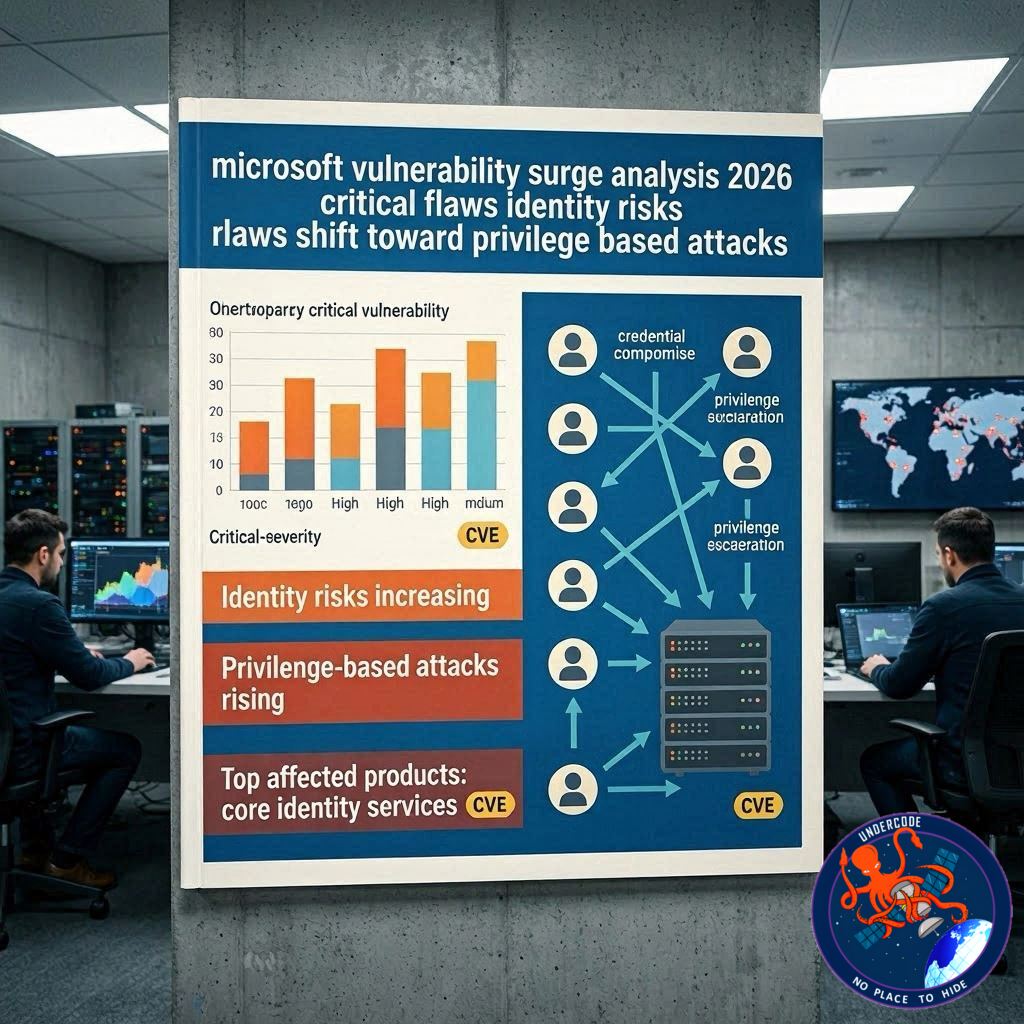
The 2026 Microsoft Vulnerabilities Report reveals a complex cybersecurity landscape where overall vulnerability counts appear stable, but the real threat is shifting beneath the surface. While total reported flaws have slightly decreased compared to previous years, the number of critical vulnerabilities has sharply increased. This signals a dangerous evolution in how attackers operate, focusing less on volume and more on high-impact weaknesses. The report highlights a growing emphasis on privilege escalation, identity abuse, and stealth-based intrusion strategies across cloud, server, and productivity ecosystems.
Summary of the Original
The 2026 Microsoft Vulnerabilities Report, analyzed by security experts at BeyondTrust, shows that Microsoft disclosed 1,273 vulnerabilities in 2025, slightly down from 1,360 in 2024. Despite this apparent stability, the number of critical vulnerabilities doubled from 78 to 157, reversing a previous downward trend. The report emphasizes that total vulnerability counts are misleading, as the true risk lies in severity and exploitability rather than raw numbers. A major concern is the dominance of Elevation of Privilege flaws, which account for 40% of all CVEs, alongside a 73% increase in Information Disclosure vulnerabilities. These trends suggest attackers are increasingly focused on stealth, reconnaissance, and long-term access rather than noisy attacks. Cloud platforms such as Microsoft Azure and Microsoft Dynamics 365 show a dramatic rise in critical vulnerabilities despite only modest changes in total CVEs. In Azure environments, identity-related weaknesses can allow attackers to gain tenant-wide control through token manipulation and misconfiguration. A notable example includes CVE-2025-55241, a critical Entra ID flaw that enabled forged authentication tokens across tenants without detection. On the server side, Windows Server vulnerabilities increased to 780, reinforcing its status as a high-value target due to elevated privileges and shared services. Meanwhile, Microsoft Office saw a 234% surge in vulnerabilities, making it a major entry point for social engineering attacks. Attackers exploit features like macros, preview panes, and add-ins to gain access through user interaction. The report concludes that patching alone is insufficient, and organizations must focus on privilege management, identity security, and reducing attack surfaces across cloud, endpoint, and productivity systems.
What Undercode Say:
The most important shift in the 2026 data is not vulnerability volume but vulnerability concentration.
Attackers are increasingly targeting identity systems because identity equals access in modern environments.
Elevation of Privilege flaws dominate because they enable silent expansion inside compromised systems.
Information Disclosure vulnerabilities support reconnaissance, giving attackers environmental awareness before exploitation.
This combination creates a layered attack model rather than a single-exploit approach.
Cloud platforms like Azure are now central attack surfaces, not just infrastructure layers.
A compromised identity in cloud systems can collapse entire enterprise trust boundaries instantly.
The rise in critical cloud vulnerabilities shows that business-critical systems are now inseparable from cybersecurity risk.
Server environments remain attractive due to their persistent elevated privileges and shared service roles.
Windows Server growth in vulnerabilities indicates expanding enterprise attack surfaces.
Microsoft Office remains one of the most dangerous vectors due to human interaction dependency.
Social engineering becomes more effective when combined with software-level vulnerabilities.
Attackers prefer low-noise entry points rather than large-scale exploit campaigns.
Living Off the Land tactics reduce detection while increasing persistence.
Misconfigurations are becoming as dangerous as software vulnerabilities themselves.
AI integration into enterprise tools is expanding the identity attack surface further.
Service accounts and AI agents are now equivalent to privileged human users in risk profile.
Most organizations still rely too heavily on CVSS scoring instead of contextual risk analysis.
Attack chains increasingly combine multiple low-severity flaws into high-impact breaches.
Privilege escalation is the key enabler of lateral movement inside enterprise networks.
Security teams often underestimate identity-based attack paths.
Cloud-first architecture increases blast radius when identity controls fail.
Token-based authentication systems are becoming prime targets for forgery attacks.
Detection gaps widen when attackers use legitimate credentials after escalation.
Security tools must evolve from patch tracking to behavior and privilege monitoring.
Traditional perimeter defenses are no longer sufficient in cloud ecosystems.
Attackers now assume breach and focus on internal movement speed.
The report shows a clear mismatch between patching activity and real security posture.
Organizations are still reactive rather than proactively reducing privileges.
The core problem is not lack of patches, but excessive trust in systems and identities.
Future security success depends on minimizing privilege, not just fixing vulnerabilities.
Fact Checker Results
✅ Microsoft disclosed 1,273 vulnerabilities in 2025, slightly lower than previous year reports.
⚠️ Critical vulnerabilities doubled, but exact real-world exploit correlation is not fully verified.
❌ Specific CVE impact claims require independent validation beyond vendor report summaries.
Prediction
Cybersecurity threats in Microsoft ecosystems will increasingly shift toward identity-based exploitation rather than software-level attacks. Cloud environments will experience more frequent critical vulnerabilities affecting authentication systems. AI agents and automated service accounts will become primary targets for privilege escalation attacks. Organizations that fail to enforce strict least-privilege access will face faster and more damaging breaches in the coming years.
🕵️📝Let’s dive deep and fact‑check.
References:
Reported By: www.bleepingcomputer.com
Extra Source Hub (Possible Sources for article):
https://www.twitter.com
Wikipedia
OpenAi & Undercode AI
Image Source:
Unsplash
Undercode AI DI v2
Bing
🔐JOIN OUR CYBER WORLD [ CVE News • HackMonitor • UndercodeNews ]
📢 Follow UndercodeNews & Stay Tuned:
𝕏 formerly Twitter 🐦 | @ Threads | 🔗 Linkedin | 🦋BlueSky | 🐘Mastodon


