
Listen to this Post
Introduction
Cybercrime networks across the Middle East and North Africa are facing one of the region’s largest coordinated crackdowns in recent years. In a sweeping international operation known as “Operation Ramz,” law enforcement agencies from 13 countries joined forces with global cybersecurity firms to dismantle phishing operations, malware infrastructure, and online fraud campaigns that targeted thousands of victims.
The operation exposed how modern cybercriminals operate across borders using phishing-as-a-service platforms, malware-infected servers, and stolen digital identities. It also revealed the growing collaboration between governments and private cybersecurity companies in fighting increasingly sophisticated online threats.
Operation Ramz: A Major Blow to Cybercrime Networks
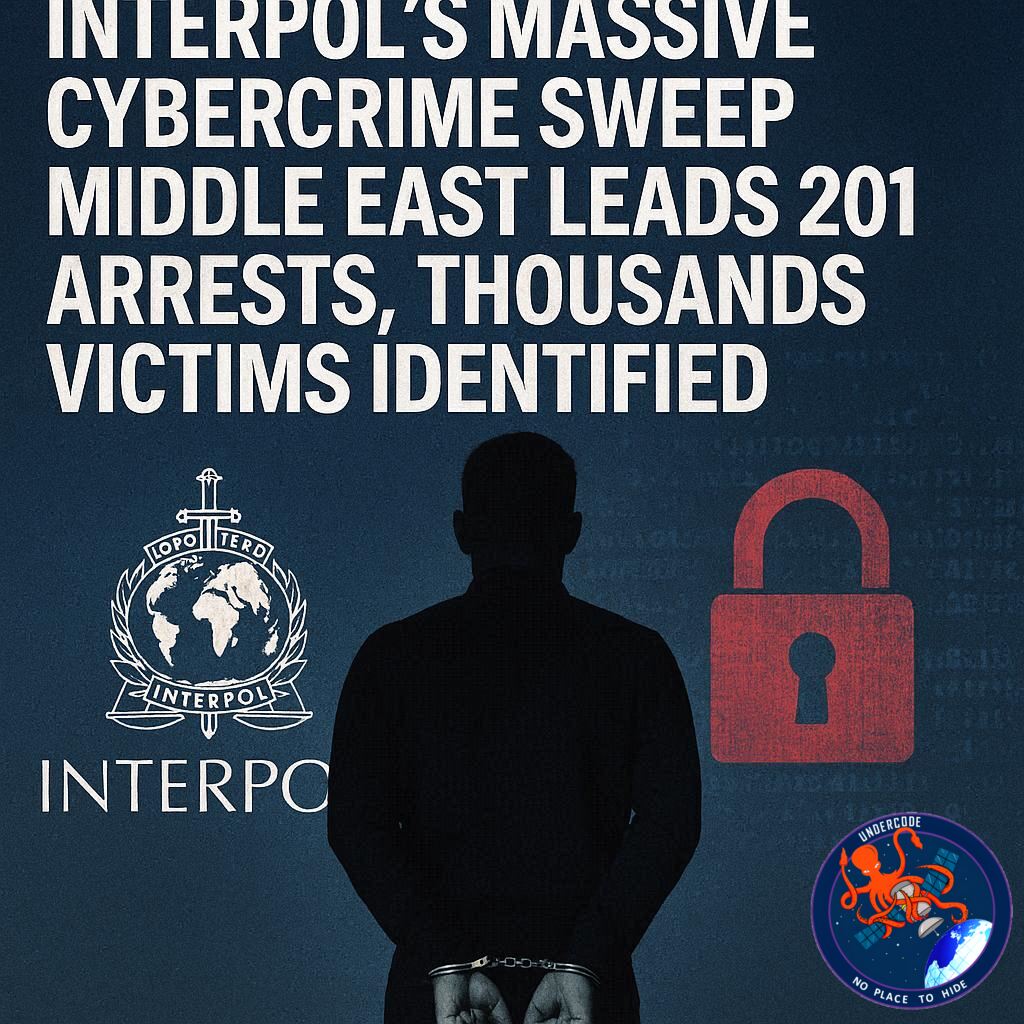
Interpol announced that Operation Ramz resulted in the arrest of 201 individuals linked to phishing, malware distribution, and cyber fraud activities throughout the MENA region. Authorities also identified an additional 382 suspects believed to be connected to the same criminal ecosystem.
The multinational operation ran between October 2025 and February 28, 2026, bringing together law enforcement agencies from Algeria, Bahrain, Egypt, Iraq, Jordan, Lebanon, Libya, Morocco, Oman, Palestine, Qatar, Tunisia, and the UAE.
During the coordinated campaign, investigators managed to seize 53 servers connected to malicious cyber infrastructure. Officials also identified 3,867 victims affected by various phishing attacks and malware campaigns across participating countries.
Private cybersecurity organizations played a major role in supporting the investigation. Companies and organizations including Kaspersky, Group-IB, Shadowserver Foundation, Team Cymru, and TrendAI helped authorities trace malicious infrastructure and identify digital evidence tied to the criminal operations.
Algeria Dismantles Phishing-as-a-Service Platform
Authorities in Algeria successfully shut down a phishing-as-a-service website used to facilitate large-scale cyber fraud campaigns. The platform reportedly enabled criminals to launch phishing attacks using ready-made tools and stolen templates.
Police arrested one suspect during the raid and confiscated servers, computers, mobile phones, and storage devices containing malware scripts and cyberattack infrastructure.
The discovery highlights how phishing-as-a-service operations continue to lower the barrier for entry into cybercrime, allowing even low-skilled criminals to execute sophisticated attacks.
Human Trafficking Linked to Cyber Fraud Operations in Jordan
One of the most disturbing revelations emerged from Jordan, where police uncovered a cyber fraud scheme connected to human trafficking.
Authorities arrested two individuals accused of orchestrating financial scams using trafficked workers. Investigators discovered that 15 people involved in the operation were not willing participants but victims who had been lured from several Asian countries with promises of employment.
After arriving in Jordan, the victims reportedly had their passports confiscated and were forced to participate in online scam activities under coercion.
The case demonstrates how cybercrime organizations increasingly overlap with organized crime and human exploitation networks.
Morocco and Oman Target Malware Infrastructure
In Morocco, authorities arrested three suspects allegedly involved in phishing campaigns. Investigators seized multiple computers, smartphones, and storage devices believed to contain operational data and stolen credentials.
Meanwhile, authorities in Oman disabled a compromised server that contained sensitive information and suffered from several critical vulnerabilities. The system had reportedly been infected with malware and posed a major cybersecurity risk.
These actions helped reduce active attack infrastructure that could have continued targeting businesses and individuals throughout the region.
Qatar Secures Compromised Devices Used in Malware Distribution
Investigators in Qatar identified multiple compromised devices unknowingly being used to distribute malware.
Authorities secured the infected systems and contacted device owners to notify them about the unauthorized activity occurring on their networks.
This part of the operation highlights an increasingly common tactic among cybercriminals: hijacking ordinary consumer devices to silently spread malware and conduct attacks without the owners realizing it.
International Collaboration Becomes the Key Weapon Against Cybercrime
According to Joe Sander, cybercrime can only be effectively countered through international collaboration between governments and trusted private-sector partners.
His statement reflects a growing reality in global cybersecurity. Criminal operations no longer operate within one country’s borders. Instead, phishing servers, malware delivery systems, money laundering networks, and scam operators are spread across multiple regions simultaneously.
Operations like Ramz demonstrate that coordinated intelligence sharing and synchronized enforcement actions are becoming essential tools in modern cyber defense strategies.
What Undercode Says:
Cybercrime Has Become an Industrialized Global Business
Operation Ramz reveals that cybercrime is no longer the work of isolated hackers operating from dark rooms. Modern cybercrime resembles a multinational industry complete with infrastructure, customer support models, subscription services, and recruitment systems.
Phishing-as-a-service platforms are especially dangerous because they allow inexperienced criminals to purchase ready-made attack kits. This dramatically increases the scale and frequency of phishing attacks worldwide.
The involvement of multiple countries in this operation also shows how difficult it has become to track digital criminals using traditional law enforcement methods. Criminals exploit jurisdiction gaps, weak enforcement regions, anonymous hosting providers, and cryptocurrency payments to avoid detection.
Another critical point is the merging of cybercrime with human trafficking. The Jordan case is particularly alarming because it confirms a trend already observed in Southeast Asian scam compounds. Organized criminal groups are increasingly forcing vulnerable individuals into digital fraud operations.
This changes the perception of cybercrime from a purely technical issue into a humanitarian and organized crime issue as well.
The participation of private cybersecurity firms was also essential. Governments often lack the real-time threat intelligence and infrastructure visibility that cybersecurity companies possess. Public-private cooperation is becoming mandatory rather than optional.
Operation Ramz may also indicate that Interpol and regional governments are shifting toward proactive cyber disruption strategies instead of waiting for major attacks to occur. Seizing servers and dismantling infrastructure before attacks spread further can significantly reduce global cyber risk.
However, despite the success of the operation, the number of victims identified — nearly 4,000 — likely represents only a small fraction of the real total. Many phishing victims never report incidents, and many malware infections remain undetected for months.
The operation also exposes the cybersecurity weaknesses of many organizations and consumers in the MENA region. Vulnerable servers, poor security practices, outdated systems, and weak phishing awareness continue to create opportunities for attackers.
Another major concern is the rapid evolution of AI-powered cybercrime. Criminal groups are increasingly using artificial intelligence to generate realistic phishing emails, fake voices, cloned identities, and multilingual scam campaigns. Future operations may become even more difficult to detect.
Governments participating in Operation Ramz will likely increase cybersecurity regulations, expand digital surveillance capabilities, and invest more heavily in cyber intelligence units after seeing the scale of these threats.
From a geopolitical perspective, cybercrime has become a national security issue rather than merely a financial threat. Attacks targeting banks, telecom companies, healthcare providers, and government infrastructure can destabilize entire economies.
The seizure of only 53 servers may seem small, but in cyber operations, disrupting core infrastructure can cripple entire criminal ecosystems temporarily. Removing command-and-control systems often causes cascading operational failures among connected threat actors.
Still, cybercriminal groups are highly adaptive. New phishing domains, malware servers, and scam operations can reappear within days if preventive measures are not sustained.
Education remains one of the strongest long-term defenses. Many phishing attacks continue to succeed because users unknowingly provide credentials or download infected files. Without stronger digital literacy, law enforcement crackdowns alone cannot eliminate the threat.
The operation also sends a symbolic message: regional cooperation in cybersecurity is improving rapidly. Historically, cross-border cyber investigations in the MENA region faced legal, political, and technical obstacles. Operation Ramz suggests those barriers are beginning to weaken.
In the broader cybersecurity landscape, operations like this could become more common globally as governments recognize that cybercrime now rivals traditional organized crime in profitability and scale.
🔍 Fact Checker Results
✅ Interpol confirmed that Operation Ramz led to 201 arrests and the identification of 382 additional suspects across 13 participating countries.
✅ Authorities reported the seizure of 53 servers and identified 3,867 victims connected to phishing and malware campaigns.
❌ There is currently no public evidence proving that Operation Ramz permanently dismantled the cybercriminal networks involved, as similar groups often rebuild infrastructure quickly.
📊 Prediction
Operation Ramz will likely trigger a new wave of cybercrime investigations across the Middle East and North Africa throughout 2026. Governments in the region are expected to strengthen cybersecurity alliances, increase digital surveillance operations, and impose stricter compliance requirements on telecom providers, financial institutions, and cloud infrastructure companies.
Cybercriminal organizations, meanwhile, will probably shift toward more decentralized infrastructure, encrypted communications, AI-generated phishing attacks, and compromised consumer devices to avoid future crackdowns. The battle between international law enforcement and cybercrime syndicates is expected to intensify significantly over the next few years.
🕵️📝Let’s dive deep and fact‑check.
References:
Reported By: www.securityweek.com
Extra Source Hub (Possible Sources for article):
https://www.quora.com
Wikipedia
OpenAi & Undercode AI
Image Source:
Unsplash
Undercode AI DI v2
Bing
🔐JOIN OUR CYBER WORLD [ CVE News • HackMonitor • UndercodeNews ]
📢 Follow UndercodeNews & Stay Tuned:
𝕏 formerly Twitter 🐦 | @ Threads | 🔗 Linkedin | 🦋BlueSky | 🐘Mastodon | 📺Youtube


