Listen to this Post
Introduction
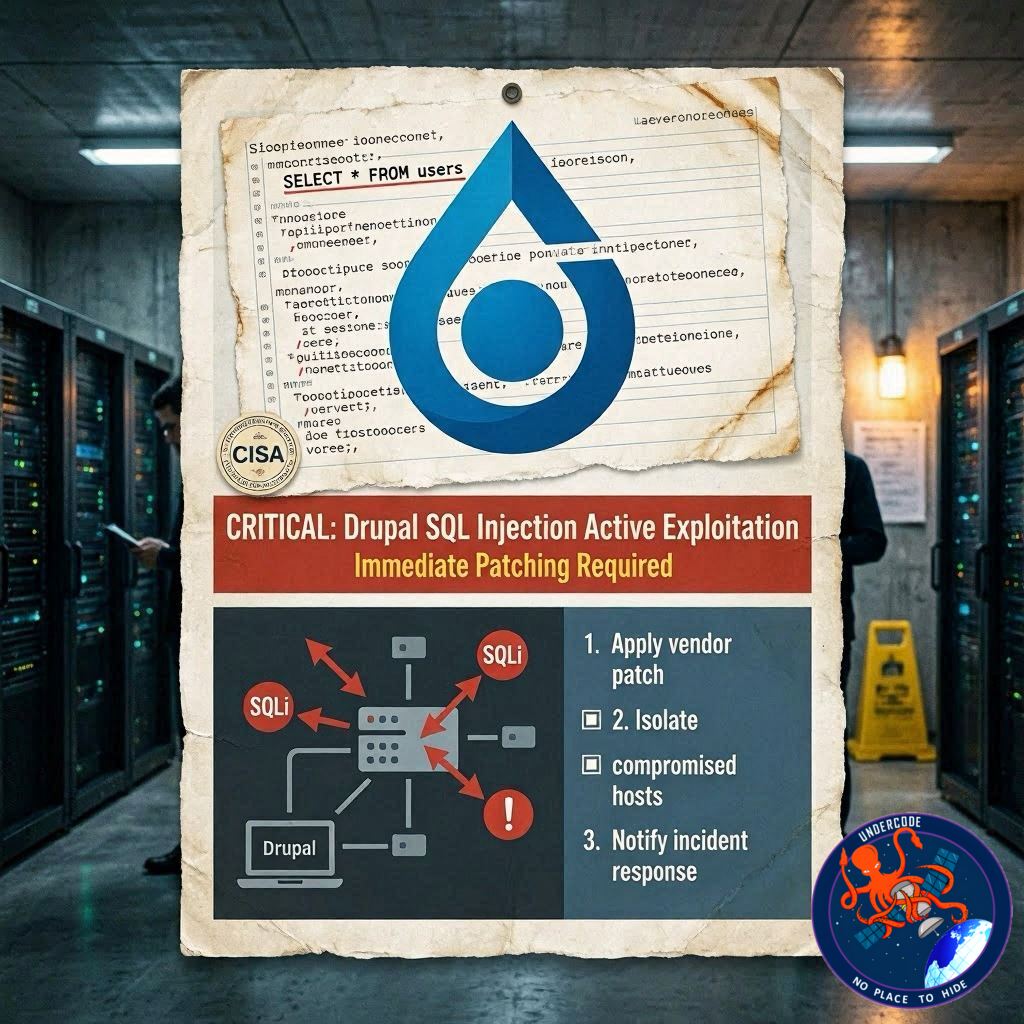
A newly disclosed security flaw in Drupal Core has rapidly escalated into a major cybersecurity concern after active exploitation attempts were detected worldwide only days after disclosure. The vulnerability, tracked as CVE-2026-9082, has now been officially added to the U.S. Cybersecurity and Infrastructure Security Agency (CISA) Known Exploited Vulnerabilities (KEV) catalog, highlighting the severity of the threat and signaling urgent remediation requirements for affected organizations.
Drupal remains one of the internet’s most widely deployed content management systems, powering government websites, enterprise portals, educational institutions, and large-scale digital platforms. A vulnerability affecting Drupal Core itself immediately becomes a high-priority target for attackers, especially when exploitation requires no authentication and can be triggered remotely.
Security researchers are already observing aggressive attack campaigns attempting to compromise vulnerable systems globally, making patching and mitigation efforts critical.
Critical Drupal SQL Injection Vulnerability Added to CISA KEV Catalog
The U.S. Cybersecurity and Infrastructure Security Agency officially added CVE-2026-9082 to its Known Exploited Vulnerabilities catalog on May 22, 2026, after evidence confirmed active exploitation in the wild.
The vulnerability originates from a failure in input sanitization inside Drupal’s PostgreSQL EntityQuery condition handler. The weakness exists specifically within how Drupal processes specially crafted array structures supplied through HTTP requests.
The issue becomes particularly dangerous because PHP’s query string parser allows attackers to manipulate array keys in addition to values. Those manipulated inputs can survive multiple internal processing stages, including JSON:API and Views pipelines, eventually reaching PostgreSQL databases without proper sanitization.
Once malicious input reaches the database layer, attackers may execute unauthorized SQL commands directly against the backend system.
Drupal classified the issue as “highly critical” and assigned it an internal severity rating of 23 out of 25, emphasizing the seriousness of the exposure.
Exploitation Began Almost Immediately
Security teams observed attackers moving rapidly.
The vulnerability disclosure occurred on May 19, 2026. Less than 48 hours later, exploitation activity had already begun.
Researchers documented more than 15,000 attack attempts targeting roughly 6,000 individual Drupal websites distributed across 65 countries.
The attack patterns suggest widespread opportunistic scanning rather than isolated targeting.
Threat actors appear to be aggressively identifying internet-facing Drupal deployments that use PostgreSQL as their backend database.
The most alarming aspect is that attackers do not require credentials.
Anonymous users can potentially exploit vulnerable systems remotely, dramatically increasing exposure levels for organizations running affected configurations.
Any publicly accessible Drupal deployment using PostgreSQL infrastructure may face immediate risk.
Affected Drupal Versions
Drupal developers released security fixes across supported versions and even issued exceptional releases for some end-of-life branches because of the extraordinary severity.
Affected deployments include:
Drupal 11.3.0 through 11.3.9 now require upgrading to 11.3.10.
Drupal 11.2.0 through 11.2.11 should move immediately to version 11.2.12.
Drupal 11.0.x and 11.1.x environments require updating to 11.1.10.
Drupal 10.6.0 through 10.6.8 should upgrade to 10.6.9.
Drupal 10.5.x environments require migration to 10.5.10.
Drupal 10.4 and earlier branches require version 10.4.10.
Organizations still operating Drupal 8.9 or Drupal 9.5 must implement manual hotfix patches.
Drupal 7 installations are not impacted by this vulnerability.
Importantly, the issue specifically affects PostgreSQL-backed deployments.
Sites running MySQL, MariaDB, or SQLite databases are not vulnerable to CVE-2026-9082.
Immediate Mitigation Guidance
CISA instructed Federal Civilian Executive Branch agencies to remediate affected systems under Binding Operational Directive 22-01 before May 27, 2026.
Organizations should prioritize defensive actions immediately.
Update Drupal Core to the patched version appropriate for the deployed branch.
Verify database architecture to confirm whether PostgreSQL is being used.
Apply available manual hotfixes if operating unsupported Drupal versions that remain exposed.
Deploy Web Application Firewall protections capable of identifying malicious JSON:API and Views requests that attempt array-key manipulation techniques.
Security teams should additionally inspect logs for unusual query behavior, failed application requests, and suspicious POST traffic aimed at Drupal endpoints.
Organizations handling sensitive customer information or operating public-facing services should consider accelerated vulnerability validation efforts.
Enterprise Risk Remains Significant
Drupal powers millions of websites globally.
Government agencies, universities, healthcare providers, media organizations, and major enterprises rely on Drupal infrastructure for mission-critical operations.
A Core-level vulnerability offering unauthenticated exploitation opportunities naturally becomes a valuable asset for threat actors.
Although no ransomware operations have been formally connected to CVE-2026-9082 at this stage, history shows SQL injection vulnerabilities frequently serve as initial entry points.
Attackers often chain initial database compromise into larger intrusion campaigns.
Credential harvesting, privilege escalation, lateral movement, data theft, persistence deployment, and backdoor installation commonly follow successful exploitation.
Even organizations that do not immediately observe malicious activity should avoid assuming safety.
Modern attackers increasingly automate exploitation pipelines, meaning exposure windows measured in hours can become sufficient for compromise.
What Undercode Say:
The rapid weaponization of CVE-2026-9082 demonstrates an increasingly familiar cybersecurity pattern: disclosure-to-exploitation timelines continue shrinking dramatically.
Years ago, defenders often had weeks before attackers operationalized newly disclosed vulnerabilities.
Today, automated scanning infrastructure, exploit sharing communities, and AI-assisted reconnaissance significantly compress that timeline.
The fact that exploitation began within 48 hours illustrates how threat actors maintain readiness to capitalize immediately on high-value exposures.
Another notable aspect involves application-layer complexity.
The vulnerability does not originate from traditional SQL concatenation mistakes developers typically expect.
Instead, it emerges from interactions between PHP query parsing behavior, Drupal request processing pipelines, and PostgreSQL query construction.
Modern software stacks increasingly contain layered abstractions.
Those abstractions create hidden attack surfaces where input validation assumptions fail.
Organizations frequently focus patch prioritization exclusively on CVSS scores.
However, exploitability conditions matter equally.
An unauthenticated remote vulnerability affecting a globally deployed CMS platform carries enormous operational risk regardless of numeric severity scoring.
The PostgreSQL limitation may reduce total exposure compared to vulnerabilities affecting every Drupal installation.
However, PostgreSQL remains widely deployed in enterprise environments because of scalability and open-source flexibility.
Government environments also frequently favor PostgreSQL infrastructure.
That reality increases strategic value for attackers.
The attack volume already observed indicates adversaries recognize the opportunity.
Security teams should also evaluate whether vulnerable systems exposed administrative APIs unnecessarily.
JSON:API functionality provides tremendous development flexibility but can unintentionally expand attack surface exposure.
Web Application Firewall protections can reduce risk but should never replace patching.
Signature-based protections often lag evolving attacker techniques.
Defenders should combine patching, traffic monitoring, endpoint visibility, database auditing, and anomaly detection capabilities.
Another long-term lesson centers on unsupported software.
Drupal releasing exceptional patches for end-of-life versions reflects responsible emergency handling.
Organizations should not rely on emergency exceptions becoming standard practice.
Legacy software accumulates operational risk over time.
Security maturity increasingly depends not only on vulnerability management speed but also software lifecycle discipline.
The broader cybersecurity industry continues moving toward shorter defensive response cycles.
Organizations unable to patch critical infrastructure rapidly may increasingly struggle against automated threat ecosystems.
This incident reinforces a reality many defenders already understand.
Speed now defines security resilience.
Fact Checker Results
✅ CVE-2026-9082 impacts Drupal Core installations using PostgreSQL database backends.
✅ Public reporting indicates exploitation activity began shortly after disclosure.
✅ Drupal issued patched versions and mitigation guidance for affected deployments.
Prediction
🔮 Automated exploitation campaigns targeting exposed Drupal PostgreSQL environments will likely continue increasing over the coming weeks.
🔮 Security vendors may release additional detection signatures and behavioral indicators as attack patterns evolve.
🔮 Organizations maintaining delayed patch cycles could experience heightened compromise risk as threat actors industrialize exploitation efforts.
▶️ Related Video (82% Match):
🕵️📝Let’s dive deep and fact‑check.
References:
Reported By: cyberpress.org
Extra Source Hub (Possible Sources for article):
https://www.facebook.com
Wikipedia
OpenAi & Undercode AI
Image Source:
Unsplash
Undercode AI DI v2
Bing
🔐JOIN OUR CYBER WORLD [ CVE News • HackMonitor • UndercodeNews ]
📢 Follow UndercodeNews & Stay Tuned:
𝕏 formerly Twitter 🐦 | @ Threads | 🔗 Linkedin | 🦋BlueSky | 🐘Mastodon | 📺Youtube