
Listen to this Post
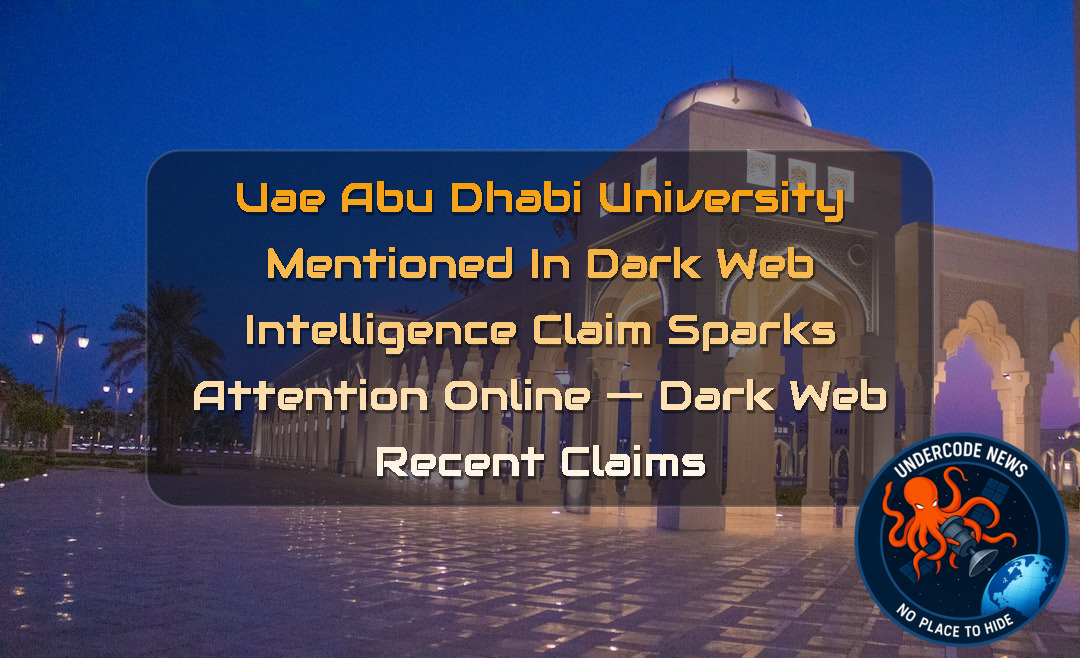 Introduction: A Claim Circulating in the Shadows of the Internet
A recent post shared by the X account “Dark Web Intelligence” has drawn attention after referencing the United Arab Emirates and Abu Dhabi University in a cryptic message. The post, shared without detailed technical context, appears to be part of a broader stream of dark web monitoring content that often surfaces on social media platforms. While the message is brief and lacks verified technical disclosure, it has still managed to generate curiosity due to its association with cybersecurity and underground data narratives.
In the absence of official confirmation or technical evidence, the situation remains firmly in the category of an unverified claim circulating online.
The Original Claim as Shared on Social Media
The post from the account “Dark Web Intelligence” simply referenced “🇦🇪 United Arab Emirates – Abu Dhabi University” along with a timestamp and minimal engagement data. No explicit details about systems, breaches, leaks, or compromised data were provided in the visible content.
Instead, the post aligns with a pattern often seen in cyber intelligence commentary accounts, where brief institutional mentions are shared without context, sometimes hinting at monitoring activity or alleged underground discussions.
Context Behind the Online Attention
The reason such posts gain traction is not necessarily because of confirmed incidents, but because of the sensitive nature of the keywords involved. When institutions like universities or government-linked regions are mentioned in proximity to terms like “dark web intelligence,” audiences often assume cybersecurity implications even when none are explicitly stated.
Abu Dhabi University, as a recognized academic institution in the UAE, naturally draws further attention due to its regional importance and scale. However, no verifiable breach data or official cybersecurity disclosure has been attached to this claim at the time of writing.
Why These Claims Spread Quickly Online
Posts like this often gain visibility for three key reasons:
First, they use authoritative-sounding account names such as “Dark Web Intelligence,” which creates an impression of insider monitoring.
Second, they reference real institutions or countries, which increases perceived credibility even without evidence.
Third, they provide minimal context, leaving interpretation open-ended, which encourages speculation and engagement.
This combination is common in modern information ecosystems where cybersecurity topics overlap with social media virality.
What Undercode Say:
Dark web intelligence posts often blur the line between monitoring and speculation
Lack of technical indicators reduces verifiability of the claim
Institutional naming increases psychological impact on readers
UAE institutions are frequently high-interest targets in cybersecurity narratives
No hashes, logs, or indicators of compromise were shared
The post resembles informational tagging rather than breach reporting
Social media cybersecurity accounts often post without full context
Absence of victim statement weakens credibility
No evidence of ransomware group attribution is visible
No data sample or leak excerpt was included
Timing metadata alone is insufficient for threat validation
Many dark web claims circulate without confirmation
Universities are common subjects in cyber rumor cycles
Engagement level does not equal factual severity
Cyber threat intelligence requires multi-source validation
This post shows no corroboration from known cybersecurity firms
No technical exploitation method was described
No IOC (Indicators of Compromise) were listed
Could represent monitoring rather than incident reporting
Could represent recycled or aggregated mention
Social amplification often distorts original intent
Institutional reputation increases post visibility
Lack of clarity fuels speculation loops
Cybersecurity awareness accounts often use ambiguity intentionally
No data leak samples or screenshots were provided
No confirmation from UAE cybersecurity authorities
No mention of affected systems or services
Could be part of threat intelligence scraping feeds
Public interpretation often exceeds original content scope
Risk perception is higher than evidence level
Absence of context limits analytical depth
Social platforms amplify incomplete security signals
Academic institutions remain frequent mention targets
No breach timeline established
No attacker identity disclosed
No malware or ransomware family identified
No technical advisory issued
Information remains unverified social claim
Requires cautious interpretation in cybersecurity analysis
Overall confidence level: low due to insufficient data
❌ No confirmed breach report from official UAE or university sources
❌ No technical evidence such as logs, leaks, or malware indicators provided
❌ No cybersecurity firm validation supporting the claim
✅ The post itself exists as a public social media mention
❌ No attribution to known ransomware or threat actor groups
The available information remains insufficient to classify this as a verified cybersecurity incident. It currently stands as an unconfirmed intelligence-style social media post.
Prediction
(+1) Increased monitoring activity may lead to clarification or official denial from relevant institutions
(+1) Cyber intelligence accounts may continue referencing similar institutions in aggregated threat feeds
(-1) Public confusion may increase if similar unverified posts continue without context
(-1) Risk of misinformation spreading in cybersecurity communities remains high without verification
Deep Analysis
uname -a
whoami
id
last -a
ps aux --sort=-%mem
netstat -tulnp
ss -tulwn
lsof -i
cat /etc/passwd
cat /etc/shadow
dmesg | tail -50
journalctl -xe
ls -la /var/log
grep -i "error" /var/log/syslog
grep -i "fail" /var/log/auth.log
tcpdump -i eth0
ip a
ip route
arp -a
traceroute 8.8.8.8
curl ifconfig.me
dig any abu-dhabi-university.ac.ae
openssl s_client -connect example.com:443
find / -type f -perm -4000 2>/dev/null
crontab -l
systemctl list-units --type=service
top
htop
vmstat 1 5
iostat -xz 1 5
free -m
df -h
du -sh /
auditctl -l
ausearch -m avc
chkrootkit
rkhunter --check
strings /bin/ls
strace -p 1
history | tail -50
▶️ Related Video (72% Match):
🕵️📝Let’s dive deep and fact‑check.
🎓 Live Courses & Certifications:
Join Undercode Academy for Verified Certifications
🚀 Request a Custom Project:
Secure, high-velocity infrastructure and disruptive technological engineering. Contact our engineering team for high-tier development and proprietary systems:
[email protected]
💎 Smart Architecture | 🛡️ Secure by Design | ⭐ Trusted by Thousands
References:
Reported By: x.com
Extra Source Hub (Possible Sources for article):
https://www.digitaltrends.com
Wikipedia
OpenAi & Undercode AI
Image Source:
Unsplash
Undercode AI DI v2
🔐JOIN OUR CYBER WORLD [ CVE News • HackMonitor • UndercodeNews ]
📢 Follow UndercodeNews & Stay Tuned:
𝕏 formerly Twitter 🐦 | @ Threads | 🔗 Linkedin | 🦋BlueSky | 🐘Mastodon | 📺Youtube


