
Listen to this Post
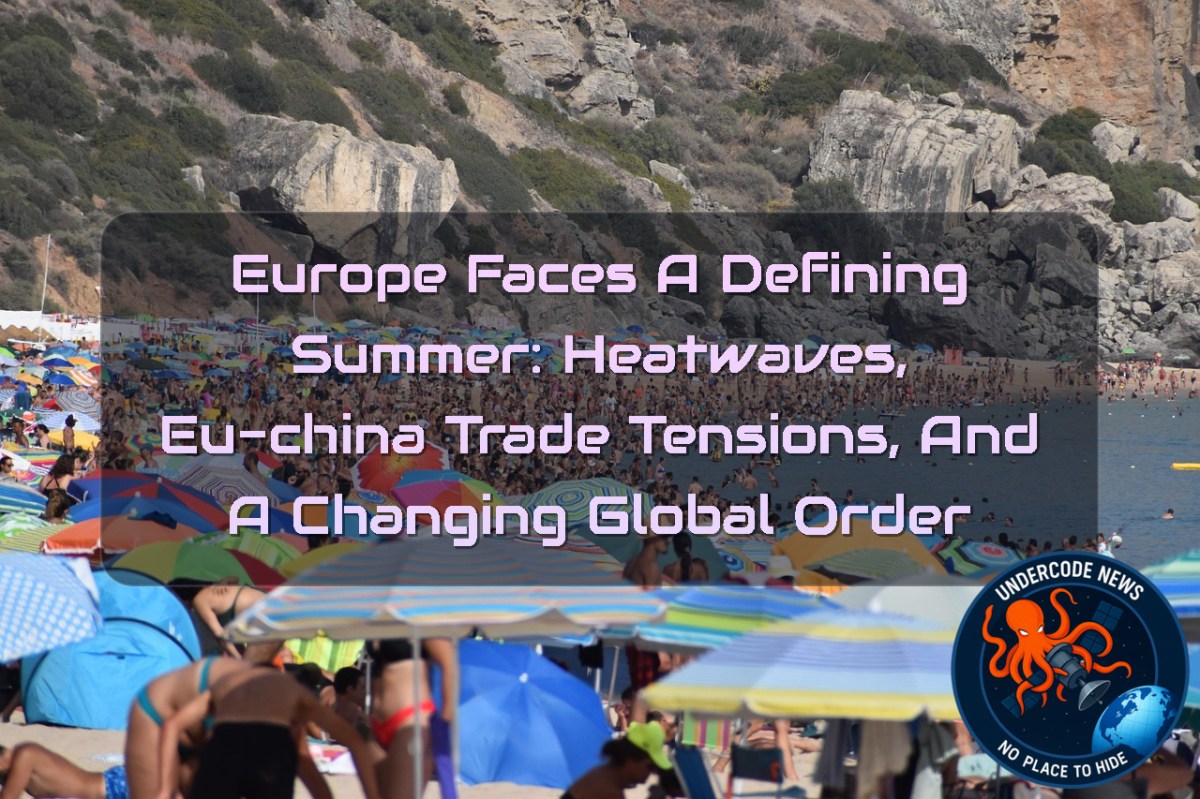
Europe Faces a Defining Summer: Heatwaves, EU-China Trade Tensions, and a Changing Global Order
Introduction
Europe has entered one of its most politically and economically challenging summers in recent years. Record-breaking temperatures, mounting geopolitical rivalries, complex trade negotiations, and growing concerns over inflation are unfolding simultaneously, creating a season where climate, diplomacy, economics, and technology have become inseparable.
While much of the
This combination of environmental emergencies, diplomatic uncertainty, and economic competition illustrates how interconnected today’s global challenges have become.
Europe Endures Historic Heatwave
An unprecedented heatwave has swept across much of Europe, breaking temperature records from Denmark to the Czech Republic while exposing weaknesses in infrastructure designed for milder climates.
Schools have temporarily closed in several regions, power systems have experienced significant strain, and essential public infrastructure has suffered damage from prolonged extreme temperatures.
France has become one of the countries hardest hit by the soaring temperatures. Authorities estimate that at least one thousand excess deaths have already been associated with the recent heatwave, highlighting the increasingly serious human cost of climate-related events.
The crisis has transformed climate adaptation from an environmental discussion into a national political priority.
Air Conditioning Becomes a Political Battlefield
The debate surrounding air conditioning has evolved into one of Europe’s most controversial political discussions.
France’s National Rally, led by Marine Le Pen, has renewed calls for a nationwide “Plan Clim,” proposing a massive €40 billion investment to expand air-conditioning infrastructure throughout the country.
Supporters argue that cooling systems should become essential public infrastructure, particularly in hospitals, nursing homes, schools, and government facilities where vulnerable populations face the greatest risks during extreme heat.
Critics, however, question the financial feasibility of such an ambitious proposal. Many argue that cost estimates remain inconsistent while warning that increased electricity consumption could undermine climate objectives.
Interestingly, even traditionally green political movements have begun softening their opposition. Environmental leaders increasingly acknowledge that certain public institutions may require modern cooling systems as Europe adapts to a warmer climate.
The discussion is no longer simply about comfort. It has become a debate over public health, energy security, infrastructure investment, and climate resilience.
Brussels Experiences Its Own Infrastructure Challenge
The European Commission headquarters in Brussels also felt the impact of the exceptional temperatures.
Cooling systems inside the Berlaymont building were temporarily shut down because of the intense heat affecting operational capacity.
Most offices experienced disruptions, although reports indicated that the upper executive floors used by European Commission President Ursula von der Leusd and senior commissioners remained unaffected.
The incident demonstrated that even
US Independence Celebration Draws
Amid the political and climate discussions, Brussels hosted one of its largest diplomatic social events of the season during the United States Independence Day celebration organized by Ambassador Bill White.
Thousands of diplomats, government officials, NATO representatives, and European leaders attended the event in Cinquantenaire Park.
Among the prominent guests were Belgian Prime Minister Bart De Wever, NATO Secretary General Mark Rutte, and European Parliament President Roberta Metsola.
The celebration combined traditional American entertainment with diplomatic networking, featuring baseball activities, line dancing, a mechanical bull, aerial demonstrations, drone performances, and fireworks.
The gathering highlighted the continuing strategic partnership between the United States and European allies despite growing geopolitical uncertainty.
EU and China Prepare for Difficult Trade Talks
While celebrations continued in Brussels, European trade officials prepared for another round of challenging negotiations with China.
European Trade Commissioner Maroš Šefčovič met Chinese Commerce Minister Wang Wentao against the backdrop of increasingly strained economic relations.
The European Union continues attempting to protect domestic industries from what it considers unfair competition caused by Chinese industrial overcapacity.
At the same time, Brussels seeks to avoid a full-scale trade confrontation that could further disrupt global supply chains.
European policymakers therefore face a delicate balancing act: defending strategic industries while maintaining one of the world’s largest trading relationships.
Europe’s Massive Trade Deficit Raises Strategic Questions
One of the major concerns influencing European policy is the enormous daily trade deficit with China, estimated at approximately €1 billion.
European governments increasingly recognize that economic dependence creates strategic vulnerabilities.
As a result, the European Commission has received political support to strengthen trade defense instruments capable of responding more rapidly to unfair trade practices.
However, European leaders remain cautious.
Completely severing commercial ties with China would create significant disruptions for manufacturing, renewable energy deployment, and numerous industrial sectors that rely heavily on Chinese imports.
China’s Remaining Dependence on Europe
Although discussions often focus on
China continues relying on European expertise across several advanced technology sectors.
These include aerospace engineering, semiconductor manufacturing equipment, pharmaceutical innovation, robotics, automotive technologies, and quantum computing research.
Nevertheless, experts caution that
Meanwhile,
These critical resources remain essential for electric vehicles, renewable energy systems, defense technologies, and advanced electronics manufactured throughout Europe.
Central Bank Leaders Prepare for Critical Economic Discussions
Attention also shifts toward Portugal, where central banking leaders gather for the annual Sintra Forum.
European Central Bank President Christine Lagarde joins international financial officials to discuss inflation, interest rates, and future monetary policy.
The forum carries additional significance because global energy markets have become increasingly volatile following geopolitical tensions affecting the Strait of Hormuz.
Higher energy prices continue placing upward pressure on inflation, complicating central banks’ efforts to balance economic growth with price stability.
Investors will closely monitor every statement for clues regarding future interest-rate decisions.
Additional International Developments
Beyond
Russia has acknowledged fuel shortages following continued Ukrainian strikes targeting oil refinery infrastructure.
Meanwhile, Venezuela continues facing humanitarian challenges after devastating earthquakes reportedly left tens of thousands of people missing while causing billions of dollars in damage.
International attention also turns toward the FIFA World Cup knockout stages, where competition intensifies as the tournament enters its decisive phase.
Deep Analysis: Climate, Trade and Technology Converge
Europe’s current situation demonstrates that modern crises rarely exist in isolation.
Climate change is now directly influencing political campaigns.
Trade policy increasingly overlaps with national security.
Technology competition shapes diplomatic negotiations.
Energy prices affect inflation.
Inflation influences interest rates.
Interest rates determine investment.
Investment affects industrial competitiveness.
These interconnected challenges require policymakers to think beyond traditional political boundaries.
From a technological perspective, infrastructure resilience has become just as important as digital resilience.
Governments increasingly rely on predictive analytics, artificial intelligence, climate modeling, and cybersecurity to prepare for future emergencies.
Professionals analyzing European infrastructure can monitor environmental and system performance using Linux-based tools:
uptime
top
htop
vmstat
iostat
journalctl -xe
dmesg
df -h
free -m
sar
ss -tulnp
netstat -rn
curl https://example.com
ping 8.8.8.8
traceroute google.com
systemctl status
systemctl list-units
ip addr
ip route
hostnamectl
timedatectl
sensors
watch sensors
These commands help administrators monitor system health, temperature-related hardware performance, network connectivity, storage capacity, and service availability during periods of high operational stress.
As Europe modernizes its infrastructure, digital resilience will become just as critical as physical resilience.
Future investments are likely to prioritize smart electrical grids, AI-powered energy management, efficient cooling technologies, semiconductor independence, renewable energy integration, and resilient digital infrastructure capable of operating under increasingly extreme environmental conditions.
What Undercode Say:
Europe’s current trajectory reveals that climate policy can no longer be separated from economic policy.
The heatwave is not simply an environmental event.
It is exposing weaknesses in infrastructure planning accumulated over decades.
Political debates over air conditioning may appear symbolic, yet they actually represent larger questions about adaptation versus prevention.
Europe spent years emphasizing emissions reduction.
Now it must simultaneously invest in adaptation.
That transition will require enormous public spending.
The EU-China relationship has entered a new strategic phase.
Neither side wishes for economic decoupling.
However, both are preparing for greater economic independence.
China continues strengthening domestic manufacturing.
Europe is attempting to rebuild strategic industrial capacity.
Rare earth minerals remain one of
Without alternative supply chains,
The semiconductor industry illustrates another important lesson.
Technological leadership is no longer measured only by innovation.
Manufacturing capability has become equally valuable.
Climate resilience is becoming an economic competitiveness issue.
Countries able to protect workers and infrastructure from extreme temperatures will experience fewer productivity losses.
Financial markets increasingly price climate risks into investment decisions.
Insurance costs continue rising.
Infrastructure investment priorities are changing.
Urban planning must evolve.
Public transportation requires redesign.
Electricity grids need modernization.
Cooling technologies will become major investment sectors.
Artificial intelligence will optimize energy consumption.
Smart buildings will become standard rather than optional.
Trade policy will increasingly include technology restrictions.
National security now extends beyond military capability.
Industrial supply chains have become strategic assets.
The Berlaymont cooling incident illustrates how even symbolic institutions require modernization.
Governments must lead by example.
Strategic autonomy remains
Achieving it will require industrial investment measured in hundreds of billions of euros.
The coming decade will likely determine whether Europe remains a technological leader or becomes increasingly dependent on external suppliers.
Success will depend upon coordinated policy rather than isolated national initiatives.
Prediction
(+1) Europe will significantly accelerate investment in climate-resilient infrastructure, modern cooling technologies, renewable energy, and advanced manufacturing over the next decade.
(-1) If EU-China trade tensions continue escalating while climate-related disruptions become more frequent, European industries may experience higher production costs, slower economic growth, and greater geopolitical uncertainty.
✅ Europe has experienced exceptional heatwaves with multiple countries recording unusually high temperatures, making climate adaptation an urgent political issue.
✅ The European Union continues facing growing trade tensions with China while maintaining active diplomatic negotiations to avoid broader economic conflict.
❌ Long-term political proposals, including large-scale national air-conditioning programs and future industrial strategies, remain subject to legislative approval, funding availability, and changing political priorities rather than guaranteed implementation.
▶️ Related Video (80% Match):
🕵️📝Let’s dive deep and fact‑check.
🎓 Live Courses & Certifications:
Join Undercode Academy for Verified Certifications
🚀 Request a Custom Project:
Secure, high-velocity infrastructure and disruptive technological engineering. Contact our engineering team for high-tier development and proprietary systems:
[email protected]
💎 Smart Architecture | 🛡️ Secure by Design | ⭐ Trusted by Thousands
References:
Reported By: www.euronews.com
Extra Source Hub (Possible Sources for article):
https://www.pinterest.com
Wikipedia
OpenAi & Undercode AI
Image Source:
Unsplash
Undercode AI DI v2
🔐JOIN OUR CYBER WORLD [ CVE News • HackMonitor • UndercodeNews ]
📢 Follow UndercodeNews & Stay Tuned:
𝕏 formerly Twitter 🐦 | @ Threads | 🔗 Linkedin | 🦋BlueSky | 🐘Mastodon | 📺Youtube


