
Listen to this Post
 Introduction: A Crisis Reopening Old Wounds Inside the Catholic Church
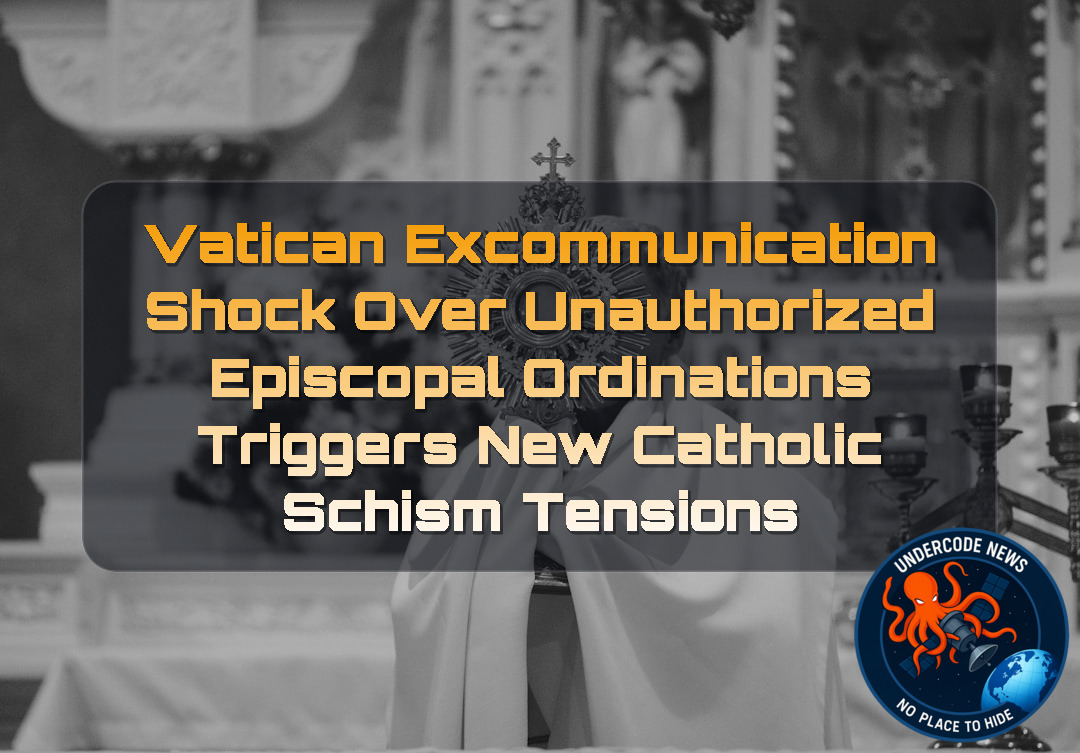
A new wave of tension has erupted inside the global Catholic community after the Vatican issued an automatic excommunication against key figures linked to the Priestly Society of Saint Pius X, also known as the Lefebvrists. The decision follows the controversial ordination of four bishops without papal approval, an act the Holy See considers a direct violation of canonical law and a threat to ecclesiastical unity. The move has revived one of the most sensitive theological and institutional conflicts in modern Church history.
the Vatican Decree and Core Decision
The Dicastery for the Doctrine of the Faith declared that the ordinations carried out without papal mandate constitute a “schismatic act” under canon law. The decree, signed by Prefect Víctor M. Fernández, confirmed the automatic excommunication (latae sententiae) of Bishop Alfonso de Galarreta and four newly ordained bishops: Pascal Schreiber, Michael Goldade, Michel Poinsinet de Sivry, and Marc Hanappier. Bishop Bernard Fellay was also sanctioned due to his role as co-consecrator, reinforcing the Vatican’s position that participation in such acts carries severe canonical consequences.
The Unauthorized Ordinations in Écône and Immediate Fallout
The disputed ordination ceremony took place in Écône, Switzerland, despite direct appeals from the Pope to suspend the event. The Vatican maintains that conducting episcopal consecrations without papal authorization represents one of the most serious violations in Catholic law. During the ceremony, leadership within the Priestly Society of Saint Pius X defended the move as an act of preserving tradition rather than breaking communion with Rome, deepening the divide between both sides.
Vatican Warnings and the Expansion of Canonical Penalties
Beyond individual excommunications, the Vatican issued a broader warning to clergy and believers. Any participation or alignment with the schismatic act, even indirectly, could result in identical canonical penalties. Church authorities emphasized that unauthorized ordinations risk depriving the faithful of licit sacramental access and could further destabilize internal Church unity across dioceses worldwide.
The Position of the Priestly Society of Saint Pius X
The Priestly Society of Saint Pius X (SSPX), founded by Archbishop Marcel Lefebvre in 1970, continues to argue that its mission is not separation but restoration of traditional Catholic liturgy and doctrine. Its leadership insists that adherence to pre-conciliar traditions remains central to its identity. However, the Vatican views its actions as incompatible with full ecclesial communion, especially when they bypass papal authority in sacramental governance.
Historical Roots of the Conflict With the Vatican
The tension between SSPX and Rome dates back decades, deeply tied to opposition to reforms introduced by the Second Vatican Council, particularly changes in liturgy and language in Mass. The most significant rupture occurred in 1988 when Lefebvre ordained bishops without papal approval, leading to excommunications that were later partially lifted. Despite attempts at reconciliation under Pope Benedict XVI, full doctrinal alignment was never achieved.
Past Reconciliation Efforts and Renewed Fractures
Between 2007 and 2009, Pope Benedict XVI attempted to bridge divisions through liturgical liberalization and the lifting of earlier excommunications. However, doctrinal disagreements persisted, particularly regarding interpretation of conciliar texts. Later restrictions on traditional liturgy under Pope Francis further complicated relations, reinforcing perceptions of unresolved theological tension within the Church.
Current Implications for Global Catholic Unity
The Vatican has described the latest ordinations as reopening an unresolved wound in Church unity. While Rome continues to call for doctrinal obedience and reconciliation, SSPX maintains that its actions are necessary to preserve authentic tradition. The situation now risks entering a prolonged phase of canonical isolation and theological confrontation, with uncertain prospects for renewed dialogue.
What Undercode Say:
The Vatican decision reflects a strict enforcement of canonical authority over episcopal ordinations
The SSPX continues to challenge post-Vatican II reforms, keeping theological friction alive
This event shows how unresolved doctrinal disputes can re-emerge after decades of partial reconciliation
The concept of ecclesial unity remains fragile when authority and tradition collide
Canon law is being used as the primary tool of institutional discipline
Excommunication here functions both as punishment and warning to wider clergy networks
The timing suggests Rome is attempting to prevent parallel church structures
Historical precedent from 1988 strongly influences today’s response
The Vatican is prioritizing institutional control over negotiated flexibility
SSPX framing of “tradition preservation” directly conflicts with Vatican unity doctrine
The situation highlights a long-term structural divide within global Catholicism
Religious authority remains centralized in papal mandate enforcement
Unauthorized ordinations are treated as systemic threats, not isolated acts
The Church is signaling zero tolerance for independent episcopal authority
This reinforces the hierarchy-driven model of Catholic governance
Internal dissent is increasingly treated as canonical risk exposure
The crisis reflects deeper identity conflict within post-conciliar Catholicism
The Vatican is attempting to prevent fragmentation into parallel hierarchies
Historical reconciliation attempts are now partially reversed in practice
The balance between tradition and reform remains unresolved
SSPX continues to operate in a semi-autonomous theological space
Rome sees doctrinal obedience as non-negotiable for unity
The ordination event represents a symbolic challenge to papal supremacy
Canonical penalties serve as deterrence for future unauthorized acts
The Church is reinforcing structural boundaries of sacramental legitimacy
The dispute is both theological and institutional in nature
Global Catholic unity depends on compliance with centralized authority
The conflict exposes limits of past reconciliation strategies
The SSPX remains influential despite lack of official recognition
This may trigger renewed internal diplomatic negotiations
The Vatican is signaling readiness for prolonged disciplinary stance
Future dialogue will depend on doctrinal concessions
The situation reflects unresolved post-Vatican II tensions
The Church hierarchy is prioritizing stability over plural liturgical practice
The crisis may reshape future governance of traditionalist groups
The risk of parallel ecclesial structures is increasing
The Vatican response is intended as both corrective and preventive
Historical memory of Lefebvre’s 1988 actions remains decisive
Institutional unity is being enforced through canonical law
The situation remains fluid with potential escalation or dialogue
✅ The 1988 Lefebvre ordinations and resulting excommunications are historically documented
❌ The Vatican declaring automatic excommunication follows canon law conditions, but each case requires formal canonical assessment context
❌ Claims of immediate global sacramental deprivation are interpretative and not universally applicable across dioceses
Prediction:
(+1) The Vatican may open conditional dialogue channels if SSPX signals doctrinal concessions
(+1) Pressure for internal Church unity will likely increase disciplinary enforcement in similar cases
(-1) Continued unauthorized ordinations could deepen structural separation from Rome
(-1) Long-term reconciliation remains uncertain due to persistent theological disagreements
Deep Analysis:
Inspect canonical documents and historical decrees
grep -i "excommunication" vatican_documents.txt
Search references to SSPX doctrinal disputes
grep -R "Priestly Society of Saint Pius X" /church_history/councils/
Compare historical reconciliation phases
diff -r 1988_case/ 2009_reconciliation/
Analyze textual changes in doctrinal statements
sed -n '1,200p' canon_law.txt
Track keyword evolution in Vatican communications
awk '{print $0}' vatican_statements.log | grep -i "unity|schism|ordination"
▶️ Related Video (84% Match):
🕵️📝Let’s dive deep and fact‑check.
🎓 Live Courses & Certifications:
Join Undercode Academy for Verified Certifications
🚀 Request a Custom Project:
Secure, high-velocity infrastructure and disruptive technological engineering. Contact our engineering team for high-tier development and proprietary systems:
[email protected]
💎 Smart Architecture | 🛡️ Secure by Design | ⭐ Trusted by Thousands
References:
Reported By: www.euronews.com
Extra Source Hub (Possible Sources for article):
https://www.instagram.com
Wikipedia
OpenAi & Undercode AI
Image Source:
Unsplash
Undercode AI DI v2
🔐JOIN OUR CYBER WORLD [ CVE News • HackMonitor • UndercodeNews ]
📢 Follow UndercodeNews & Stay Tuned:
𝕏 formerly Twitter 🐦 | @ Threads | 🔗 Linkedin | 🦋BlueSky | 🐘Mastodon | 📺Youtube


