
Listen to this Post
 A Quiet Intelligence Operation Raises a Much Bigger Alarm
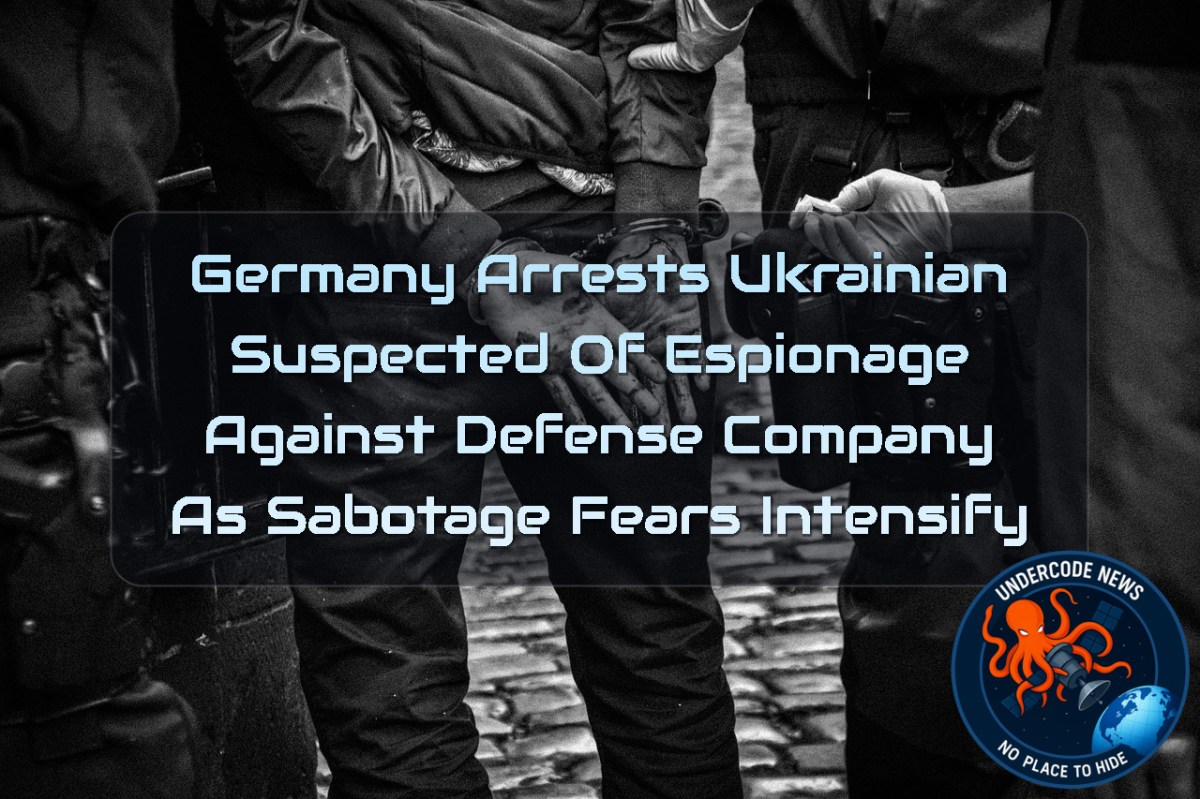
Germany has detained a 33-year-old Ukrainian national accused of gathering intelligence on a defense company in southern Germany, in a case that has renewed fears about espionage, sabotage and covert foreign operations targeting Europe’s military and critical infrastructure.
According to German federal prosecutors, the man allegedly collected information about the premises of a defense company with the suspected purpose of supporting potential sabotage. Authorities believe he was operating as a low-level agent for a foreign intelligence service, but they have not publicly identified which country was allegedly directing the operation.
The arrest is significant not simply because of the suspect’s alleged actions, but because of the broader security environment surrounding Germany. European governments have increasingly warned that foreign intelligence services can rely on seemingly ordinary individuals to conduct surveillance, identify vulnerable facilities, gather photographs and collect information that could later support disruptive or destructive operations.
The Arrest in Southern Germany
German authorities detained the 33-year-old man on Sunday, according to prosecutors cited by Reuters. Investigators suspect that he had been gathering information about a defense company’s premises in southern Germany.
The information allegedly collected was not described as an immediate cyberattack or direct physical assault. Instead, the case appears centered on reconnaissance, an activity that can become extremely valuable during the preparation phase of a sabotage operation.
This distinction matters.
A person photographing a facility or studying its surroundings may appear far less threatening than someone attempting to breach a computer network or acquire explosives. Yet intelligence collection can provide the foundation for a much larger operation.
The Suspected Foreign Intelligence Connection
German prosecutors believe the suspect was acting as a low-level agent for a foreign intelligence service. The country behind the alleged operation has not been disclosed.
That missing detail is one of the most important elements of the investigation.
It would be premature to identify the alleged sponsor based solely on the suspect’s nationality. The fact that the detainee is Ukrainian does not establish that he was working for Ukraine, and German authorities have not publicly made such an accusation.
Modern intelligence operations frequently use intermediaries whose nationality does not necessarily correspond to the government ultimately directing an operation.
Why the Ukrainian Nationality Matters Less Than the Intelligence Trail
The nationality of the suspect is likely to attract immediate attention because Germany is deeply involved in European defense efforts and Ukraine-related security matters.
But nationality should not be confused with attribution.
A foreign intelligence service can recruit individuals from many different backgrounds. A person may be motivated by money, coercion, ideology, personal connections or other incentives. The operational objective is what matters most to investigators.
In this case, German prosecutors are focusing on the alleged intelligence-gathering activity and its suspected connection to sabotage rather than presenting the suspect’s nationality as evidence of state responsibility.
Reconnaissance Can Be the First Stage of Sabotage
The most concerning element of the case is the alleged purpose behind the information gathering.
If investigators are correct that the surveillance was intended to support sabotage, the activity represents something more serious than simple curiosity or unauthorized photography.
Reconnaissance can help an operator understand entrances, security procedures, physical layouts, transportation routes, working hours and other characteristics of a facility.
Those details can later be combined with information obtained from public records, social media, employees, satellite imagery and digital infrastructure.
The result can be a detailed operational picture without the attacker ever needing sophisticated hacking capabilities.
Defense Companies Are Increasingly Valuable Targets
Defense manufacturers occupy an unusually sensitive position in the European security environment.
Their facilities may contain production systems, research programs, supply-chain information, engineering data and specialized equipment. Disrupting even one important facility could create consequences beyond the company itself.
A successful sabotage operation could potentially delay production, interrupt logistics, damage equipment, expose sensitive information or create uncertainty throughout a wider supply chain.
That makes physical reconnaissance a serious national-security concern.
Germany Faces a Broader Hybrid Threat
The arrest also fits into a much larger European discussion about hybrid threats.
Modern state-backed operations do not necessarily resemble the traditional image of an intelligence officer operating under diplomatic cover.
Instead, hostile services can potentially combine cyber operations, disinformation, surveillance, influence campaigns, criminal intermediaries and physical reconnaissance.
The objective may be to remain below the threshold of an obvious military attack while still creating economic, political or security consequences.
Germany’s defense industry is therefore part of a much wider strategic battlefield.
The Low-Level Agent Model
The description of the suspect as a low-level agent is particularly interesting.
Intelligence organizations do not always need highly trained operatives on the ground.
A disposable intermediary can sometimes perform simple but useful tasks while remaining separated from the people who planned the broader operation.
This creates layers between the person collecting information and the intelligence organization allegedly interested in that information.
Such compartmentalization can make attribution more difficult.
It can also allow an intelligence service to deny direct involvement if an operation is exposed.
The Human Element Remains Critical
Cybersecurity discussions often focus on malware, vulnerabilities and sophisticated intrusion techniques.
But this case illustrates why physical security and human intelligence remain important.
A heavily protected network can still coexist with an exposed parking area.
A sophisticated security system can still be undermined by an employee sharing information.
An organization can spend millions defending its digital infrastructure while overlooking what an outsider can learn simply by watching the facility from a public location.
Security is therefore not purely a technical problem.
From Observation to Operational Intelligence
A single photograph may seem insignificant.
A collection of photographs can be different.
When combined with maps, publicly available information, employee schedules and observations of daily activity, seemingly harmless details can form a useful intelligence package.
This is why security organizations increasingly treat suspicious reconnaissance as an early warning signal rather than dismissing it as an isolated incident.
The danger is not necessarily the individual observation.
The danger is what someone else might eventually do with the accumulated information.
Germany’s Defense Industry Under Pressure
Germany has been strengthening its defense posture as the European security environment becomes more dangerous.
That means defense companies are becoming increasingly important to national resilience.
Facilities involved in weapons production, military technology, logistics and related supply chains could become attractive targets for intelligence collection or disruption.
The strategic value of these companies extends beyond their commercial operations.
Their production capacity can influence military readiness.
The Investigation Is Still Developing
German authorities have not publicly disclosed every detail of the investigation.
The identity of the defense company has not been publicly established in the Reuters report, and the foreign intelligence service allegedly connected to the suspect has not been named.
That means some of the most important questions remain unanswered.
Who allegedly recruited the suspect?
What information was collected?
How long had the surveillance been taking place?
Was the information transmitted outside Germany?
Was an actual sabotage operation being prepared?
And were other individuals involved?
Those questions could determine how serious the wider network may be.
A Larger European Pattern
This incident should also be viewed alongside
Germany has previously dealt with other espionage investigations involving foreign intelligence services and military-related information. In April 2026, German authorities arrested a Kazakh national accused of passing information concerning German military assistance to Ukraine and the German defense industry to Russia, while also allegedly identifying potential sabotage targets.
The cases are not necessarily connected.
But together they demonstrate why European security agencies increasingly treat intelligence collection around defense infrastructure as a serious warning sign.
The Dark Web Is Only One Piece of the Puzzle
The term “Dark Web” often dominates discussions about covert threats, but physical espionage demonstrates why underground online activity is only one part of the modern threat landscape.
A hostile operation can involve open websites, encrypted communications, criminal marketplaces, social media, compromised accounts and physical surveillance.
Threat actors do not need to stay exclusively online.
The strongest operations may move between digital and physical environments.
Why Attribution Is Difficult
Attribution is one of the hardest problems in intelligence investigations.
Finding the person who physically collected information is not necessarily the same as identifying the organization that ordered the activity.
Investigators may need to establish communication links, financial transfers, digital accounts, travel patterns, contacts and instructions.
Even then, intelligence services can deliberately create layers of separation.
That is why German prosecutors have so far stopped short of publicly naming the foreign service allegedly behind the operation.
The Strategic Value of Ambiguity
From an intelligence perspective, ambiguity can be useful.
A state may want information without creating a clear trail leading directly back to government institutions.
Using intermediaries can provide plausible deniability.
For investigators, however, ambiguity creates a difficult evidentiary challenge.
Authorities must distinguish between an
The difference is strategically enormous.
What Undercode Say:
1. Reconnaissance Is a Security Signal
The most important lesson from this case is that reconnaissance should never automatically be treated as harmless.
2. Physical Intelligence Still Matters
Digital defenses cannot protect an organization from every form of physical intelligence collection.
3. Defense Facilities Are Strategic Assets
A defense company is not merely a private business when its production supports national military capabilities.
4. Low-Level Operators Can Create High-Level Risks
An individual with limited technical expertise can still collect information with significant operational value.
5. Intelligence Operations Often Begin Quietly
The first stage may involve observation rather than intrusion, malware or violence.
6. Attribution Requires Patience
Identifying the person on the ground does not automatically identify the organization behind the operation.
7. Nationality Is Not Attribution
The
8. Investigators Need the Full Network
Authorities will likely be interested not only in the suspect but also in his communications and contacts.
9. Digital Evidence Could Become Important
Phones, computers, messaging accounts and financial records could potentially reveal connections between the suspect and external actors.
10. Physical Surveillance Can Complement Cyber Operations
Information gathered outside a network can later make digital intrusion or physical disruption more effective.
11. Defense Supply Chains Are Vulnerable
A disruption at one facility can potentially affect suppliers, manufacturers and downstream military logistics.
- Small Pieces of Information Can Become Valuable
Individually insignificant observations may become meaningful when aggregated.
- Employees Are Part of the Security Perimeter
Personnel awareness remains essential because outsiders can exploit human behavior.
14. Public Information Can Be Operationally Useful
Attackers can combine publicly available information with observations from the physical world.
15. Security Teams Need Cross-Domain Awareness
Physical security, cybersecurity and intelligence teams should not operate as isolated departments.
16. Hybrid Operations Blur Traditional Boundaries
A single operation can combine espionage, cyber activity, criminal networks and physical surveillance.
- Sabotage Preparation Can Be Difficult to Detect
The early stages may look mundane until investigators reconstruct the broader pattern.
18. Defense Manufacturers Need Continuous Monitoring
Security assessments should account for both cyber and physical threats.
19. Suspicious Photography Can Matter
Repeated or unusual surveillance around sensitive facilities deserves appropriate investigation.
20. Timing Can Reveal Intent
Investigators should examine whether reconnaissance coincided with geopolitical events, military production changes or other strategic developments.
21. Financial Links Can Be Critical
Payments can potentially reveal relationships that ordinary communications do not immediately expose.
22. Disposable Agents Are Difficult to Attribute
A low-level intermediary can provide separation between an intelligence service and an operation.
23. Intelligence Services Can Exploit Ordinary People
Recruitment does not always require a highly trained spy.
24. Security Awareness Must Extend Beyond Employees
Contractors, visitors and surrounding environments can also affect facility security.
25. Critical Infrastructure Requires Layered Protection
No single security technology can address every threat.
26. Physical Security Should Be Intelligence-Led
Security teams should understand why a facility might be targeted, not simply where fences and cameras are located.
- Europe Is Entering a More Difficult Security Era
The increasing strategic importance of European defense production makes industrial espionage more consequential.
- Espionage Can Be a Precursor to Disruption
Information may be collected because someone intends to exploit it later.
- Cybersecurity Teams Should Talk to Physical Security
Threat intelligence can lose important context when physical indicators are ignored.
30. Intelligence Collection Can Leave Digital Traces
Even physical operations may generate communications, searches, location data or financial records.
- The Dark Web Narrative Is Too Narrow
Covert threats cannot be understood exclusively through underground forums and marketplaces.
32. Hybrid Threats Require Hybrid Defenses
Organizations need coordinated physical, digital and human-security strategies.
33. Attribution Should Follow Evidence
Political assumptions should never replace forensic evidence.
34. The Investigation Could Expand
If German authorities discover additional communications or collaborators, the case could become substantially larger.
- Defense Companies Should Assume They Are Observed
Strategically important facilities should operate under the assumption that adversaries may attempt reconnaissance.
36. Security Teams Need to Detect Patterns
One unusual observation may be meaningless, but repeated activity can reveal intent.
37. Intelligence Sharing Is Essential
Information from companies, police and national security agencies can help connect otherwise isolated indicators.
38. Prevention Is Cheaper Than Recovery
Detecting surveillance before sabotage occurs is far less damaging than responding after a facility has been disrupted.
- The Real Story May Be Larger Than the Arrest
The detained individual may represent only one operational component of a wider intelligence network.
40. Germanys Warning Is Europes Warning
The central lesson is clear:
Deep Analysis
What Security Teams Should Monitor
Organizations protecting sensitive facilities should examine suspicious patterns across physical and digital environments.
Useful defensive checks can begin with ordinary system and network visibility.
Review recent authentication activity
last -a
Inspect recent SSH authentication events on systems using systemd
journalctl -u ssh --since "7 days ago"
Review active network connections
ss -tupn
Identify listening services
ss -lntup
Review recent system log activity
journalctl --since "24 hours ago"
These commands are defensive examples for administrators investigating unusual activity on systems they are authorized to manage.
Examine Authentication Patterns
Unexpected logins, unusual access times and unfamiliar source addresses can help security teams determine whether physical surveillance is accompanied by digital activity.
Recent successful SSH logins
journalctl _SYSTEMD_UNIT=ssh.service --since "7 days ago"
Review failed authentication attempts
journalctl --since "7 days ago" | grep -i "failed"
Review currently logged-in users
who
The objective is not to assume that every unusual login is connected to espionage. Instead, defenders should correlate multiple indicators before drawing conclusions.
Check Network Exposure
Defense organizations should also periodically examine the services exposed by their own systems.
Display local listening services
ss -lntup
Display network interfaces
ip addr
Display routing information
ip route
These checks can help administrators identify unexpected services or configuration changes.
Review File Activity
If investigators suspect that sensitive information may have been accessed, file-level auditing can become important.
Search for recently modified files in a sensitive directory
find /sensitive-data -type f -mtime -7 -ls
Review permissions
ls -lah /sensitive-data
The exact paths should be replaced with authorized directories belonging to the organization.
Correlate Physical and Digital Indicators
The strongest defensive strategy is correlation.
A suspicious person near a facility may be unrelated to a cyber incident.
A strange login may also be unrelated to physical surveillance.
But if physical reconnaissance, unusual account activity, suspicious communications and unauthorized access attempts occur around the same period, the combined picture becomes much more important.
This is where security operations centers and threat-intelligence teams can add significant value.
The Difference Between Surveillance and Attribution
Investigators must maintain a clear distinction between what has been observed and what has been inferred.
The arrest itself is a confirmed event reported by Reuters.
The alleged intelligence-gathering activity is part of the German prosecutors’ case.
The suspected connection to a foreign intelligence service is an allegation under investigation.
The identity of that foreign service has not been publicly disclosed.
That distinction is essential for responsible reporting.
✅ Confirmed: German authorities detained a 33-year-old Ukrainian national over suspected espionage involving a defense company in southern Germany.
✅ Confirmed: Prosecutors said the suspect allegedly gathered information about the company’s premises and believed the activity was connected to potential sabotage.
❌ Unverified: The identity of the foreign intelligence service allegedly behind the operation has not been publicly established, so claims naming a specific country should not be presented as confirmed fact.
Prediction
(+1) More Surveillance Cases Will Surface
Germany and other European countries are likely to investigate more cases involving suspicious surveillance around defense facilities as military production becomes increasingly important.
(+1) Physical and Cybersecurity Will Become More Integrated
Defense organizations will increasingly combine physical security monitoring with cyber threat intelligence to identify coordinated activity.
(+1) Low-Level Recruitment Will Remain Attractive
Foreign intelligence services are likely to continue seeking inexpensive and replaceable intermediaries for relatively simple collection tasks.
(+1) Defense Companies Will Increase Security Spending
Growing concern about espionage and sabotage should push sensitive manufacturers toward stronger perimeter security, employee awareness and intelligence-sharing programs.
(-1) Public Attribution Will Not Always Be Immediate
Authorities may continue withholding the identities of suspected foreign intelligence services while investigations remain active, particularly when revealing attribution could compromise intelligence sources or ongoing operations.
The Bigger Warning Behind One Arrest
The most important message from this case is not simply that one man was arrested.
It is that modern espionage can begin with remarkably ordinary activity.
A photograph.
A visit.
An observation.
A conversation.
A small payment.
A piece of information that appears meaningless when viewed alone.
When those pieces are assembled by an intelligence organization, however, they can become part of a much larger operational picture.
Germany’s latest case demonstrates why defense companies cannot afford to think about security only in terms of firewalls, endpoint protection and encrypted networks. The threat can exist outside the network, beyond the perimeter and sometimes in plain sight.
For European defense infrastructure, the era of treating physical reconnaissance as a minor security concern is rapidly disappearing.
The real challenge is recognizing the operation before reconnaissance becomes disruption, and before information collected quietly becomes the foundation for a much more damaging attack.
▶️ Related Video (82% Match):
🕵️📝Let’s dive deep and fact‑check.
🎓 Live Courses & Certifications:
Join Undercode Academy for Verified Certifications
🚀 Request a Custom Project:
Secure, high-velocity infrastructure and disruptive technological engineering. Contact our engineering team for high-tier development and proprietary systems:
[email protected]
💎 Smart Architecture | 🛡️ Secure by Design | ⭐ Trusted by Thousands
References:
Reported By: x.com
Extra Source Hub (Possible Sources for article):
https://www.pinterest.com
Wikipedia
OpenAi & Undercode AI
Image Source:
Unsplash
Undercode AI DI v2
🔐JOIN OUR CYBER WORLD [ CVE News • HackMonitor • UndercodeNews ]
📢 Follow UndercodeNews & Stay Tuned:
𝕏 formerly Twitter 🐦 | @ Threads | 🔗 Linkedin | 🦋BlueSky | 🐘Mastodon | 📺Youtube


