
Listen to this Post
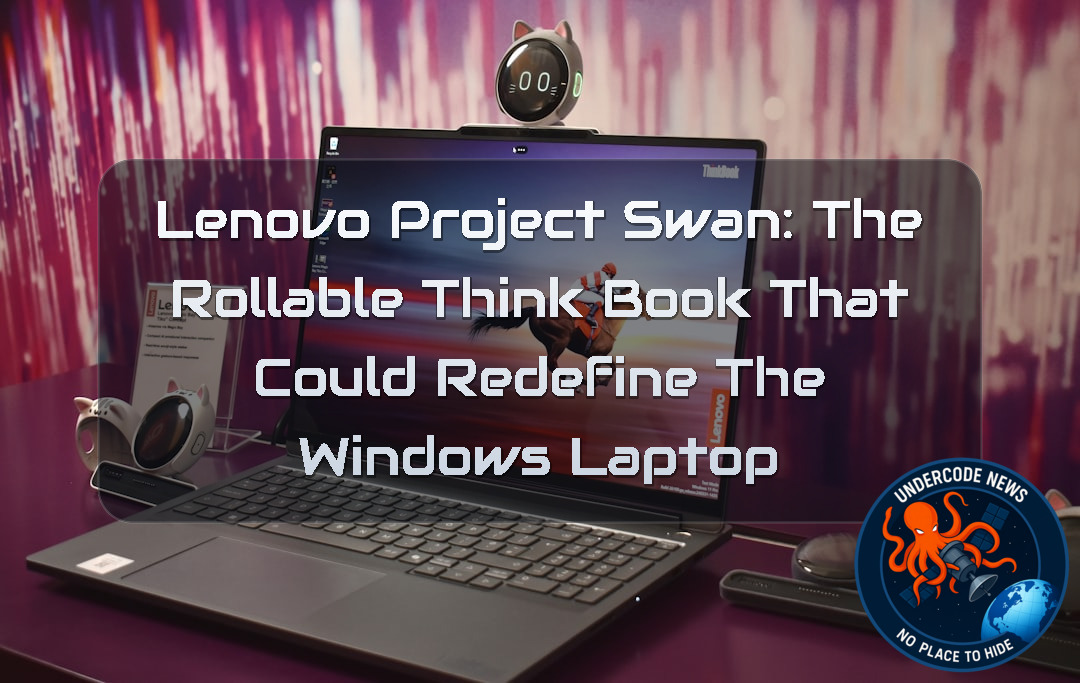 A New Laptop Idea Arrives at a Difficult Time
The laptop industry is entering a strange and increasingly competitive era. Manufacturers are fighting rising component costs, unpredictable memory supply, growing demand for AI hardware, and a market where consumers expect thinner, smarter, and more versatile machines every year. Yet, while many PC makers are concentrating on protecting margins and refining familiar designs, Lenovo appears willing to take another gamble.
That gamble is reportedly called Project Swan.
Lenovo is preparing a new rollable-display ThinkBook that could transform from a conventional productivity laptop into a much larger-screen workstation with the press of a button. High-resolution images reportedly offer an early look at the device, revealing a horizontally expanding display mechanism that hides additional flexible OLED screen area inside the laptop’s chassis.
The concept is not completely unexpected. Lenovo has already demonstrated that it is willing to experiment with rollable computers, including the Legion Pro Rollable and ThinkPad Rollable XD. Project Swan appears to represent the next chapter in that strategy: a business-focused Windows 11 laptop designed to deliver a larger workspace without forcing users to carry a physically larger machine.
Project Swan Could Be
The most important detail about the leaked device is its ThinkBook branding.
The ThinkBook line generally targets professionals, creators, entrepreneurs, and business users who want a balance between productivity features, modern design, and portability. Bringing a rollable display into this family suggests that Lenovo may be thinking beyond technology demonstrations and toward practical productivity.
At first glance, Project Swan reportedly looks surprisingly normal.
When the display is fully retracted, the machine resembles a relatively conventional ThinkBook. The screen has a centered webcam housing along the upper bezel, while the keyboard deck maintains the familiar laptop layout that users would immediately recognize.
That ordinary appearance may actually be one of the concept’s biggest strengths.
A futuristic laptop does not necessarily need to look futuristic when it is closed. The real transformation happens when the display begins expanding.
A Screen That Grows Sideways
Unlike traditional foldable laptops, Project Swan reportedly uses a horizontal rollable OLED display.
Instead of folding the screen down the middle, the flexible panel can extend sideways, revealing additional display real estate. This approach could provide users with a significantly wider workspace without requiring a permanently oversized laptop chassis.
Imagine opening the laptop on an airplane or in a coffee shop and initially working with a compact display.
Then, when you need more room for a spreadsheet, timeline, code editor, browser windows, or creative application, the display could extend outward.
That is the fundamental appeal of rollable technology: the device remains compact when portability matters and becomes larger when productivity matters.
Lenovo Has Already Tested the Rollable Laptop Concept
Project Swan is not
The company previously attracted attention with the Legion Pro Rollable, a gaming-oriented laptop featuring a horizontally expanding 21:9 display. Lenovo also demonstrated the ThinkPad Rollable XD, which took a different approach by expanding vertically from approximately 13.3 inches to 16 inches.
Those concepts were particularly interesting because they demonstrated that Lenovo was not treating rollable displays as a one-off experiment.
The company was exploring multiple configurations.
The Legion concept investigated horizontal expansion for gaming and entertainment, while the ThinkPad concept explored vertical expansion for productivity. Project Swan appears to combine that broader rollable philosophy with the ThinkBook business ecosystem.
The Images Could Represent More Than a Concept
There is another reason Project Swan deserves attention.
Previous Lenovo rollable designs that appeared through leaks were later shown publicly by the company. That history makes the latest Project Swan imagery considerably more interesting than an ordinary speculative render.
If Lenovo follows the same pattern, these images could represent hardware that is much closer to reality than the word “concept” might suggest.
Of course, leaked images are not the same as an official announcement. Specifications, availability, pricing, screen dimensions, battery capacity, processor selection, and the final mechanism could all change before launch.
Still,
The Engineering Challenge Is Hidden Inside the Chassis
The most fascinating part of Project Swan may not actually be the screen.
It is the mechanism that makes the screen move.
A flexible OLED panel cannot simply be folded and unfolded repeatedly without careful engineering. Lenovo therefore appears to be using a rail-and-frame architecture in which the unused portion of the display is stored inside housings along the sides of the device.
Motorized rails can then move the hidden screen section outward and flatten it into an expanded viewing area.
This creates a remarkably difficult engineering problem.
The system must move smoothly.
It must maintain appropriate tension across the flexible panel.
It must prevent creasing.
It must protect the OLED material from dust and debris.
It must survive thousands of expansion cycles.
And it must accomplish all of that without turning the laptop into a heavy mechanical machine.
The Shorter Hinge Is an Important Clue
One of the more subtle details visible in the reported design is the hinge.
Project
That design decision makes sense.
A conventional laptop hinge can extend across much of the rear of the chassis because nothing needs to travel horizontally through that space. A rollable display is different.
The expansion rails need room to move toward the left and right sides.
A full-width hinge could interfere with that mechanism.
The shorter hinge therefore appears to be another indication that the laptop’s entire architecture has been redesigned around the rollable display rather than simply adding a new screen to an existing ThinkBook chassis.
The Rear Design Reveals More of the Mechanism
The reported rear view is particularly revealing.
The laptop appears to feature a dual-tone rear cover with openings toward both sides. These areas could accommodate components associated with the display’s movement system.
That design resembles the mechanical philosophy previously demonstrated by Lenovo in its Legion Pro Rollable.
The result is a laptop that looks relatively conventional from the user’s perspective while concealing a surprisingly complex mechanical system underneath.
This is one of the reasons rollable devices are so difficult to commercialize.
The engineering is not simply about making a flexible display.
It is about designing an entire computer around the display.
USB-C Connectivity Appears to Be Present
The leaked images reportedly show two USB-C ports along the left side of the laptop.
That is useful information, although it is impossible to determine the complete port selection from the available views.
The right side is not clearly visible, so additional USB-C, USB-A, HDMI, audio, or other connectivity could potentially be present.
For a productivity-oriented ThinkBook, connectivity will be especially important.
A larger expandable display could make Project Swan attractive to professionals, but business users also expect docking support, external monitors, storage devices, networking accessories, projectors, and other peripherals.
A beautiful rollable display would lose some of its appeal if the laptop sacrificed practical connectivity.
Why a Rollable Display Makes Sense for Productivity
The strongest argument for Project Swan may be productivity rather than novelty.
A traditional 14-inch laptop is portable, but its screen can become restrictive when working with multiple applications.
A larger 16-inch or ultrawide workspace provides significantly more room, but carrying a larger laptop creates compromises.
It takes up more space.
It can weigh more.
It can be less comfortable on small desks.
It may be more difficult to use during travel.
A rollable laptop attempts to escape that trade-off.
The user carries the compact form factor but gains access to a larger screen when needed.
That is a much more compelling proposition than simply making another unusual laptop.
Rollable Computers Still Need Their Foldable-Phone Moment
The smartphone market has already demonstrated that consumers can become comfortable with unconventional displays.
Foldable phones have moved from experimental prototypes toward increasingly sophisticated mainstream products. Manufacturers have learned how to improve hinges, flexible OLED panels, durability, software interfaces, and multitasking.
The laptop market has not reached the same point.
Foldable PCs exist, but they remain relatively niche.
Rollable PCs are even more experimental.
That creates both a challenge and an opportunity for Lenovo.
If the company can solve durability and cost problems, it could establish itself as one of the companies that defines the next generation of flexible computers.
The Memory Crisis Makes
The timing of Project Swan is particularly notable because the PC industry is dealing with significant pressure from memory and semiconductor supply.
When component costs rise, experimental hardware becomes harder to justify.
Companies usually respond by prioritizing products that are already proven to sell.
Lenovo appears to be doing something different.
Instead of abandoning unusual form factors, it continues to invest in research and development around devices that could eventually create new categories.
That does not guarantee commercial success.
But it does suggest that Lenovo believes innovation remains necessary even when the hardware market becomes increasingly expensive.
Project Swan Could Become an AI Productivity Machine
There is another layer to the story.
The next generation of business laptops is increasingly being designed around local AI capabilities, and Project Swan could potentially become a particularly interesting platform for that trend.
A larger expandable screen is naturally suited to AI-assisted workflows.
Users could keep an AI assistant, document analysis window, coding environment, browser, and communications application visible simultaneously.
Instead of switching between windows on a small display, professionals could use the expanded screen as a portable command center.
The combination of local AI hardware and adaptive displays could therefore be more important than either technology individually.
The Missing Copilot Key Raises Questions
There is, however, an unusual detail in the reported imagery.
The laptop reportedly does not appear to have a dedicated Copilot key, despite showing Microsoft’s Recall icon pinned in the taskbar and apparently displaying related functionality near the system tray.
That creates an interesting contradiction.
Microsoft has been changing how Windows handles AI-related features and has also explored ways for users to customize or disable certain AI shortcuts.
Because Project Swan appears to be pre-production hardware, the keyboard and operating-system presentation may not represent the final commercial configuration.
It would therefore be risky to interpret the missing Copilot key as a final product decision.
Windows 11 Is Becoming Part of the Hardware Design
Modern Windows laptops are increasingly being designed around Microsoft’s evolving AI platform.
That means Project Swan is not just a hardware experiment.
It is also potentially a test of how Windows can adapt to unusual display dimensions.
A rollable laptop introduces questions that ordinary PCs do not need to answer.
How should Windows react when the screen expands?
Should applications automatically resize?
Should windows reposition themselves?
Should the operating system remember layouts?
Can users define different configurations for different display states?
These software questions could ultimately determine whether rollable PCs feel revolutionary or merely gimmicky.
Deep Analysis: How to Investigate the Hardware When It Arrives
For technology enthusiasts and IT professionals, Project Swan will eventually be interesting not only as a design experiment but also as a platform that can be examined at the operating-system level.
Once a Windows 11 rollable system becomes available, administrators can begin by collecting basic hardware information.
Get-ComputerInfo | Select-Object WindowsProductName, WindowsVersion, OsBuildNumber, CsSystemFamily, CsTotalPhysicalMemory
This can provide a quick overview of the Windows installation, system family, and installed memory.
Processor information can be inspected with:
Get-CimInstance Win32_Processor |
Select-Object Name, NumberOfCores, NumberOfLogicalProcessors, MaxClockSpeed
Memory modules can be investigated with:
Get-CimInstance Win32_PhysicalMemory |
Select-Object Manufacturer, PartNumber, Capacity, Speed
Storage devices can be reviewed using:
Get-PhysicalDisk |
Select-Object FriendlyName, MediaType, Size, HealthStatus
Graphics hardware can be identified with:
Get-CimInstance Win32_VideoController |
Select-Object Name, DriverVersion, AdapterRAM
Display information will be especially important for a rollable machine.
Administrators can inspect connected monitors with:
Get-CimInstance Win32_DesktopMonitor |
Select-Object Name, ScreenWidth, ScreenHeight, PNPDeviceID
For more detailed Windows diagnostics, the following command can launch Microsoft’s DirectX Diagnostic Tool:
dxdiag
Windows System Information can also provide a broader hardware inventory:
msinfo32
The important point is that a rollable laptop should eventually be evaluated like any other business endpoint: processor performance, memory bandwidth, storage speed, graphics capability, thermals, battery life, firmware stability, driver support, and security must all be tested.
The display mechanism adds another entire category of testing.
Engineers will need to measure expansion-cycle durability, motor reliability, panel wear, mechanical noise, power consumption, recovery behavior after failed expansion, and what happens if the mechanism encounters resistance.
That is where the difference between a technology demonstration and a reliable business product becomes obvious.
Durability Could Decide Project
The biggest question surrounding any rollable computer is simple: How long will the mechanism last?
Consumers expect a laptop to survive years of daily use.
If a user expands the screen several times every day, the mechanism could experience thousands of cycles over the lifetime of the machine.
That puts enormous pressure on the flexible OLED, rails, motors, gears, hinges, protective layers, and internal cables.
A failure in a traditional laptop display can already be expensive.
A failure involving a motorized rollable panel could be significantly more complicated.
Lenovo will therefore need to demonstrate durability before business customers can confidently deploy the device at scale.
Dust Could Be an Invisible Enemy
Mechanical laptops also face an environmental problem that ordinary screens largely avoid.
Dust.
A rollable display mechanism introduces moving components and narrow openings into the chassis.
Everyday environments contain dust, fibers, crumbs, and other particles that can eventually find their way into mechanical systems.
A premium rollable computer will need carefully designed seals and protective structures.
The challenge becomes even greater in offices, factories, airports, schools, and other environments where devices are exposed to frequent handling.
Battery Life Will Matter More Than Ever
Motorized displays require power.
That immediately raises another question: how much battery life will Project Swan sacrifice to deliver its signature feature?
The actual energy cost of extending the display might be relatively small because the motor operates only for short periods.
The larger concern is the display itself.
A larger OLED panel consumes more energy when illuminated, particularly at high brightness and refresh rates.
If the expanded configuration becomes the primary way users work, battery consumption could increase significantly.
Lenovo therefore has an incentive to optimize both the display controller and the Windows power-management system.
Software Could Make or Break the Experience
The mechanical transformation will attract attention, but software determines whether people actually want to use it.
Imagine expanding the display and watching Windows automatically reorganize your workspace.
Your browser moves to the left.
Your document occupies the center.
Your communications application appears on the right.
Your AI assistant opens in a dedicated panel.
That could feel genuinely futuristic.
If instead the screen simply becomes wider and every application behaves unpredictably, users may quickly stop using the feature.
Lenovo and Microsoft therefore have an opportunity to create software specifically designed for adaptive screens.
Business Users Could Be the Ideal Audience
ThinkBook branding makes Project Swan especially interesting for business professionals.
A consultant could use the compact configuration while traveling and expand the screen during a client presentation.
A programmer could display code, documentation, terminals, and browser windows side by side.
A financial analyst could work with large spreadsheets without carrying a desktop-sized portable monitor.
A content creator could use the expanded display for timelines and editing tools.
A salesperson could use the larger screen during demonstrations while keeping the machine compact during transportation.
The possibilities are broader than simple screen enlargement.
Developers Could Benefit From the Expanded Workspace
Software development is another obvious use case.
Modern development environments often require multiple windows.
An engineer may need an IDE, terminal, browser, documentation, database console, monitoring dashboard, and communication application simultaneously.
A rollable display could provide a wider canvas without forcing the developer to carry an external monitor.
For remote workers and frequent travelers, that could be a meaningful advantage.
Creators May Also Find the Concept Attractive
Creative professionals could benefit from the same principle.
Video editors need timelines.
Graphic designers need tool panels.
Photographers need image previews.
Music producers need arrangement views.
Architects and engineers need large technical interfaces.
A larger screen does not automatically make someone more productive, but having additional workspace available when necessary can reduce the friction of constantly switching windows.
Project
Lenovo’s Broader 2026 Hardware Strategy
Project Swan also appears to fit into a larger Lenovo strategy focused on experimental hardware.
The company is reportedly preparing a range of products around Lenovo Innovation World 2026, including potentially one of its thinnest ThinkBooks, an NVIDIA RTX-powered convertible concept, and a redesigned IdeaCentre all-in-one aimed at competing with Apple’s iMac.
That suggests Lenovo is not relying on a single design trend.
Instead, it appears to be experimenting across laptops, desktops, AI PCs, gaming systems, and flexible displays.
Project Swan may therefore be one component of a much larger push to differentiate Lenovo hardware in an increasingly crowded PC market.
Why Lenovo Is Willing to Take the Risk
There is a strategic reason Lenovo might continue investing in concepts like Project Swan.
Hardware specifications are becoming increasingly standardized.
Most premium laptops use similar processors.
They use similar memory technologies.
They compete on battery life, display quality, weight, thermals, and design.
AI PCs are adding another layer of differentiation, but even that market is becoming crowded quickly.
A genuinely rollable computer is different.
If Lenovo can make the concept practical, the company gains something that is much harder for competitors to copy immediately: a distinctive hardware identity.
Apple Could Become an Important Benchmark
Apple’s rumored interest in foldable hardware could further increase attention on unconventional displays.
If foldable iPhones eventually become mainstream, consumer expectations around flexible screens could change.
That could indirectly help rollable PCs.
Consumers may become more comfortable with devices that physically transform.
The PC industry could then move from asking whether flexible hardware is possible to asking which form factor provides the best experience.
That would be a much more mature market.
Rollable Versus Foldable Is Still an Open Battle
Foldable and rollable computers solve similar problems in very different ways.
A foldable display physically bends around a hinge or crease.
A rollable display remains substantially flatter while storing unused screen area inside the device.
That could give rollable technology a major visual advantage if Lenovo can eliminate visible creasing.
However, rollable systems introduce motors and rails that foldables do not necessarily require.
The industry may ultimately discover that both approaches have a place.
The Real Question Is Price
Even if Project Swan works technically, commercial success will depend heavily on cost.
Flexible OLED panels are expensive.
Precision mechanical components are expensive.
Motors, sensors, rails, custom chassis engineering, testing, and specialized manufacturing all increase production costs.
A rollable ThinkBook that costs slightly more than a premium conventional laptop could potentially attract enthusiasts and professionals.
A device priced dramatically above comparable laptops could remain a niche technology demonstration.
Lenovo therefore needs to find a difficult balance between innovation and affordability.
What Would Make Project Swan a Success?
A successful rollable ThinkBook would need more than a spectacular screen.
It would need strong battery life.
It would need excellent keyboard quality.
It would need reliable ports.
It would need competitive processors.
It would need robust security.
It would need a durable mechanism.
It would need intelligent Windows integration.
And perhaps most importantly, it would need a reason for users to expand the screen frequently.
Technology becomes useful when its special feature solves a real problem.
The Security Perspective Matters Too
A business-focused rollable Windows laptop must also meet enterprise security expectations.
That means hardware-backed security, secure boot, firmware protection, biometric authentication, device encryption, driver reliability, and manageable update mechanisms.
A complicated mechanical system also introduces a new firmware layer.
If the display mechanism is controlled electronically, the system may contain additional controllers and firmware that need to be secured and updated.
The more sophisticated the hardware becomes, the more important its security architecture becomes.
Enterprise Deployment Could Be Complicated
IT departments generally prefer predictable hardware.
A standard ThinkBook can be repaired, replaced, imaged, and managed using established procedures.
A rollable ThinkBook could introduce new service requirements.
Technicians may need specialized components.
Display failures could require more complicated repairs.
Mechanical failures could potentially make the entire screen assembly expensive to replace.
Lenovo would therefore need strong enterprise support if it wants Project Swan to become more than a premium consumer experiment.
What the Project Swan Leak Really Tells Us
The most important message from the Project Swan story is not that Lenovo has built another unusual laptop.
It is that the company continues to believe the traditional rectangular laptop has room for reinvention.
The PC industry is under pressure from rising component costs and increasingly standardized hardware.
At the same time, consumers are becoming familiar with devices that transform physically.
That combination creates an opening for companies willing to experiment.
Lenovo appears determined to occupy that space.
What Undercode Say:
- The Laptop Shape Is Becoming a Software Question
The traditional laptop assumes that the physical dimensions of the display never change.
Project Swan challenges that assumption.
Once the screen can change size, Windows itself needs to become more adaptive.
2. Lenovo Is Betting on Transformation
Lenovo’s repeated investment in rollable concepts suggests this is not an isolated experiment.
The company appears to be exploring transformation as a long-term design direction.
3. The ThinkBook Branding Is Significant
Putting Project Swan under the ThinkBook family gives the concept a productivity-oriented identity.
That makes its potential use cases more practical than those of a pure technology showcase.
- The Display Mechanism Is the Real Innovation
The OLED panel gets the attention, but the mechanical architecture may be the harder engineering achievement.
Rails, motors, tension, alignment, durability, and protection all have to work together.
5. Durability Will Determine Consumer Confidence
Nobody wants a laptop whose most impressive feature becomes its biggest repair problem.
Lenovo will need to prove that the mechanism can survive years of regular use.
6. OLED Is a Natural Choice
Flexible OLED technology is particularly suited to rollable designs because it can bend without requiring the rigid glass construction used in conventional displays.
7. Horizontal Expansion Makes Sense
A horizontally expanding laptop can create an ultrawide workspace without dramatically increasing the device’s depth.
That could be particularly useful for multitasking.
8. Developers Could Be Major Beneficiaries
Programming environments are often limited by screen space.
A wider workspace can make simultaneous coding, testing, documentation, and monitoring much easier.
9. Business Users Need Reliability First
Corporate customers may love the concept, but they will prioritize uptime over novelty.
Lenovo must prove that the rollable mechanism is dependable.
- The AI PC Era Creates an Opportunity
AI assistants increasingly require additional screen space.
A rollable display could provide room for AI interfaces without forcing users to constantly switch between applications.
11. Recall Raises Important Questions
The reported presence of Windows Recall-related UI makes the device particularly interesting in the context of Microsoft’s evolving AI strategy.
Privacy, security, storage, and enterprise controls will remain important considerations.
- The Missing Copilot Key Is Probably Not Definitive
Because the hardware appears to be pre-production, keyboard details should not be treated as final.
Lenovo and Microsoft could still change the design before launch.
13. Lenovo Has Experience Here
Previous Lenovo rollable concepts eventually appeared publicly, giving Project Swan more credibility than a completely new rumor.
14. The Company Is Building a Portfolio
Project Swan appears alongside other experimental Lenovo products.
That suggests a broader strategy rather than one isolated bet.
15. Competition Will Eventually Follow
If rollable PCs become commercially viable, other major PC manufacturers are likely to investigate similar designs.
16.
The smartphone
17. Apple Could Accelerate Flexible Hardware
If Apple eventually launches foldable products, flexible computing could become considerably more mainstream.
18. Rollable PCs Have One Major Advantage
They can potentially provide a large display without permanently making the laptop larger.
That is the fundamental value proposition.
19. They Also Have One Major Disadvantage
More moving parts usually mean more potential failure points.
That is the central engineering trade-off.
20. Battery Life Cannot Be Ignored
The larger screen could consume considerably more power when fully expanded.
Power efficiency will therefore be critical.
21. Heat Management Will Matter
A powerful processor combined with a large OLED panel and a compact chassis could create thermal challenges.
22. Port Selection Will Be Important
Business laptops still need practical connectivity.
Two visible USB-C ports are promising, but the complete I/O configuration remains unknown.
23. The Keyboard Should Remain Conventional
A transformative display does not necessarily require a strange keyboard.
Keeping the input experience familiar could make adoption easier.
- The Device Could Replace a Portable Monitor
For some professionals, that may be the most compelling argument.
Instead of carrying a second screen, users could expand the laptop itself.
25. Travel Is Another Strong Use Case
Frequent travelers could benefit from having a compact device that transforms into a larger workstation.
26. Presentations Could Become More Interesting
A larger screen could make demonstrations and collaborative viewing easier without requiring external equipment.
27. Repairability Is a Concern
The more complicated the mechanism, the more difficult repairs could become.
Lenovo will need a strong service strategy.
28. Enterprise Adoption May Come Later
Consumers and enthusiasts are usually more willing to experiment with new form factors.
Businesses typically follow after reliability has been demonstrated.
29. Price Will Be Critical
A revolutionary display does not matter if the final machine becomes financially impractical.
30. Manufacturing Scale Could Change Everything
If Lenovo can manufacture the mechanism efficiently, prices could eventually fall.
31. Software Must Understand the Physical Transformation
Windows should know when the display expands and respond intelligently.
32. Applications Need Adaptive Layouts
Developers may eventually need to consider laptops whose screen dimensions can change dynamically.
33. This Could Influence Future Windows Design
Microsoft may eventually design more Windows features around flexible screen configurations.
34. The Concept Is Bigger Than Lenovo
Project Swan represents a broader question for the PC industry.
Should the future laptop simply become thinner, or should it become physically adaptive?
35. The PC Market Needs Differentiation
As processors, memory, and AI capabilities become increasingly standardized, physical design can become an important competitive advantage.
36. Lenovo Is Taking the Initiative
Continuing to fund rollable R&D while the market is under cost pressure demonstrates a willingness to accept technological risk.
- The First Generation May Not Be Perfect
That is normal for a new category.
Early rollable devices may be expensive, thick, fragile, or limited.
38. But Early Experiments Create Valuable Lessons
Even if Project Swan never becomes a mass-market product, Lenovo can use the engineering experience in future generations.
- The Second Generation Could Be the Real Breakthrough
Once manufacturers understand the durability and manufacturing problems, future rollable PCs could become thinner, cheaper, and more reliable.
40. Project Swan Deserves Attention
The biggest reason to watch Project Swan is not whether one laptop succeeds.
It is whether Lenovo can demonstrate that the laptop itself no longer has to be physically fixed.
✅ Lenovo Has Previously Demonstrated Rollable PC Concepts
Lenovo has publicly explored rollable laptop concepts, including the Legion Pro Rollable and ThinkPad Rollable XD.
That history supports the broader claim that Project Swan fits into an existing Lenovo research direction rather than appearing completely out of nowhere.
✅ Project Swan Is Reported as a ThinkBook Concept
The reported images show ThinkBook branding, while the internal name Project Swan is described as a concept or pre-production project.
That distinction is important because leaked hardware should not automatically be interpreted as a finalized retail product.
✅ Horizontal Rollable Displays Are Technically Feasible
Lenovo has already demonstrated horizontal rollable display technology in previous concepts.
The key uncertainty is not whether the mechanism can work, but whether it can be made durable, affordable, thin, quiet, and reliable enough for mass production.
❌ A Commercial Launch Is Not Guaranteed
Project Swan should not be treated as a confirmed retail laptop until Lenovo officially announces specifications, pricing, availability, and final design.
Concept and pre-production hardware can change substantially before reaching consumers.
❌ Final Specifications Cannot Yet Be Confirmed
Processor, memory, storage, display dimensions, refresh rate, battery capacity, weight, ports, and pricing remain subject to official confirmation.
Any detailed specifications circulating before
Prediction
(+1) Rollable ThinkBooks Will Become More Practical Over the Next Few Generations
Lenovo’s continued experimentation suggests that rollable PCs are unlikely to disappear simply because the first generation is difficult to commercialize.
The technology will probably evolve through several iterations.
Early models may remain expensive and niche, but manufacturing improvements could eventually reduce the cost and complexity of flexible displays and mechanical systems.
If Lenovo succeeds in making the mechanism reliable, future ThinkBooks could use rollable displays as a genuine productivity feature rather than a technology demonstration.
(+1) Adaptive Windows Interfaces Could Become a Major Advantage
The most interesting long-term development may happen in software.
Windows could eventually recognize different physical display states and automatically reorganize applications, layouts, scaling, and multitasking environments.
That would make a rollable PC fundamentally different from simply connecting an external monitor.
(+1) AI PCs Could Give Rollable Displays a Stronger Reason to Exist
As AI assistants become integrated deeper into professional workflows, users will increasingly need room for multiple interfaces.
A rollable screen provides additional workspace exactly when it is needed.
That combination could turn flexible displays from an aesthetic novelty into a useful productivity technology.
(-1) High Costs Could Keep Rollable PCs Niche
The biggest threat remains economics.
Flexible OLED panels, specialized mechanisms, additional testing, and complex manufacturing could keep rollable laptops considerably more expensive than conventional alternatives.
If consumers cannot see enough value to justify the premium, the category could remain limited to enthusiasts and executives.
(-1) Mechanical Reliability Could Delay Mass Adoption
A single failed mechanism can undermine confidence in an entire product category.
Lenovo will need to demonstrate years of reliability, not merely impressive demonstrations on a stage.
(+1) Lenovo Could Become One of the Main Leaders in Flexible PCs
Among major PC manufacturers, Lenovo has repeatedly demonstrated a willingness to experiment with unusual form factors.
If Project Swan reaches the market and performs well, that experience could give Lenovo a meaningful advantage in the next generation of adaptive computing.
The Bigger Picture: The Laptop May Be Entering Its Transformative Era
Project Swan represents something more significant than another experimental ThinkBook.
For decades, laptop design has revolved around a relatively simple compromise: make the machine small enough to carry and large enough to use comfortably.
Foldable and rollable technologies challenge that compromise.
Instead of choosing one physical size, the computer can potentially have several.
That is the real promise of Project Swan.
A laptop that fits into a compact bag in the morning could become a wide productivity workstation in the afternoon. A machine that looks ordinary when closed could reveal an entirely different computing environment when activated.
The technology still faces serious obstacles. Durability, battery life, software support, repairability, manufacturing complexity, and price could all prevent rollable PCs from becoming mainstream.
But
The company has already demonstrated rollable concepts in different configurations, and Project Swan appears to push the idea toward a business-oriented ThinkBook environment.
If Lenovo can solve the mechanical problems without compromising the fundamentals that make a great laptop great, the result could be one of the most interesting Windows PCs of this generation.
The future of laptops may not simply be thinner.
It may be adaptive.
And Project Swan could be an early glimpse of what that future looks like.
▶️ Related Video (84% Match):
🕵️📝Let’s dive deep and fact‑check.
🎓 Live Courses & Certifications:
Join Undercode Academy for Verified Certifications
🚀 Request a Custom Project:
Secure, high-velocity infrastructure and disruptive technological engineering. Contact our engineering team for high-tier development and proprietary systems:
[email protected]
💎 Smart Architecture | 🛡️ Secure by Design | ⭐ Trusted by Thousands
References:
Reported By: www.windowslatest.com
Extra Source Hub (Possible Sources for article):
https://www.instagram.com
Wikipedia
OpenAi & Undercode AI
Image Source:
Unsplash
Undercode AI DI v2
🔐JOIN OUR CYBER WORLD [ CVE News • HackMonitor • UndercodeNews ]
📢 Follow UndercodeNews & Stay Tuned:
𝕏 formerly Twitter 🐦 | @ Threads | 🔗 Linkedin | 🦋BlueSky | 🐘Mastodon | 📺Youtube


