
Listen to this Post
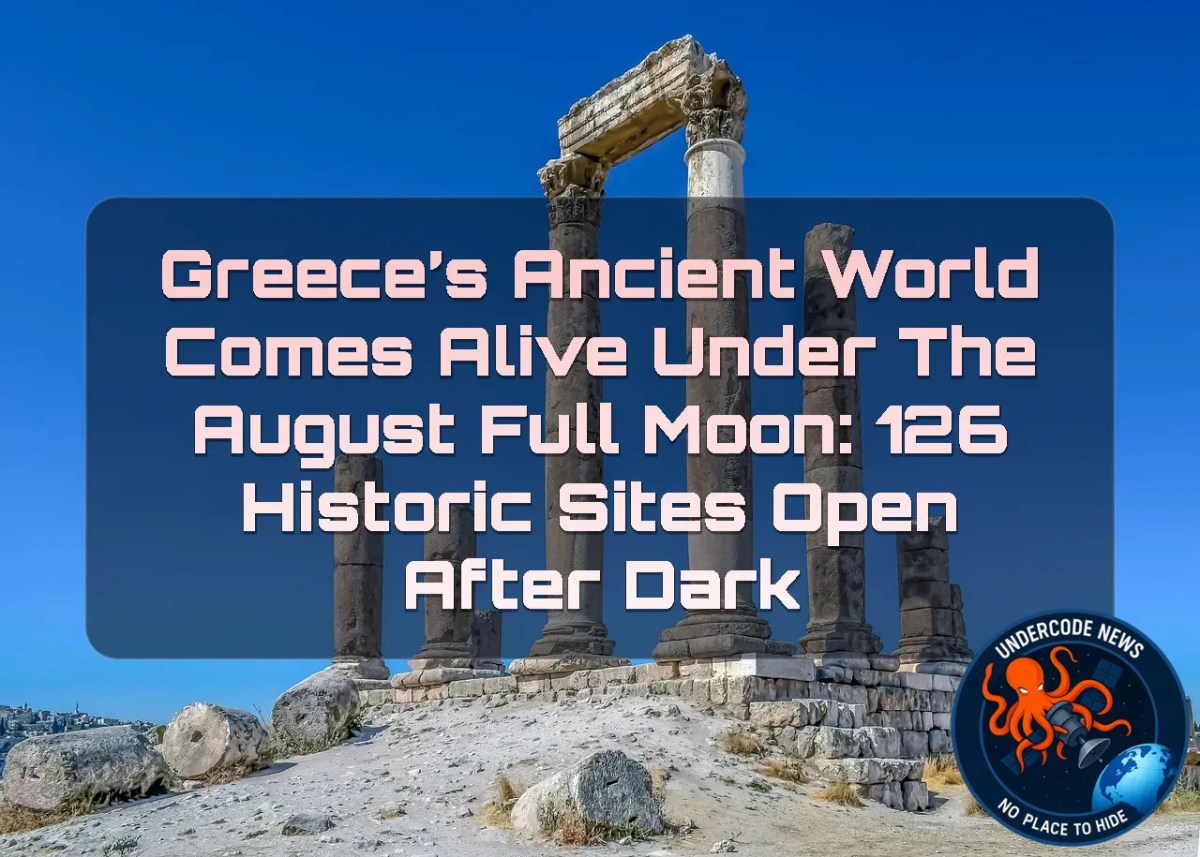
A Night When History Meets Moonlight
Imagine standing among ancient Greek ruins after sunset, with the noise of the modern world fading into the distance and the August full moon illuminating columns, temples, stone walls and centuries-old paths.
For one extraordinary night this August, that experience will become possible across Greece as the country opens 126 archaeological sites, historic places, monuments and museums free of charge as part of its annual August Full Moon celebration. The nationwide event will take place on Friday, 28 August 2026, with many locations remaining open from approximately 7:30 or 8:00 p.m. until 11:00 p.m. or midnight.
Greece Invites the World to Experience History Differently
The event is far more than a late-night museum opening.
For a few hours, some of Greece’s most important archaeological treasures will become evening destinations, combining ancient history with moonlight, music, guided tours and cultural performances.
The Hellenic Ministry of Culture says this will be the 27th consecutive year of the August Full Moon programme. Of the 126 participating locations, 61 will host cultural events, while another 65 will remain open for visitors with free admission. The broader programme also includes activities on 26, 27, 29 and 30 August.
Why the August Full Moon Is So Special
Ancient Greek monuments already possess a powerful visual presence during daylight.
At night, however, the experience changes completely.
A temple illuminated by artificial lights can feel impressive, but ancient stone beneath a full moon creates a much quieter and more mysterious atmosphere. Shadows become part of the architecture. Mountains and coastlines become silhouettes. Ruins that tourists normally experience during crowded afternoons can suddenly feel distant from the modern world.
That transformation is precisely what makes the August Full Moon celebration so compelling.
Delphi Under the Moon
Among the most famous destinations participating is Delphi, the ancient sanctuary on Mount Parnassus that became one of the most influential religious centres of the Greek world.
For centuries, people travelled to Delphi seeking guidance from the Oracle of Apollo, asking questions connected to war, politics, colonisation, marriage and the future.
On 28 August, visitors will be able to enter the archaeological site free of charge, with access extending to the terrace of the Temple of Apollo during the evening programme.
There is something particularly fitting about experiencing Delphi at night. The sanctuary’s relationship with prophecy, ritual and the supernatural makes an illuminated moonlit landscape feel far removed from an ordinary sightseeing trip.
Ancient Olympia Returns to the Spotlight
In the western Peloponnese, Ancient Olympia offers another extraordinary opportunity.
Olympia is inseparable from the history of the Olympic Games. It was here that the ancient athletic festival developed into one of the most important religious and sporting traditions of the Greek world.
For the August Full Moon event, both the archaeological site and museum will offer free admission, with archaeologists providing guided tours between approximately 8 p.m. and midnight.
This combination is especially valuable for visitors who want more than photographs. A guided explanation can transform columns, foundations and statues from beautiful ruins into evidence of a living ancient society.
Mystras Adds a Medieval Dimension
Greece’s historic landscape does not end with classical antiquity.
Near Sparta, the extraordinary medieval settlement of Mystras will also participate. The fortified town, built on the slopes of Mount Taygetos, preserves churches, palaces and streets associated with the Byzantine world.
The site will remain open from approximately 8 p.m. until midnight and will host a musical event.
Mystras therefore offers a different perspective from Delphi or Olympia. Instead of returning visitors to classical Greece, it opens a window into the medieval history of the region.
Athens Extends the Night
For travellers staying in Athens, the Acropolis Museum is another major destination.
On Friday, 28 August, the museum will remain open continuously from 9 a.m. until midnight. Standard admission will apply to the permanent collections, while the ticket desk and shops will close at 11:30 p.m.
This makes the museum an especially practical option for visitors who want to combine a daytime itinerary with an evening cultural experience.
A Rare Exhibition Adds Another Reason to Visit
The Acropolis Museum is also hosting the temporary exhibition “Inspirations. Ancient Greek Art living in Italy”, which runs through 30 August 2026.
The exhibition brings together 38 ceramic, bronze and marble masterpieces and explores how ancient Greek art influenced, travelled through and was interpreted within Italy. The museum describes the objects as works travelling outside Italy for the first time.
The timing is particularly fortunate for travellers visiting Athens in late August because the exhibition will close only two days after the Full Moon event.
A Free Guided Tour in Athens
At 6 p.m. on 28 August, visitors can also join a guided presentation of the temporary exhibition led by a museum archaeologist.
The tour lasts approximately 45 minutes and participation is free, although advance registration is required and places are limited. The museum’s official programme lists the 28 August presentation among its scheduled Greek-language gallery talks.
This creates an interesting itinerary: an archaeological exhibition in the early evening, followed by the city’s monuments and Acropolis views under the night sky.
Beyond the Famous Names
The biggest mistake visitors could make is concentrating only on Greece’s most famous archaeological sites.
The August Full Moon programme also opens the door to locations that receive far less international attention.
These smaller or less familiar sites can sometimes provide a more intimate experience because they attract fewer visitors and offer a stronger sense of discovery.
The Mysterious Nekromanteion of Acheron
One particularly atmospheric destination is the Nekromanteion of Acheron in Epirus.
The ancient sanctuary was associated with the world of the dead, and ancient visitors believed the area provided a connection to the underworld where people could seek contact with deceased souls.
The site will offer free evening admission from approximately 7:30 or 8 p.m. until midnight.
Few archaeological locations could be better suited to a moonlit visit.
The darkness is not simply a backdrop. It connects directly with the site’s ancient religious associations and the mythology surrounding the underworld.
Dodona and the Oracle of Zeus
Another remarkable site in northwestern Epirus is Dodona, widely regarded as one of the oldest oracle sites in Greece.
Instead of Apollo at Delphi, Dodona was associated with Zeus and a sacred oak.
The ancient
Visitors will be able to enter free of charge during the evening programme, approximately from 8 p.m. until midnight.
Malia Brings Minoan Crete to Life
On Crete, the archaeological site of Malia offers an opportunity to explore the Minoan world after sunset.
The palace complex on
This combination of archaeology and live music reflects one of the defining characteristics of Greece’s August Full Moon celebration: the monuments are not treated merely as static ruins.
They become stages for cultural experiences.
Gortyna Preserves Ancient Law in Stone
Another Cretan destination worth watching is Gortyna, famous for the Gortyn Code.
The inscription preserves an extensive body of ancient Greek civil law carved directly into stone. Its survival provides historians with an unusually detailed glimpse into the legal structures of the ancient world.
During the Full Moon celebration, Gortyna will offer free admission and a musical evening.
For visitors interested in history, law and archaeology, it could be one of the most intellectually rewarding stops of the night.
Nafpaktos Castle and the Gulf of Corinth
In western Greece, Nafpaktos Castle presents an entirely different visual experience.
The Venetian fortress rises above the harbour town of Nafpaktos, overlooking the Gulf of Corinth.
After dark, the location becomes as much about the landscape as the architecture.
Moonlight reflecting across the gulf while the castle rises above the harbour could create one of the most memorable photographic scenes of the entire programme.
It is a reminder that
An Opera Beneath the Greek Night Sky
For music lovers, the Sanctuary of Ammon Zeus in Chalkidiki offers another unusual experience.
The coastal sanctuary on the Kassandra peninsula is scheduled to host a fully staged performance of Orpheus and Eurydice.
Few settings can compete with an ancient sanctuary beside the sea for an opera based on one of the most enduring stories of the classical tradition.
The mythology of Orpheus and Eurydice is itself concerned with love, death and the boundary between the living and the dead, making the archaeological setting particularly evocative.
The Event Is Bigger Than Tourism
At first glance, the August Full Moon programme might look like a clever tourism promotion.
It is certainly useful for tourism, but its importance goes deeper.
Greece is effectively turning its archaeological heritage into a nationwide cultural network for one night.
Instead of treating archaeological sites as isolated attractions that visitors check off a list, the programme connects them through a common experience.
Athens, Crete, Epirus, the Peloponnese, Central Greece and the islands can all become part of the same cultural evening.
Why Nighttime Archaeology Changes the Experience
There is an important psychological difference between visiting a monument at noon and visiting it beneath a full moon.
Daylight reveals everything at once.
Night reveals selectively.
A column may emerge from darkness. A mountain may become a silhouette. A ruined wall may appear more dramatic because the surrounding landscape disappears.
The result encourages visitors to slow down.
That matters because archaeology is often experienced too quickly. People photograph a monument, read a sign and move on.
Moonlight can interrupt that routine.
Greece Is Turning Heritage Into an Experience
Modern cultural tourism increasingly depends on experiences rather than simple access.
Visitors want stories. They want atmosphere. They want something they cannot reproduce by looking at a photograph online.
The August Full Moon programme provides exactly that.
A person can visit Delphi during the day, but visiting Delphi at night during a nationwide cultural celebration is a fundamentally different memory.
The same applies to Olympia, Mystras, Malia, Gortyna and the smaller sites.
The Economic Effect Could Be Significant
Events like this also distribute tourism beyond the largest Greek destinations.
Athens and the most famous islands receive enormous international attention, but archaeological sites throughout mainland Greece and the islands can benefit when visitors are given a reason to travel farther.
Hotels, restaurants, taxis, local guides and small businesses can all potentially benefit from increased evening activity.
The cultural programme therefore has a secondary economic function: it encourages visitors to spend time in communities that might otherwise receive less international tourism.
Why Smaller Sites May Be the Better Choice
There is another reason to consider the lesser-known locations.
Famous archaeological sites can become crowded, especially during peak summer travel.
A smaller sanctuary or fortress may offer a more peaceful evening.
Visitors who choose less famous destinations may also discover something increasingly rare in modern tourism: the feeling that they have found a place rather than simply followed a checklist.
What Travellers Should Know Before Going
Free admission does not mean every site will operate under identical conditions.
The Ministry of Culture states that opening hours vary, with many locations operating approximately from 7:30 or 8 p.m. until 11 p.m. or midnight.
Some sites have performances or guided tours, while others simply remain open for visitors.
The programme is also subject to updates and changes, so travellers should verify the individual site’s schedule before making a journey.
Reservations Can Matter
The Acropolis Museum demonstrates why checking details in advance is important.
The
Travellers should therefore distinguish between free admission and unlimited access to every special event.
They are not necessarily the same thing.
A Smarter Way to Plan the Evening
The best strategy is to choose one primary destination rather than attempting to visit several distant sites in a single night.
Greece’s archaeological heritage is geographically scattered, and travelling between locations can consume far more time than expected.
A better plan is to select a site based on three factors: location, atmosphere and programme.
For Athens, the Acropolis Museum offers convenience.
For history lovers, Delphi or Olympia provides enormous cultural depth.
For something unusual, Nekromanteion or Dodona may offer the stronger experience.
For music, Malia, Mystras or Ammon Zeus could be especially attractive.
The Full Moon Is Only Part of the Story
The moon is what gives the event its identity, but the real attraction is the interaction between landscape, history and human imagination.
Ancient Greeks themselves built sanctuaries around mountains, springs, forests, coastlines and sacred landscapes.
Seeing those locations at night can remind visitors that ancient monuments were never simply buildings.
They were places embedded in nature, religion, politics and mythology.
A Tradition With Deep Roots
The Ministry of Culture has organised the August Full Moon celebration for decades, with the event dating back to 1999.
The 2026 edition continues that tradition while bringing together a huge national network of archaeological locations and cultural institutions.
That longevity is significant.
This is not a one-off experiment designed for social media.
It has become an established part of
What Undercode Say:
Heritage Becomes More Powerful When It Feels Alive
The most interesting aspect of
It is the decision to change the context in which people encounter history.
Archaeological heritage can sometimes feel distant.
Moonlight removes some of that distance.
It creates an emotional bridge between the modern visitor and the ancient landscape.
That emotional connection can be more powerful than another information panel.
The Programme Creates a National Cultural Network
With 126 participating locations, the event operates on an unusually large scale.
It effectively transforms Greece into a connected nighttime heritage destination.
A visitor in Crete can participate.
A visitor in Epirus can participate.
A visitor in Athens can participate.
A visitor in the Peloponnese can participate.
The same moon becomes the common theme connecting them.
Free Admission Changes Who Gets Access
Making many archaeological locations free for the evening removes one important barrier to cultural participation.
Families, students, local residents and travellers can all potentially experience places that might otherwise be skipped because of cost or time.
That is particularly valuable for lesser-known archaeological sites.
Night Tourism Could Become More Important
Tourism does not have to stop when the sun goes down.
Greece’s Full Moon programme demonstrates how cultural destinations can extend their operating hours without turning heritage into a conventional nightlife product.
That distinction matters.
The objective is not simply to keep tourists spending money later.
It is to create a different cultural rhythm.
The Event Can Reduce Pressure on Major Attractions
Spreading visitors across 126 locations gives Greece an opportunity to redirect some tourism demand away from its most crowded destinations.
That does not eliminate overtourism.
But it can encourage travellers to explore alternative locations.
A visitor who chooses Dodona instead of another crowded attraction is not only discovering a remarkable site but also contributing to a broader distribution of tourism.
Local Communities Have Something to Gain
Cultural events create reasons for visitors to remain in an area longer.
That can benefit accommodation providers, restaurants, transport services and local cultural organisations.
The strongest tourism model is rarely based on one famous monument alone.
It is based on an ecosystem surrounding the monument.
The Programming Is Just as Important as the Architecture
Concerts, choirs, theatre, dance and guided tours make the sites more accessible to audiences who may not normally consider themselves archaeology enthusiasts.
Someone might attend because of the music and leave with a new interest in ancient history.
That is an extremely effective form of cultural outreach.
Smaller Sites Could Become the Breakout Stars
The biggest names will attract attention first.
But the most memorable experiences may come from places such as Dodona, Nekromanteion, Gortyna or Nafpaktos.
Their relative obscurity can become their greatest advantage.
People increasingly value experiences that feel authentic and less crowded.
Ancient Landscapes Matter as Much as Ancient Buildings
A temple without its surrounding landscape tells only part of the story.
Mountains, sea, valleys and forests were central to the meaning of ancient sacred places.
Nighttime visits restore some of that relationship.
Moonlight Is a Natural Storytelling Tool
Artificial lighting can make monuments visible.
Moonlight makes them mysterious.
That distinction is important.
Mystery encourages curiosity.
Curiosity encourages people to ask questions.
And questions are often the beginning of meaningful historical learning.
Greece Has an Advantage Few Countries Can Match
Few destinations possess such a dense concentration of ancient monuments spread across such varied landscapes.
Greece can therefore create cultural events that are simultaneously local and national.
That is a powerful tourism asset.
The Programme Also Strengthens Cultural Identity
Although international tourists are important, the event is equally meaningful for Greek residents.
Opening heritage sites after dark gives local communities another opportunity to encounter their own history.
Cultural heritage becomes something experienced, not simply preserved behind gates.
The Acropolis Museum Adds a Modern Dimension
The Athens programme shows that ancient history does not have to be separated from modern museum practice.
The temporary exhibition on Greek art in Italy demonstrates how Greek cultural influence travelled beyond Greece and continued evolving across centuries.
The Italy Exhibition Is Particularly Relevant
The
That reinforces an important historical lesson: ancient Mediterranean civilisation was interconnected.
Ideas, artistic styles, objects and people travelled.
Greek history cannot be understood entirely within modern national borders.
The Programme Could Inspire More Nighttime Heritage Events
If visitors respond strongly to nighttime archaeology, other countries could adopt similar models.
Historic castles, Roman ruins, medieval cities and museums around the world could experiment with moonlit cultural programmes.
Technology Does Not Have to Replace History
Virtual reality and digital museum experiences are increasingly important.
But an event like this demonstrates the continuing power of physical places.
No screen can fully reproduce standing beside an ancient sanctuary beneath the actual night sky.
The Human Element Remains Essential
Archaeologists, guides, musicians and performers help transform ruins into stories.
Their presence gives visitors context.
Without interpretation, a stone wall is simply a stone wall.
With the right story, it becomes evidence of a civilisation.
Tourism Needs More Moments People Remember
Travellers increasingly photograph everything.
Yet photographs are not necessarily memories.
A memorable experience usually contains emotion, surprise or atmosphere.
The August Full Moon programme offers all three.
The Best Travel Experiences Are Sometimes Unexpected
A traveller may arrive expecting an ordinary archaeological visit.
Instead, they find music echoing through ancient stone, families gathering beneath the moon and monuments illuminated by natural light.
That surprise becomes part of the journey.
Free Does Not Mean Casual
Because the programme is free, visitors should not assume that planning is unnecessary.
Popular locations may attract significant crowds.
Special events may have limited capacity.
Transport options can also change substantially after dark.
Planning Is Especially Important Outside Athens
Athens has extensive transport infrastructure.
Remote archaeological sites do not always offer the same convenience.
Visitors should research the route, parking situation, last transport options and closing time before setting out.
The Weather Still Matters
August in Greece can be hot during the day.
Night temperatures are generally more comfortable, but conditions vary by region.
Travellers should still prepare for warm weather, water needs and long periods outdoors.
Comfortable Shoes Matter
Archaeological sites frequently contain uneven ground.
Ancient pathways were not designed for modern visitors wearing fashionable footwear.
Comfortable shoes can make the difference between enjoying a moonlit walk and ending the evening with sore feet.
The Event Encourages Slower Travel
Modern tourism often rewards speed.
This programme rewards patience.
There is little reason to rush through an archaeological site when the purpose of the evening is atmosphere.
The Moon Becomes Part of the Architecture
This may be the most beautiful idea behind the programme.
The monuments do not simply sit beneath the moon.
They interact with it.
Columns create shadows.
Walls frame the sky.
Ancient stone reflects changing light.
The landscape becomes part of the experience.
Greece Is Selling Memory, Not Just Tickets
That is ultimately why the event matters.
A free ticket has limited value.
A powerful memory can last for decades.
The August Full Moon programme is designed to create precisely those memories.
The 2026 Edition Looks Especially Strong
The combination of 126 participating locations, 61 cultural-event venues and an additional 65 sites offering free evening access makes the programme unusually broad.
Visitors Should Look Beyond the Headliners
Delphi and Olympia deserve attention.
So do the lesser-known sanctuaries, castles and archaeological landscapes.
The smartest traveller may not choose the most famous name.
They may choose the place that creates the strongest atmosphere.
Cultural Tourism Is Changing
Visitors increasingly want experiences that combine education, entertainment and authenticity.
Greece’s Full Moon celebration sits directly at that intersection.
History Does Not Have to Feel Distant
A dark sky, a full moon and ancient ruins can make history feel immediate.
That emotional effect is difficult to manufacture.
The Programme Connects Past and Present
Modern Greeks and international visitors will gather at monuments created by people who lived thousands of years ago.
Music will fill spaces once used for ritual.
Guides will explain structures created by forgotten hands.
The moon will illuminate the same landscapes that ancient communities once watched.
That Is the Real Power of the Event
The August Full Moon celebration does not merely open archaeological sites.
It temporarily changes the way people experience them.
And that may be one of the most effective ways to keep ancient history relevant in the modern world.
Deep Analysis: Turning the Trip Into a Practical Plan
Check the Official Programme
Before travelling, verify the latest schedule from the Greek Ministry of Culture because the ministry explicitly notes that the programme can be updated.
Use Linux to Track Your Itinerary
For travellers organising several destinations from a Linux machine, a simple text file can keep the plan manageable:
nano greece-full-moon-2026.txt
Record Each Site
Create a basic structure for locations, opening times and special events:
cat > greece-full-moon-2026.txt <<'EOF'
28 August 2026
Delphi – evening access
Olympia – evening access + archaeologist tours
Mystras – evening access + music
Malia – evening access + concert
Gortyna – evening access + music
Nafpaktos – evening heritage experience
Ammon Zeus – Orpheus and Eurydice
Acropolis Museum – open until midnight
EOF
Search Your Notes Quickly
If you are deciding between destinations, use:
grep -i "music|concert|opera" greece-full-moon-2026.txt
Check Your Travel Structure
You can also use:
sort greece-full-moon-2026.txt
The command is simple, but the underlying principle is useful: organise the night around geography rather than trying to chase every event.
Protect the Evening From Overplanning
The most important planning rule is not technical.
Do not attempt to visit five distant archaeological sites in one evening simply because they are free.
Choose one major experience.
Then give yourself time to actually experience it.
Accuracy Check
✅ The central event is confirmed:
✅ The Acropolis Museum details are confirmed: It will remain open from 9 a.m. until midnight on 28 August, while the temporary exhibition “Inspirations. Ancient Greek Art living in Italy” remains available through 30 August.
❌ One detail requires correction: the original article suggests a 6 p.m. guided tour of the exhibition without clearly specifying the language. The official Acropolis Museum schedule lists the 28 August 6 p.m. gallery talk under the Greek-language presentations, so English-speaking visitors should verify language and availability before booking.
Prediction
(+1) Greece Will See Strong Interest in Moonlit Heritage Tourism
The combination of free admission, major archaeological sites and evening cultural performances is likely to attract substantial domestic and international interest.
Lesser-known sites could receive more attention as travellers search for quieter alternatives to Greece’s most crowded attractions.
The August Full Moon programme is likely to continue strengthening Greece’s reputation for combining cultural heritage with memorable tourism experiences.
Social media photography and travel coverage could further increase awareness of locations such as Dodona, Nekromanteion and Nafpaktos.
The most popular sites may experience crowding, particularly where special performances are scheduled.
Limited-capacity tours and events may fill quickly.
Travellers who rely only on the general programme without checking individual site details could encounter different opening times or access conditions.
Final Perspective: One Night, Thousands of Years
On 28 August 2026, Greece will offer something that no conventional sightseeing itinerary can quite reproduce.
Ancient sanctuaries, medieval fortresses, museums and archaeological landscapes will remain open deep into the evening while the August full moon hangs above them.
The experience will stretch from Delphi and Olympia to Crete, Epirus, the Peloponnese and Athens.
For travellers, the opportunity is simple but powerful: step away from the daytime crowds, slow down, and see Greece’s ancient world under a different kind of light.
The monuments will be the same.
The history will be the same.
But the atmosphere will not.
And sometimes, changing the light is enough to make thousands of years of history feel alive again.
Official Programme
Ministry of Culture
The Greek Ministry of
Official Greece Ministry of Culture: August Full Moon 2026
Acropolis Museum
The
Acropolis Museum: August Full Moon 2026
▶️ Related Video (76% Match):
🕵️📝Let’s dive deep and fact‑check.
🎓 Live Courses & Certifications:
Join Undercode Academy for Verified Certifications
🚀 Request a Custom Project:
Secure, high-velocity infrastructure and disruptive technological engineering. Contact our engineering team for high-tier development and proprietary systems:
[email protected]
💎 Smart Architecture | 🛡️ Secure by Design | ⭐ Trusted by Thousands
References:
Reported By: www.euronews.com
Extra Source Hub (Possible Sources for article):
https://www.instagram.com
Wikipedia
OpenAi & Undercode AI
Image Source:
Unsplash
Undercode AI DI v2
🔐JOIN OUR CYBER WORLD [ CVE News • HackMonitor • UndercodeNews ]
📢 Follow UndercodeNews & Stay Tuned:
𝕏 formerly Twitter 🐦 | @ Threads | 🔗 Linkedin | 🦋BlueSky | 🐘Mastodon | 📺Youtube


