
Listen to this Post
 A Sensitive Leak That Could Put Officers at Risk
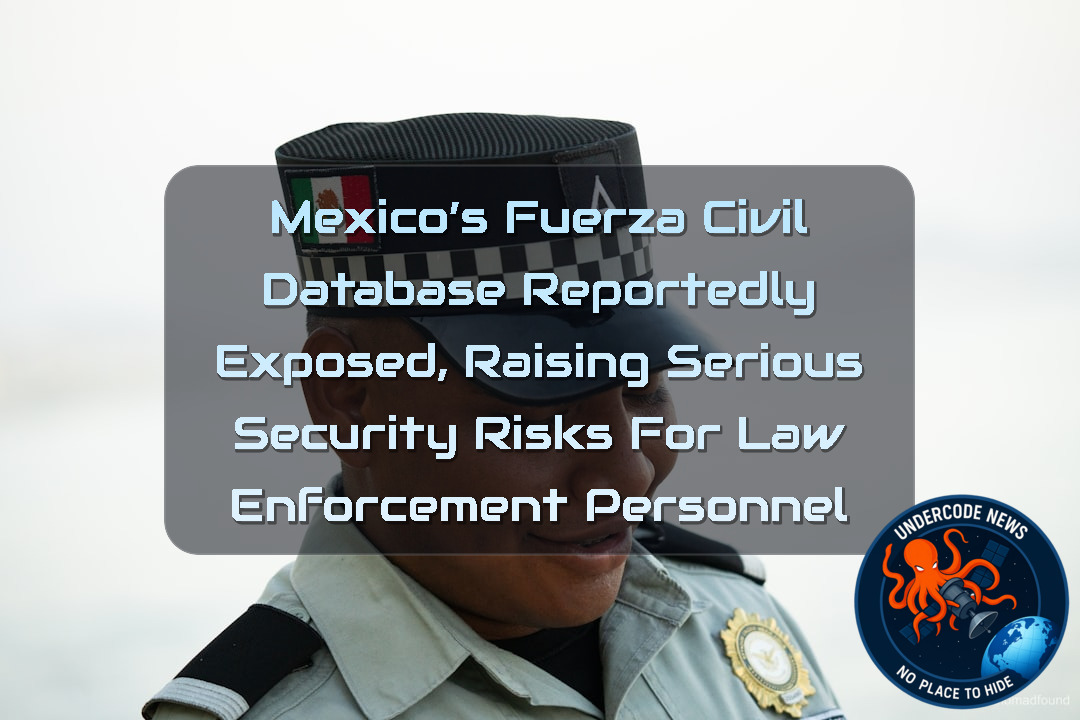
A reported leak involving Fuerza Civil, the state police force of Nuevo León, Mexico, has raised fresh concerns about the security of law-enforcement databases and the growing danger posed by stolen personnel information. A threat actor has published a sample of records allegedly connected to the agency, displaying information that reportedly includes police ranks, employee numbers, institutional details, and full names.
What Happened
According to Dark Web Intelligence, a threat actor published what they described as a database belonging to Fuerza Civil. The post includes several alleged personnel records as evidence and claims that the information was obtained from the agency’s systems.
What the Exposed Data Appears to Contain
The sample reportedly contains several categories of personnel information. These include the institution name, police rank, employee number, and full name of individuals allegedly associated with Fuerza Civil.
Why Personnel Information Matters
At first glance, names and employee numbers may appear less dangerous than passwords or financial records. In a law-enforcement environment, however, seemingly basic personnel information can become extremely valuable when combined with information obtained from other sources.
The Operational-Security Risk
Knowing who works for a police organization can help criminals identify employees, establish believable identities, construct targeted social-engineering campaigns, or gather additional intelligence about the structure of an agency.
The Phishing Threat
A leaked employee name and rank can make a phishing message dramatically more convincing. An attacker could potentially impersonate an administrator, colleague, supervisor, government official, or service provider while referencing authentic-looking details about the intended victim.
The Impersonation Problem
Employee numbers and police ranks can also contribute to impersonation attempts. If criminals combine these records with publicly available photographs, social-media profiles, telephone numbers, or other leaked information, they may be able to construct convincing identities.
Targeted Attacks Could Follow
Law-enforcement personnel can represent particularly attractive targets because of the information and authority associated with their positions. A database leak does not need to contain classified operational information to become useful to an adversary.
The Dark Web Dimension
Threat actors increasingly use underground forums and leak channels to advertise databases, stolen credentials, internal documents, and employee information. Sometimes these posts involve complete datasets. In other cases, attackers publish limited samples to attract buyers or demonstrate that they possess a particular collection of information.
An Important Warning About Verification
The reported Fuerza Civil dataset should currently be treated as an unverified exposure. The threat actor’s statement alone does not establish that the database genuinely originated from Fuerza Civil’s infrastructure.
What Has Not Been Established
The available report does not provide technical evidence explaining how the alleged database was obtained. No initial access vector, exploited vulnerability, compromised account, malware infection, or intrusion timeline has been publicly identified in the supplied material.
The Question of Authenticity
Another important question is whether the records are authentic, current, and genuinely associated with Fuerza Civil. A database can contain real-looking information while being outdated, repackaged from an older breach, assembled from public sources, or misrepresented by an attacker.
The Scope Is Also Unknown
The published sample does not establish the total size of the alleged dataset. It is therefore impossible from the available information to determine whether this represents a small collection of records or a substantially larger personnel database.
Freshness Matters
Even if the records are authentic, their age is important. Personnel databases can become outdated as employees change roles, leave agencies, receive new identification numbers, or move between departments.
Why Old Data Can Still Be Dangerous
Outdated information should not automatically be considered harmless. Historical employee information can still be used for identity correlation, social engineering, credential attacks, fraudulent documentation, and reconnaissance.
The Human Element
Cybersecurity incidents involving government agencies are often discussed in terms of servers, databases, vulnerabilities, and access controls. The people behind those systems can be overlooked.
Employees Become Part of the Attack Surface
Once personnel information is exposed, the attack surface can extend beyond the original database. Attackers may begin targeting employees directly through email, messaging platforms, telephone calls, or fraudulent websites.
Social Engineering Becomes Easier
A criminal who knows a
Information Can Be Combined
The real danger may come from combining the alleged database with previously leaked information. One dataset can provide names, another can provide phone numbers, and public sources can provide photographs, professional histories, and organizational relationships.
Building an Intelligence Picture
This type of correlation allows attackers to construct a broader intelligence picture without necessarily compromising every system individually.
Law Enforcement Requires Stronger Protection
Police organizations have a particularly difficult cybersecurity challenge because they must protect ordinary administrative information alongside sensitive operational resources.
Not Every Record Is Classified
That does not mean every employee record is secret. It means organizations must understand how apparently ordinary information can become dangerous when aggregated and weaponized.
Database Security Is Only One Layer
Protecting a personnel database requires more than placing it behind a firewall. Strong authentication, access controls, monitoring, encryption, segmentation, logging, and rapid incident response all play important roles.
Credential Security Remains Critical
If the alleged incident resulted from compromised credentials, the consequences could extend beyond the database itself. Attackers who obtain legitimate credentials may attempt to move laterally into additional systems.
Monitoring Can Reveal Suspicious Activity
Security teams should monitor unusual database queries, abnormal authentication behavior, unexpected administrative activity, mass exports, and access from unfamiliar locations or devices.
Data Loss Prevention Matters
Organizations handling sensitive personnel records can also use data-loss prevention controls to detect unusual bulk transfers and identify attempts to move large quantities of information outside approved environments.
Incident Response Must Be Fast
When sensitive personnel data may have been exposed, organizations should quickly determine what systems were accessed, which accounts were involved, what information was retrieved, and whether unauthorized persistence remains inside the environment.
The Threat
The sample published by the threat actor may demonstrate possession of information, but it does not independently prove how that information was obtained.
A Sample Is Not the Same as Proof of Intrusion
This distinction matters. A threat actor can possess a dataset without having directly breached the organization named in a post.
Attribution Requires Technical Evidence
Reliable attribution normally requires evidence such as authentication logs, endpoint telemetry, database access records, malware artifacts, forensic findings, infrastructure indicators, or other corroborating information.
Organizations Should Not Wait for Perfect Certainty
At the same time, uncertainty should not become an excuse for inaction. If the exposed records appear credible, security teams can begin protective measures while forensic verification continues.
Protecting Personnel
Potentially affected employees should be warned about targeted phishing, suspicious calls, impersonation attempts, fraudulent messages, and unexpected requests for credentials or internal information.
Protecting Accounts
Organizations should review privileged accounts, enforce strong authentication, rotate potentially exposed credentials, and investigate unusual login activity associated with personnel databases.
Protecting the Database
Database administrators should review permissions and ensure that employees, applications, and service accounts only have access to the information they actually require.
The Principle of Least Privilege
Least-privilege access can significantly reduce the impact of a compromised account. An account that does not need to export an entire personnel database should not be capable of doing so.
Segmentation Can Limit Damage
Separating personnel databases from operational systems can also reduce the ability of attackers to move from an administrative environment into more sensitive infrastructure.
Logging Is Essential
Detailed and tamper-resistant logs can help investigators reconstruct what happened and determine whether data was accessed, modified, or exported.
Dark Web Monitoring Has a Role
Organizations can monitor underground sources for references to their domains, credentials, employee identities, internal documents, and other potentially sensitive material.
But Monitoring Is Not Prevention
Dark Web monitoring can provide early warning, but it cannot replace secure architecture, endpoint protection, identity controls, vulnerability management, and incident response.
The Bigger Cybersecurity Lesson
The Fuerza Civil report illustrates a broader problem facing public-sector organizations around the world. Attackers do not always need classified documents to create serious consequences.
Identity Data Can Become Operational Intelligence
A person’s name, rank, and employee number may appear administrative, but together they can provide a foundation for targeted reconnaissance.
Small Leaks Can Become Larger Attacks
The most damaging consequences may emerge later, when attackers combine the exposed information with other datasets and use it to target individuals.
Why Verification Should Remain Central
The responsible approach is to take the reported exposure seriously while separating confirmed facts from statements made by an unknown threat actor.
Current Assessment
Based on the supplied report, a threat actor has published information they claim is associated with Fuerza Civil in Nuevo León. The reported sample contains personnel-related information, but the provenance, completeness, freshness, and authenticity of the database have not been independently established.
What Undercode Say:
The Real Risk Is Not Just the Database
The most important issue is not simply whether a database exists.
The larger concern is what attackers can do with the information if it is authentic.
Law-enforcement personnel are high-value targets for social engineering.
A name and rank can turn a generic phishing campaign into a highly targeted operation.
An employee number can add another layer of apparent legitimacy.
Attackers can use organizational terminology to make fraudulent communications sound authentic.
The exposed information can also support reconnaissance.
Threat actors frequently build intelligence by combining multiple sources.
A leaked database may therefore become one component of a much larger information picture.
Public social-media profiles can fill gaps left by the leaked dataset.
Previous breaches can provide email addresses or telephone numbers.
Other underground datasets may provide passwords or authentication information.
Attackers can correlate these records automatically.
This makes data aggregation a major cybersecurity threat.
The value of stolen information is often determined by what it can be connected to.
Law-enforcement organizations should therefore assume that exposed personnel data can become targeting intelligence.
The danger increases when privileged employees are identified.
Administrators and technical personnel may become especially attractive targets.
Attackers can attempt to impersonate supervisors.
They can also create fake government communications.
A believable message can be more dangerous than an obvious malware attachment.
Personnel should be trained to verify unusual requests through trusted channels.
Organizations should also minimize unnecessary exposure of employee information.
Internal databases should not provide broad access simply because users belong to the same organization.
Database exports deserve particular attention.
Large unexpected queries can be an early warning sign of data theft.
Security teams should investigate unusual access patterns.
They should also correlate database activity with identity-provider and endpoint logs.
Authentication anomalies can reveal compromised accounts.
Endpoint telemetry can reveal malicious tools or unauthorized database access.
Network monitoring can identify unusual outbound transfers.
Incident responders should preserve evidence before systems are unnecessarily altered.
Attribution should be based on technical evidence rather than underground-post rhetoric.
The threat
That distinction is especially important when reporting cybersecurity incidents publicly.
Overstating an unverified detail can create misinformation.
Underestimating the potential exposure can create unnecessary risk.
The correct position is to acknowledge the report while clearly identifying what remains unknown.
If the data proves authentic, affected personnel should be considered potential targets.
Credential resets and stronger authentication may become necessary.
Privileged access should receive additional scrutiny.
Organizations should review whether the database can be exported in bulk.
They should also determine whether excessive permissions allowed unnecessary access.
The long-term lesson is straightforward.
Sensitive information does not need to be classified to become dangerous.
A personnel directory can become an intelligence resource.
A database record can become a phishing weapon.
A leaked identity can become the beginning of a much larger attack chain.
For that reason, public-sector cybersecurity must protect not only systems, but also the people represented inside those systems.
Deep Analysis
Defensive Commands for Security Teams
For organizations investigating a possible exposure, Linux administrators can begin by reviewing authentication activity and unusual access patterns.
sudo journalctl --since "24 hours ago" | grep -Ei "authentication|failed|sudo|ssh"
Review Recent Successful Logins
last -a | head -50
Inspect Failed Authentication Attempts
sudo journalctl -u ssh --since "24 hours ago" | grep -Ei "failed|invalid"
Identify Unexpected Privileged Accounts
getent group sudo
Review Recent Administrative Activity
sudo journalctl --since "24 hours ago" | grep -Ei "sudo|useradd|usermod|passwd"
Search for Large File Transfers
sudo find /var/log -type f -mtime -2 -print
Check Listening Services
sudo ss -tulpn
Review Active Network Connections
sudo ss -tpn
Inspect Running Processes
ps aux --sort=-%cpu | head -30
Find Recently Modified Files
sudo find /etc /var/www /opt -type f -mtime -2 -ls
Review Scheduled Tasks
sudo crontab -l
sudo find /etc/cron -type f -maxdepth 2 -print
Check for Unexpected SSH Keys
sudo find /home /root -name authorized_keys -type f -print
Investigate Database Access
Security teams should correlate database audit logs with identity-provider logs, endpoint telemetry, VPN records, and firewall events.
Search for Bulk Exports
Investigators should specifically look for unusually large queries, database dumps, compressed archives, and transfers occurring outside normal working patterns.
Preserve Evidence
Potentially compromised systems should be investigated carefully so that valuable forensic evidence is not destroyed by rushed cleanup actions.
Rotate Credentials Carefully
If compromise is confirmed, credentials should be rotated according to an incident-response plan, with particular priority given to privileged and service accounts.
Enforce Strong Authentication
Multi-factor authentication should be enabled wherever technically possible, particularly for administrative systems and remote access.
Reduce Database Permissions
Security teams should regularly audit database permissions and remove access that employees or applications no longer require.
Monitor Identity Exposure
Organizations should watch for employee identities appearing alongside suspicious login attempts, phishing domains, fraudulent accounts, or underground advertisements.
Correlate Multiple Sources
The strongest investigation will combine endpoint, network, identity, database, and threat-intelligence evidence rather than relying on a single indicator.
Database Exposure Report
❌ Not independently verified: The supplied report describes a threat actor’s publication and does not establish that the dataset genuinely originated from Fuerza Civil systems.
Personnel Information
✅ Supported by the published sample description: The post reportedly displays institution information, police rank, employee number, and full names.
Intrusion Details
❌ No confirmed attack method: The available report does not identify the initial access vector, exploited vulnerability, compromised account, or technical intrusion mechanism.
Prediction
(+1) Increased Security Attention
The reported exposure is likely to attract additional scrutiny toward law-enforcement databases and personnel-security practices.
If the records are authentic, affected personnel could face targeted phishing and impersonation attempts.
Security teams are likely to increase monitoring around exposed identities and authentication systems.
Underground actors may attempt to combine the alleged dataset with information from other breaches.
Organizations handling law-enforcement personnel information may place greater emphasis on least privilege, database monitoring, and data-loss prevention.
(-1) Continued Uncertainty
The full scope of the alleged exposure may remain unclear until independent technical evidence becomes available.
The dataset may prove smaller, older, or less operationally significant than the threat actor suggests.
The published sample alone cannot establish whether Fuerza Civil infrastructure was directly compromised.
Final Assessment
The reported Fuerza Civil database exposure deserves attention because law-enforcement personnel information can become highly valuable intelligence when placed in the hands of attackers. Names, ranks, and employee numbers can facilitate impersonation, phishing, reconnaissance, and targeted social engineering.
At the same time, responsible cybersecurity reporting requires a clear distinction between what has been demonstrated and what has merely been stated by a threat actor. The current material supports the existence of a published alleged dataset, but it does not independently establish its origin, authenticity, freshness, or the method by which it was supposedly obtained.
If the information is genuine, the priority should be protecting affected personnel, reviewing access controls, investigating database activity, examining authentication logs, and determining whether additional systems were accessed. The incident is another reminder that cybersecurity is not only about protecting passwords and servers. Sometimes the most valuable target is the human identity sitting inside the database.
▶️ Related Video (80% Match):
🕵️📝Let’s dive deep and fact‑check.
🎓 Live Courses & Certifications:
Join Undercode Academy for Verified Certifications
🚀 Request a Custom Project:
Secure, high-velocity infrastructure and disruptive technological engineering. Contact our engineering team for high-tier development and proprietary systems:
[email protected]
💎 Smart Architecture | 🛡️ Secure by Design | ⭐ Trusted by Thousands
References:
Reported By: x.com
Extra Source Hub (Possible Sources for article):
https://stackoverflow.com
Wikipedia
OpenAi & Undercode AI
Image Source:
Unsplash
Undercode AI DI v2
🔐JOIN OUR CYBER WORLD [ CVE News • HackMonitor • UndercodeNews ]
📢 Follow UndercodeNews & Stay Tuned:
𝕏 formerly Twitter 🐦 | @ Threads | 🔗 Linkedin | 🦋BlueSky | 🐘Mastodon | 📺Youtube


