
Listen to this Post
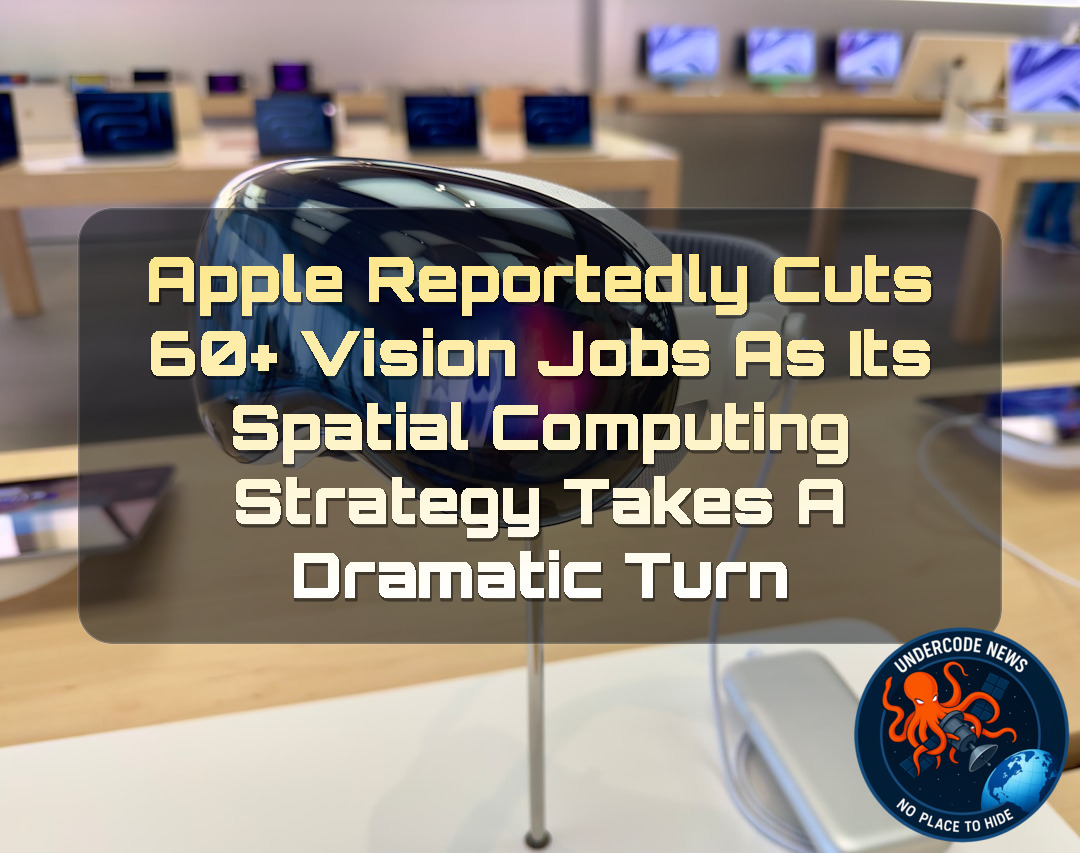
A Troubling Signal From Apple’s Vision Division
Apple’s Vision Pro journey may be entering a very different phase. A new report claims that Apple has laid off at least 60 employees connected to its virtual-reality and Vision-related development efforts, raising fresh questions about the company’s long-term ambitions for spatial computing.
The reported cuts do not necessarily mean Apple is abandoning Vision Pro or visionOS. In fact, Apple continues to publicly invest in visionOS, developer tools, spatial experiences, and enterprise applications. Its latest visionOS 27 materials describe a platform receiving major new capabilities, including enhanced Siri, Visual Intelligence, Spatial Preview, improved object tracking, new spatial accessories, and stronger support for professional workflows.
The more interesting possibility is that Apple is changing where it wants the next generation of spatial computing to happen.
Instead of putting all its resources behind large, expensive headsets, Apple appears increasingly interested in smaller AI-powered wearables — particularly smart glasses that could bring Siri and visual intelligence into everyday life.
That would represent a major strategic shift.
Apple Reportedly Cuts at Least 60 Vision-Related Employees
According to the report summarized by AppleInsider, Apple has reportedly laid off at least 60 employees associated with its VR team, the Apple Vision Group, and related positions.
Apple has not publicly confirmed the reported layoffs or provided an explanation for the specific positions affected.
The distinction matters because Apple has already reorganized its Vision organization in the past. The company’s Vision Products Group was reportedly broken apart, with employees moved into Apple’s larger hardware and software organizations rather than remaining inside one centralized division.
That means a reduction in employees associated with a particular Vision team does not automatically translate into the cancellation of Apple’s spatial-computing strategy.
The Vision Products Group Was Already Changing
Apple’s organizational changes surrounding Vision Pro have been underway for some time.
Reports previously indicated that Apple had reorganized the Vision Products Group, distributing its hardware and software personnel across broader engineering organizations.
Mike Rockwell, who had overseen the group, also moved into a major role connected with Apple’s Siri overhaul.
That change was particularly revealing because it demonstrated how Apple’s priorities were beginning to overlap.
The company was no longer treating spatial computing as an isolated product category. Instead, technologies such as artificial intelligence, computer vision, Siri, hardware sensors, and wearable computing were increasingly becoming interconnected pieces of a much larger strategy.
Apple Says Spatial Computing Is Still in Its Early Innings
Despite the reported layoffs,
Apple executives have repeatedly described the category as being in its early stages.
That argument is becoming increasingly important because Vision Pro was never designed as an ordinary consumer electronics product. At $3,499 at launch, it targeted developers, professionals, enterprise customers, creators, and enthusiasts rather than the mass-market audience that made the iPhone and Apple Watch enormous successes.
Apple therefore has an unusual challenge.
It needs to keep developing the underlying technology without necessarily expecting the first-generation headset to become a mainstream hit.
visionOS 27 Tells a Different Story
The strongest evidence that Apple has not simply abandoned the Vision platform comes from Apple’s own software development.
Apple’s visionOS 27 platform introduces a substantial collection of new features, including a more capable Siri experience, Visual Intelligence, spatial scenes, improved Mac integration, Spatial Preview, enhanced object tracking, new spatial accessories, and additional tools for developers.
Apple’s developer documentation also continues to position visionOS as a serious platform for applications and games.
Developers can build experiences using SwiftUI, RealityKit, CompositorServices, Unity, Unreal Engine, and Godot, while Apple’s new Spatial Preview framework allows Mac applications and 3D content to interact more deeply with Vision Pro.
That is not what a completely abandoned platform normally looks like.
Apple Is Expanding Vision Pro Beyond Entertainment
One of the most important developments is that Apple appears to be moving the Vision platform beyond the traditional VR conversation.
The company is increasingly emphasizing productivity, professional design, medicine, simulation, enterprise workflows, and spatial content creation.
visionOS 27, for example, adds enhanced object tracking that can support high-precision spatial measurements. Apple specifically highlights potential applications involving medical training and other professional scenarios.
This could be a more realistic long-term market for Vision Pro than ordinary consumers watching movies or browsing the web inside a headset.
Spatial Preview Could Be More Important Than It Looks
Apple’s Spatial Preview framework is another clue about where the company is heading.
Rather than requiring every professional application to become a full visionOS application, Apple is allowing Mac content to be previewed and manipulated spatially through Vision Pro.
Designers can work with 3D assets, spatial photos, immersive media, and other content inside a spatial environment.
This approach could make Vision Pro valuable even if consumers never wear one every day.
Apple may be building Vision Pro into a specialized computing tool — something closer to a professional workstation, development platform, visualization system, or spatial laboratory.
The $3,499 Price Remains a Major Barrier
The biggest obstacle has always been price.
Vision Pro launched at $3,499, placing it far above mainstream consumer electronics.
Even
For comparison, smartphones, laptops, tablets, and smartwatches became successful by offering increasingly powerful experiences at prices that ordinary consumers could justify.
Vision Pro entered the market from the opposite direction.
It offered extraordinary technology first and waited for the ecosystem and use cases to develop around it.
Hardware Improvements Have Not Solved the Bigger Problem
Apple has continued improving the hardware.
The Vision Pro received an M5 upgrade that improved performance and display-related capabilities while retaining the headset’s premium positioning.
But faster hardware alone cannot solve the central problem.
The question is not simply whether Vision Pro is powerful enough.
The question is whether enough people have a reason to wear a large headset for hours every day.
That is a much harder problem.
Apple May Be Moving Toward Glasses Instead
This is where
Recent reports indicate that Apple is working toward smart glasses that could be introduced around WWDC 2027.
Unlike Vision Pro, these glasses are reportedly expected to focus on cameras, microphones, speakers, Siri, and Visual Intelligence rather than placing a full augmented-reality display directly in front of the user’s eyes.
That would put Apple’s product much closer to the emerging category represented by Meta’s Ray-Ban smart glasses.
The Camera Problem Could Determine Apple’s Strategy
Apple’s biggest challenge with smart glasses may not be technical.
It may be social.
People have already become uncomfortable with the idea of strangers wearing cameras on their faces.
Meta’s smart glasses have helped establish the category, but they have also intensified conversations about recording, consent, surveillance, and privacy.
Apple therefore has to solve a problem that is much larger than building attractive glasses.
It has to convince people that wearing them around other people is socially acceptable.
Apple Could Make Privacy the Product
This could become one of
The company has reportedly explored different approaches to the camera question, including designs that limit or remove conventional recording capabilities.
One possible direction is to use cameras primarily for visual intelligence — allowing the glasses to understand what the wearer is looking at — without turning them into conventional wearable cameras.
That would allow a person to ask Siri what they are seeing, identify an object, understand a location, or receive contextual information without necessarily creating a device designed around constant photo and video recording.
The idea is strategically fascinating.
Apple could attempt to turn privacy from a limitation into a selling point.
Siri Could Become the Interface for Apple’s Next Wearable
The importance of Siri is easy to underestimate.
If Apple wants to build screenless or minimally visual wearables, voice interaction becomes critical.
A smart-glasses user cannot interact with a conventional touchscreen.
Instead, the interaction could become conversational.
Ask a question.
Look at something.
Receive an answer.
Ask for directions.
Translate something.
Identify an object.
Send a message.
Play audio.
That is a completely different computing model from the smartphone.
Visual Intelligence Could Be the Missing Piece
Apple’s expansion of Visual Intelligence into visionOS provides another important clue.
Apple’s current visionOS strategy increasingly combines computer vision with Siri and AI. On Vision Pro, Siri can use visual intelligence to understand what the user is looking at.
That capability makes even more sense on glasses.
A headset can show information directly in your field of view, but glasses without a display would need another interface.
Voice becomes that interface.
The glasses could essentially become a pair of eyes and ears for Apple’s AI ecosystem.
Apple May Not Be Abandoning Vision Pro — It May Be Repositioning It
This is perhaps the most important interpretation of the reported layoffs.
Apple could be reducing the number of people working on certain Vision projects while simultaneously increasing investment in the underlying technologies.
That sounds contradictory, but large technology companies frequently reorganize teams when a product category moves from one stage to another.
The early stage requires building the hardware.
The next stage requires integrating the technology into a broader ecosystem.
Apple may now be moving toward that second stage.
Vision Pro Could Become Apple’s Spatial Technology Laboratory
Vision Pro may ultimately serve a role similar to a technology laboratory.
Apple can experiment with spatial interfaces, computer vision, hand tracking, eye tracking, immersive media, spatial audio, 3D content, object recognition, AI assistants, and developer frameworks.
Those technologies do not have to remain exclusive to Vision Pro.
They can eventually migrate into smaller products.
This is one reason reported layoffs should not automatically be interpreted as the death of spatial computing.
The Technology Could Spread Across Apple’s Entire Ecosystem
Apple’s long-term opportunity is much larger than one headset.
Imagine a future in which an iPhone provides the computing foundation, AirPods provide audio and microphones, Apple Watch provides health and contextual information, and lightweight glasses provide visual awareness.
The products could work together rather than competing with one another.
Vision Pro could then become the high-end spatial-computing platform while glasses become the everyday wearable.
That would make much more strategic sense than expecting everyone to replace their smartphone with a headset.
Enterprise May Become Vision Pro’s Real Battlefield
The enterprise opportunity deserves special attention.
A $3,499 headset can be difficult to justify for entertainment.
It can become much easier to justify if it saves a company thousands of dollars in training, design, engineering, medical simulation, architecture, manufacturing, or remote collaboration.
Apple is already highlighting enterprise and professional spatial workflows.
That could eventually give Vision Pro a sustainable niche even if consumer adoption remains limited.
Medical Applications Could Be Especially Important
Healthcare is one of the areas where spatial computing can provide genuinely different capabilities.
A surgeon, medical student, engineer, or researcher can work with three-dimensional models that are difficult to understand on a conventional two-dimensional display.
Apple’s enhanced object-tracking capabilities in visionOS 27 further demonstrate how the company is developing spatial technologies that can support high-precision professional applications.
This is a much more compelling argument for spatial computing than simply watching movies on a giant virtual screen.
Developers Still Matter
A platform is only as strong as the developers building for it.
Apple appears to understand this.
Its visionOS 27 developer strategy includes support for major game engines and multiple development paths, making it easier to bring existing iOS, iPadOS, macOS, PC, Unity, Unreal, and Godot experiences into spatial computing.
That is an important sign.
Apple is not treating visionOS as a closed experiment.
It is still building an ecosystem around it.
The Real Question Is Where Apple Wants Growth
The reported layoffs therefore raise a different question from the one dominating headlines.
The question is not simply:
“Is Apple killing Vision Pro?”
The more useful question is:
“Where does Apple believe the next billion-dollar wearable opportunity will come from?”
If the answer is smart glasses, the reported organizational changes become easier to understand.
Apple could be reducing investment in bulky headset projects while redirecting talent toward AI, computer vision, wearable hardware, privacy engineering, and lightweight devices.
Meta’s Success May Have Changed Apple’s Thinking
Meta’s smart glasses have demonstrated that consumers may be more interested in wearable AI than traditional virtual reality.
That is a major development.
Instead of isolating users from the physical world, smart glasses can enhance it.
That distinction matters.
Virtual reality asks users to leave their surroundings.
AI glasses ask users to keep living normally while adding a layer of intelligence.
For everyday computing, the second approach may have much broader appeal.
Apple’s Biggest Risk Is Moving Too Slowly
Apple has historically preferred to enter markets after technology becomes mature enough to deliver a polished experience.
That strategy worked spectacularly with the iPhone and Apple Watch.
But wearable AI is developing quickly.
Meta already has consumer smart glasses.
Google is returning aggressively to Android-based wearable and XR experiences.
Other companies are exploring AI-powered earbuds, pins, glasses, and cameras.
Apple therefore cannot spend years perfecting the category while competitors establish consumer expectations.
Apple’s Biggest Advantage Is Integration
At the same time, Apple possesses something many competitors do not.
It controls the hardware, operating systems, silicon, services, AI interfaces, developer ecosystem, and enormous installed base surrounding the iPhone.
If Apple introduces smart glasses, the glasses do not need to operate independently.
They can become another extension of the Apple ecosystem.
That could make them dramatically more useful than a standalone AI device.
What the Reported Layoffs Actually Tell Us
The reported cuts should be viewed as a strategic signal rather than definitive evidence of cancellation.
They suggest that
The company appears to be moving away from the idea that spatial computing is synonymous with a single expensive headset.
Instead, spatial intelligence could become a technology spread across multiple products.
That is a much bigger ambition.
Deep Analysis: What Is Really Happening Inside Apple?
Apple Is Moving From Product to Platform
The biggest strategic change may be the transition from Vision Pro as a product to visionOS and spatial computing as a platform.
Apple can continue investing in the software and underlying technologies without expanding the headset business at the same pace.
The Headset May Have Served Its First Purpose
Vision Pro gave Apple something extremely valuable: real-world experience.
Apple learned how users interact with eye tracking, hand gestures, spatial windows, immersive environments, and 3D content.
Those lessons can now influence smaller devices.
AI Changes the Economics of Wearables
Traditional wearables require screens and interfaces.
AI can reduce that requirement.
If Siri can understand context and respond conversationally, a wearable device does not need to display everything.
That makes smaller hardware possible.
Smart Glasses Could Be More Scalable
A lightweight pair of glasses has a fundamentally larger potential audience than a $3,499 headset.
People already wear glasses.
They already use headphones.
They already carry smartphones.
Combining those behaviors is far easier than asking consumers to adopt a large new headset.
Vision Pro Can Remain the Premium Tier
Apple does not need to choose between Vision Pro and smart glasses.
It could create a product hierarchy.
Glasses for everyday life.
Vision Pro for professional and immersive computing.
iPhone as the central computing device.
AirPods and Apple Watch as supporting interfaces.
That ecosystem would be far more powerful than any individual product.
Apple’s AI Strategy Is Becoming Hardware Strategy
AI is no longer simply a software feature.
It is influencing which sensors devices need, how interfaces work, how much processing occurs locally, and what form factors become possible.
Apple’s wearable strategy is therefore increasingly tied to its AI strategy.
Siri Becomes More Important Than the Screen
A screenless wearable requires a powerful assistant.
That makes
If Siri becomes fast, context-aware, visually intelligent, and capable of taking meaningful actions, it could become the primary interface for an entirely new class of devices.
Privacy Could Define Apple’s Glasses
Apple cannot simply copy Meta.
It needs a reason for consumers to trust its glasses around other people.
Privacy indicators, local processing, recording controls, transparent sensors, and strict software permissions could become central product features.
The Camera Debate Is Not Going Away
Even if
The social problem therefore remains.
Apple will need to communicate clearly when sensors are active and what information is being processed.
Spatial Computing Is Becoming Less About VR
The term “VR” increasingly fails to describe
VisionOS combines augmented reality, virtual reality, traditional computing, 3D interfaces, spatial audio, AI, and real-world object tracking.
The broader category is spatial computing.
Enterprise Could Protect Apple’s Investment
Even if consumer adoption remains limited, professional applications can sustain the platform.
Engineering, medicine, training, architecture, design, manufacturing, and simulation all have reasons to use spatial technology.
Developers Need a Reason to Stay
Apple’s continued investment in development frameworks is therefore crucial.
The more easily developers can bring existing applications into visionOS, the less risky the platform becomes.
Apple Is Building a Technology Stack
The company is developing much more than a headset.
It is developing sensors, operating systems, computer vision, spatial APIs, AI integration, rendering technology, developer tools, and interaction models.
Those assets can be reused.
That Makes the Layoffs Less Straightforward
A company can reduce headcount in one organization while increasing investment in another.
Employees can move.
Teams can merge.
Projects can be canceled.
Technologies can survive.
Therefore, employee reductions alone cannot establish that
The Smart-Glasses Pivot Makes Strategic Sense
If Apple believes glasses will eventually reach a much larger market, moving resources toward that category would be rational.
The timing is especially important as AI makes lightweight wearable computing more practical.
Apple Needs a Mass-Market Wearable
Vision Pro demonstrated
The next challenge is accessibility.
Apple needs a device ordinary consumers can wear without thinking about it.
That is exactly where smart glasses could fit.
The iPhone May Remain at the Center
The glasses do not necessarily need to replace the iPhone.
Instead, they could become an extension of it.
The phone could handle heavy computation, storage, configuration, and connectivity while the glasses provide sensors and natural interaction.
AirPods Could Become Part of the Same Strategy
Audio is essential for screenless computing.
Apple already owns one of the strongest consumer audio ecosystems in the world.
Combining AirPods-like audio capabilities with visual sensing could create a powerful wearable platform.
Apple Watch Could Add Context
The Apple Watch provides health, location, movement, and notification context.
A future wearable ecosystem could combine all of these signals.
The result could be an AI assistant that understands far more about the user’s environment.
Apple’s Silicon Gives It Another Advantage
Apple’s custom chips allow the company to tightly optimize hardware and software.
That matters enormously for wearable devices where battery life, heat, weight, and processing power are tightly constrained.
The Next Breakthrough May Be Smaller
The irony of Vision Pro is that
The headset could be the beginning rather than the destination.
Vision Pro May Become a Developer Platform
Apple can use Vision Pro to encourage developers to experiment with spatial applications.
Those applications can later migrate to other hardware.
This creates an ecosystem before mass-market hardware arrives.
The AI Glasses Timeline Is Still Uncertain
Reports pointing toward 2027 should be treated as a roadmap, not a guarantee.
Apple frequently changes product schedules while engineering, supply-chain, regulatory, and privacy challenges evolve.
Privacy Could Delay the Product
The camera issue alone could cause Apple to delay its glasses.
That would be understandable.
Launching a wearable that creates widespread privacy anxiety could damage the category before Apple has an opportunity to establish trust.
Apple’s Reputation Raises the Stakes
Consumers expect Apple to make products feel socially acceptable.
If
The company therefore needs industrial design and privacy engineering to work together.
The Competition Is Already Moving
Meta’s progress has given Apple less time to experiment privately.
The longer Apple waits, the more consumers become accustomed to competing wearable AI products.
But Apple Does Not Need to Be First
Apple’s advantage has never necessarily been being first.
Its advantage has often been turning complicated technology into products ordinary people understand.
That could happen again with AI glasses.
The Next Vision Product Could Be Far More Important Than Vision Pro
Vision Pro introduced spatial computing to
A successful pair of AI glasses could bring that concept to millions of people.
That would be a vastly bigger commercial opportunity.
The Layoffs Could Ultimately Be Part of a Larger Reorganization
If the reported cuts are accurate, they may represent Apple’s attempt to concentrate resources.
The company may be eliminating overlapping positions while directing investment toward AI-powered wearables.
The Most Important Signal Is Apple’s Software Investment
Despite the reported layoffs, Apple continues developing visionOS aggressively.
That is the strongest reason not to interpret the news as a complete retreat.
The Vision Platform Is Still Moving
Apple’s latest developer materials demonstrate continued work on spatial computing, object tracking, streaming, developer tools, and immersive experiences.
Apple May Be Preparing for a Post-Headset Era
The ultimate strategy could be to make spatial computing invisible.
Instead of putting people inside computers, Apple could put computers around people.
That is a much more ambitious vision.
What Undercode Say:
The Headline Is Bigger Than the Reality
A report saying Apple has “laid off the Vision team” naturally sounds like the end of Vision Pro.
But the underlying situation appears more complicated.
Apple continues to develop visionOS and provide developers with new spatial-computing tools.
Apple Could Be Cutting the Old Strategy
The more convincing interpretation is that Apple may be reducing investment in specific Vision hardware efforts while keeping the underlying spatial technology alive.
That is a very different story.
Vision Pro May Have Been a Learning Platform
Apple did not necessarily need Vision Pro to become an immediate iPhone-sized success.
The company may have needed millions of dollars of real-world engineering lessons about spatial interfaces, sensors, cameras, displays, and human interaction.
The Real Prize Could Be Glasses
The smart-glasses opportunity is considerably larger.
Glasses are lighter.
They are socially familiar.
They can potentially be worn throughout the day.
And they can integrate AI without completely isolating the user from reality.
Apple’s AI Push Changes Everything
The
AI can become the interface.
Privacy Will Make or Break the Product
Apple cannot simply copy
It needs to answer the uncomfortable question of what happens when the glasses see other people.
A Camera Is Not Just a Hardware Component
For smart glasses, a camera becomes a social signal.
People need to understand whether they are being recorded.
Apple will need extremely clear privacy indicators and policies.
Apple Has a Rare Opportunity
If Apple can make camera-equipped glasses feel trustworthy, it could transform the wearable market.
The company could position privacy as a fundamental difference rather than a legal footnote.
VisionOS 27 Is Evidence Against a Full Retreat
Apple’s latest visionOS release contains too many substantial platform investments to comfortably describe spatial computing as abandoned.
But That Does Not Guarantee Vision Pro’s Future
A company can support an operating system while reducing investment in a particular hardware form factor.
That distinction is essential.
Apple May Be Splitting the Market
The likely future could involve premium Vision devices for professional users and lightweight AI glasses for mainstream consumers.
That Strategy Could Actually Be Stronger
Instead of forcing one product to serve everyone, Apple could create separate devices for different computing needs.
Vision Pro Could Become Apple’s Pro Machine
Just as Apple sells MacBook Air and MacBook Pro, it could eventually sell everyday glasses and professional spatial computers.
Developers Would Benefit
A growing spatial platform would encourage developers to create applications that work across multiple Apple devices.
The Long-Term Winner May Be the Ecosystem
The individual headset may not be the most important product.
The ecosystem connecting iPhone, Apple Watch, AirPods, glasses, Vision Pro, Siri, and Apple Intelligence could be the real strategy.
Apple’s Biggest Risk Is Execution
The opportunity is enormous, but Apple must deliver a product that is lightweight, comfortable, private, useful, and affordable.
Failing any one of those requirements could limit adoption.
The Reported Layoffs Are Still Significant
Even if they do not mean the end of Vision Pro, losing dozens of employees is a meaningful organizational signal.
It suggests
The Next Question Is What Happens to the Remaining Teams
If Apple continues hiring in AI, computer vision, wearable hardware, and privacy engineering, the direction will become much clearer.
Watch the Software
The easiest way to understand
If development continues aggressively, the platform remains strategically important.
Watch the Glasses
If
Watch Siri
The success of
Watch Privacy
Apple’s approach to cameras may ultimately define the product more than its processor or industrial design.
The Future May Not Look Like Vision Pro
The next major Apple wearable could look almost nothing like the headset that started this journey.
It may be lighter, quieter, smaller, and far more ordinary.
That Could Be the Point
The most successful wearable technology is often the technology people forget they are wearing.
Apple May Be Trying to Make Spatial Computing Invisible
That would be the most interesting interpretation of all.
Spatial computing does not necessarily have to mean putting a giant computer on someone’s face.
It could mean giving ordinary objects the ability to understand the world around them.
Undercode’s Bottom Line
The reported layoffs are concerning, but they should not be mistaken for proof that Apple has abandoned spatial computing.
Apple’s continued investment in visionOS 27, developer frameworks, spatial APIs, object tracking, immersive experiences, and AI features suggests the underlying technology remains important.
The bigger story may be
The future may be less about selling an expensive headset to everyone and more about taking the technology developed for Vision Pro and shrinking it into products people can use every day.
If Apple succeeds, Vision Pro may eventually be remembered not as Apple’s final destination in spatial computing, but as the expensive first chapter of a much larger wearable-AI revolution.
✅ Apple continues investing in visionOS: Apple’s official visionOS 27 materials show continued development, including new Siri AI, Visual Intelligence, Spatial Preview, object tracking, spatial accessories, and other capabilities.
⚠️ The reported 60+ layoffs should be treated as a report, not an officially confirmed Apple announcement: The supplied article attributes the claim to AppleInsider sources, while Apple has not publicly confirmed the specific cuts.
✅ Apple is actively developing spatial-computing technology: Apple’s 2026 developer materials document continued work on visionOS, RealityKit, spatial content, third-party engines, foveated streaming, and professional spatial applications.
Prediction
(+1) Apple will continue investing in spatial computing, but the center of gravity is likely to shift toward smaller AI-powered wearables. Vision Pro can remain Apple’s high-end spatial platform while smart glasses target a much larger everyday market.
(+1) Apple’s strongest long-term opportunity may be the combination of Siri, Visual Intelligence, cameras, AirPods, and lightweight glasses. If Apple can make the experience feel natural, the glasses could become an important new interface to the Apple ecosystem.
(+1) Vision Pro is likely to survive as a professional and developer-oriented platform even if mainstream consumer adoption remains limited. Its value in design, simulation, enterprise, medicine, and spatial development gives Apple reasons to keep the technology alive.
(-1) Apple's smart-glasses project could face delays if privacy concerns remain unresolved. The camera issue is not merely a technical problem; it is a social acceptance problem that Apple will have to solve before the product can become mainstream.
(+1) The reported layoffs could ultimately represent a reallocation rather than a retreat. If Apple is moving resources from large headset development toward AI, computer vision, wearable hardware, and privacy technologies, the cuts could be part of a broader transformation of its spatial-computing strategy.
▶️ Related Video (78% Match):
🕵️📝Let’s dive deep and fact‑check.
🎓 Live Courses & Certifications:
Join Undercode Academy for Verified Certifications
🚀 Request a Custom Project:
Secure, high-velocity infrastructure and disruptive technological engineering. Contact our engineering team for high-tier development and proprietary systems:
[email protected]
💎 Smart Architecture | 🛡️ Secure by Design | ⭐ Trusted by Thousands
References:
Reported By: 9to5mac.com
Extra Source Hub (Possible Sources for article):
https://www.facebook.com
Wikipedia
OpenAi & Undercode AI
Image Source:
Unsplash
Undercode AI DI v2
🔐JOIN OUR CYBER WORLD [ CVE News • HackMonitor • UndercodeNews ]
📢 Follow UndercodeNews & Stay Tuned:
𝕏 formerly Twitter 🐦 | @ Threads | 🔗 Linkedin | 🦋BlueSky | 🐘Mastodon | 📺Youtube


