
Listen to this Post
Apple Is Reshaping Its Future
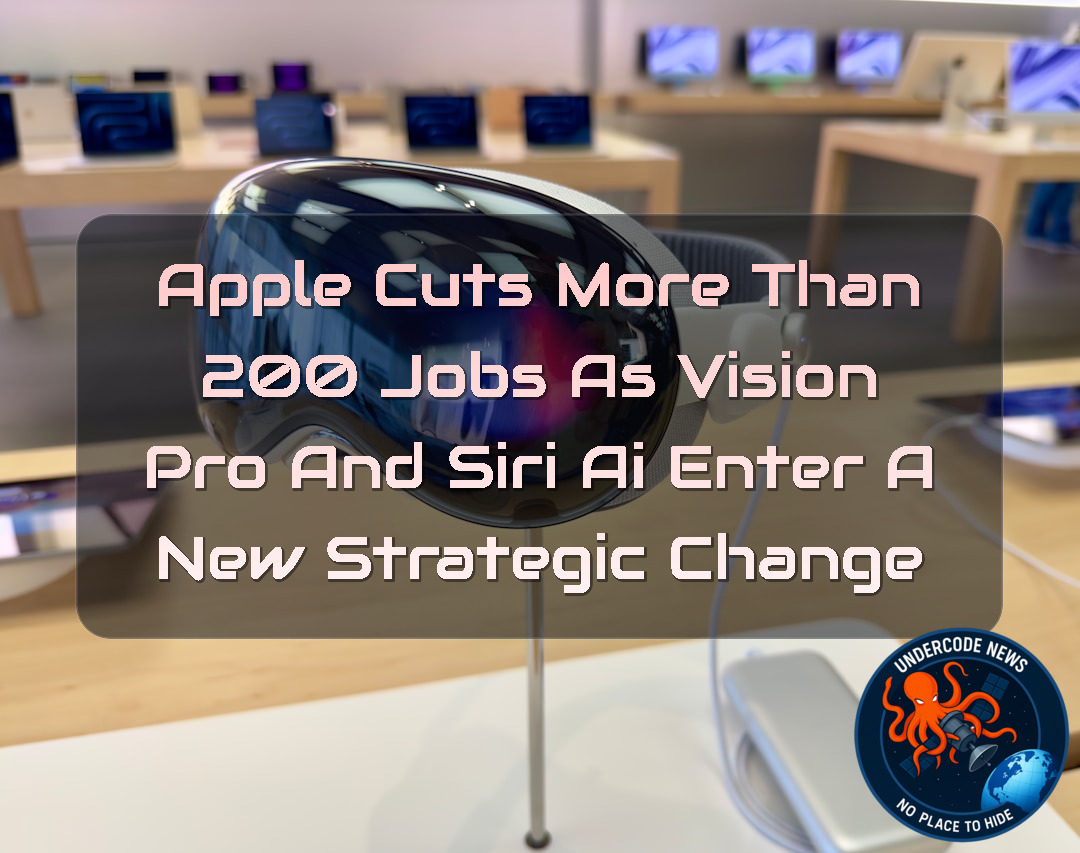
Apple is cutting more than 200 jobs across teams responsible for the Vision Pro, Siri, and software engineering, according to a new Bloomberg report. The reductions represent another significant sign that Apple is reorganizing its technology ambitions around artificial intelligence, smart glasses, and a new generation of software experiences.
The cuts do not appear to signal that Apple is abandoning the Vision Pro or visionOS. Instead, they point toward a broader shift in priorities. Apple is reducing investment in some areas of spatial computing while redirecting people and resources toward technologies it believes will have a larger impact on its future.
For Apple, this is more than a routine workforce adjustment. The company is simultaneously trying to evolve the Vision Pro platform, rebuild Siri around a new AI architecture, expand AI capabilities across its software ecosystem, and prepare for new wearable products. That combination is forcing Apple to decide which projects deserve the largest teams and the greatest investment.
More Than 200 Positions Are Being Eliminated
According to Bloomberg, Apple has eliminated more than 200 positions across several teams. Roughly 100 of those jobs are connected to the Vision Pro organization, while another approximately 100 positions involve Siri and software teams.
Apple confirmed that changes were taking place but framed the restructuring as part of an effort to evolve its business and improve the experiences it provides to users.
The company also emphasized that the restructuring will create new positions even as some existing roles disappear. Employees affected by the changes are being offered support during the transition, including opportunities to apply for other positions within Apple.
That distinction is important. Apple is not simply shrinking these organizations across the board. It is changing what kinds of expertise it needs.
Vision Pro Takes One of the Biggest Hits
The Vision Pro organization appears to be experiencing the most visible portion of the restructuring. Bloomberg reports that approximately 100 employees are affected, including workers involved in gaming and immersive video.
Apple is reportedly largely shutting down a Vision Pro team focused on gaming. At the same time, the company is scaling back its internal production of Immersive Video content.
That does not mean immersive content is disappearing entirely.
Instead, Apple plans to produce a smaller number of videos internally while encouraging outside creators and partners to develop additional immersive experiences for the platform.
Apple Is Not Abandoning Vision Pro
One of the most important details in the report is that Apple has reportedly told employees that Vision Pro and visionOS are not going away.
That message matters because the Vision Pro has always represented a long-term bet rather than a conventional consumer product launch. Apple entered the spatial-computing market with an expensive first-generation device designed to establish a new platform and demonstrate what the company believes is possible.
However, the
Apple appears increasingly interested in taking lessons from Vision Pro technology and applying them to products that could reach a much larger audience.
Smart Glasses Could Become the Next Priority
The biggest strategic clue may be
According to the report, Apple is prioritizing smart glasses that would not initially support Vision Pro-style immersive video or advanced gaming experiences.
That would represent a very different product philosophy.
Instead of asking consumers to wear a relatively large and expensive spatial computer, smart glasses could focus on everyday tasks, information, communication, cameras, AI assistance, and lightweight contextual experiences.
This could potentially make
The Vision Pro May Have a Longer Road Ahead
Apple is still reportedly considering a new Vision Pro model, potentially arriving as early as the end of 2028.
That timeline suggests that Apple may be thinking about Vision Pro as a specialized product line that can evolve slowly while other wearable devices receive more immediate attention.
Rather than abandoning spatial computing, Apple may be moving toward a portfolio strategy.
Smart glasses could target everyday users, while Vision Pro remains Apple’s high-end platform for developers, professionals, entertainment, design, training, and advanced spatial experiences.
Immersive Video Is Being Reconsidered
Apple’s Immersive Video initiative was one of the most impressive demonstrations of what Vision Pro could do.
The company invested heavily in high-quality immersive productions designed specifically for the headset. These experiences helped demonstrate the potential of spatial video and showed why Apple’s hardware could offer something different from conventional smartphones, tablets, and televisions.
But producing this type of content is expensive and time-consuming.
If the audience remains relatively limited, Apple has to question whether producing large volumes of content internally is the most efficient use of its resources.
The reported move toward producing fewer videos internally while encouraging third parties to participate could therefore be less about abandoning immersive entertainment and more about changing who pays for and creates the content.
Siri Is Undergoing an Even Bigger Transformation
The other major part of the restructuring involves Siri.
Approximately 100 positions have reportedly been affected across Siri and software teams as Apple reorganizes its AI strategy.
The reason is closely connected to
Apple’s next-generation Siri is being built around a revamped technical architecture. That architecture requires different expertise from the teams that previously developed Siri.
As a result, Apple is eliminating some existing positions, reallocating resources, and creating new roles designed around the company’s updated AI ambitions.
AI Is Changing the Skills Apple Needs
This is perhaps the most important lesson from Apple’s restructuring.
Artificial intelligence is not simply another feature being added to Siri. It is changing the technical foundation behind Apple’s software strategy.
Traditional voice assistants were largely designed around predefined commands, intent recognition, search, app actions, and tightly controlled workflows.
Modern AI assistants require a much broader collection of capabilities, including large language models, machine learning infrastructure, inference systems, context management, tool use, personalization, evaluation, privacy engineering, and multimodal processing.
That means an organization built for the old version of Siri may not have the exact skills required for the new one.
Apple’s restructuring therefore reflects a much larger transformation in how software teams are being built.
The Intelligent Systems Experience Team Is Also Affected
Apple’s Intelligent Systems Experience team is reportedly among the groups affected by the changes.
The team works on AI-powered capabilities that can appear across Apple’s software ecosystem.
As artificial intelligence becomes embedded into more applications and services, Apple needs to coordinate AI development across an increasingly complicated collection of products.
That includes the iPhone, iPad, Mac, Apple Watch, Vision Pro, and other parts of the Apple ecosystem.
The company is therefore reorganizing teams to better match its AI priorities and accelerate development.
Apple Is Moving From AI Features to an AI Architecture
There is an important difference between adding AI features and rebuilding a company around AI.
Apple has already introduced Apple Intelligence capabilities, but the company has faced criticism over the pace and availability of some of its most ambitious AI features.
A next-generation Siri requires something deeper than simply placing a chatbot behind the existing assistant.
It requires an architecture capable of understanding context, interacting with applications, carrying out multi-step tasks, processing information securely, and potentially acting as a persistent assistant across Apple’s ecosystem.
That kind of transformation inevitably affects staffing.
The Vision Pro and Siri Stories Are Connected
At first glance, layoffs affecting Vision Pro and Siri may appear unrelated.
They are actually connected by a larger strategic question: where does Apple believe computing is going next?
Vision Pro represents
Siri AI represents its bet on intelligent computing.
Smart glasses potentially sit directly between the two.
The company could ultimately combine lightweight wearable hardware with powerful AI assistance, creating a product that does not need the enormous displays and advanced gaming capabilities of Vision Pro to deliver useful experiences.
Apple May Be Learning From the Vision Pro
The Vision Pro gave Apple something extremely valuable: real-world data about how consumers interact with spatial computing.
Apple learned how people use eye tracking, hand gestures, spatial interfaces, immersive media, passthrough video, and mixed-reality environments.
The company also learned where the current generation of hardware creates friction.
Price is an obvious issue.
Weight, battery life, social acceptance, content availability, and the size of the target market are equally important.
Smart glasses could allow Apple to apply some of those lessons in a much smaller and more approachable form.
Why Gaming May Have Lost Priority
Gaming was an obvious potential growth area for Vision Pro, but Apple’s reported decision to largely shut down a gaming-focused team suggests that the company does not currently see advanced gaming as a central pillar of the platform.
That may be because gaming on Vision Pro faces a difficult market equation.
High-end games require substantial development resources, while developers need confidence that enough customers will purchase the hardware to justify those investments.
Without a large installed base, the content ecosystem can struggle to reach a self-sustaining cycle.
Apple may therefore prefer to concentrate on experiences where its hardware has a clearer competitive advantage.
Third-Party Developers Could Become More Important
Apple’s decision to encourage third parties to create immersive content could help reduce the company’s internal production burden.
The
That model is familiar throughout the technology industry.
Apple does not need to create every application available on the App Store. It provides the platform, tools, distribution system, and hardware, while developers create the majority of experiences.
Vision Pro may increasingly follow the same pattern.
The Bigger Battle Is AI
The most consequential part of this restructuring is probably not the Vision Pro cuts.
It is Siri.
Apple operates one of the
If Apple can successfully integrate advanced AI into that ecosystem, Siri could become far more important than it has been historically.
Instead of simply answering questions, Siri could potentially become the layer connecting users with applications, settings, files, messages, devices, and services.
That would make Siri an operating-system-level AI platform rather than a traditional voice assistant.
Apple’s Privacy Advantage Could Matter
Apple has repeatedly positioned privacy as a central part of its AI strategy.
That could become one of the
The technical challenge is significant.
Users increasingly expect AI assistants to understand personal context. At the same time, the more personal information an assistant can access, the greater the privacy and security risks become.
Apple’s ability to balance these competing demands could determine whether its AI strategy becomes a meaningful competitive advantage.
The Workforce Changes Reflect a Broader Technology Shift
The restructuring also highlights how quickly technology priorities can change.
A team can spend years developing a particular product direction only for new technology to change the assumptions behind that work.
Generative AI has done exactly that.
It has transformed expectations around search, assistants, software development, content creation, productivity, and user interfaces in only a few years.
Apple now has to ensure that its workforce reflects that new reality.
This Is Not a Traditional Layoff Story
Calling the situation simply an Apple layoff would miss the bigger picture.
The company is eliminating certain roles while simultaneously creating others.
That suggests a restructuring rather than a simple reduction in headcount.
Apple is effectively changing the composition of its workforce.
Some expertise associated with previous product strategies is becoming less important, while expertise related to AI, machine learning, software architecture, and next-generation interfaces is becoming more valuable.
What This Means for Apple Users
For consumers, the immediate impact may not be obvious.
Vision Pro owners will not suddenly lose visionOS.
Immersive Video will not disappear completely.
Siri will continue to exist.
The bigger changes will emerge gradually as Apple reallocates resources toward future products.
Users could eventually see faster AI development, more capable Siri features, new wearable products, and a different approach to Vision Pro content.
What This Means for Developers
Developers should pay close attention to
If Apple moves more AI functionality directly into its operating systems, developers could gain access to new tools for building intelligent applications.
At the same time,
For Vision Pro developers, the situation is more complicated.
The platform remains alive, but
Apple’s Strategic Gamble Is Becoming Clearer
The
First, Apple wants AI to become deeply integrated across its software platforms.
Second, it appears interested in making smart glasses a more accessible wearable computing category.
Third, it is keeping Vision Pro alive as a premium spatial-computing platform while reducing some of the expensive internal initiatives surrounding it.
This approach could allow Apple to pursue multiple technologies without spending equally on all of them.
The Next Siri Could Define
Apple has enormous expectations surrounding its next-generation Siri.
The company has spent years building an ecosystem where Siri is already present across its devices.
The challenge is transforming that existing presence into genuinely useful intelligence.
If Apple succeeds, Siri could become one of the most important software layers in the company’s history.
If it fails again, the restructuring could instead be remembered as evidence that Apple struggled to catch up with competitors in the AI race.
The Cost of Catching Up Is Organizational Change
Major technology shifts rarely happen without internal disruption.
Apple’s latest restructuring shows that the company is willing to dismantle or reduce teams that no longer align with its highest priorities.
That may be uncomfortable for employees, but it is also a normal part of technological evolution at a company operating at Apple’s scale.
The real question is whether the new organization can move faster than the old one.
Deep Analysis: What
Apple Is Choosing Priorities Over Momentum
Apple has historically been willing to move slowly when entering new markets, but the current AI environment is different.
Competitors are moving quickly, and consumer expectations are changing rapidly.
The reported restructuring suggests Apple is becoming more selective about where it spends engineering resources.
Vision Pro Is Becoming a Platform Rather Than a Product Obsession
The Vision Pro appears increasingly likely to occupy a specialized role within Apple’s ecosystem.
Instead of attempting to make the headset the center of Apple’s future, Apple may use it as an advanced platform for developers, professionals, and spatial-computing experimentation.
Smart Glasses Could Be
Smart glasses could potentially reach a vastly larger market than Vision Pro.
They could be lighter, cheaper, easier to wear, and more socially acceptable.
Most importantly, AI could make them useful without requiring the immersive displays that define Vision Pro.
AI Could Become the Interface Layer
The traditional operating system is built around applications, menus, icons, and commands.
AI introduces another possibility: users describe what they want, and the system figures out how to accomplish it.
If Apple can make Siri capable of operating across applications, the assistant could become an interface layer over iOS and macOS.
Apple Needs a New AI Talent Mix
The restructuring of Siri suggests that Apple needs different technical expertise than it did when Siri was primarily a voice assistant.
Large-scale AI requires specialized engineering, model development, infrastructure, data, evaluation, safety, and inference expertise.
Apple is reorganizing accordingly.
The Vision Pro Content Problem Remains
High-quality immersive content is expensive.
Apple’s decision to reduce internal production could indicate that the economics of producing large volumes of immersive video have not yet justified the investment.
Third-party creators may eventually need to fill that gap.
Gaming Is a Difficult Vision Pro Market
Advanced gaming requires a large enough audience to attract major developers.
The Vision
Apple’s reduced gaming investment may therefore reflect market economics rather than a belief that gaming itself is unimportant.
Third-Party Content Could Rescue Spatial Computing
Apple does not need to create every experience itself.
If the company provides developers with better tools and a sufficiently large audience, the ecosystem could eventually grow organically.
The challenge is reaching the critical mass necessary to make that happen.
Apple’s AI Strategy Is Also a Hardware Strategy
AI will not remain confined to the iPhone.
Apple’s future AI could appear across phones, computers, watches, earbuds, cars, glasses, and spatial devices.
That makes AI one of the most important forces shaping Apple’s hardware roadmap.
Siri Could Become More Important Than Vision Pro
From a business perspective, Siri has a much larger potential addressable market.
Almost every Apple device can use Siri.
Only a small percentage of consumers currently own Vision Pro.
That difference explains why Apple may be shifting resources toward AI.
Apple’s Ecosystem Gives It an Enormous Advantage
Apple controls the hardware, operating systems, software distribution, developer frameworks, and many of the devices through which users interact with technology.
If it develops a powerful AI layer, it can deploy that intelligence across an enormous installed base.
But Integration Is Hard
Apple’s advantage is also a technical challenge.
AI must work across different devices with different processing capabilities.
Some workloads can run locally, while others may require cloud infrastructure.
Apple must balance speed, privacy, cost, battery life, and reliability.
Privacy Could Become a Competitive Weapon
If Apple can deliver personalized AI without forcing users to surrender excessive personal information to cloud systems, it could differentiate itself from competitors.
That could be particularly important as AI assistants become more deeply connected to personal data.
Apple’s Biggest Risk Is Delay
The greatest threat to
It may be time.
Consumers are becoming accustomed to increasingly capable AI assistants.
Every year Apple spends reorganizing and rebuilding its technology is another year competitors can strengthen their positions.
The Restructuring May Improve Execution
The positive interpretation is that Apple is removing organizational complexity.
Large companies can develop duplicated teams and competing priorities.
Reorganizing those groups can make decision-making faster and clarify accountability.
But Reorganizations Can Also Slow Companies Down
There is another side.
When teams are dismantled and employees are moved between projects, productivity can temporarily decline.
Important institutional knowledge can also be lost.
Apple will need to manage the transition carefully.
The 2028 Vision Pro Possibility Is Significant
A potential Vision Pro successor as early as late 2028 suggests Apple has not abandoned the category.
Instead, the company may be giving itself more time to improve the technology.
That could mean lighter hardware, better displays, improved battery life, lower costs, and stronger software.
Smart Glasses Could Arrive First
If Apple introduces smart glasses before another major Vision Pro model, the company’s wearable strategy could change dramatically.
The glasses could serve as the mass-market product while Vision Pro remains the premium spatial device.
AI and Glasses Could Reinforce Each Other
Smart glasses become far more compelling when paired with an intelligent assistant.
The glasses could provide cameras, microphones, speakers, sensors, and contextual information while AI handles much of the interaction.
That combination could be more practical than trying to reproduce a full computer interface inside glasses.
Apple’s Future May Be Less About Screens
For decades,
AI-powered wearables could change that.
Users may increasingly interact with technology through voice, vision, gestures, and context rather than tapping applications on a screen.
The Vision Pro Experiment Still Matters
Even if Vision Pro never becomes a mainstream consumer product, its technology could influence Apple’s future hardware.
Eye tracking, spatial interfaces, cameras, sensors, and mixed-reality technologies can be transferred into other products.
Apple Is Potentially Reallocating From Experimentation to Scale
Vision Pro represents experimentation.
AI represents scale.
Smart glasses potentially represent both.
The reported job changes suggest Apple is moving resources toward technologies it believes can reach significantly more users.
Developers Should Watch
The most important signals may eventually come from Apple’s developer tools.
If Apple exposes more powerful AI capabilities to third-party applications, that would demonstrate that Siri is becoming a broader platform rather than a standalone assistant.
The App Ecosystem Could Change
AI could reduce the importance of traditional application navigation.
Instead of opening several apps manually, users could tell Siri what they want and allow the system to coordinate actions across those applications.
That would fundamentally change how people use
Apple Is Betting on Integration
Apple’s historical strength has always been integration.
The company controls the hardware and software experience more tightly than many competitors.
AI gives Apple another opportunity to exploit that advantage.
The Workforce Changes Are a Warning and an Opportunity
For employees, the restructuring is disruptive.
For Apple, it is an attempt to adapt.
For investors and consumers, it is a signal that the company believes its next major growth opportunities will come from AI and new forms of computing rather than simply extending existing product categories.
The Next Two Years Will Be Critical
Apple’s ability to turn its new organizational structure into actual products will determine whether these changes were necessary.
If the company delivers a dramatically better Siri and compelling AI-powered hardware, the restructuring could look strategically brilliant in hindsight.
If progress remains slow, the cuts could instead highlight how difficult Apple’s transition into the AI era has become.
What Undercode Say:
A Strategic Reset, Not the End of Vision Pro
Apple’s reported cuts should not be interpreted as the death of Vision Pro. The more convincing explanation is that Apple is changing the role Vision Pro plays inside its broader product strategy.
AI Is Clearly Moving to the Center
The restructuring around Siri and intelligent systems is the strongest signal that AI is now one of Apple’s highest priorities.
Siri Needs More Than a New Voice
Apple’s next Siri must become an intelligent system capable of understanding context and performing actions, not simply a better version of the existing assistant.
Apple’s Organizational Structure Must Match Its AI Ambitions
If Apple wants to compete with companies that have spent years building foundation models and AI infrastructure, it needs teams with the right expertise and decision-making structures.
Vision Pro Has a Content Problem
Reducing internal Immersive Video production suggests Apple may have concluded that the economics of creating large amounts of exclusive spatial content are difficult to justify at the current scale.
Third Parties Will Matter More
Apple can keep Vision Pro alive while reducing internal spending by making developers and content creators responsible for expanding the ecosystem.
Gaming Was Probably Not Delivering Enough Value
The reduction of Vision Pro gaming resources suggests that Apple did not see enough evidence that advanced gaming could drive headset adoption.
Smart Glasses Could Be the Real Endgame
The most interesting possibility is that Vision Pro was never meant to be the final destination.
It may have been
AI Makes Wearables More Useful
Smart glasses without AI would have limited usefulness.
Smart glasses connected to a powerful assistant could become an entirely different category of device.
Apple Has an Ecosystem Advantage
If Apple succeeds with AI, it can deploy the technology across a massive ecosystem rather than relying on a single standalone product.
The Risk Is Execution
Apple’s biggest problem is no longer whether it understands that AI matters.
The question is whether it can execute quickly enough.
Rebuilding Siri Will Take Time
Changing the underlying architecture of Siri is a major engineering challenge.
The workforce changes indicate Apple is already reshaping the organization around that challenge.
Apple Cannot Ignore the Competitive Clock
AI development is moving rapidly.
A brilliant architecture delivered too late can still lose to a good architecture that reaches consumers first.
Privacy Could Save
Apple has an opportunity to make privacy a major differentiator if it can deliver genuinely personalized AI without sacrificing user trust.
Vision Pro Still Has Strategic Value
Even with reduced investment, Vision Pro can remain Apple’s high-end research and development platform for spatial computing.
The Product Portfolio Could Become More Balanced
Apple may eventually operate three complementary categories: AI-powered mainstream devices, smart glasses for lightweight computing, and Vision Pro for premium spatial experiences.
The Cuts Reveal
Companies reveal strategy through budgets and staffing as much as through keynote presentations.
The reported job changes are therefore worth watching closely.
Apple’s Future May Be More AI-First Than Vision-First
Vision Pro introduced Apple to spatial computing.
AI may determine what Apple actually does with the lessons learned from that experiment.
The Biggest Story Is Still Ahead
The true test will come when Apple launches the products and services that these reorganized teams are building.
If the results are compelling, today’s cuts may eventually look like the beginning of Apple’s next major technology transition.
✅ Bloomberg reported that Apple was cutting more than 200 positions across Vision Pro, Siri, and software-related teams, with approximately 100 cuts associated with Vision Pro and approximately 100 affecting Siri and software organizations.
✅ The reported restructuring does not indicate that Apple is abandoning Vision Pro or visionOS. The company is reportedly continuing to support the platform while changing its investment priorities.
❌ The restructuring should not automatically be described as Apple “killing” Vision Pro. The reported possibility of another Vision Pro model in the future and continued support for visionOS point toward a strategic reduction or reallocation rather than a confirmed cancellation.
Prediction
(+1) AI Will Receive a Larger Share of Apple’s Engineering Resources
Apple is likely to continue moving employees and investment toward artificial intelligence, particularly the next-generation Siri architecture and system-wide AI capabilities.
(+1) Smart Glasses Will Become Increasingly Important
Apple is likely to place greater emphasis on smart glasses as it searches for a wearable product capable of reaching a much broader audience than Vision Pro.
(+1) Vision Pro Will Survive as a Premium Platform
Vision Pro is likely to remain part of Apple’s product strategy, but with a more specialized role focused on premium spatial computing rather than becoming an immediate mass-market device.
(+1) Third-Party Immersive Content Will Become More Important
Apple will likely rely increasingly on outside developers and content creators to expand the Vision Pro ecosystem as it reduces the amount of immersive content it produces internally.
(+1) Siri Could Become Apple’s Most Important AI Interface
If Apple’s rebuilt Siri delivers the capabilities the company has been working toward, it could eventually become the primary AI interface connecting users with applications, devices, and services across Apple’s ecosystem.
(-1) Vision Pro Gaming May Remain a Weak Area
Unless the installed user base grows substantially, major investment in high-end Vision Pro gaming could remain difficult to justify.
(-1) Apple’s AI Transition Could Remain Slow
The organizational restructuring may improve Apple’s long-term capabilities, but rebuilding AI systems at this scale is difficult and could take considerable time before users see the full benefits.
(+1) Apple’s Current Restructuring Could Mark the Beginning of a Larger Product Shift
The most important takeaway is that Apple appears to be moving from a hardware-first expansion strategy toward a future where AI, lightweight wearables, and intelligent software are increasingly interconnected. If that strategy works, the current Vision Pro and Siri restructuring could eventually be remembered not as a retreat, but as the moment Apple began repositioning itself for its next generation of computing.
▶️ Related Video (74% Match):
🕵️📝Let’s dive deep and fact‑check.
🎓 Live Courses & Certifications:
Join Undercode Academy for Verified Certifications
🚀 Request a Custom Project:
Secure, high-velocity infrastructure and disruptive technological engineering. Contact our engineering team for high-tier development and proprietary systems:
[email protected]
💎 Smart Architecture | 🛡️ Secure by Design | ⭐ Trusted by Thousands
References:
Reported By: 9to5mac.com
Extra Source Hub (Possible Sources for article):
https://www.quora.com/topic/Technology
Wikipedia
OpenAi & Undercode AI
Image Source:
Unsplash
Undercode AI DI v2
🔐JOIN OUR CYBER WORLD [ CVE News • HackMonitor • UndercodeNews ]
📢 Follow UndercodeNews & Stay Tuned:
𝕏 formerly Twitter 🐦 | @ Threads | 🔗 Linkedin | 🦋BlueSky | 🐘Mastodon | 📺Youtube


