
Listen to this Post
A Harvest Under Extreme Pressure
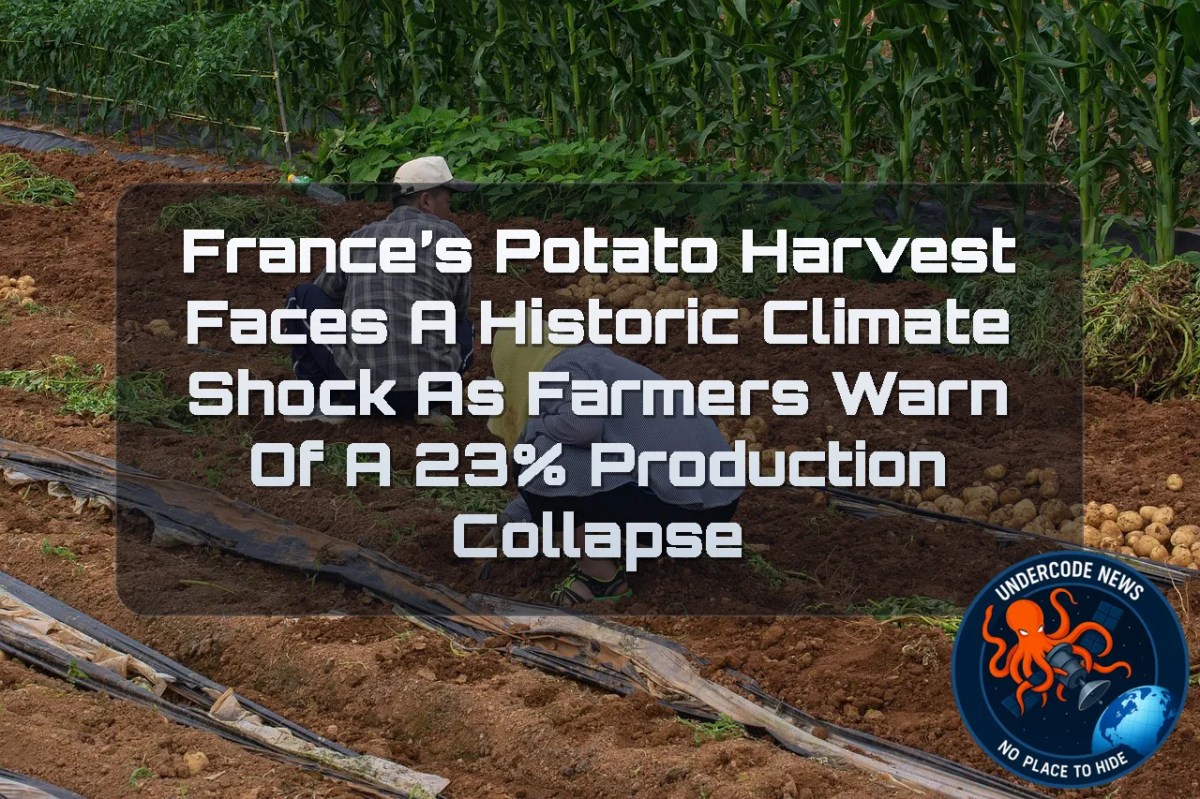
France’s potato industry is approaching one of its most difficult harvests in decades, as repeated heatwaves, severe water shortages and deteriorating growing conditions threaten to turn 2026 into a year of exceptional agricultural losses. Farmers are warning that the problem is no longer simply about smaller harvests. For many producers, the crisis could affect their ability to fulfil contracts, protect their incomes and keep their businesses economically viable.
The National Union of Potato Producers (UNPT) estimates that French potato production could fall by around 23% compared with 2025. Average yields for table potatoes are expected to reach only about 37.4 tonnes per hectare, down sharply from 43.5 tonnes per hectare in 2025. The organisation describes the expected result as potentially the lowest yield in more than 30 years.
From Record Production to a Climate Crisis
The scale of the reversal is striking because French potato production entered 2026 after an exceptionally strong previous season. In 2025, conservation potato production was estimated at around 8.5 million tonnes, supported by record planting levels and roughly 197,000 hectares devoted to the crop.
But the agricultural picture changed dramatically this year. French potato acreage was already reduced by about 9.7% in 2026, with the UNPT estimating around 173,415 hectares planted for conservation potatoes compared with 192,099 hectares in 2025. At the time, the organisation warned that it was too early to determine the final production potential, particularly because water deficits and extreme heat could severely affect yields.
Five Heatwaves and Months Without Enough Water
The weather has now become the dominant threat. According to the latest reporting, France has experienced five heatwaves alongside months of severe drought and exceptional water deficits. The combination has left many potato fields struggling during crucial stages of crop development.
Potatoes require adequate water to develop their tubers properly. When plants face prolonged heat and insufficient moisture, the result can be smaller potatoes, reduced yields and deterioration in quality. The UNPT says growers are already seeing losses in yield and calibre, accelerated crop ageing and increasing uncertainty over whether contracted volumes can be delivered.
A Yield Collapse That Could Reshape the Season
The expected yield of 37.4 tonnes per hectare is particularly alarming when placed beside the 43.5 tonnes recorded in 2025. That represents a decline of more than 14% in yield alone, before accounting for the reduction in cultivated area.
The significance goes beyond a single disappointing season. The UNPT says the expected yield would represent the lowest level observed for more than three decades, and could be worse than the decline experienced during the historic 2022 drought.
Farmers Face a Double Financial Blow
For growers, a smaller harvest does not automatically mean higher profits. In fact, the opposite can happen when production costs remain high while the amount of marketable produce falls.
Farmers still have to pay for land, machinery, fuel, fertiliser, seed potatoes, labour, irrigation and other inputs even when drought reduces the crop. The UNPT has previously warned that potato production costs have continued rising, with the cost of establishing an average hectare substantially higher than for many traditional crops.
Contracts Are Becoming a Major Problem
One of the most immediate concerns is contractual. Potato growers supplying processors often agree to deliver specific quantities. A severe climate shock can make those commitments extremely difficult to meet.
The UNPT is therefore calling for contracted volumes to be adjusted to reflect the actual harvest. Without flexibility, farmers could potentially face the painful combination of producing less while still being expected to honour commitments based on conditions that existed before the drought intensified.
Why the Timing Matters
The timing of the drought is critical. Potato plants need favourable conditions not only when they are planted but throughout the period in which tubers develop and expand.
When extreme heat arrives repeatedly and rainfall fails to replenish soil moisture, plants can mature prematurely. This leaves farmers with crops that may be harvested earlier than expected but with lower yields and more uneven sizes.
That makes the 2026 crisis more complicated than simply saying France has received less rain. It is a combination of water availability, temperature extremes, crop development, quality and harvest logistics.
The Crisis Is Also a Market Problem
There is another layer to the story: French potato farmers were already dealing with difficult market conditions before the climate crisis intensified.
The 2025 season produced exceptionally large volumes. The UNPT had warned that production growth could become disconnected from market demand, while the European potato sector was also dealing with difficult commercial conditions.
That means growers entered 2026 with an agricultural market that was already under pressure. They then reduced planting, only to face an extreme weather event capable of cutting production much more severely than expected.
Europe Is Facing the Same Structural Pressure
France is not isolated from the wider European potato market. The UNPT reported in June that potato-growing areas across the main countries of the North-West European Potato Growers region were expected to decline by roughly 11% in 2026.
Belgium’s area was estimated to fall by 16.6%, the Netherlands by 15.1% and France by 9.7%, with Germany also expected to reduce acreage.
This matters because European processors and food companies operate across borders. A poor harvest in several major producing countries at the same time can have effects on supply, prices, processing capacity and international trade.
The French Potato Industry Is Being Squeezed From Both Sides
The 2026 situation therefore creates an unusual contradiction. Farmers planted fewer potatoes because the market had become difficult, but now weather conditions threaten to reduce production even further.
This could tighten supply just as processors are trying to manage their own contractual and production commitments. The result could be a far more volatile market than the one producers experienced during the previous season.
Smaller Potatoes Could Become a Bigger Issue
Total tonnage is only one part of the problem. Potato quality and size are equally important, particularly for processors that require specific characteristics for products such as frozen fries and other processed foods.
The UNPT says growers are facing problems with calibre and quality in addition to yield losses. That means the usable commercial output could be affected more severely than a simple production percentage suggests.
Harvesting Could Become More Difficult
Dry conditions can also create practical problems when farmers eventually bring machinery into the fields.
The UNPT has warned of difficulties associated with lifting crops, alongside accelerated crop ageing. If soil conditions become too hard or crops deteriorate before harvest, farmers can face additional operational costs and greater losses during harvesting.
Why Government Support Is Becoming Central
The UNPT argues that the economic consequences of this exceptional season cannot be absorbed entirely by individual farmers. The organisation is seeking recognition of the exceptional nature of the 2026 campaign and measures designed to protect producers from the financial and contractual consequences.
Farmers are also asking the French government to engage with European partners. That request reflects the fact that the potato market does not stop at France’s borders.
A Crisis Bigger Than One Crop
The French potato story is becoming another example of how climate volatility can transform agricultural economics.
A farmer can make a decision based on planting conditions, expected prices and contractual commitments, only to see the underlying assumptions destroyed by several months of extreme weather.
This makes agriculture increasingly difficult to manage through traditional forecasting alone. Historical averages become less reliable when extreme events occur more frequently or with greater intensity.
The 2022 Drought Still Casts a Long Shadow
French farmers have a recent reminder of how damaging drought can become. The 2022 season was already considered a historic agricultural shock for potatoes.
The current projections are particularly concerning because the UNPT believes the expected decline could be even more severe than the 2022 downturn.
That comparison gives the 2026 harvest a significance that goes beyond normal seasonal variation.
The Contradiction of 2025 and 2026
Perhaps the most revealing aspect of the crisis is how quickly the industry’s position has changed.
In 2025, France was moving toward record potato production. By 2026, farmers were cutting planting areas and then confronting drought conditions capable of producing one of the weakest yields in decades.
This rapid reversal demonstrates how vulnerable agricultural supply chains can be when production decisions are made months before the final growing conditions are known.
Consumers Could Eventually Feel the Effects
Consumers may not immediately notice the consequences of the French potato crisis. Existing stocks, imports and supply-chain adjustments can temporarily absorb shortages.
But if production remains weak and quality problems become widespread, pressure could eventually move through processors, wholesalers, retailers and food-service businesses.
The effect may be especially visible in products that rely heavily on potatoes as a raw material, including processed and frozen products.
Processors Are Also Facing a Difficult Balancing Act
Food processors need reliable volumes and predictable quality. Farmers need contracts that reflect real production risks.
When a climate event sharply reduces harvest potential, both sides can find themselves exposed.
The immediate challenge will be finding a way to distribute the losses without destroying the economic viability of the producers who are responsible for growing the crop.
The Contract Model May Need to Change
The 2026 crisis could intensify the debate over agricultural contracts.
Contracts provide stability, but extreme weather exposes a weakness when fixed quantities are agreed months before the crop is harvested. If climate variability becomes more severe, contracts may need stronger mechanisms for exceptional weather events.
That could include clearer force-majeure provisions, flexible volumes, risk-sharing mechanisms or insurance arrangements capable of responding more effectively to extreme climate conditions.
France’s Potato Industry Was Already Under Pressure
This crisis did not emerge from nowhere. The UNPT warned earlier in 2026 about difficult contract conditions and a reduction in contracted volumes in the processing sector. In some cases, the organisation said the reduction could reach 20% per hectare.
That means producers were already navigating commercial uncertainty when the weather shock arrived.
Climate Risk Is Becoming an Economic Risk
For decades, discussions about drought and heat often focused primarily on agricultural output.
Today, the consequences are much broader. A drought can affect farm revenue, processor supply, food prices, exports, employment, investment and regional economies.
The French potato crisis demonstrates this chain reaction clearly.
Irrigation Cannot Solve Everything
Irrigation can reduce the impact of drought, but it cannot automatically eliminate the problem.
Water restrictions can limit availability precisely when farmers need it most. The UNPT has specifically cited irrigation restrictions as part of the exceptional conditions affecting producers during the 2026 campaign.
This means future resilience will require more than simply installing additional irrigation equipment.
The Industry Needs Better Climate Adaptation
Long-term resilience could involve changes in varieties, planting strategies, soil management, water storage, irrigation efficiency and crop monitoring.
Farmers may increasingly need varieties that can tolerate heat and water stress while still meeting the quality standards required by processors.
Technology can also play a greater role by helping growers monitor soil moisture, crop development and weather risks more precisely.
France Is Facing a Warning About Food Security
Potatoes may not attract the same political attention as wheat or maize, but they are an important part of the European food system.
A sharp production decline in a major producing country demonstrates how climate instability can affect crops that consumers normally take for granted.
The lesson is not that France will run out of potatoes. The more important lesson is that reliable food supply depends on increasingly fragile environmental conditions.
The Market Could Turn From Surplus to Tight Supply
The contrast between the previous season’s surplus concerns and today’s production fears is particularly important.
A market suffering from excess supply can quickly become tight when a major weather event destroys part of the expected harvest. This can produce significant price volatility.
However, higher prices would not necessarily solve the farmers’ problems. If yields collapse enough, additional revenue per tonne may fail to compensate for the loss of physical production.
Farmers Need Stability, Not Just Higher Prices
The
Farmers need predictable contracts, workable risk-sharing mechanisms, access to emergency support and a commercial environment that recognizes the increasing cost of climate risk.
Without those protections, repeated extreme weather events could encourage farmers to abandon crops that become too risky to grow.
The Risk of Losing Production Capacity
This is one of the most important long-term concerns.
If farmers repeatedly experience seasons where production costs remain high while yields become increasingly unpredictable, some may reduce their potato acreage permanently.
That could create a feedback loop: fewer growers, less production capacity, greater dependence on imports and increased vulnerability when another climate shock occurs.
Europe’s Food Industry Cannot Ignore This Signal
The French situation should also matter to European processors and retailers.
Potato production is deeply interconnected across countries, and simultaneous reductions in planted area and yields can quickly alter the regional balance between supply and demand.
The European sector therefore has a strong incentive to improve coordination between growers, processors and policymakers.
The 2026 Harvest Is Not Yet the Final Verdict
Despite the alarming projections, it is important to remember that the final outcome will only become clear as harvesting progresses.
The UNPT itself has emphasized that field monitoring remains essential and that yield and quality estimates need to be refined as the crop approaches harvest.
The 23% figure should therefore be treated as a serious projection rather than a final audited production number.
What Happens Next Will Matter More Than the Headline
The most important question is no longer whether French potato growers are facing a difficult year. They clearly are.
The bigger question is how the industry responds.
If contracts are adjusted, emergency support is provided and processors cooperate with farmers, the sector may be able to absorb the shock without permanent damage.
If producers are left to carry the entire burden, the consequences could extend well beyond the 2026 harvest.
Deep Analysis
Climate Volatility Is Changing Agricultural Economics
The French potato crisis shows that climate change is not simply a question of temperature records. It changes the economics of farming by increasing uncertainty around production, costs and contractual commitments.
A 23% Decline Is More Serious Than It Looks
A 23% year-on-year production decline would represent a major disruption for a country with a large processing and fresh-potato industry. The effect becomes even stronger when combined with a reduction in planted area.
Yield Is the Critical Number
The move from 43.5 tonnes per hectare to 37.4 tonnes per hectare demonstrates that the problem is not only acreage. The land that was planted is also producing substantially less.
The Industry Was Already Vulnerable
French potato growers entered 2026 after a difficult commercial period, meaning the drought arrived when many farms were already under economic pressure.
Record Production Created Its Own Problems
The exceptional 2025 harvest contributed to market imbalances, demonstrating that agricultural success can sometimes create the conditions for future financial stress when supply expands faster than demand.
Farmers Cannot Control the Weather
Growers can change varieties, planting dates and irrigation strategies, but they cannot control prolonged heatwaves or regional water shortages.
Contracts Need Climate Flexibility
Fixed-volume agreements become increasingly difficult to manage when weather volatility increases. The industry may need more sophisticated contractual mechanisms for extreme events.
Processors Have a Stake in Farmer Survival
Food processors depend on growers. If farm profitability deteriorates for too long, processors could eventually face a smaller and less reliable supplier base.
Climate Risk Can Become Supply-Chain Risk
A drought in the field can eventually become a problem for factories, retailers, restaurants and consumers.
Quality Matters as Much as Quantity
Smaller or lower-quality potatoes may be unsuitable for some processing requirements, meaning the commercially usable harvest could be weaker than the headline production estimate.
Europe Adds Another Layer of Risk
Because several European potato-producing countries are reducing acreage, France cannot necessarily rely on abundant neighbouring supplies if its own harvest falls sharply.
Water Management Will Become More Important
The crisis reinforces the importance of efficient irrigation, water storage and soil-management strategies that preserve moisture during increasingly hot summers.
But Irrigation Has Limits
Water restrictions demonstrate that irrigation infrastructure cannot guarantee production when the available resource itself becomes scarce.
Crop Breeding Could Become Strategic
Heat- and drought-tolerant potato varieties could become increasingly valuable if extreme weather becomes a recurring feature of European agriculture.
Technology Can Reduce Uncertainty
Satellite monitoring, field sensors, weather forecasting and precision agriculture could help growers make better decisions about water and crop management.
Insurance May Become More Important
As climate losses become more severe, agricultural insurance and other risk-sharing mechanisms could become central to maintaining farm viability.
Emergency Support Is Only a Short-Term Solution
Government assistance can help farmers survive an exceptional year, but it cannot replace long-term adaptation of the agricultural system.
The Market Could Become More Volatile
A combination of reduced acreage and severe drought increases the possibility of sharper price movements than producers experienced during the previous surplus period.
Higher Prices Are Not Automatically Good News
If production falls too far, higher prices may not compensate farmers for the lost tonnage and additional costs associated with drought.
Farmers Could Change Their Cropping Decisions
Repeated climate shocks may push producers toward crops perceived as less risky, potentially reducing long-term potato-growing capacity.
That Could Create a Structural Shortage
If acreage declines while demand remains stable, the market could eventually move from today’s concerns about oversupply toward recurring shortages.
Consumers Are Part of the Equation
Retailers and food companies may eventually have to adapt to higher raw-material costs and more variable availability.
The French Case Has European Significance
France is one of
2026 Could Become a Turning Point
The combination of reduced planting, extreme drought and severe yield pressure could force the sector to rethink how it manages production risk.
The Real Crisis Is Uncertainty
Farmers can plan around a known bad year. It is much harder to plan around increasingly unpredictable swings between surplus and shortage.
Climate Data Must Become Part of Commercial Planning
Production forecasts should increasingly incorporate not only historical yields but also real-time weather, water availability and crop-health indicators.
Processors May Need More Flexible Procurement
Companies relying on fixed volumes could benefit from contracts designed around realistic ranges rather than rigid expectations under extreme conditions.
Governments Face a Difficult Balance
Authorities must support farmers without creating incentives that encourage unsustainable production decisions or excessive dependence on emergency aid.
The Sector Needs Cooperation
Growers, processors, retailers, insurers and governments all have different interests, but the long-term health of the potato industry requires them to share more of the climate risk.
The 2026 Harvest Will Provide Valuable Data
The final harvest results will help determine how severe the damage actually was and whether current projections underestimated or overestimated the climate impact.
The Bigger Lesson Is Already Clear
France’s potato crisis demonstrates that extreme weather can erase the assumptions behind an entire agricultural season in a matter of months.
Resilience Will Become a Competitive Advantage
Farmers and companies that adapt faster to water scarcity, heat and market volatility may be better positioned to survive future disruptions.
The Potato May Be a Small Symbol of a Bigger Problem
What is happening in French potato fields reflects a much wider challenge facing European agriculture: producing affordable food in a climate that is becoming harder to predict.
What Undercode Says:
The Real Story Is Bigger Than a Potato Shortage
The French potato crisis should not be viewed simply as another bad harvest. It is a warning about how quickly climate stress can move from the field into contracts, markets and household food systems.
The Timing Makes the Crisis Worse
The industry had already experienced a difficult commercial environment after the exceptional 2025 harvest. The arrival of severe drought therefore creates a second shock at precisely the wrong moment.
The 23% Figure Deserves Attention
A projected 23% production decline is large enough to influence the economics of the entire sector, although the final number will depend on harvest results.
The 37.4-Tonne Yield Is the Key Indicator
The projected yield tells us that the crisis is not simply caused by farmers planting fewer hectares. The productivity of the remaining fields has also been heavily damaged.
The Contract Problem Could Become the Most Immediate Threat
A farmer who cannot physically produce the contracted volume cannot solve the problem simply by working harder. Extreme weather creates a situation where commercial rules may need to accommodate agricultural reality.
France Is Experiencing a New Kind of Agricultural Risk
The old model assumed that weather variations could largely be absorbed within normal seasonal ranges. Increasingly extreme conditions challenge that assumption.
The Industry Cannot Keep Treating Every Crisis as Exceptional
If droughts and heatwaves become more frequent, emergency measures cannot remain the only response. Adaptation has to become part of normal agricultural planning.
Water Will Become an Economic Asset
The ability to access and manage water could increasingly influence which crops farmers can grow profitably and where production remains economically sustainable.
The 2025 Surplus and 2026 Shortfall Tell the Same Story
At first glance, the two seasons look completely different. Economically, however, they reveal the same vulnerability: farmers are exposed to major changes that they cannot control.
Market Forecasting Needs to Improve
Better forecasting will be essential because planting decisions are made long before farmers know whether the summer will bring ordinary weather or an extreme climate event.
The European Dimension Cannot Be Ignored
France’s problems are occurring alongside reductions in potato acreage elsewhere in Europe. That could make regional supply adjustments more difficult.
The Processing Industry Faces Its Own Risk
Processors require consistent raw materials. If extreme weather becomes more common, factories may have to rethink sourcing strategies and inventory planning.
Farmers Need Risk-Sharing Mechanisms
The financial consequences of extreme weather should not automatically fall on one side of the supply chain. More balanced risk-sharing could strengthen the industry.
The Consumer Impact May Come Later
Consumers may not see immediate shortages, but supply-chain pressure can eventually appear through higher prices, product reformulation or increased imports.
Food Security Is Becoming a Climate Issue
The French example reinforces a broader point: food security depends not only on agricultural land and technology but also on reliable climatic conditions.
Adaptation Is No Longer Optional
Better irrigation, soil management, crop varieties and forecasting are increasingly becoming necessities rather than optional improvements.
The Industry Should Learn From 2026
The final harvest numbers should be used to determine exactly which regions, varieties and farming systems proved most resilient.
Government Policy Will Matter
Public authorities can influence the sector through water policy, agricultural support, insurance frameworks, research funding and emergency assistance.
Farmers Also Need Commercial Predictability
Climate resilience will not work if growers simultaneously face unstable contracts and weak profitability.
The Potato Market Could Become More Volatile
A sequence of surplus and drought conditions could produce larger price swings, making long-term planning more difficult for everyone involved.
The Biggest Danger Is Producer Exit
If farming potatoes becomes too risky, some producers may leave the sector permanently. That would reduce domestic production capacity even after weather conditions improve.
Supply Chains Need More Flexibility
Businesses that depend on a single production region or rigid purchasing arrangements could become increasingly vulnerable to local climate disasters.
Europe Needs Better Coordination
Cross-border cooperation could become increasingly important as climate shocks affect multiple producing regions simultaneously.
The 2026 Crisis Should Be Treated as a Warning
Even if the final harvest proves less severe than the current projection, the underlying risks will remain.
Weather Extremes Are Becoming Commercial Variables
Heat, rainfall and water availability now need to be considered alongside prices, demand and production costs when agricultural decisions are made.
The Industry Has an Opportunity
A crisis can force changes that ultimately create a stronger and more resilient sector if producers and buyers use the experience to redesign how risk is managed.
France Can Still Adapt
The situation is serious, but it is not a reason to assume that French potato production has no future. Adaptation, investment and better risk-sharing can make the sector more resilient.
The Next Few Months Will Be Critical
The harvest itself will determine how much of the projected production loss becomes reality and how severely quality and contractual obligations are affected.
The Real Test Will Come After Harvest
The industry will ultimately be judged not only by how it survives 2026 but by whether it learns from the season and prepares differently for the next extreme weather event.
Undercode’s Bottom Line
France’s potato crisis is a warning that climate volatility is becoming an economic force. The projected 23% production decline, falling yields and contractual pressures show how quickly extreme weather can threaten an entire agricultural chain. The solution cannot be limited to emergency financial support. France and Europe will need better water management, stronger climate adaptation, more flexible contracts and a fairer distribution of agricultural risk.
✅ The UNPT has publicly warned in August 2026 that persistent drought, repeated heatwaves and irrigation restrictions are causing yield, size and quality problems for French potato growers.
✅ The figures of approximately 37.4 tonnes per hectare in 2026 versus 43.5 tonnes per hectare in 2025, along with the projected 23% production decline, are consistent with current reporting based on UNPT assessments.
❌ The 23% decline should not yet be treated as the final audited harvest result. The UNPT has emphasized that field monitoring and harvesting are still necessary to refine production and yield estimates.
Prediction
(+1) If the harvest confirms the current projections, French potato supplies will likely tighten significantly, increasing pressure on processors and potentially supporting higher prices later in the season.
(+1) The crisis is likely to accelerate investment in drought-resistant varieties, precision irrigation, soil-moisture management and more sophisticated agricultural forecasting.
(+1) French policymakers and European agricultural organisations are likely to face stronger pressure to create more flexible mechanisms for exceptional climate-related production failures.
(-1) If extreme heat and water shortages continue into future growing seasons without major adaptation, repeated yield shocks could make potato production less economically attractive for some French farmers.
(-1) Producers who face both weak contractual conditions and repeated climate losses could reduce potato acreage further, potentially creating a longer-term supply problem for processors.
(+1) The strongest long-term outcome could be a more resilient French potato industry, but only if the lessons of the 2026 crisis lead to structural changes rather than another cycle of emergency assistance followed by a return to business as usual.
▶️ Related Video (76% Match):
🕵️📝Let’s dive deep and fact‑check.
🎓 Live Courses & Certifications:
Join Undercode Academy for Verified Certifications
🚀 Request a Custom Project:
Secure, high-velocity infrastructure and disruptive technological engineering. Contact our engineering team for high-tier development and proprietary systems:
[email protected]
💎 Smart Architecture | 🛡️ Secure by Design | ⭐ Trusted by Thousands
References:
Reported By: www.euronews.com
Extra Source Hub (Possible Sources for article):
https://www.digitaltrends.com
Wikipedia
OpenAi & Undercode AI
Image Source:
Unsplash
Undercode AI DI v2
🔐JOIN OUR CYBER WORLD [ CVE News • HackMonitor • UndercodeNews ]
📢 Follow UndercodeNews & Stay Tuned:
𝕏 formerly Twitter 🐦 | @ Threads | 🔗 Linkedin | 🦋BlueSky | 🐘Mastodon | 📺Youtube


