
Listen to this Post
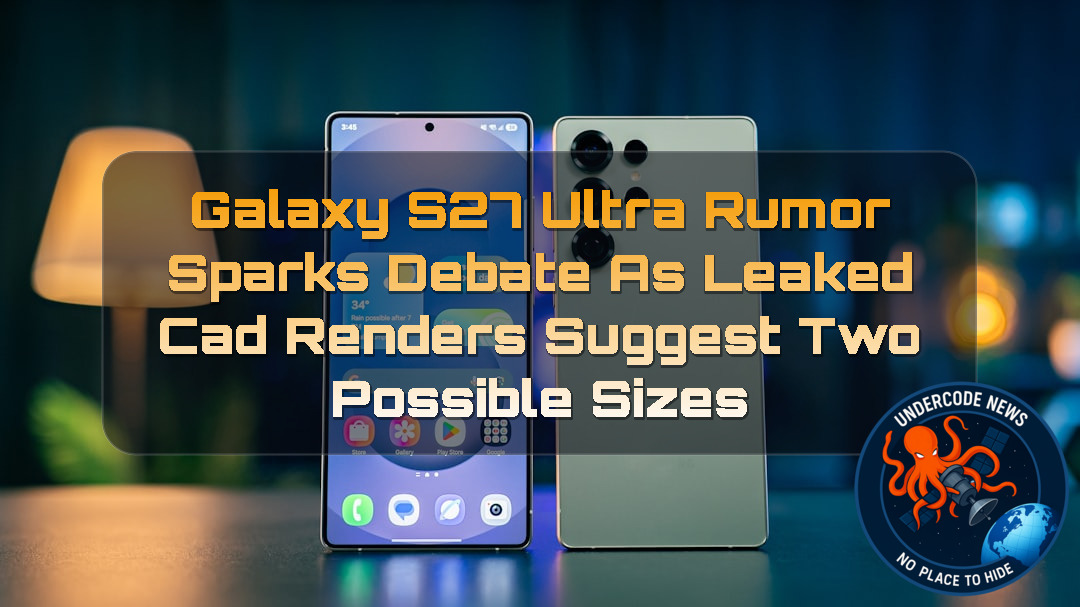 A New Leak Has Turned Samsung’s Next Ultra Flagship Into a Mystery
Samsung’s Galaxy S27 Ultra may still be far from its expected launch, yet the rumor cycle surrounding the company’s future flagship has already begun to accelerate. A newly circulated set of purported CAD renders has sparked fresh speculation about the device’s possible design, its camera layout, and, more surprisingly, the possibility that Samsung could release the Galaxy S27 Ultra in two different sizes.
The images, shared online by Sonny Dickson, appear to show multiple versions of what is claimed to be Samsung’s future Ultra smartphone. The renders immediately attracted attention because of their apparent size differences and because the camera area seems visually different from the design language Samsung has used on recent Galaxy Ultra devices.
Some observers have gone even further, suggesting that Samsung may be preparing to introduce two Galaxy S27 Ultra models distinguished primarily by their physical dimensions.
It is an interesting theory. It is also, at this stage, a theory built on extremely limited evidence.
The Galaxy S27 Ultra remains a distant product, and leaked CAD renders, particularly this early in a product cycle, should never be treated as final confirmation of Samsung’s plans. Still, the discussion reveals something important about the smartphone industry in 2026: flagship design is becoming increasingly difficult to predict, and even a single unexplained difference in a leaked render can trigger speculation about an entirely new product strategy.
The Original Report in Summary
The original report focuses on purported CAD renders of the Samsung Galaxy S27 Ultra that recently appeared online.
The leaked images are said to show a possible design for the future flagship, including a camera section that some observers believe bears similarities to the visual style associated with Apple’s iPhone Pro lineup.
More importantly, the renders appear to exist in different physical sizes. This has led to speculation that Samsung could launch the Galaxy S27 Ultra in two separate size variants.
The source of the speculation is Sonny Dickson, who shared the CAD renders and suggested that Samsung may be planning to offer the Galaxy S27 Ultra in two sizes.
However, there is currently no substantial evidence confirming that the images represent an authentic final Samsung design. There is also no reliable confirmation that Samsung intends to split the Ultra model into two size categories.
The original report argues that such a move would be difficult to justify because Samsung’s flagship lineup already provides consumers with several choices. Introducing another Ultra variant could make the product portfolio more confusing rather than more useful.
For now, the safest conclusion is simple: the Galaxy S27 Ultra rumor is generating attention, but the available evidence is not enough to confirm Samsung’s plans.
The CAD Render Leak That Started the Conversation
CAD leaks have become a familiar part of the modern smartphone industry.
Accessory manufacturers often need information about a
This is why CAD-based leaks can sometimes provide valuable clues.
At the same time, not every CAD file circulating online represents a final production device.
A render can be based on an early prototype.
It can represent an abandoned design.
It can contain inaccurate dimensions.
It can also be created from incomplete information or assumptions.
That distinction is especially important in the case of the Galaxy S27 Ultra. The phone is still expected to be many months away, leaving plenty of time for Samsung’s engineering teams to modify the hardware.
A design that appears convincing in August may look completely different by the time Samsung finalizes the device.
The existence of multiple render sizes, therefore, does not automatically mean that Samsung is developing two retail versions of the Galaxy S27 Ultra.
There may be several other explanations.
Could Samsung Really Release Two Galaxy S27 Ultra Sizes?
The idea of two Ultra models is certainly unusual, but it is not completely impossible.
Samsung has repeatedly experimented with different screen sizes and form factors across its broader Galaxy ecosystem. The company already operates one of the most diverse smartphone portfolios in the industry, spanning entry-level devices, mid-range phones, conventional flagships, foldables, and specialized Ultra products.
However, the Ultra branding currently serves a very specific purpose.
It represents the highest-end conventional smartphone in
The Ultra model traditionally brings together the largest display, the most advanced camera hardware, premium materials, and Samsung’s most ambitious software features.
Creating two different Ultra sizes could complicate that identity.
Imagine a Galaxy S27 Ultra with a massive display and another Galaxy S27 Ultra with a significantly smaller body.
Which one would receive the largest battery?
Would both models have identical camera hardware?
Would Samsung reduce features on the smaller version?
Would the smaller model still support every Ultra-exclusive capability?
Those questions demonstrate why the rumor should be approached carefully.
Two different sizes with identical specifications would increase manufacturing complexity.
Two different sizes with different specifications could weaken the meaning of the Ultra name.
Samsung would need a compelling reason to introduce such a strategy.
Samsung Already Has a Crowded Flagship Lineup
One of the strongest arguments against the two-size Ultra theory is Samsung’s existing product structure.
The Galaxy S family already gives customers multiple choices.
Consumers generally choose between a more compact standard model, a larger Plus-style model, and the feature-packed Ultra device.
This approach allows Samsung to target different preferences without creating too much confusion.
A customer who wants a smaller phone can select the standard model.
A customer who wants a larger screen without paying for every premium feature can choose the middle option.
A customer looking for
Adding a second Ultra based primarily on physical size could disrupt this simple hierarchy.
Instead of making the lineup easier to understand, Samsung could create a new question for buyers: which Ultra is the real Ultra?
That is not necessarily impossible to solve, but it would require extremely careful branding.
The Camera Design Is Also Raising Eyebrows
The leaked renders have generated discussion not only because of their apparent size differences but also because of the camera design.
Some observers believe the rear camera area shown in the renders looks visually closer to the style used by Apple’s Pro iPhone models than to Samsung’s recent approach.
Smartphone camera designs are increasingly becoming a major part of brand identity.
For years, Samsung has used prominent individual camera rings on several Galaxy devices. This design language has made Galaxy flagships recognizable from the back even when viewed from a distance.
If Samsung were to move toward a more unified camera bar or a larger camera structure, it could represent a noticeable visual shift.
However, similarities in broad design concepts should not automatically be interpreted as direct copying.
Large camera sensors require space.
Multiple lenses require structural protection.
Advanced optical systems create engineering constraints.
As smartphone hardware becomes more sophisticated, companies may naturally arrive at similar physical solutions.
A rectangular camera island, a raised bar, or a large protective housing can be the result of engineering requirements as much as visual design choices.
Why Early Galaxy S27 Ultra Rumors Should Be Treated Carefully
The smartphone rumor ecosystem moves faster than product development.
A manufacturer may spend years researching a new device while the public begins speculating based on a single image.
That gap creates an environment where early information can quickly become exaggerated.
One leaked render becomes a design confirmation.
A second version of an image becomes a new product model.
An unexplained measurement becomes evidence of a new lineup strategy.
The Galaxy S27 Ultra discussion demonstrates exactly how this process works.
The apparent differences in the renders are interesting.
They deserve analysis.
But analysis is not the same as confirmation.
Until more independent sources provide consistent information, the claim that Samsung will sell the Galaxy S27 Ultra in two sizes should remain speculation rather than established fact.
The difference is important, especially when consumers, investors, accessory makers, and technology enthusiasts are trying to understand Samsung’s future direction.
What Could Explain the Different-Sized Renders?
There are several possible explanations for the apparent differences in the leaked images.
The first possibility is simple scaling.
Images displayed online can be resized, cropped, or presented at different proportions, making two identical devices appear to have different dimensions.
The second possibility is that the CAD material represents multiple development stages.
Samsung may test different physical sizes during the engineering process before selecting a final design.
The third possibility involves regional or internal prototypes.
Large smartphone manufacturers frequently create test hardware that never reaches consumers.
The fourth possibility is that the files represent accessories rather than final retail devices.
A CAD drawing used to design a case or component may contain dimensions that differ from the finished phone.
Finally, the leak itself may simply be inaccurate.
This is why a single source, even one with a history of sharing technology leaks, should not be treated as the final authority on a product that has not yet been officially announced.
A Smaller Ultra Could Still Have an Audience
Despite the skepticism surrounding the rumor, the concept itself is worth discussing.
There is a significant group of smartphone users who want flagship performance without an enormous device.
Modern Ultra phones are powerful, but they are also physically large.
For some users, this creates a dilemma.
They want the best camera.
They want the fastest processor.
They want premium materials.
They want advanced artificial intelligence features.
But they do not necessarily want a phone that dominates their pocket.
A smaller Galaxy S27 Ultra could theoretically address this problem.
Samsung could create a more compact flagship while retaining the best camera system and high-end hardware.
The challenge would be engineering.
A smaller body provides less room for a large battery.
Thermal management becomes more difficult.
Large camera sensors require physical space.
The S Pen, if retained, would introduce another space requirement.
As a result, creating a compact Ultra without significant compromises could be difficult and expensive.
The Business Case for a Second Ultra Model
From a business perspective, Samsung would need to consider more than consumer interest.
Every additional model increases complexity.
More components must be sourced.
More production lines may be required.
Inventory becomes more difficult to manage.
Marketing costs can increase.
Retailers must explain another product to customers.
Software testing may also become more complicated.
A second Ultra could increase sales, but only if it attracts customers who would not otherwise purchase another Galaxy S model.
If most customers simply moved from one Ultra to another, Samsung could create additional complexity without significantly expanding its overall market.
This is why product segmentation is so important.
The best product lineups give customers meaningful choices.
Too many similar devices can produce the opposite effect.
Instead of freedom, consumers experience decision fatigue.
Samsung’s Future Flagship Strategy Could Be Changing
Even if the two-size Galaxy S27 Ultra rumor ultimately proves incorrect, the leak may still point toward a broader question.
Is Samsung preparing to rethink its flagship design strategy?
The company faces increasing pressure from competitors across several markets.
Apple continues to dominate the premium smartphone conversation.
Chinese manufacturers continue to push camera hardware, charging technology, battery capacity, and increasingly aggressive hardware specifications.
Foldable smartphones are also becoming more mature.
Artificial intelligence has introduced another competitive layer, shifting attention away from specifications alone and toward what a smartphone can actually do for its owner.
Samsung may therefore be approaching a period where incremental upgrades are no longer enough to create excitement.
A more significant redesign could help differentiate the Galaxy S27 generation.
That does not mean the current leak is accurate.
It simply means Samsung has strong reasons to explore different ideas.
The Real Galaxy S27 Ultra Story May Be Software and AI
Hardware rumors often receive the most attention because they are easy to visualize.
A new camera bump can be photographed.
A thinner frame can be measured.
A larger display can be compared.
Software is more difficult to leak.
Yet software may become one of the most important parts of Samsung’s next flagship generation.
Artificial intelligence is rapidly changing how users interact with smartphones.
The next stage may involve more personalized assistance, deeper on-device processing, improved image generation, advanced voice interaction, and AI systems that can understand context across applications.
The Galaxy S27 Ultra may therefore be defined by more than its physical dimensions.
The real question could be whether Samsung can create software experiences that justify another generation of premium hardware.
Consumers increasingly ask a difficult question before upgrading.
What can this new phone do that my current phone cannot?
Samsung will need a strong answer.
The Danger of Building Expectations Too Early
Early leaks create excitement, but they can also create disappointment.
When consumers become attached to a rumored feature, the manufacturer may later be criticized for failing to deliver something it never officially promised.
This phenomenon has become common in the technology industry.
A rumor spreads.
Social media amplifies it.
Concept renders appear.
Expectation becomes accepted as reality.
When the final product arrives, people compare it not only with the previous generation but with an imaginary device created by months of speculation.
Samsung has not publicly confirmed two Galaxy S27 Ultra sizes.
It has not publicly confirmed the leaked camera design.
It has not officially revealed the device.
Until that changes, the rumor should remain exactly what it currently is: an interesting possibility, not a confirmed product roadmap.
What Undercode Say:
The Most Important Detail Is Not the Size, It Is the Evidence
The Galaxy S27 Ultra discussion shows how quickly modern technology rumors can evolve.
One set of CAD renders can trigger an entire narrative about Samsung changing its flagship strategy.
The possibility of two Ultra sizes sounds dramatic.
That is precisely why it spreads so quickly.
But dramatic claims require strong evidence.
At the moment, the evidence publicly discussed around this rumor appears limited.
The difference between possibility and confirmation must remain clear.
A CAD render can reveal useful information.
It cannot automatically reveal
Samsung Would Need a Very Strong Reason to Split the Ultra Brand
The Ultra name already represents
Introducing two sizes could create opportunities.
It could also create confusion.
A compact Ultra would appeal to users who dislike extremely large phones.
That is a real market opportunity.
However, Samsung would need to maintain the defining characteristics of the Ultra experience.
A smaller battery would be a compromise.
Smaller cooling capacity would be a compromise.
Reduced camera hardware would be a compromise.
At some point, a smaller Ultra could begin to resemble a standard flagship with premium branding.
That is the strategic danger.
The Leak Could Represent Development Hardware Instead of a Retail Plan
Smartphone companies rarely develop only one physical concept.
Engineers test alternatives.
Designers experiment with proportions.
Component suppliers produce early samples.
Some prototypes survive.
Others disappear forever.
Therefore, multiple sizes in leaked material may represent experimentation rather than a final product family.
This possibility deserves more attention than it usually receives on social media.
A development process is not the same thing as a launch roadmap.
The Camera Design Debate May Be More Important Than It Looks
If Samsung changes the visual structure of the rear cameras, the company could be preparing a broader design reset.
Samsung’s recent flagship identity has been strongly connected to individual camera rings.
A unified camera structure would immediately change the visual personality of the device.
The important question is whether the change would be cosmetic or functional.
Larger sensors may require additional internal space.
Advanced telephoto systems may require stronger structural protection.
New imaging hardware could force Samsung to redesign the entire upper section of the phone.
A new camera layout could therefore indicate a hardware evolution rather than simply a new appearance.
Apple Comparisons Should Not Dominate the Discussion
Every major smartphone design eventually gets compared with a competitor.
That is unavoidable.
However, visual similarity does not prove that one company copied another.
The engineering requirements of modern smartphones are becoming increasingly restrictive.
Large sensors need room.
Lenses need protection.
Wireless charging components require space.
Thin bodies limit internal architecture.
Different manufacturers may arrive at similar external solutions.
The real comparison should focus on implementation.
How well does the camera system perform?
How durable is the design?
How efficiently is internal space used?
Those questions matter more than whether a camera shape resembles another phone from a distance.
A Compact Ultra Could Become a Powerful Market Weapon
Samsung has an opportunity if it can solve the engineering challenge.
Many users want flagship features without flagship dimensions.
The market has historically struggled to serve this audience consistently.
A genuinely compact Ultra with uncompromised cameras, battery life, and performance could attract significant attention.
But the word “uncompromised” is the difficult part.
Physics does not disappear because consumers want smaller phones.
Samsung would have to solve battery density, heat, internal layout, and camera space.
That could make a smaller Ultra more expensive to manufacture.
The Rumor Also Reveals a Growing Desire for Better Product Differentiation
Consumers are becoming tired of small annual upgrades.
A slightly faster processor is not always enough.
A slightly brighter display is not always enough.
Another camera improvement may not convince owners of recent flagships to upgrade.
Samsung needs meaningful differentiation.
Two Ultra sizes would certainly create a new talking point.
But a talking point alone is not a strategy.
The product must solve a real consumer problem.
The Galaxy S27 Ultra Will Likely Face Higher Expectations Than Its Predecessors
By the time Samsung introduces its next-generation flagship, AI expectations will likely be even higher.
Users will expect their phones to understand context.
They will expect better photography.
They will expect stronger privacy.
They will expect improved battery life despite increasingly demanding workloads.
The physical design is only one part of that equation.
Samsung’s challenge will be integration.
Hardware, AI, cameras, software, security, and battery efficiency must work together.
The best flagship of the next generation may not simply be the one with the largest specifications.
It may be the one that makes complicated technology feel invisible.
Our Verdict Is Simple
The two-size Galaxy S27 Ultra rumor is interesting.
It is not yet strong enough to be treated as confirmed.
The leaked renders may represent something important.
They may also represent early development material, inaccurate scaling, or incomplete information.
Samsung still has plenty of time to change the device.
The smartest approach is to watch for independent evidence.
If multiple reliable leaks begin showing the same design and the same two-size strategy, the rumor will become much more significant.
Until then, excitement is understandable.
Certainty is not.
The Two Galaxy S27 Ultra Sizes Are Not Officially Confirmed
❌ The available information does not establish that Samsung has officially confirmed two Galaxy S27 Ultra sizes. The idea is based on interpretation of purported CAD renders and online claims.
The CAD Renders Exist, but Their Final Accuracy Is Unverified
✅ Renders shared online have generated the speculation, but the existence of leaked imagery does not prove that the design represents the final retail Galaxy S27 Ultra.
Samsung’s Future Design and Camera Strategy Remain Unconfirmed
❌ There is currently no definitive confirmation that the Galaxy S27 Ultra will use the exact camera design shown in the circulated renders or that it will resemble any specific competing smartphone.
Prediction
(+1) A More Significant Galaxy S27 Ultra Redesign Is Increasingly Plausible
Samsung may use the Galaxy S27 generation to introduce a more noticeable physical redesign, particularly around the camera system, as competition in the premium smartphone market becomes more intense.
Additional leaks are likely to emerge before launch, potentially revealing more consistent information about dimensions, cameras, battery capacity, and Samsung’s AI strategy.
If Samsung seriously tests a compact Ultra concept, the industry could see increased pressure to bring top-tier hardware to smaller smartphones.
(-1) The Two-Size Ultra Theory May Not Survive Future Leaks
The apparent differences in the current CAD renders may eventually be explained by prototype development, image scaling, accessory measurements, or inaccurate information.
Samsung may decide that its existing flagship segmentation is already sufficient and continue with a single Galaxy S27 Ultra model.
Early speculation could disappear entirely once more reliable information about the final device becomes available.
Deep Analysis
How Researchers Can Examine a Purported CAD Leak
A careful technical investigation should begin with file integrity and metadata analysis rather than visual assumptions.
If an original file is available, researchers can calculate a cryptographic hash:
sha256sum galaxy-s27-ultra-render.png
Image metadata can also be inspected:
exiftool galaxy-s27-ultra-render.png
Basic file identification can reveal whether a file matches its claimed format:
file galaxy-s27-ultra-render.png
Researchers can compare image dimensions and technical properties:
identify galaxy-s27-ultra-render.png
For multiple leaked images, hashes can help determine whether files are duplicates or modified versions:
sha256sum .png
A visual comparison can be performed after placing the files into a dedicated analysis directory:
mkdir galaxy_s27_analysis
cp .png galaxy_s27_analysis/
cd galaxy_s27_analysis
Researchers can then record available metadata:
exiftool .png > metadata_report.txt
And search for potentially relevant descriptive fields:
grep -Ei "model|software|date|creator|description" metadata_report.txt
The next step should be dimensional analysis.
If the renders contain reference measurements, researchers can compare relative proportions rather than relying on how large the devices appear on a social media timeline.
A basic workflow for organizing evidence could look like this:
mkdir -p evidence/original evidence/modified evidence/reports
Files can then be documented with hashes:
find evidence/original -type f -exec sha256sum {} \; > evidence/reports/original_hashes.txt
The critical analytical principle is straightforward: do not allow visual excitement to replace evidence.
A CAD leak becomes more credible when independent sources provide matching dimensions.
It becomes even stronger when those dimensions align with accessory manufacturing information.
Confidence increases when multiple unrelated sources converge on the same design.
Until that happens, every interpretation should remain provisional.
The Galaxy S27 Ultra may eventually arrive with a dramatically different design.
Samsung may even experiment with more than one size.
But the current discussion demonstrates why the cybersecurity-style principle of verification also applies to technology leaks: collect the evidence, validate the source, compare independent signals, and only then decide how much confidence the information deserves.
The biggest mistake is not believing a rumor.
The biggest mistake is confusing a possibility with a confirmed reality.
▶️ Related Video (80% Match):
🕵️📝Let’s dive deep and fact‑check.
🎓 Live Courses & Certifications:
Join Undercode Academy for Verified Certifications
🚀 Request a Custom Project:
Secure, high-velocity infrastructure and disruptive technological engineering. Contact our engineering team for high-tier development and proprietary systems:
[email protected]
💎 Smart Architecture | 🛡️ Secure by Design | ⭐ Trusted by Thousands
References:
Reported By: www.sammobile.com
Extra Source Hub (Possible Sources for article):
https://www.facebook.com
Wikipedia
OpenAi & Undercode AI
Image Source:
Unsplash
Undercode AI DI v2
🔐JOIN OUR CYBER WORLD [ CVE News • HackMonitor • UndercodeNews ]
📢 Follow UndercodeNews & Stay Tuned:
𝕏 formerly Twitter 🐦 | @ Threads | 🔗 Linkedin | 🦋BlueSky | 🐘Mastodon | 📺Youtube


