
Listen to this Post
A Dramatic Shift in Colombia’s Migration Policy
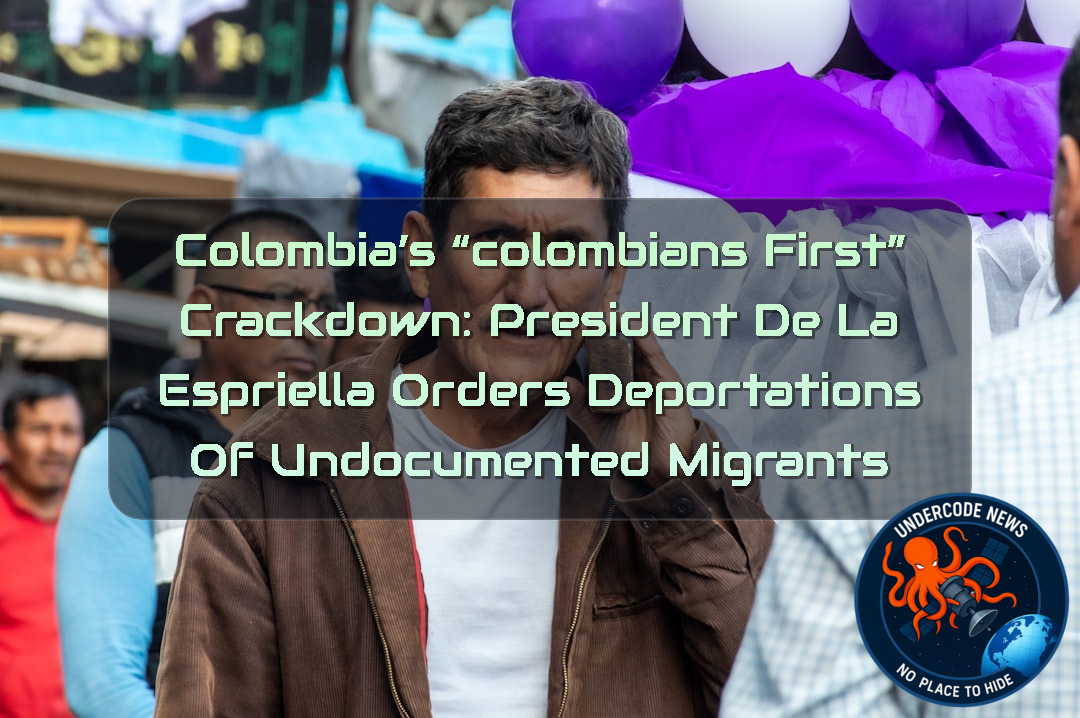
Colombia has entered a new political era, and one of the clearest signs is emerging from the country’s approach to migration. President Abelardo de la Espriella, who took office on August 7, 2026, has ordered authorities to begin operations against migrants living in the country without regular legal status, marking a sharp departure from Colombia’s relatively welcoming approach to Venezuelan migrants over the past decade.
The new president, a nationalist and far-right political figure closely aligned with Donald Trump, has framed the policy as part of a broader campaign to restore security and put Colombian citizens first. During a security meeting in Barranquilla, de la Espriella declared that Colombians would come “first,” echoing the nationalist rhetoric associated with Trump’s “America First” agenda.
The announcement is likely to have its greatest impact on Venezuelans, who make up the overwhelming majority of Colombia’s migrant population. Millions of Venezuelans have crossed the border over the past decade as they escaped political repression, economic collapse and deteriorating living conditions in their homeland. Colombia became one of the principal destinations for that enormous migration wave.
The President’s Order Is Clear
De la Espriella has instructed immigration authorities and police to begin coordinated operations designed to identify migrants who are either involved in criminal activity or living in Colombia without regular documentation.
His stated priority is significant: migrants suspected of crimes are supposed to be targeted first, followed by people whose immigration status has not been regularized. According to reports, deportation procedures are expected to begin during the week of August 25.
The president has presented the policy as both a security measure and an immigration reform. His argument is that Colombia cannot successfully confront organized crime while allowing people who have no legal status to remain outside the formal immigration system.
That framing will likely appeal to Colombians who are frustrated with crime, insecurity and the perception that the government has lost control over parts of the country. But it also creates a difficult question: how much of the security problem is actually caused by undocumented migration, and how much is connected to Colombia’s longstanding armed groups, drug-trafficking networks and criminal organizations?
Venezuela’s Migration Crisis Is at the Center
The scale of Venezuelan migration explains why the announcement is so consequential. Around 2.8 million Venezuelans were living in Colombia according to figures cited by international reporting, with more than 527,000 described as undocumented.
That means the government is not dealing with a small immigration problem. It is confronting a population comparable to that of a major city, much of which has spent years building lives inside Colombia.
Many Venezuelan migrants have children in Colombian schools, jobs in the informal economy, businesses, families and established communities. A mass enforcement campaign therefore has the potential to affect far more than immigration statistics.
It could influence Colombia’s labor market, housing system, healthcare services, border communities and relations with Venezuela.
A Complete Break From the Previous Approach
The most striking aspect of de la Espriella’s announcement is not simply that he wants stronger immigration enforcement. It is how dramatically the policy differs from Colombia’s recent history.
For years, Colombian governments treated Venezuelan migrants largely as people fleeing a humanitarian crisis rather than as a security threat. Colombia created mechanisms that allowed millions of Venezuelans to regularize their status and gain access to legal employment, healthcare and other services.
A temporary protection program introduced in 2021 under then-President Iván Duque was designed to provide Venezuelan migrants with a pathway toward legal status. Colombia ultimately granted temporary residence permits to approximately 2.3 million undocumented Venezuelans through the program.
That approach was unusual in the region. Instead of focusing primarily on deportations, Colombia attempted to bring a massive undocumented population into the legal economy.
De la Espriella’s strategy moves in the opposite direction.
From Regularization to Enforcement
The difference can be summarized in two competing philosophies.
The previous approach essentially argued that undocumented migrants should be brought into the formal system because legalization would make them easier to identify, employ and regulate.
The new government is emphasizing enforcement, deportation and security.
Neither strategy automatically guarantees better results. Regularization can improve government visibility and economic participation, while enforcement can demonstrate that immigration rules are being actively applied.
The critical question is whether Colombia can combine security enforcement with a functioning legal pathway for people who are not criminals but simply lack documentation.
The Crime Argument Faces a Major Test
The president has connected immigration enforcement with his broader campaign against crime. That is politically powerful because insecurity has become one of the defining concerns across Latin America.
Venezuelan criminal groups have also become a major subject of political debate in several countries. Some governments and politicians have argued that criminal organizations made up partly or heavily of Venezuelan nationals have contributed to rising violence.
But there is an important distinction between criminal organizations and an entire migrant population.
Migration status is not evidence of criminality.
Ana Karina García, director of the migrant-support organization Juntos Se Puede, argued that foreigners do not commit crimes at higher rates simply because they are foreigners.
That distinction will become increasingly important as the new policy is implemented.
The Risk of Collective Blame
One of the biggest dangers in a policy like this is allowing the actions of criminal individuals to become justification for treating an entire nationality as a security problem.
The vast majority of Venezuelans living in Colombia are not members of criminal organizations. Many are workers, parents, students, entrepreneurs and refugees who have spent years attempting to rebuild their lives.
A government can legitimately remove a foreign national who commits a serious crime, subject to applicable law and due process. But treating undocumented status itself as evidence of criminal behavior is a much more controversial proposition.
That is why the implementation of the crackdown could matter more than the president’s rhetoric.
What “Colombians First” Really Signals
The phrase “Colombians first” is more than a slogan. It reveals the ideological direction of the new administration.
De la Espriella’s political rise represents a major shift in Colombia. He defeated left-wing candidate Iván Cepeda in the June 2026 presidential runoff and was subsequently confirmed by Colombia’s electoral authorities. He took office for the 2026–2030 term on August 7.
His political platform has emphasized security, a stronger state response to criminal organizations and a significant departure from the policies of outgoing President Gustavo Petro.
Immigration enforcement therefore fits into a much larger political project.
The president is attempting to communicate that Colombia has entered an era of stronger borders, tougher policing and a government more willing to use executive authority against perceived sources of insecurity.
Trump’s Influence Is Impossible to Ignore
The comparison with Donald Trump is particularly striking.
De la Espriella has openly aligned himself with Trump and has adopted rhetoric that resembles the American president’s nationalist messaging. His “Colombians first” statement closely mirrors the political logic behind “America First.”
This does not mean Colombia will simply copy U.S. immigration policy. Colombia has different laws, institutions, geography and migration pressures.
But the political symbolism matters.
A new generation of Latin American conservative leaders is increasingly presenting migration control, crime prevention and national identity as interconnected political issues.
Colombia now appears to be joining that trend.
The Venezuelan Community Is Watching Closely
For Venezuelans living in Colombia, the announcement creates enormous uncertainty.
Someone who has lived in Colombia for years but failed to regularize their status may suddenly face immigration enforcement. Families could be forced to navigate a legal system that they previously believed was moving toward greater inclusion.
The situation may be especially difficult for people working informally, those without complete documentation and people who have limited access to legal assistance.
The government will therefore face pressure to distinguish between different categories of migrants rather than treating every undocumented person as an identical case.
A “Colombian ICE” Debate Emerges
Critics have already compared the proposed enforcement apparatus to the U.S. Immigration and Customs Enforcement model.
Left-wing senator María José Pizarro described the idea as resembling a “Colombian ICE” and accused the government of xenophobia.
The comparison is politically loaded, but it highlights a genuine issue: whether Colombia’s immigration agencies have enough personnel, infrastructure and legal capacity to carry out a major enforcement campaign without producing abuses or administrative chaos.
Reports have also raised concerns about the capacity of Colombia’s immigration authorities to handle such an ambitious operation.
The Difference Between Illegal and Irregular
Language will also matter.
Migrants without valid documentation are commonly described in political rhetoric as “illegal immigrants,” but Colombian immigration law distinguishes between a person being in an irregular immigration situation and committing a criminal offense.
That distinction is essential.
An expired permit is an administrative problem. Participating in organized crime is a criminal matter.
Conflating the two can make immigration policy appear harsher than the legal reality and can create unnecessary fear among migrant communities.
Security vs. Humanitarian Protection
Colombia now faces a difficult balancing act.
The government has a responsibility to protect its citizens from crime. At the same time, migrants have legal rights and, depending on their circumstances, may have humanitarian protections that cannot simply be ignored.
The challenge is especially complicated because Venezuela’s crisis has produced one of the largest displacement movements in the Western Hemisphere.
A successful policy would therefore need to separate criminals from vulnerable migrants rather than treating vulnerability itself as a security threat.
The Economic Dimension
There is also an economic argument that often gets lost in the political debate.
Millions of Venezuelans are already integrated into Colombia’s economy. Some work formally, others operate businesses and many contribute through consumption, rent, taxes and services.
A large-scale deportation campaign could remove workers from industries already dependent on migrant labor.
At the same time, the government could argue that undocumented workers create unfair competition by operating outside the formal labor system.
This is why regularization and enforcement are not necessarily opposites. Bringing migrants into the legal economy can potentially make labor markets easier to monitor while allowing authorities to identify people who genuinely pose security risks.
Border Cities Could Feel the Impact First
The consequences will probably be most visible in cities and regions close to Venezuela.
Border communities have spent years adapting to large-scale migration. Local governments have had to manage healthcare, education, housing, employment and public security pressures generated by the population increase.
A sudden enforcement campaign could change those dynamics almost immediately.
If migrants begin avoiding authorities because they fear deportation, some may also become less willing to report crimes, seek medical care or cooperate with police investigations.
That could unintentionally make certain communities harder for authorities to monitor.
The Policy Could Become a Political Test
De la Espriella has made security one of the central pillars of his presidency.
That means the immigration crackdown will likely become a test of whether his administration can translate aggressive campaign rhetoric into measurable improvements.
If crime falls and authorities successfully remove criminal actors while maintaining legal safeguards, the government could portray the policy as a major victory.
If the crackdown produces humanitarian problems without a noticeable effect on crime, opponents will have a powerful argument that the policy targeted migrants rather than the underlying causes of insecurity.
Colombia’s Bigger Security Problem
Colombia’s security problems did not begin with Venezuelan migration.
The country has decades of experience with guerrilla organizations, paramilitary structures, drug-trafficking networks, criminal gangs and illegal armed groups.
The new president has promised a tougher response to those threats as well.
That context matters because immigration enforcement can only address one narrow part of Colombia’s security challenge.
Even a highly effective deportation program would not eliminate the domestic criminal networks that control territory, traffic drugs, extort businesses and recruit vulnerable young people.
The Danger of a Simple Political Narrative
Politics often rewards simple explanations.
Crime is rising, therefore migration must be responsible.
That argument may be emotionally compelling, but it is not sufficient on its own.
A serious security strategy needs evidence showing which crimes are being committed, by whom, where they are occurring and what factors are driving them.
The government will ultimately need to demonstrate that deportations are producing measurable security benefits rather than simply producing dramatic headlines.
What Undercode Says:
The Real Battle Is About Control
The most important part of this story is not the slogan “Colombians first.” It is the question of whether the Colombian state can regain control over its immigration system without losing control of the legal safeguards that protect migrants.
De la Espriella Is Establishing His Identity
The president is only weeks into his administration, but he is already defining himself as a leader willing to make decisions that previous governments avoided.
Immigration Is Becoming a Security Tool
The new policy demonstrates how immigration is increasingly being incorporated into national-security strategies across Latin America.
Venezuelans Are Likely to Bear the Greatest Pressure
Because Venezuelans make up the overwhelming majority of Colombia’s migrant population, they will inevitably experience the greatest consequences of the crackdown.
The Numbers Explain the Political Impact
With roughly 2.8 million Venezuelans in Colombia, even a policy affecting only undocumented residents could involve hundreds of thousands of people.
Regularization Was Colombia’s Previous Solution
The earlier strategy attempted to turn undocumented migrants into legally recognized residents rather than simply deporting them.
The New Government Is Reversing That Philosophy
De la Espriella appears determined to replace integration-first policies with enforcement-first policies.
Crime Is the Political Justification
The administration is presenting immigration enforcement as part of a wider campaign against criminal groups.
Evidence Will Decide Whether the Strategy Works
The government will eventually need statistics demonstrating whether deportations actually reduce crime.
Criminality Must Not Become a Nationality Test
A Venezuelan migrant involved in organized crime should be treated according to the law, but nationality itself should not become evidence of criminality.
Documentation and Crime Are Different Issues
Someone can be undocumented without being dangerous, just as a citizen can commit serious crimes while being completely documented.
The Government Has a Legitimate Security Responsibility
Colombian authorities have every right to enforce immigration law and protect citizens.
Enforcement Needs Due Process
The credibility of the policy will depend heavily on whether authorities provide lawful procedures for identification, detention, appeals and deportation.
Mass Enforcement Could Produce Unintended Consequences
If vulnerable migrants disappear from official systems, authorities could actually lose visibility over parts of the population they are trying to control.
Fear Can Damage Police Cooperation
Migrants who fear deportation may become reluctant to report crimes or cooperate with investigations.
The Economic Consequences Are Uncertain
Removing large numbers of workers could affect businesses and labor markets in areas with significant Venezuelan populations.
Formalization Could Be More Effective Than Pure Deportation
A system that identifies, registers and legally integrates non-criminal migrants may give authorities more control than leaving people outside the formal system.
Border Regions Face the Greatest Pressure
Cities near Venezuela will likely become the first testing grounds for the new policy.
The International Dimension Matters
Colombia’s treatment of Venezuelans is closely watched by neighboring countries and international organizations.
Trump’s Political Influence Is Visible
De la Espriella’s rhetoric demonstrates how American-style nationalist messaging is influencing political discourse in Colombia.
Latin America Is Moving Toward Harder Security Policies
The Colombian crackdown fits into a broader regional movement toward stronger borders, tougher policing and more aggressive approaches to organized crime.
Colombia Is Different From the United States
Despite rhetorical similarities, Colombia has its own migration crisis, legal framework and relationship with Venezuela.
The Venezuelan Crisis Is Still the Core Problem
As long as political and economic instability continues to push people out of Venezuela, migration pressure on Colombia will remain.
Deportation Cannot Solve the Root Cause
Returning people to Venezuela does not resolve the political and economic conditions that originally drove them to leave.
Security Policy Needs More Than Immigration Control
Drug trafficking, armed groups, extortion and territorial criminal networks remain much larger structural problems.
The President Is Taking a Political Risk
If the policy fails to improve security, critics will argue that the administration chose symbolism over substance.
Success Could Strengthen the Right
If de la Espriella demonstrates measurable security improvements, his approach could become a model for conservative politicians elsewhere in the region.
Failure Could Trigger a Backlash
Humanitarian abuses, administrative chaos or weak crime results could rapidly turn public opinion against the strategy.
The Biggest Question Is Implementation
The announcement is dramatic, but the details of how police and immigration officials actually enforce it will determine its real impact.
Colombia’s Institutions Will Be Tested
Courts, immigration agencies, police forces and local governments will all play important roles in determining whether the policy remains within legal boundaries.
Migrants Are Not a Monolithic Group
The Venezuelan population includes refugees, workers, families, students, entrepreneurs and people with very different immigration circumstances.
One Policy Cannot Treat Everyone the Same
A sophisticated system must distinguish between serious criminals, undocumented workers, asylum seekers, families and people with valid humanitarian claims.
The Political Message Is Already Powerful
Even before the policy produces measurable results, de la Espriella has succeeded in signaling that his government intends to be dramatically tougher on migration.
The Coming Months Will Matter
The first months of implementation will reveal whether this is primarily political messaging or the beginning of a sustained transformation of Colombia’s immigration system.
The Bigger Test Is Security
Ultimately, Colombians will judge the policy based on whether they feel safer.
The Human Cost Cannot Be Ignored
Behind every deportation statistic is an individual or family whose future can change overnight.
Undercode’s Bottom Line
Colombia is entering a new phase in which immigration, national identity and security are becoming tightly connected. De la Espriella’s crackdown may satisfy voters demanding stronger enforcement, but its long-term success will depend on whether his government can target genuine criminal threats without turning undocumented status or nationality into a substitute for evidence.
Deep Analysis: Commands for Understanding the Policy
Command 1 — Separate migration from criminality. The first analytical rule should be simple: undocumented status does not automatically equal criminal behavior.
Command 2 — Follow the numbers. The government should publish transparent figures showing how many people are detained, deported, charged with crimes and successfully prosecuted.
Command 3 — Measure crime before and after enforcement. Without reliable comparisons, it will be impossible to determine whether deportations actually improve public security.
Command 4 — Watch border regions. Changes in crime, employment, housing and migrant movement near Venezuela will reveal the policy’s earliest effects.
Command 5 — Monitor legal challenges. Courts will likely become an important arena for testing the limits of the new enforcement strategy.
Command 6 — Track economic disruption. Large-scale removals could create labor shortages in sectors that depend heavily on migrant workers.
Command 7 — Examine police cooperation. Authorities should monitor whether migrant communities become more or less willing to report crimes.
Command 8 — Watch humanitarian indicators. Families separated, people denied asylum protections or vulnerable migrants returned to dangerous conditions would represent major warning signs.
Command 9 — Compare deportations with criminal prosecutions. A security strategy focused heavily on deportation but producing few criminal prosecutions may indicate that immigration status, rather than criminality, has become the primary target.
Command 10 — Follow public opinion. Colombian voters will ultimately determine whether the policy strengthens or weakens de la Espriella’s political position.
Command 11 — Examine regional influence. If Colombia’s strategy appears successful, neighboring governments may adopt similar measures.
Command 12 — Watch Venezuela’s response. Large-scale deportations could place additional political pressure on Colombia-Venezuela relations.
Command 13 — Measure administrative capacity. Immigration enforcement is only effective if authorities have enough personnel, databases, detention capacity and legal infrastructure.
Command 14 — Distinguish rhetoric from implementation. Political speeches can be dramatic, but operational policy determines real-world consequences.
Command 15 — Watch for mission expansion. A program initially targeting criminals could gradually expand to broader categories of undocumented migrants.
Command 16 — Protect due process. Immigration enforcement should remain subject to Colombia’s constitutional and legal framework.
Command 17 — Evaluate long-term regularization. The government may eventually need a legal pathway for non-criminal migrants who have established deep ties to Colombia.
Command 18 — Watch the labor market. Removing hundreds of thousands of people could have consequences far beyond immigration statistics.
Command 19 — Compare security outcomes. Colombia should compare the effects of deportation with other anti-crime measures instead of assuming that migration enforcement alone will solve insecurity.
Command 20 — Focus on organized crime. The most important security question is whether authorities dismantle criminal networks, not simply whether they remove foreign nationals.
Command 21 — Track Venezuelan integration. Migrants already integrated into Colombian communities may be affected very differently from recent arrivals.
Command 22 — Examine family consequences. Mixed-status families could face particularly difficult decisions if enforcement intensifies.
Command 23 — Watch the language. Political language can influence how citizens perceive entire communities.
Command 24 — Avoid collective punishment. Effective law enforcement should remain focused on individual conduct.
Command 25 — Compare Colombia with other countries. Similar policies elsewhere in Latin America could provide useful evidence about what works and what fails.
Command 26 — Watch the Trump relationship. De la Espriella’s alignment with Trump may influence both his rhetoric and international cooperation.
Command 27 — Measure public safety honestly. If crime does not improve, the government should be held accountable regardless of political ideology.
Command 28 — Track deportation destinations. The safety and legal status of people returned to Venezuela will be an important humanitarian indicator.
Command 29 — Watch local government reactions. Mayors and regional authorities will carry much of the practical burden of the policy.
Command 30 — Examine the cost. Large-scale immigration enforcement can be expensive, and taxpayers will ultimately bear much of that cost.
Command 31 — Follow employment formalization. Migrants who can legally work may become easier for the government to monitor and tax.
Command 32 — Monitor discrimination risks. Enforcement operations should avoid turning nationality or appearance into a proxy for immigration status.
Command 33 — Watch civil society. Human-rights organizations and migrant groups are likely to document the effects of the policy closely.
Command 34 — Examine court decisions. Judicial rulings could determine how aggressively the executive branch can proceed.
Command 35 — Measure political durability. The policy may remain popular only if voters believe it produces tangible security benefits.
Command 36 — Track criminal-group adaptation. Criminal organizations may change recruitment and smuggling strategies in response to stronger immigration enforcement.
Command 37 — Watch migration routes. Stronger enforcement in Colombia could redirect migration toward other countries and border crossings.
Command 38 — Analyze the next policy stage. The initial crackdown could eventually evolve into a broader immigration overhaul.
Command 39 — Judge outcomes, not slogans. “Colombians first” is politically powerful, but measurable results will determine whether the policy deserves to be considered successful.
Command 40 — Keep the human story visible. Behind the political battle are millions of people whose lives depend on decisions made in Bogotá.
✅ Fact: Abelardo de la Espriella is Colombia’s president for the 2026–2030 term. He was officially confirmed as president-elect in June and sworn into office on August 7, 2026.
✅ Fact: De la Espriella has announced an immigration crackdown targeting migrants in irregular status and those suspected of criminal activity, with police and immigration authorities expected to begin operations this week.
✅ Fact: Venezuelans make up the largest migrant population affected by the policy, with international reporting citing roughly 2.8 million Venezuelans in Colombia and more than 527,000 without regular status.
Prediction
(+1) The Colombian government is likely to significantly increase immigration enforcement over the coming months. De la Espriella has made security and national control central themes of his presidency, making a retreat from the policy unlikely in the immediate future.
(+1) The administration will probably prioritize migrants accused or convicted of crimes before expanding enforcement toward broader undocumented populations. This approach gives the government a stronger political and legal argument for the crackdown.
(-1) The policy is likely to generate serious political and humanitarian controversy. Migrant organizations, opposition politicians and human-rights groups are expected to challenge measures they believe unfairly associate Venezuelan migration with criminality.
(-1) A mass deportation campaign is unlikely by itself to solve Colombia’s broader crime problem. Colombia’s security challenges involve deeply established criminal and armed organizations whose operations extend far beyond immigration.
(+1) The policy could nevertheless become one of the defining political symbols of de la Espriella’s presidency. If his administration can demonstrate measurable improvements in security while maintaining legal protections, the crackdown could strengthen his political position and encourage similar policies elsewhere in Latin America.
The decisive test will not be how forcefully the president announces the policy, but whether Colombia becomes safer without sacrificing the legal and humanitarian protections that distinguish criminal enforcement from immigration enforcement.
🕵️📝Let’s dive deep and fact‑check.
🎓 Live Courses & Certifications:
Join Undercode Academy for Verified Certifications
🚀 Request a Custom Project:
Secure, high-velocity infrastructure and disruptive technological engineering. Contact our engineering team for high-tier development and proprietary systems:
[email protected]
💎 Smart Architecture | 🛡️ Secure by Design | ⭐ Trusted by Thousands
References:
Reported By: www.euronews.com
Extra Source Hub (Possible Sources for article):
https://www.discord.com
Wikipedia
OpenAi & Undercode AI
Image Source:
Unsplash
Undercode AI DI v2
🔐JOIN OUR CYBER WORLD [ CVE News • HackMonitor • UndercodeNews ]
📢 Follow UndercodeNews & Stay Tuned:
𝕏 formerly Twitter 🐦 | @ Threads | 🔗 Linkedin | 🦋BlueSky | 🐘Mastodon | 📺Youtube


