
Listen to this Post
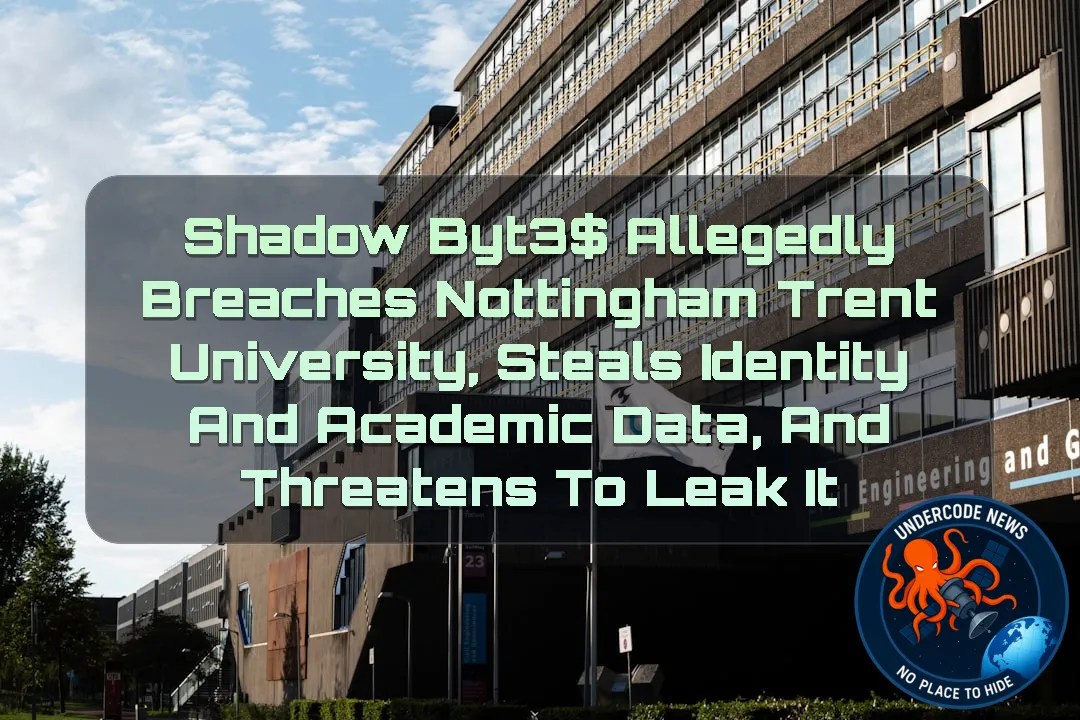 A New Cyberattack Claim Raises Serious Questions About University Security
A disturbing cybersecurity claim circulating on August 25, 2026, alleges that the threat actor known as ShadowByt3$ breached Nottingham Trent University through web application access and obtained sensitive personal and academic information. According to the claim, the allegedly stolen data includes passport information, dates of birth, contact details, addresses, and academic records.
The attacker is also alleged to have locked the victim out of affected systems and threatened to publish the stolen information. At the time of writing, this remains an unverified third-party claim, rather than a confirmed breach announcement from Nottingham Trent University.
The allegation is nevertheless significant because the type of information reportedly targeted goes far beyond ordinary usernames and passwords. Passport details, dates of birth, addresses, and academic records can potentially be combined to create detailed identity profiles, increasing the consequences for individuals if such information is genuinely exposed.
The Alleged Attack on Nottingham Trent University
The claim was posted by the cybersecurity-focused X account Cybersecurity News Everyday, which stated that ShadowByt3$ allegedly gained access through web applications associated with Nottingham Trent University.
According to the post, the attacker supposedly obtained several categories of sensitive information before restricting the victim’s access and threatening to release the stolen material.
No technical evidence, breach notification, database sample, vulnerability identifier, forensic report, or independent confirmation was included in the short social-media post supplied for this report. That distinction is important when evaluating claims involving major organizations.
The Data Allegedly Stolen
The most concerning part of the allegation is the breadth of the information supposedly obtained. The claim specifically mentions passport data, dates of birth, contact information, addresses, and academic records.
Each of these categories can be valuable independently, but the risk becomes considerably greater when they are combined. A passport-related identifier paired with a person’s name, date of birth, address, and educational history can create a highly detailed identity record.
Academic records can also contain information that is not immediately recognized as cybersecurity-sensitive. Course histories, student identifiers, institutional communications, enrollment information, and associated personal details can provide attackers with additional material for impersonation and social engineering.
Why Passport Information Is Particularly Sensitive
Passport information deserves special attention because it is closely associated with identity verification. Although possession of passport information does not automatically allow someone to impersonate another person successfully, leaked identity documents can become useful components in broader fraud attempts.
Attackers may use personal information to construct convincing phishing messages, attempt account recovery, impersonate employees or students, or target other organizations where identity verification relies heavily on personal details.
This is why a university data breach involving identity information can potentially create consequences beyond the university’s own systems.
The Alleged Lockout Adds Another Layer
The claim also says that the attacker locked the victim out after gaining access. If accurate, this could indicate that the incident was not simply a case of unauthorized data access.
Account lockouts can interfere with legitimate users’ ability to access systems, disrupt normal operations, and potentially delay an organization’s response. In a more serious intrusion, attackers may deliberately change credentials, disable accounts, alter permissions, or otherwise attempt to maintain control.
However, without forensic evidence, it is impossible to determine from the supplied claim exactly what “locked out” means or which systems were allegedly affected.
The Threat of Publishing Stolen Data
The reported threat to leak the information is consistent with the broader evolution of cyber extortion.
Modern attackers increasingly understand that stealing data can provide leverage even when encryption is not involved. A criminal does not necessarily need to encrypt an organization’s systems to create pressure. The possibility of publicly releasing sensitive information can itself become an extortion mechanism.
If the alleged data includes passport and identity information, a public leak could create risks for individuals long after the original intrusion has been contained.
Universities Are Attractive Targets
Universities operate unusually complex digital environments. They often support large populations of students, researchers, faculty, contractors, administrators, alumni, and external partners.
That creates an enormous identity and access-management challenge.
A modern university may operate student portals, learning-management systems, admissions platforms, research infrastructure, financial services, staff applications, cloud environments, library systems, authentication platforms, and numerous third-party services.
Every externally accessible application increases the potential attack surface.
The Web Application Attack Surface
The allegation that access was obtained through web applications is particularly relevant.
Web applications are often exposed directly to the internet, making them attractive targets for attackers searching for vulnerabilities in authentication, authorization, session management, APIs, input validation, or account-recovery processes.
A weakness does not always have to be a dramatic zero-day vulnerability. Poor access controls, forgotten legacy applications, exposed administrative interfaces, weak credentials, insecure APIs, and configuration mistakes can all create opportunities.
The Human Layer Remains Critical
Technical vulnerabilities are only part of the equation.
The second cybersecurity post included with the original material highlights another important trend: attackers are increasingly looking at weaknesses in identity verification and account recovery rather than relying exclusively on traditional login bypass techniques.
Service-desk procedures, onboarding processes, password-reset mechanisms, identity checks, and employee verification can become attractive targets because they may provide a path around otherwise strong authentication controls.
Identity Verification Can Become an Attack Surface
An organization can deploy strong passwords, multifactor authentication, endpoint protection, and network monitoring while still maintaining a weak recovery process.
For example, if an attacker can convincingly impersonate a legitimate user and persuade a support employee to reset an account, the attacker may effectively bypass security controls without exploiting a sophisticated software vulnerability.
This makes identity verification an increasingly important part of cybersecurity architecture.
Document Validation and Liveness Checks
The second post referenced document validation and liveness checks as mechanisms that can help strengthen identity verification.
These technologies can make impersonation more difficult by comparing identity documents with biometric or live-user verification signals.
However, they should not be treated as a universal solution. Identity verification needs to be combined with strong authentication, risk-based controls, employee training, logging, anomaly detection, and carefully designed recovery procedures.
The Potential Role of Social Engineering
The alleged Nottingham Trent University incident also illustrates why social engineering should remain part of the threat model.
An attacker who obtains personal information can use it to make subsequent communications appear more credible. Knowing someone’s name, address, academic background, institution, or other identifying details can make phishing messages substantially more convincing.
This creates a dangerous feedback loop: one breach can provide information that helps facilitate another attack.
A Single Record Can Become a Larger Profile
Data rarely exists in isolation.
A date of birth may appear harmless in one database. An address may appear harmless somewhere else. An academic record may seem relatively limited. But when these pieces are combined with identity-document information and contact details, they can form a detailed profile of an individual.
Cybercriminals understand this value.
That is why organizations should treat seemingly ordinary personal information as part of a larger identity-security ecosystem.
What Organizations Should Learn From the Claim
Even if the ShadowByt3$ allegation ultimately proves inaccurate or exaggerated, the scenario illustrates several security lessons that remain valid.
Organizations should maintain an accurate inventory of internet-facing applications, continuously test authentication and authorization controls, review account-recovery procedures, monitor unusual access patterns, and minimize the amount of sensitive information exposed to individual applications.
Universities in particular should assume that their enormous user populations make them attractive targets.
The Importance of Web Application Testing
Regular penetration testing and vulnerability assessments can help identify weaknesses before attackers do.
But testing should not focus exclusively on technical vulnerabilities.
Security teams should also evaluate business logic, privilege boundaries, API authorization, account recovery, session management, forgotten applications, third-party integrations, and administrative interfaces.
An application can be technically patched and still be vulnerable because its access-control model is poorly designed.
Monitoring Matters After Authentication
A successful login should never automatically be considered legitimate.
Organizations should monitor impossible-travel events, unusual login locations, new devices, abnormal session behavior, suspicious downloads, mass data access, unusual administrative actions, and sudden changes to account permissions.
Behavioral signals can help identify compromised accounts even when the attacker has valid credentials.
Data Minimization Can Reduce the Damage
Another lesson is the importance of limiting the amount of sensitive information accessible through any single system.
If an application does not need a passport number, it should not unnecessarily store or expose it.
If an employee does not need access to an entire academic database, their permissions should be restricted.
The principle is straightforward: the less data an attacker can reach, the less data an attacker can steal.
Incident Response Must Include Identity Protection
When sensitive identity information is potentially compromised, incident response should extend beyond restoring systems.
Organizations may need to identify affected individuals, determine exactly what information was exposed, assess fraud risks, coordinate with relevant authorities, strengthen authentication, review suspicious activity, and provide guidance to affected users.
A stolen database is not simply an IT problem. It can become an identity-security problem for thousands of people.
Deep Analysis
Command 01 — Separate the Claim From the Evidence
The first analytical step is to distinguish the allegation from independently verified facts. The supplied material establishes that a social-media account made the claim, but it does not independently establish that ShadowByt3$ actually breached Nottingham Trent University.
That distinction should remain central to responsible reporting.
Command 02 — Identify the Alleged Attack Vector
The reported attack vector is web application access. This suggests that investigators would need to examine externally exposed applications, APIs, authentication mechanisms, application logs, WAF records, endpoint telemetry, and cloud access histories.
Without those records, the precise intrusion method cannot be determined.
Command 03 — Examine the Data Categories
The alleged combination of passport information, dates of birth, addresses, contact details, and academic records would represent a potentially serious privacy incident.
The risk is not determined only by the number of records. The sensitivity and combination of fields can be more important than raw volume.
Command 04 — Investigate Account-Control Changes
The reported lockout should trigger examination of credential changes, privilege modifications, session invalidation, account-disable events, password resets, and identity-provider logs.
If attackers modified accounts after accessing them, those actions could provide useful forensic evidence.
Command 05 — Analyze the Extortion Strategy
The alleged threat to publish stolen information suggests an extortion component.
Investigators should determine whether the attacker actually possesses the claimed data, whether samples are authentic, whether the material came from the named organization, and whether the attacker has demonstrated access to information that could not reasonably have been obtained elsewhere.
Command 06 — Examine Third-Party Exposure
Universities frequently depend on external software providers and cloud services.
A breach attributed to a university may originate from a vendor, integration, SaaS platform, authentication provider, or other connected environment. Determining the true point of compromise therefore requires examination of the broader ecosystem.
Command 07 — Investigate Identity Recovery
The accompanying discussion about identity verification is especially relevant.
Security teams should test whether a malicious actor could manipulate help-desk personnel, exploit password-reset workflows, abuse account recovery, or impersonate a legitimate user using publicly available personal information.
Command 08 — Review Privilege Boundaries
If an ordinary compromised account could access passport information and academic records belonging to large numbers of people, that would raise serious questions about authorization architecture.
Sensitive databases should be protected through strict role-based access controls and additional monitoring.
Command 09 — Evaluate Data Exfiltration
A real investigation would need to determine whether data actually left the environment.
Large database exports, unusual API requests, abnormal outbound traffic, cloud storage transfers, compressed archives, and suspicious authentication activity could all become relevant evidence.
Command 10 — Measure the Human Consequences
The most important question is ultimately not how impressive the alleged attack appears, but what consequences it could create for real people.
If identity documents and personal records were genuinely exposed, affected individuals could face phishing, impersonation, fraud attempts, targeted scams, and long-term privacy concerns.
What Undercode Says:
The Bigger Story Is Identity Security
The most important lesson from this allegation is that cybersecurity is increasingly becoming a battle over identity rather than simply passwords and malware.
Attackers want credentials, personal information, recovery pathways, and trusted relationships because these can provide access without requiring noisy exploitation.
Web Applications Are Front Doors
Internet-facing applications effectively function as digital front doors.
Every exposed application should therefore be treated as a potential entry point and continuously assessed for vulnerabilities, authentication weaknesses, insecure APIs, excessive permissions, and configuration problems.
Universities Face a Difficult Security Equation
Educational institutions have to balance openness with security.
Students need access to systems from countless devices and locations. Researchers need collaboration tools. Staff require remote access. Third-party services are deeply integrated into university operations.
That flexibility creates an environment attackers can exploit.
Sensitive Data Has Long-Term Value
A password can be changed.
A passport number, date of birth, historical address, or academic identity is much harder to replace.
This is why breaches involving identity data can have consequences that persist for years.
Extortion Is Becoming More Data-Centric
The alleged leak threat also reflects a broader trend in ransomware and cybercrime.
Attackers increasingly recognize that the threat of exposure can be powerful even when systems are not encrypted.
Data theft and public disclosure can become the primary weapon.
Identity Recovery Needs the Same Security as Login
Organizations sometimes spend enormous resources protecting login systems while leaving account-recovery processes comparatively weak.
That imbalance creates opportunities for attackers.
A secure identity system needs strong controls at login, during authentication changes, and throughout account recovery.
Human Verification Cannot Be an Afterthought
Help-desk employees and administrators are increasingly becoming security boundaries.
Organizations should provide them with clear procedures for handling unusual password-reset requests, identity disputes, urgent access requests, and suspected impersonation attempts.
Security Teams Need Better Visibility
Organizations cannot investigate what they cannot see.
Centralized logging, identity-provider telemetry, application monitoring, endpoint detection, cloud audit records, and data-access monitoring can dramatically improve the ability to reconstruct suspicious activity.
The Claim Requires Independent Confirmation
At present, the ShadowByt3$ allegation should be treated as a claim rather than a confirmed breach based on the material provided.
A responsible assessment requires confirmation from Nottingham Trent University, technical evidence, independent researchers, or credible reporting based on verifiable evidence.
The Absence of Confirmation Does Not Mean the Scenario Is Impossible
Unverified does not mean impossible.
It simply means that the available evidence is insufficient to establish the allegation as fact.
That distinction is particularly important when the allegation involves potentially sensitive personal information belonging to students and staff.
Attackers Benefit From Confusion
Threat actors can use exaggerated claims, fabricated samples, old datasets, or unrelated information to create pressure.
Organizations and journalists therefore need to verify alleged breach data before accepting attribution or record-count claims.
Victims Should Prepare for Secondary Attacks
If sensitive personal information is eventually confirmed to have been exposed, affected individuals should expect that criminals could attempt follow-up phishing or impersonation campaigns.
The original breach may therefore be only the beginning of the threat lifecycle.
The Most Dangerous Combination Is Personal Data Plus Trust
Personal information becomes particularly powerful when attackers can use it to appear legitimate.
Knowing
Zero-Trust Principles Remain Relevant
The incident scenario reinforces the value of zero-trust principles: verify continuously, minimize privileges, restrict access, and assume that credentials can eventually be compromised.
Attack Surface Management Should Be Continuous
Organizations should not assume that an application is secure simply because it passed a security review months earlier.
New code, integrations, configuration changes, and exposed services can continuously alter the attack surface.
Data Protection Is Part of Cybersecurity
Protecting databases is not merely a compliance obligation.
It is a core cybersecurity responsibility because every sensitive record represents a potential target and a potential victim.
The Strongest Defense Is Layered
No single technology can prevent every attack.
Effective defense requires secure development, vulnerability management, identity protection, multifactor authentication, privileged-access controls, monitoring, employee training, and incident response.
The Threat Model Must Include Impersonation
Organizations should increasingly model attacks in which criminals impersonate legitimate users rather than simply attempting technical exploitation.
Account Recovery Deserves Red-Team Testing
Security teams should attempt to break their own recovery processes.
If an attacker can convince support staff to reset an account without adequate verification, that pathway can undermine stronger controls elsewhere.
Document Verification Needs Context
Document and liveness verification can improve security, but organizations should combine them with additional signals rather than treating them as perfect identity proof.
Sensitive Records Need Segmentation
Passport information and academic records should not necessarily be reachable through the same access pathways.
Segmentation can reduce the blast radius of a compromised account.
Detection Should Focus on Behavior
Attackers using valid credentials can look legitimate at first.
Behavioral analytics can help identify actions that do not match the user’s normal activity.
The Cost of a Breach Goes Beyond Ransom
Even when no ransom is paid, organizations can face investigation costs, operational disruption, legal consequences, notification requirements, reputational damage, and long-term support obligations.
Students Can Be Particularly Vulnerable
Students may have limited experience identifying sophisticated phishing or identity-fraud attempts.
Universities therefore have a responsibility to communicate clearly and quickly if sensitive information is confirmed to have been exposed.
Researchers Are Also High-Value Targets
Academic environments may contain valuable research, intellectual property, credentials, and connections to external institutions.
The attack surface is therefore broader than student records alone.
Third-Party Services Matter
Security programs should continuously evaluate suppliers and integrations because attackers may choose the weakest connected organization rather than the primary target.
Attribution Requires Evidence
A threat actor name attached to an alleged breach should not automatically be interpreted as proof of responsibility.
Attribution requires technical and contextual evidence.
Breach Claims Can Evolve
An initial social-media allegation may later be confirmed, corrected, expanded, or disproven.
The responsible approach is to update the assessment as stronger evidence becomes available.
The Data Itself Should Be Investigated
If alleged samples appear online, investigators should determine whether the information is genuinely new, previously leaked, publicly available, fabricated, or recycled from another incident.
Universities Need Faster Incident Communication
If a serious breach occurs, delayed communication can increase uncertainty and give attackers additional time to exploit confusion.
Clear communication is therefore part of the security response.
Cybersecurity Is Now an Identity Problem
The combination of web applications, account recovery, personal information, social engineering, and extortion demonstrates how closely cybersecurity and identity protection have become connected.
The Biggest Lesson
The strongest takeaway is simple: protecting access is no longer enough; organizations must protect the entire identity lifecycle.
That includes registration, onboarding, authentication, authorization, account recovery, privileged access, monitoring, and eventual account decommissioning.
❓ The alleged Nottingham Trent University breach is not independently confirmed by the material provided. The original information comes from a social-media cybersecurity account, so the incident should currently be described as an allegation rather than an established fact.
❓ ShadowByt3$ is alleged to be responsible for the intrusion, but attribution has not been independently demonstrated. No forensic report, vulnerability identifier, technical evidence, or official confirmation was included in the supplied post.
❓ The alleged stolen information includes highly sensitive identity and academic data. The post specifically claims passport, date-of-birth, contact, address, and academic records were obtained, but the authenticity and scope of the alleged dataset remain unverified.
Prediction
(-1) If the allegation is confirmed, the incident could develop into a wider identity-security problem rather than remaining a conventional university breach. Passport information, dates of birth, addresses, and contact details could provide material for follow-up impersonation and phishing attacks.
(-1) If the alleged attacker genuinely obtained access through a web application, other connected systems could warrant investigation. Attackers frequently move from an initial foothold toward additional accounts, databases, cloud services, or administrative systems.
(+1) The incident could also push universities toward stronger identity-verification and account-recovery controls. Increased attention to help-desk impersonation, recovery workflows, document validation, and behavioral monitoring could reduce similar risks in the future.
(+1) Independent verification would provide the clearest path toward understanding the incident. If Nottingham Trent University or credible security researchers confirm the claim and publish additional technical details, organizations can better identify the attack mechanism and defend against comparable campaigns.
(-1) The greatest long-term risk would be secondary exploitation of exposed personal information. Even after an alleged intrusion is contained, criminals may continue using stolen identity information in phishing, fraud, impersonation, and social-engineering campaigns.
Final Assessment
The ShadowByt3$ allegation is serious because the claimed target data includes some of the most sensitive information an educational institution can hold. However, the evidence supplied at this stage does not establish that Nottingham Trent University was definitively breached or that the named threat actor actually obtained the claimed records.
The broader cybersecurity lesson remains clear regardless of the final outcome: web applications, authentication systems, account-recovery procedures, and identity-verification processes must be protected as one connected security chain.
When attackers cannot break through the front door, they increasingly look for another way in—and sometimes the weakest point is not the password at all, but the process used to prove who a person is.
▶️ Related Video (76% Match):
🕵️📝Let’s dive deep and fact‑check.
🎓 Live Courses & Certifications:
Join Undercode Academy for Verified Certifications
🚀 Request a Custom Project:
Secure, high-velocity infrastructure and disruptive technological engineering. Contact our engineering team for high-tier development and proprietary systems:
[email protected]
💎 Smart Architecture | 🛡️ Secure by Design | ⭐ Trusted by Thousands
References:
Reported By: x.com
Extra Source Hub (Possible Sources for article):
https://www.reddit.com/r/AskReddit
Wikipedia
OpenAi & Undercode AI
Image Source:
Unsplash
Undercode AI DI v2
🔐JOIN OUR CYBER WORLD [ CVE News • HackMonitor • UndercodeNews ]
📢 Follow UndercodeNews & Stay Tuned:
𝕏 formerly Twitter 🐦 | @ Threads | 🔗 Linkedin | 🦋BlueSky | 🐘Mastodon | 📺Youtube


