
Listen to this Post
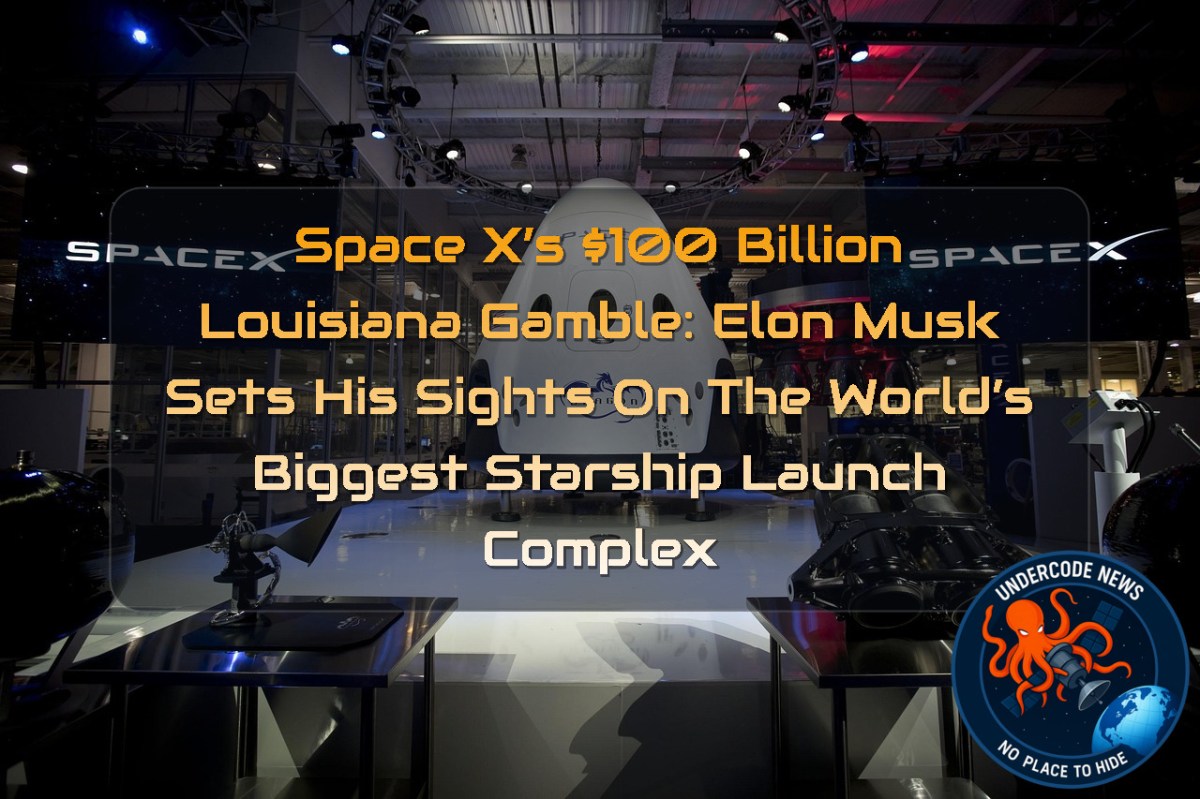
A New Chapter for Starship
SpaceX is preparing to make one of the most ambitious infrastructure bets in the history of commercial spaceflight. The company has announced plans to invest at least $100 billion in a massive new Starship launch complex on the Louisiana Gulf Coast, transforming a previously quiet stretch of the southern United States into what could eventually become one of the busiest spaceports on Earth.
The proposed facility, known as Starbase Louisiana, is planned for Vermilion Parish, roughly 115 miles (185 kilometers) west of New Orleans. SpaceX says construction is expected to begin next year, with the first Starship launches from the site targeted for 2029.
The announcement is much larger than the construction of another rocket launch pad. SpaceX is describing an entire industrial ecosystem designed around a future in which Starship flights could become routine rather than exceptional.
And if Musk’s vision becomes reality, Louisiana could find itself at the center of humanity’s next great push beyond Earth.
A $100 Billion Bet on the Future
SpaceX says it intends to invest at least $100 billion in the Louisiana project and create more than 3,000 new jobs.
That figure immediately puts the proposal in extraordinary territory. A $100 billion commitment would represent one of the largest private investments ever associated with a single spaceflight infrastructure project.
The company is not simply talking about building a launch tower and waiting for rockets to arrive. SpaceX says the complex would include the infrastructure required to support thousands of Starship flights every year.
That changes the scale of the project completely.
A conventional launch facility is designed around relatively infrequent missions. Starbase Louisiana, by contrast, is being presented as a high-throughput transportation hub.
More Than a Launchpad
SpaceX’s vision is centered on a simple but radical idea: Starship should eventually operate more like a transportation system than a traditional expendable rocket.
The company says Starbase Louisiana could ultimately contain more than a dozen launch towers, supporting potentially more than 30 Starship flights per day.
If that operational tempo were achieved, the facility would not merely be another American launch site.
It could become the largest launch complex on Earth.
The distinction is important because
The Rocket Behind the Vision
Starship is
The system is intended to support missions to the Moon and, ultimately, Mars.
Its architecture consists of a massive Super Heavy booster and the Starship upper stage. Both components are being developed around the idea of rapid reusability.
That concept is central to
Instead of treating every launch as a one-time event, SpaceX wants Starship to become a reusable transportation platform capable of moving enormous quantities of cargo and potentially large numbers of passengers.
Louisiana Could Become the Second Starship Powerhouse
SpaceX currently develops and launches Starship from its facilities at Starbase in South Texas.
The Texas site has become one of the most recognizable symbols of SpaceX’s approach to rocket development: rapid construction, frequent testing and an unusually aggressive iteration cycle.
But concentrating all Starship operations in one location creates obvious limitations.
A second major launch complex could provide additional capacity, geographic flexibility and operational redundancy.
Louisiana could therefore become an important part of SpaceX’s attempt to transform Starship from an experimental vehicle into a large-scale launch system.
Why Louisiana?
The Louisiana Gulf Coast offers something SpaceX increasingly needs: enormous areas of coastal land suitable for large aerospace infrastructure.
The region also has a long history connected to the American aerospace industry.
Louisiana’s existing industrial base, transportation networks and access to the Gulf of Mexico could potentially help support a huge manufacturing and launch ecosystem.
But the same geography that makes the area attractive also creates one of the project’s greatest challenges.
The Louisiana coastline is environmentally fragile.
A Coastline Under Pressure
Louisiana has suffered some of the most severe coastal wetland losses in the United States.
According to the U.S. Geological Survey,
That makes the environmental dimension of Starbase Louisiana impossible to ignore.
SpaceX says it will undertake significant measures to preserve the coastline and protect wildlife.
Those commitments will likely become one of the most closely watched aspects of the project.
A launch complex containing more than a dozen towers and supporting potentially dozens of launches every day would inevitably have a substantial physical and environmental footprint.
The Environmental Question
The Louisiana project also arrives with a history that makes environmental scrutiny particularly relevant.
SpaceX’s Texas Starbase facility has faced opposition from environmental organizations because of its proximity to sensitive and protected areas.
The Louisiana project could therefore become another major test of how the United States balances rapid private-sector space development against environmental protection.
The debate will not necessarily be about whether rockets should launch.
The harder question will be how frequently they can launch, what infrastructure is required, how wildlife is affected, how wetlands are protected and what happens when accidents or launch anomalies occur.
The Economic Promise
For Louisiana, however, the economic potential is enormous.
The state’s economic development agency says workers at the facility could earn an average salary 192 percent higher than the region’s current mean wage.
That would make the project much more than a space program.
It could become a major regional economic engine.
Thousands of highly paid jobs could stimulate demand for housing, transportation, restaurants, engineering services, construction companies, logistics providers and technology businesses.
The indirect economic impact could extend far beyond SpaceX’s payroll.
A New Aerospace Economy
If the project proceeds at the scale SpaceX has described, Louisiana could attract an entirely new generation of aerospace suppliers.
Rocket manufacturing requires highly specialized components, electronics, propulsion systems, software, materials, testing equipment and industrial services.
A large Starship operation could therefore create an ecosystem in which SpaceX is only the largest player.
The surrounding region could gradually become an aerospace manufacturing and technology cluster.
That would be particularly significant for a state whose coastal economy has historically depended heavily on energy, shipping, fishing and industrial activity.
The 2029 Question
SpaceX says the first Starship launches from Louisiana are expected in 2029.
That timeline should be treated carefully.
Musk has developed a reputation for setting extremely aggressive deadlines, sometimes years before the underlying technology is ready.
SpaceX has repeatedly demonstrated an ability to move faster than traditional aerospace companies, but Starship is also an extraordinarily complex system.
The company must simultaneously solve challenges involving orbital launch operations, vehicle reliability, thermal protection, reusability, propulsion, environmental approvals, infrastructure and high-frequency launch operations.
The difference between building infrastructure and operating it safely at massive scale can be enormous.
Thirty Flights a Day
The most eye-catching claim is arguably the proposed capability of more than 30 Starship flights per day.
That would mean a launch cadence of roughly one flight every 48 minutes if operations continued around the clock.
Even with multiple launch towers, such a schedule would require an extraordinary logistics operation.
Vehicles would need to be prepared rapidly.
Propellant would need to be supplied continuously.
Launch infrastructure would have to withstand repeated operations.
Airspace and maritime zones would have to be coordinated.
Recovery operations would need to happen with remarkable efficiency.
And every part of the system would need to become substantially more reliable than today’s experimental Starship operations.
Reusability Is the Entire Point
The ambitious flight rate makes sense only if Starship achieves a very high level of reusability.
Traditional rockets are expensive partly because significant portions of the vehicle are discarded after launch.
SpaceX’s Falcon 9 demonstrated that orbital rocket boosters can be recovered and reused at meaningful scale.
Starship is intended to take that philosophy much further.
If the entire system becomes rapidly reusable, SpaceX could theoretically reduce the marginal cost of each launch and dramatically increase the number of missions that can be economically performed.
That is the economic foundation beneath the Louisiana proposal.
From Rocket to Transportation Network
The deeper story is not really about Louisiana.
It is about whether SpaceX can turn Starship into a global transportation platform.
A fleet of reusable Starships could theoretically launch satellites, transport cargo, support lunar missions, deliver large scientific instruments and eventually carry humans beyond Earth.
That requires something fundamentally different from
Instead of thinking in terms of individual missions, SpaceX is thinking in terms of flight operations at industrial scale.
Louisiana could become one of the physical nodes in that future network.
The Moon Is Part of the Equation
The Moon is likely to be an important intermediate destination in the Starship strategy.
NASA’s Artemis program has already made lunar transportation a major area of interest for SpaceX, which is developing a Starship-derived lunar lander architecture.
A high-capacity Starship infrastructure could eventually support repeated lunar logistics missions.
That could include delivering equipment, scientific payloads, fuel and eventually infrastructure.
The long-term vision is therefore considerably larger than commercial satellite launches.
Mars Remains the Ultimate Ambition
Mars sits at the far end of
SpaceX has repeatedly presented Starship as a potential foundation for establishing a human presence on Mars.
Achieving that goal would require a transportation system capable of moving enormous quantities of equipment and supplies between Earth and Mars.
No existing launch system approaches that theoretical scale.
But Mars also represents the hardest possible test of the architecture.
A vehicle capable of launching frequently from Earth still needs to survive deep-space travel, atmospheric entry, landing and potentially long-duration surface operations.
The Scale of the Investment Raises Questions
A $100 billion commitment naturally invites scrutiny.
SpaceX’s investment would need to translate into infrastructure capable of supporting a future market that does not yet fully exist.
There is a fundamental strategic gamble here.
SpaceX is building capacity before the full demand for that capacity has materialized.
That is risky.
But it is also exactly how transformational infrastructure is sometimes created.
Railways were built before every route had mature demand.
Electric grids expanded before modern electricity consumption existed.
Internet infrastructure was deployed before many of
SpaceX is effectively betting that Starship could create its own demand.
The Regulatory Challenge
A project of this scale will inevitably face extensive regulatory scrutiny.
Large rocket launches require coordination involving federal agencies, environmental authorities, aviation regulators and local governments.
The environmental review process could become particularly important in Louisiana because of the region’s wetlands and coastal ecosystems.
The company may also need to address noise, debris, airspace restrictions, emergency planning and impacts on surrounding communities.
The bigger the proposed launch cadence becomes, the more difficult these issues become.
A Different Kind of Space Race
The Louisiana project also reflects how the modern space industry has changed.
The United States is no longer relying exclusively on traditional government-led aerospace programs.
Private companies are increasingly building launch infrastructure, spacecraft and large-scale industrial systems with commercial ambitions.
SpaceX has been one of the strongest examples of this shift.
Starbase Louisiana would take that philosophy into an entirely new category.
It would represent private-sector space infrastructure on a scale that once would have sounded more like a government megaproject.
What Could Go Right?
If SpaceX succeeds, Louisiana could gain thousands of high-paying jobs, a major aerospace cluster and a globally significant launch facility.
The United States could gain additional launch capacity and a second major Starship base.
SpaceX could gain the infrastructure needed to operate a large reusable spacecraft fleet.
And the broader space industry could gain access to dramatically greater launch capacity.
The technological consequences could extend into satellite communications, scientific research, lunar exploration and deep-space missions.
What Could Go Wrong?
The opposite scenario is equally important.
Starship development could take longer than expected.
The $100 billion investment could be deployed more slowly than announced.
Environmental opposition could delay construction.
Regulatory requirements could constrain launch frequency.
Technical problems could prevent the proposed flight cadence from becoming practical.
And the economics of extremely frequent Starship launches may not develop as quickly as SpaceX expects.
A launch tower is one thing.
A 30-flights-per-day transportation network is something else entirely.
Deep Analysis: What 30 Starship Flights a Day Would Actually Require
Launch Cadence
A target of 30 flights per day implies an average interval of approximately 48 minutes between missions if distributed evenly across 24 hours.
That means launch preparation, fueling, inspection, range clearance and vehicle turnover would need to operate with extraordinary efficiency.
Infrastructure Density
More than a dozen launch towers would provide redundancy and parallel operations.
Instead of waiting for one tower to become available, SpaceX could potentially rotate vehicles and launch infrastructure through a continuous operational cycle.
Propellant Logistics
Starship relies on enormous quantities of cryogenic propellants.
A high-frequency launch site would therefore require industrial-scale storage, transfer systems and replenishment infrastructure.
For Linux or Unix administrators working on telemetry and infrastructure systems, basic monitoring commands might include:
df -h
free -h
uptime
top
These commands are not Starship-specific; they illustrate the kind of continuous systems monitoring required by any large-scale operational technology environment.
Network Reliability
A future launch complex would depend heavily on software.
Telemetry systems, flight computers, weather systems, ground stations, security systems and logistics platforms would need to communicate continuously.
A basic network diagnostic workflow could include:
ip addr
ip route
ping -c 4 <gateway>
ss -tulpn
The important principle is redundancy.
A system supporting dozens of launches cannot depend on one network path, one server or one monitoring system.
Telemetry Monitoring
Every launch produces enormous quantities of engineering data.
A high-frequency Starship operation would require automated systems capable of detecting anomalies in real time.
A simplified Linux log-monitoring workflow might look like:
journalctl -f
dmesg --follow
tail -f /var/log/syslog
Production aerospace systems would of course use specialized safety-critical infrastructure rather than generic desktop administration tools.
Cybersecurity
The larger the launch operation becomes, the larger its digital attack surface becomes.
A modern spaceport could contain industrial control systems, cloud infrastructure, access-control systems, corporate networks, telemetry networks, communications equipment and third-party suppliers.
That creates a significant cybersecurity challenge.
A basic defensive Linux audit might begin with:
ss -tulpn
sudo systemctl --type=service --state=running
sudo journalctl --since "1 hour ago"
The goal would be visibility rather than aggressive intervention.
Supply Chain Security
Starship infrastructure would depend on thousands of components.
That means supply-chain security would become increasingly important.
A compromised software dependency or hardware component could potentially affect systems far beyond a single server.
Modern aerospace infrastructure therefore needs the same software-security discipline increasingly expected in financial services and critical infrastructure.
Automated Failure Detection
At 30 launches per day, manual inspection alone would become impractical.
Machine learning and automated analytics could help identify unusual patterns across engines, tanks, communications systems and environmental sensors.
The challenge would be ensuring that automation assists engineers rather than introducing an additional source of failure.
Weather
The Gulf Coast creates another operational complication: weather.
Lightning, hurricanes, high winds and severe storms could disrupt operations.
A major Louisiana spaceport would therefore require extensive weather monitoring and contingency planning.
The site would need to be designed not only for rockets but also for the realities of coastal weather.
Hurricane Resilience
Louisiana’s history with major hurricanes makes resilience particularly important.
A $100 billion infrastructure project cannot be treated like a conventional industrial facility.
Critical systems would require elevated protection, backup power, redundant communications and carefully designed emergency procedures.
Environmental Monitoring
Environmental monitoring would also need to become a permanent part of the operation.
Sensors could monitor air quality, water quality, noise, wildlife activity and coastal conditions.
The data could potentially provide regulators and local communities with a clearer picture of the site’s real-world impact.
Wetland Protection
Louisiana’s wetlands provide ecological protection and support important wildlife habitats.
Any large-scale construction project must therefore consider more than the immediate footprint of launch towers.
Roads, pipelines, storage facilities, power infrastructure and worker facilities can collectively create a much larger environmental impact.
Economic Multiplier
The direct employment figure may only represent the beginning.
Aerospace suppliers, restaurants, housing developers, transportation companies, engineering firms and maintenance contractors could all benefit from increased activity.
The economic multiplier could therefore be significantly larger than SpaceX’s direct payroll.
Skilled Labor
A project of this scale would require engineers, technicians, construction specialists, software developers, cybersecurity professionals, electricians, mechanics and logistics experts.
The demand for specialized labor could reshape the regional employment market.
Housing Pressure
There is also a potential downside.
Thousands of highly paid workers arriving in a relatively small region could increase housing demand.
If construction does not keep pace, housing costs could rise and put pressure on existing communities.
Transportation
A major spaceport would require reliable roads, ports and transportation infrastructure.
Workers and equipment would need to move efficiently between industrial areas, launch complexes and surrounding communities.
The project could therefore create pressure for public infrastructure improvements.
Local Communities
The success of Starbase Louisiana will not be determined solely by rocket engineering.
Community support could become equally important.
Residents will want clear answers about noise, traffic, environmental impacts, emergency procedures and economic benefits.
Space Industry Competition
A successful Starship could fundamentally change competition in the launch market.
If launch prices fall dramatically while payload capacity rises, competitors would have to rethink their strategies.
Traditional launch providers may increasingly focus on specialized missions rather than competing directly on raw capacity.
Satellite Industry
The satellite industry could be one of the biggest beneficiaries.
A huge reusable launch vehicle could make deploying very large satellites, constellations and space infrastructure significantly easier.
SpaceX itself could benefit through Starlink, which requires continuous deployment and replenishment of satellites.
Scientific Missions
Lower launch costs could also transform science.
Large telescopes, planetary probes and massive scientific instruments could become more practical.
Some missions that are currently limited by launch cost could become technically feasible.
Lunar Infrastructure
Starship’s large payload capacity could support construction of lunar infrastructure.
Equipment that would otherwise require multiple smaller missions could potentially be transported using fewer high-capacity launches.
Mars Logistics
Mars represents the ultimate long-term use case.
A successful transportation architecture would need to move enormous amounts of cargo before humans could realistically establish a sustained presence there.
Starship’s enormous payload capacity is designed with exactly this type of ambition in mind.
The Reliability Problem
However, high flight frequency magnifies failure risk.
A system launching once a month can tolerate lengthy inspections.
A system launching dozens of times per day cannot.
SpaceX will therefore need to demonstrate not only that Starship can fly, but that it can fly repeatedly with predictable turnaround times.
The Economics of Reuse
Reusability only produces revolutionary economics if maintenance and turnaround costs remain low.
If each flight requires extensive refurbishment, the theoretical advantages of reuse become much smaller.
The real test will be operational efficiency.
Why Louisiana Matters
Louisiana could ultimately become a test of whether Starship can transition from an experimental rocket program into an industrial transportation system.
That is a much bigger challenge than simply achieving orbit.
SpaceX must demonstrate repeatability, safety, reliability and economics simultaneously.
What Undercode Say:
1. A Monumental Announcement
SpaceX’s Louisiana proposal is one of those announcements that sounds almost unbelievable when reduced to a single number: $100 billion.
2. The Real Story Is Capacity
The most important element is not the investment figure itself.
It is the planned launch capacity behind it.
3. Starship Is Being Treated Differently
SpaceX is no longer describing Starship simply as a rocket.
It is increasingly presenting it as transportation infrastructure.
4. Thirty Flights Per Day Changes Everything
Thirty launches every day would represent a completely different operational model from today’s launch industry.
5. The Timeline Deserves Skepticism
The 2029 target should be viewed as an objective rather than a guaranteed deadline.
6. Musk Thinks in Decades
Musk’s public timelines can be aggressive, but his infrastructure investments often reflect a much longer strategic horizon.
7. Louisiana Is a Strategic Choice
The Gulf Coast provides access to large areas of land and existing industrial infrastructure.
8. Geography Is Also the Weakness
The same coastline that makes the site attractive creates serious environmental and weather challenges.
9. Wetlands Cannot Be an Afterthought
Louisiana’s coastal ecosystems are unusually vulnerable.
10. Environmental Monitoring Will Matter
SpaceX will likely face pressure to demonstrate measurable environmental protections rather than relying only on promises.
11. Jobs Could Transform the Region
More than 3,000 direct jobs could generate thousands of additional indirect jobs.
12. Salaries Could Be Significant
The reported wage premium could attract skilled workers from outside the region.
13. Housing Could Become a Problem
Rapid economic growth can create affordability pressure if housing supply does not expand quickly enough.
14. Infrastructure Must Grow With SpaceX
Roads, power, communications and emergency services will need to scale alongside the spaceport.
15. Cybersecurity Will Become Critical
A modern spaceport is also a massive digital environment.
16. The Supply Chain Will Expand
Thousands of suppliers could eventually become connected to Starship operations.
17. That Creates New Attack Surfaces
Every supplier, software component and network connection can introduce potential security weaknesses.
18. Automation Will Be Essential
Thirty launches per day cannot be managed through manual processes alone.
19. But Automation Creates Risk
Highly automated systems must be designed to fail safely.
20. Human Oversight Remains Necessary
Engineers will still need to make decisions when systems encounter unexpected conditions.
21. Reusability Is the Economic Engine
The entire business case becomes stronger if Starship can fly repeatedly without expensive refurbishment.
22. Flight Frequency Is the Ultimate Test
A reusable rocket that launches occasionally is impressive.
A reusable rocket that launches every day is transformational.
23. Starlink Could Benefit
SpaceX’s satellite business provides a potential internal customer for enormous launch capacity.
24. NASA Could Benefit
Lunar exploration could also create demand for Starship missions.
25. Commercial Customers Matter Too
SpaceX will eventually need broader commercial demand if Starship becomes a high-frequency transportation platform.
26. Bigger Rockets Could Change Satellite Design
Manufacturers could design larger spacecraft if launch constraints become less restrictive.
27. Science Could Get Cheaper
Large scientific payloads could become easier to place into orbit.
28. Mars Requires Massive Logistics
A human Mars program cannot realistically depend on tiny payloads.
29. Starship Is Designed Around Scale
Its size is not merely a technological statement.
It is part of the strategic plan.
30. Louisiana Could Become Historic
If the project succeeds, the region could become permanently associated with the next generation of spaceflight.
31. Failure Would Also Be Expensive
A $100 billion infrastructure vision carries enormous financial and strategic expectations.
32. Regulation Will Shape the Outcome
SpaceX cannot build its future independently of federal, state and local authorities.
33. Environmental Approval Could Define the Timeline
Construction schedules may depend heavily on regulatory and environmental requirements.
34. Hurricanes Add Another Risk
Coastal resilience must be built into the project from the beginning.
35. The Project Is Bigger Than SpaceX
Suppliers, governments, universities and local businesses could all become part of the ecosystem.
36. The U.S. Gains Strategic Capacity
Additional launch infrastructure could strengthen
37. Competitors Will Be Watching
Other launch providers will have to consider how a high-frequency Starship system could change market economics.
38. The Biggest Question Is Reliability
The technology must move from spectacular demonstrations to predictable operations.
- The Next Few Years Will Be Crucial
Starship testing, regulatory decisions and infrastructure development will reveal how realistic the Louisiana vision is.
40. The Real Bet Is Civilization-Scale
Ultimately, SpaceX is betting that reusable heavy-lift transportation can make space dramatically more accessible.
✅ $100 Billion Investment Claim
Fact: SpaceX announced plans to invest at least $100 billion in the Louisiana project.
Analysis: This is the
Assessment: ✅ Accurate as an announced plan, not a guarantee that the entire amount will immediately be spent.
✅ 3,000+ Jobs
Fact: SpaceX says the project will create more than 3,000 jobs.
Analysis: The figure represents the
Assessment: ✅ Accurate as a stated projection.
✅ More Than a Dozen Launch Towers
Fact: SpaceX says the eventual site could contain more than a dozen launch towers.
Analysis: This represents the
Assessment: ✅ Accurate as an announced plan.
⚠️ 30 Flights Per Day
Fact: Elon Musk said the facility could eventually enable more than 30 Starship flights per day.
Analysis: This is a future operational target rather than a currently demonstrated capability.
Assessment: ⚠️ The statement is factual as a projection, but the operational capability remains unproven.
⚠️ 2029 Launch Target
Fact: SpaceX expects the first Starship launches from Louisiana in 2029.
Analysis: This is a target rather than a confirmed launch schedule.
Assessment: ⚠️ Treat the date as an objective that remains subject to construction, testing and regulatory progress.
✅ Louisiana’s Coastal Vulnerability
Fact: Louisiana has experienced severe coastal wetland loss.
Analysis: The
Assessment: ✅ Supported by long-standing scientific assessments.
Prediction
(+1) Louisiana Could Become a Major Global Space Hub
If SpaceX delivers even a substantial portion of its proposed infrastructure, Louisiana could become one of the world’s most important centers for commercial spaceflight.
The combination of high launch capacity, reusable rockets, satellite demand and lunar exploration could create a powerful aerospace ecosystem.
(+1) Starship Could Drive a New Launch Economy
If Starship achieves reliable and rapid reuse, launch costs could decline while payload capacity increases.
That combination could encourage companies to build larger satellites, deploy more ambitious scientific missions and develop new commercial applications for space.
(+1) High-Paying Technology Jobs Could Expand
The project could attract engineers, software developers, technicians, cybersecurity professionals and advanced manufacturing specialists to the region.
Over time, those workers could help create an aerospace technology cluster far beyond SpaceX itself.
(-1) Environmental Opposition Could Slow the Project
Louisiana’s fragile coastline creates a serious potential obstacle.
Environmental reviews, habitat protection requirements and public opposition could affect the project’s scale or timeline.
(-1) Musk’s Timeline Could Slip
The 2029 launch target is ambitious.
Starship development has repeatedly demonstrated how difficult it is to predict the schedule of a system this complex.
(+1) The Biggest Impact May Be Beyond Louisiana
The most important consequence could ultimately be global.
If Starship becomes a reliable, rapidly reusable heavy-lift system, the economics of reaching orbit could change dramatically.
And if that happens, a $100 billion Louisiana spaceport may eventually be remembered not as an enormous construction project, but as one of the foundations of a new era in human spaceflight.
🕵️📝Let’s dive deep and fact‑check.
🎓 Live Courses & Certifications:
Join Undercode Academy for Verified Certifications
🚀 Request a Custom Project:
Secure, high-velocity infrastructure and disruptive technological engineering. Contact our engineering team for high-tier development and proprietary systems:
[email protected]
💎 Smart Architecture | 🛡️ Secure by Design | ⭐ Trusted by Thousands
References:
Reported By: www.channelstv.com
Extra Source Hub (Possible Sources for article):
https://www.stackexchange.com
Wikipedia
OpenAi & Undercode AI
Image Source:
Unsplash
Undercode AI DI v2
🔐JOIN OUR CYBER WORLD [ CVE News • HackMonitor • UndercodeNews ]
📢 Follow UndercodeNews & Stay Tuned:
𝕏 formerly Twitter 🐦 | @ Threads | 🔗 Linkedin | 🦋BlueSky | 🐘Mastodon | 📺Youtube


