
Listen to this Post
 A New Chapter for Tesla’s Most Controversial Pickup
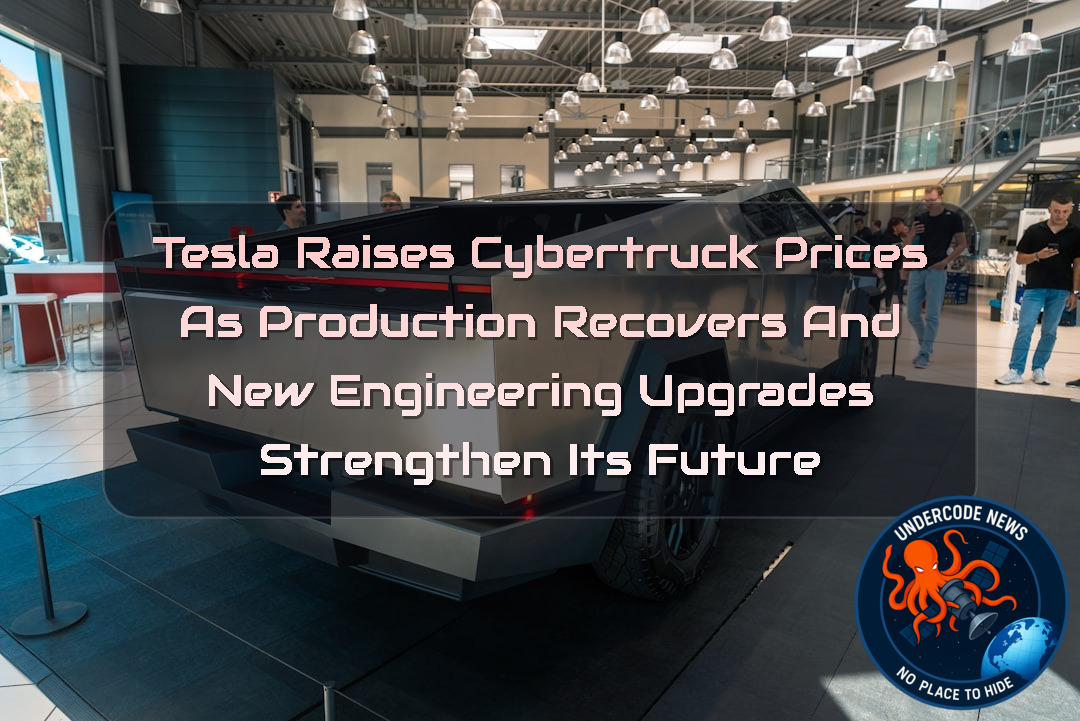
The Tesla Cybertruck has never followed the conventional rules of the automotive industry. From its polarizing stainless-steel design to its unusual steering system, massive storage capacity, and aggressive performance, the electric pickup has spent years dividing opinion while attracting enormous attention. Now, the Cybertruck is entering another important phase. Tesla has increased prices on two of its three available trims, production at Giga Texas appears to be recovering after a serious supplier dispute, and a new engineering update has reportedly made the vehicle’s underbody lighter, stronger, and more efficient.
Tesla Pushes Cybertruck Prices Higher
Tesla has raised the price of the Cybertruck Base All-Wheel-Drive from $69,990 to $74,990, while the Premium All-Wheel-Drive configuration has increased from $79,990 to $84,990. Both models received a $5,000 increase. The high-performance Cyberbeast remains at $99,990, making it the only Cybertruck configuration that did not receive a new price adjustment.
A Seven Percent Signal From Tesla
The increase represents roughly a 7% jump for the affected trims, and it immediately raises an important question: why would Tesla increase prices if demand for the Cybertruck were weak? Price increases are always risky, especially in an electric vehicle market where buyers have become increasingly sensitive to monthly payments, financing costs, and competition. Tesla’s decision suggests that the company believes demand can support the higher pricing, or that production costs and supply conditions now require a different strategy.
Demand Has Always Been a Complicated Cybertruck Story
The Cybertruck is one of those products that generates two completely different reactions. Some people see a futuristic machine unlike anything else on the road. Others see a vehicle whose appearance alone makes them unwilling to consider buying it. The design is therefore not simply an aesthetic choice. It is part of the product’s identity, and that identity naturally limits its appeal to buyers looking for a conventional pickup.
The Price May Matter More Than the Shape
While the Cybertruck’s appearance undoubtedly creates division, pricing may be the more important obstacle. When Tesla originally unveiled the Cybertruck in 2019, the company’s pricing expectations were dramatically lower than what consumers see today. At one point, the most expensive announced version was priced at $69,990. In 2026, according to the supplied report, even the least expensive available trim is now priced above that figure.
Tesla Faces the Reality of Building an Extreme Vehicle
The Cybertruck is not an ordinary pickup with an electric motor added to it. Its stainless-steel exterior, steer-by-wire system, unusual manufacturing requirements, large battery system, performance targets, and specialized engineering all contribute to a complicated production equation. Tesla may want to make the vehicle more accessible, but reducing prices aggressively could also put pressure on margins.
The Cheapest Cybertruck Is Still a Premium Purchase
At $74,990, the Base All-Wheel-Drive Cybertruck is no longer positioned as an affordable entry point into Tesla ownership. It is a premium electric pickup competing for customers who have significant purchasing power and who are willing to pay for technology, utility, performance, and design. This could make the Cybertruck increasingly dependent on a smaller but more dedicated group of buyers.
The Product Still Has Powerful Selling Points
Despite the debate surrounding its appearance and pricing, the Cybertruck offers features that distinguish it from Tesla’s other vehicles. The supplied article highlights steer-by-wire, interior space, storage, and performance as major advantages. For some Tesla owners, the Cybertruck represents a more dramatic and capable step beyond vehicles such as the Model Y.
Production Suddenly Appears to Be Recovering
The pricing news arrives during another major development for the Cybertruck. Production at Giga Texas reportedly showed signs of recovery after Tesla entered an urgent legal dispute with supplier Angstrom Automotive Group. An aerial observation reportedly showed roughly 100 or more Cybertrucks in an outbound lot, representing a visible increase compared with the thinner numbers observed in previous weeks.
A Supplier Dispute Became a Manufacturing Emergency
Tesla’s legal complaint described an increasingly serious conflict involving manufacturing tooling and Cybertruck parts. According to the supplied material, Tesla alleged that equipment and components necessary for Cybertruck production were located at a facility operated by Angstrom Automotive Group and that access to this equipment became the subject of an urgent dispute.
Hundreds of Parts Were Reportedly Caught in the Conflict
Tesla’s complaint stated that a shipment of 700 finished parts did not leave the supplier’s facility as expected. The company also alleged that representatives attempting to recover Tesla-owned equipment were turned away. The dispute reportedly became serious enough that Tesla sought emergency intervention from a federal court.
Tesla Said Production Could Be Affected Within Days
The urgency of the case came from
A Court Order Opened the Door to Recovery
The supplied article states that a temporary restraining order and writ of replevin gave Tesla immediate authority to enter the supplier’s facility and recover the disputed tooling. The broader legal dispute was still expected to continue, but the immediate court action appears to have removed a major obstacle from the Cybertruck production chain.
The Outbound Lot Became an Important Signal
Vehicle counts at factory lots do not provide a perfect measurement of production. Finished vehicles can remain parked before shipping, logistics schedules can change, and temporary inventory fluctuations do not necessarily represent long-term manufacturing performance. However, a significant increase in visible Cybertruck inventory shortly after Tesla received emergency legal relief creates a strong indication that the supplier issue had become an important production bottleneck.
Supply Chains Can Stop Even the Most Advanced Factories
Tesla operates some of the
Tesla Is Also Changing the Cybertruck Itself
While production issues were being addressed, Tesla was reportedly making another significant engineering change. The company replaced aluminum underbody panels with carbon fiber after testing indicated that the new material could provide greater durability while reducing weight and cost.
Carbon Fiber Moves Below the Surface
The underbody of a vehicle may not receive the same attention as the exterior design, but it performs an important role. Protection underneath the vehicle must withstand road debris, impacts, environmental exposure, and aerodynamic forces. A change in this area demonstrates that Tesla continues to modify the Cybertruck even after years of development and production.
Tesla Says the New Material Performs Better
Cybertruck Lead Engineer Wes Morrill reportedly confirmed that Tesla tested different materials and found the carbon fiber solution to be more durable than aluminum while also reducing weight and cost. The new design was also said to provide a slight efficiency improvement because the material could be shaped more effectively around mounting points, helping improve airflow underneath the vehicle.
Engineering Improvements Can Be More Important Than Visible Changes
Consumers often notice new paint colors, displays, wheels, or software features, but some of the most meaningful vehicle improvements happen where drivers cannot easily see them. A stronger and lighter underbody component may not transform the Cybertruck’s appearance, but it can contribute to durability, efficiency, manufacturing optimization, and long-term reliability.
One Material Strategy Can Simplify Production
According to the supplied report, the carbon fiber update was being applied across trims to reduce variation and improve supply chain efficiency. This is particularly important for a vehicle like the Cybertruck, which has already experienced manufacturing and supplier challenges. Reducing unnecessary differences between versions can simplify procurement, production, quality control, and inventory management.
The Cybertruck Is Becoming a More Mature Product
The latest developments suggest that Tesla is moving beyond the earliest stage of Cybertruck production. The company is adjusting prices, responding to supply disruptions through legal action, refining materials, and continuing to modify the vehicle’s engineering. This is what happens when a radical concept becomes a real industrial product: the experimentation does not stop when deliveries begin.
But Higher Prices Could Create a New Challenge
Tesla now faces a delicate balance. If Cybertruck demand is strong enough to justify higher prices, the company may be able to protect margins and reinforce the vehicle’s premium position. However, if a significant number of potential buyers were already waiting for a lower price, another $5,000 increase could push the truck even further away from the mainstream market.
The Cybertruck May Never Be a Conventional Bestseller
Tesla does not necessarily need the Cybertruck to appeal to everyone. The vehicle was designed around a strong identity, and its unconventional appearance ensures that it will always attract passionate supporters and equally passionate critics. The real question is whether Tesla can build a sustainable business around that identity while maintaining production efficiency and controlling costs.
What Undercode Say:
The Price Increase Is More Than a Number
Tesla’s $5,000 increase should not be viewed only as a simple pricing decision.
It may also reflect Tesla’s confidence in the Cybertruck’s position.
The company is testing how much value customers place on the product.
That is especially important because the Cybertruck does not compete only on specifications.
It competes on identity.
People do not usually buy a Cybertruck because it looks like every other pickup.
They buy it because it does not.
The Market Is Testing
The Cybertruck has become an experiment in product differentiation.
Traditional automakers often try to appeal to the largest possible audience.
Tesla took the opposite approach.
It created a vehicle that immediately creates an emotional reaction.
That strategy can create extremely loyal customers.
But it can also reduce the number of potential buyers.
The higher price increases this pressure.
Tesla must therefore prove that uniqueness can translate into sustainable demand.
The Supplier Crisis Reveals a Deeper Risk
The dispute involving manufacturing tooling is perhaps more important than it initially appears.
A factory is only as resilient as its supply chain.
If critical equipment or components are controlled by an external supplier, manufacturing can become vulnerable.
Tesla’s emergency legal action demonstrates how quickly a supplier conflict can become a production crisis.
This is a warning not only for Tesla.
It is a lesson for the entire automotive industry.
Manufacturing Control Is Becoming a Competitive Weapon
Companies increasingly want more control over the technologies that define their products.
Tesla has invested heavily in vertical integration.
Yet the Cybertruck dispute shows that complete independence is extremely difficult.
A vehicle requires thousands of parts.
Each supplier relationship creates potential operational risk.
The future winners may be companies that combine vertical integration with stronger supplier contingency planning.
The Carbon Fiber Update Shows
Tesla rarely treats production vehicles as completely finished products.
The
If a component can become lighter, cheaper, stronger, or easier to manufacture, Tesla appears willing to modify it.
This approach can create constant improvement.
It can also create complexity.
Every material change requires testing, validation, manufacturing adjustments, and supply chain coordination.
Price and Production Are Now Connected
The Cybertruck price increase and the supplier dispute should not be analyzed separately.
Production interruptions can increase manufacturing pressure.
Higher costs can influence pricing decisions.
Supply shortages can also affect delivery schedules and inventory.
Tesla must manage all of these variables simultaneously.
The Cybertruck is therefore becoming a test of Tesla’s ability to balance engineering ambition with industrial discipline.
The Biggest Question Is Still Affordability
The Cybertruck may become stronger.
It may become more efficient.
Production may recover.
Demand may remain healthy.
But affordability remains the central issue for many potential customers.
A vehicle can be technologically impressive and still remain inaccessible to a large part of its potential market.
Tesla must decide whether the Cybertruck should remain a premium niche product or eventually become more accessible.
Undercode’s Final View
The Cybertruck is not standing still.
Tesla is changing its price strategy.
Tesla is fighting to protect production.
Tesla is refining its engineering.
Tesla is learning from real-world manufacturing challenges.
The next phase will determine whether these improvements create long-term momentum or whether rising prices limit the vehicle’s expansion.
The
It will depend on how efficiently Tesla can build it.
And ultimately, how many people are willing to pay for it.
Deep Analysis
Checking Current Cybertruck Manufacturing Signals
Monitor Tesla and Cybertruck-related production news
curl -L "https://www.tesla.com/cybertruck" | head
Search local datasets or archived reports for Cybertruck references
grep -Rin "Cybertruck" ./reports/
Review recent manufacturing and supply-chain logs
grep -Ei "supplier|tooling|production|Giga Texas" manufacturing.log
Compare historical price records stored in a CSV file
awk -F',' '{print $1, $2, $3}' cybertruck_prices.csv
Track changes between archived pricing files
diff -u cybertruck-price-old.txt cybertruck-price-new.txt
Using Data to Understand the Bigger Picture
Count production-related mentions in collected news files
grep -Rih "production" ./cybertruck-data/ | wc -l
Extract references to price changes
grep -RinE '\$[0-9,]+' ./cybertruck-data/
Search for supplier disruption indicators
grep -RinE "shortage|supplier|tooling|delay|parts" ./cybertruck-data/
Create a simple timeline from timestamped logs
sort cybertruck-events.log
Check disk usage for a large automotive research archive
du -sh ./cybertruck-data/
Why Technical Monitoring Matters
These commands do not determine Cybertruck demand by themselves, but they illustrate how researchers, journalists, analysts, and automotive observers can organize evidence. Pricing changes, factory activity, supplier disputes, inventory counts, and engineering updates should be analyzed together rather than as isolated events. A single aerial image or price adjustment can be misleading, but a timeline built from multiple indicators can reveal a much clearer picture.
Tesla Increased Prices on Two Cybertruck Trims
✅ The supplied article states that the Base AWD increased from $69,990 to $74,990 and the Premium AWD increased from $79,990 to $84,990, while the Cyberbeast remained at $99,990.
Tesla Took Emergency Legal Action Over Supplier Tooling
✅ The supplied material states that Tesla filed an emergency lawsuit involving manufacturing equipment and alleged that Cybertruck production could be affected without court intervention.
The Carbon Fiber Update Was Reported as an Engineering Improvement
✅ The source states that Tesla replaced aluminum underbody panels with carbon fiber after testing reportedly showed benefits involving durability, weight, cost, and airflow efficiency.
Prediction
(+1) Tesla Could Strengthen Cybertruck Production if Supply Problems Remain Under Control
If the supplier bottleneck has truly been removed, Tesla could stabilize Cybertruck output and improve delivery volumes.
Continued material improvements may reduce manufacturing complexity and improve the vehicle’s long-term efficiency.
Strong demand at the new pricing levels could encourage Tesla to continue positioning the Cybertruck as a premium electric pickup.
The biggest negative risk remains affordability, because further price increases could reduce the number of potential buyers.
Another serious supplier disruption could demonstrate that Cybertruck production still has vulnerabilities despite Tesla’s advanced manufacturing capabilities.
▶️ Related Video (80% Match):
🕵️📝Let’s dive deep and fact‑check.
🎓 Live Courses & Certifications:
Join Undercode Academy for Verified Certifications
🚀 Request a Custom Project:
Secure, high-velocity infrastructure and disruptive technological engineering. Contact our engineering team for high-tier development and proprietary systems:
[email protected]
💎 Smart Architecture | 🛡️ Secure by Design | ⭐ Trusted by Thousands
References:
Reported By: www.teslarati.com
Extra Source Hub (Possible Sources for article):
https://www.facebook.com
Wikipedia
OpenAi & Undercode AI
Image Source:
Unsplash
Undercode AI DI v2
🔐JOIN OUR CYBER WORLD [ CVE News • HackMonitor • UndercodeNews ]
📢 Follow UndercodeNews & Stay Tuned:
𝕏 formerly Twitter 🐦 | @ Threads | 🔗 Linkedin | 🦋BlueSky | 🐘Mastodon | 📺Youtube


