
Listen to this Post
 A New Design Direction May Be Taking Shape
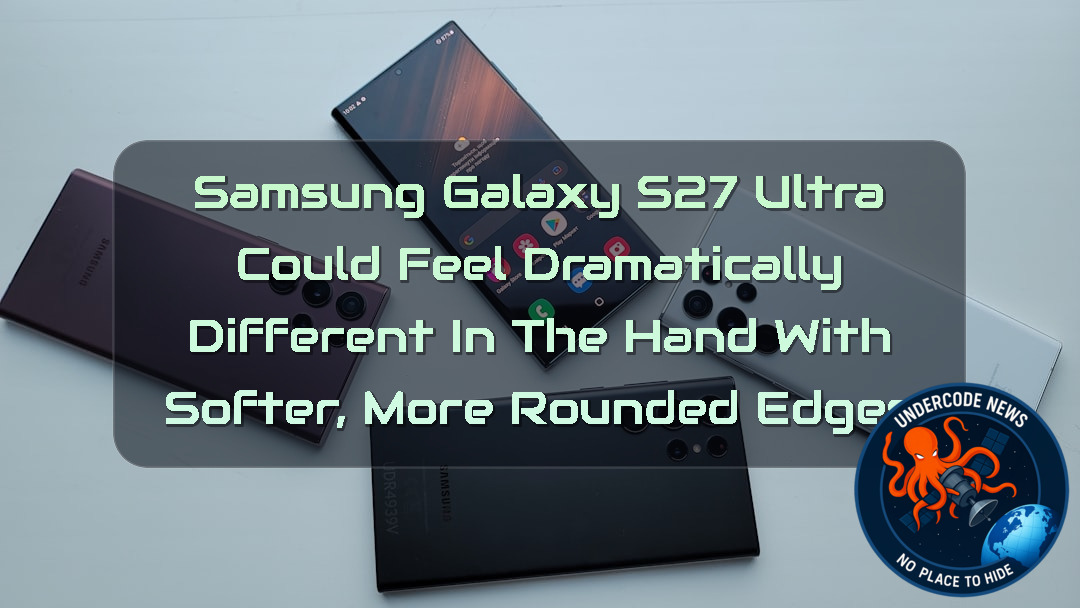
Samsung’s next generation Ultra smartphone may still be months away, but early leaks are already creating discussion around what could become one of the most noticeable changes in the Galaxy S series. The rumored Galaxy S27 Ultra, expected to arrive in early 2027, may introduce a redesigned camera housing, a refreshed physical shape, and, perhaps most interestingly, a frame with softer and more rounded edges.
At first glance, rounded corners along the side of a smartphone may sound like an insignificant detail. Yet anyone who spends hours holding a large Ultra device knows that small changes in industrial design can completely transform the experience. A phone can look almost identical on a table while feeling substantially different in the hand.
According to a recent leak attributed to Ice Universe, Samsung may be preparing to soften the lower edges of the Galaxy S27 Ultra compared with the current Galaxy S26 Ultra. The change is subtle in appearance, but it could signal a broader effort by Samsung to make its largest flagship more comfortable without sacrificing its premium identity.
The Galaxy S27 Ultra has not been officially announced, and its final design remains unknown. Still, the emerging leaks provide an early look at where Samsung’s design strategy could be heading.
The Main Rumor Points to Softer Frame Edges
A sketch reportedly shared by well-known smartphone leaker Ice Universe compares the lower portion of the Galaxy S26 Ultra with the rumored Galaxy S27 Ultra. The most obvious difference is not a new button, display, or port. Instead, the rumored S27 Ultra appears to have a frame with a slightly rounder transition between its surfaces.
The current Ultra design language has leaned toward sharper lines and a more rectangular profile. This approach gives Samsung’s flagship a distinctive, professional appearance, but sharp edges can sometimes make a large smartphone feel even larger when held without a case.
The Galaxy S27 Ultra could soften that experience.
If the leak proves accurate, Samsung may introduce a smoother curve along the frame, reducing the sharp transition where the side meets the front and rear surfaces. The difference may be difficult to notice in photographs, but it could become immediately obvious when the phone is held.
Comfort Could Become the Real Design Upgrade
Smartphone design is often judged through images, renders, and promotional videos. However, one of the most important parts of a premium smartphone cannot be fully understood through a screen: how it feels in the hand.
A large Ultra smartphone carries significant physical presence. Users hold it while reading, gaming, watching videos, taking photographs, browsing the web, and working. Even a small pressure point created by a sharp frame can become noticeable during long periods of use.
A more rounded edge could distribute pressure more naturally across the user’s hand.
This may particularly benefit people who use their Galaxy Ultra devices without protective cases. A case can soften the edges of almost any smartphone, but users who prefer the original hardware design experience every contour directly.
Samsung may therefore be focusing on a detail that will not necessarily dominate advertisements but could improve daily usability.
Small Physical Changes Can Create a Major Difference
The history of smartphone design shows that manufacturers often rely on tiny adjustments to create a completely different physical impression.
A frame can be only slightly thinner while appearing dramatically slimmer. A curved transition can make a thick phone feel more comfortable. A change in weight distribution can make a heavy device seem easier to hold.
This is why industrial design remains important even when smartphones appear to have reached a mature stage.
The Galaxy S27 Ultra may not need a radical transformation to feel new. Sometimes, a small adjustment to the physical geometry is enough to change the entire interaction between the user and the device.
Samsung has explored this concept before.
Samsung Has Experience With Slim and Curved Designs
Samsung’s smartphone history includes several periods where the shape of the device played a major role in its identity. The Galaxy Edge era, for example, demonstrated how curved surfaces could make a device appear thinner and more futuristic.
Over time,
The result was a move toward flatter surfaces and more structured shapes.
The rumored Galaxy S27 Ultra could represent an attempt to combine both philosophies.
Rather than returning to aggressively curved displays, Samsung may be looking at the frame itself as a way to improve ergonomics. This could allow the company to preserve a flat display and modern camera hardware while making the overall device feel less sharp and rigid.
The Camera Housing Could Become the Most Visible Change
While the softer frame may improve comfort, leaks suggest that the Galaxy S27 Ultra could also receive a more significant visual redesign through its camera system.
Reports and early discussions have pointed toward a wider camera housing rather than the more individually separated camera elements associated with recent Galaxy Ultra devices.
This potential change has already divided opinions.
Some users may appreciate a larger camera island because it could create a more unified and distinctive appearance. Others may prefer Samsung’s cleaner approach of allowing individual camera lenses to stand separately from the rear panel.
Both reactions are understandable.
Camera design has become one of the few major visual elements that can instantly identify a modern flagship. Displays are increasingly similar, bezels are increasingly thin, and most smartphones now use glass-and-metal constructions. The camera module has become one of the strongest ways for manufacturers to create a recognizable identity.
If Samsung changes the Galaxy S27 Ultra camera housing significantly, the device could look noticeably different even before users notice the softer frame.
Early Renders Should Not Be Treated as Final Evidence
It is important to remember that early sketches, leaks, and unofficial renders rarely represent the final product perfectly.
Smartphone development involves multiple prototypes.
Manufacturers test different dimensions, materials, camera placements, frame shapes, and internal component layouts. A design seen months before launch may represent an early engineering prototype, a partially accurate interpretation, or a mixture of reliable information and speculation.
Samsung can also modify its plans before mass production begins.
For that reason, the rumored Galaxy S27 Ultra should not be judged solely on early visual material. A camera housing that looks unusual in a simplified render may appear much more refined when combined with real materials, textures, colors, and the final proportions of the device.
The complete design experience is difficult to understand until the actual hardware exists.
The S27 Ultra May Focus on Refinement Rather Than Reinvention
The rumored rounded frame reveals something interesting about the direction of flagship smartphones.
The industry may be entering an era where refinement matters as much as dramatic redesign.
Modern premium smartphones are already extremely capable. They feature powerful processors, advanced camera systems, high-resolution displays, large batteries, AI-powered software, and fast connectivity.
The challenge for manufacturers is no longer simply adding features.
The challenge is improving the overall experience.
How comfortable is the phone? How balanced does it feel? Does it fit naturally into the user’s hand? Does the camera housing make the device unstable on a table? Are the edges comfortable during gaming?
These questions can become just as important as benchmark scores.
The Galaxy S27 Ultra could therefore represent
A More Comfortable Ultra Could Appeal to Caseless Users
One group that could benefit most from the rumored design change is users who avoid cases.
Caseless smartphone users often choose this approach because they want to experience the original materials and engineering of the device. They want to feel the metal frame, see the original color, and avoid adding additional thickness.
However, large smartphones with sharp edges can become uncomfortable without a protective case.
A slightly rounded Galaxy S27 Ultra frame could address that issue.
Samsung could preserve the premium appearance of a flat-sided flagship while reducing the uncomfortable feeling sometimes associated with sharp metal edges.
This might seem like a minor improvement, but flagship customers often notice the smallest details because they use these devices every day.
Samsung’s 2027 Lineup Could Become More Complex
The Galaxy S27 Ultra is also rumored to be part of a broader family of devices.
Current leaks suggest Samsung could introduce multiple models, potentially including a standard Galaxy S27, a Plus model, a Pro model, and the Galaxy S27 Ultra.
However, Samsung has changed its smartphone strategy before, and product names can shift during development.
Until Samsung officially announces its plans, the exact structure of the 2027 Galaxy lineup should be treated cautiously.
The possibility of four models would nevertheless give Samsung more opportunities to differentiate devices according to size, price, cameras, performance, and design.
The Ultra model would remain the expected technology showcase.
That means even subtle design improvements could eventually influence the appearance of future Galaxy devices.
The Real Test Will Be Whether the New Shape Improves Daily Use
A smartphone can have the fastest processor and the most advanced camera hardware, but users interact with the physical device first.
They pick it up.
They hold it.
They press its buttons.
They carry it in their pockets.
This is where the rumored Galaxy S27 Ultra design change could become meaningful.
The difference between a sharp edge and a softly rounded transition may seem insignificant on a specification sheet. In daily life, however, it could affect how comfortable the device feels after several hours of use.
Samsung may be betting that premium smartphone design no longer needs constant visual revolution.
Sometimes, refinement is enough.
A smoother edge may not create a dramatic reaction in a leaked render, but it could create a better experience every time a user picks up the phone.
What Undercode Say:
The rumored Galaxy S27 Ultra design shows how the smartphone industry is gradually shifting from visible innovation toward physical refinement.
For years, manufacturers competed through larger displays, more cameras, faster processors, and increasingly aggressive specifications.
Those categories are still important, but flagship smartphones are reaching a level where many improvements are becoming incremental.
That makes ergonomics more valuable.
A slightly rounded frame may sound like a small engineering decision, but it can influence the entire perception of the device.
Sharp edges communicate precision, structure, and strength.
Rounded edges communicate comfort, accessibility, and smoother interaction.
Samsung may be attempting to find a balance between these two design philosophies.
The Galaxy S27 Ultra is expected to remain a large and technically dense device.
Large camera hardware, advanced sensors, a high-capacity battery, and premium internal components create physical limitations.
Samsung cannot simply make the phone dramatically thinner without making compromises.
Instead, changing the geometry of the frame could make the existing dimensions feel less aggressive.
This is an important distinction.
A device does not always need to become smaller to feel smaller.
It can become easier to hold through better weight distribution and improved edge transitions.
The rumored wide camera housing is also strategically interesting.
Samsung’s recent camera design has become recognizable, but recognizable design can eventually become predictable.
A new housing could refresh the visual identity of the Ultra series.
At the same time, Samsung faces a difficult challenge.
Changing too much could alienate users who appreciate the clean appearance of recent Galaxy Ultra models.
Changing too little could make the S27 Ultra appear almost identical to its predecessor.
The combination of a new camera housing and softer edges could therefore represent a calculated middle ground.
The phone could look new without abandoning the established Ultra identity.
Another important factor is competition.
Premium smartphone manufacturers increasingly compete through design perception rather than raw specifications alone.
Consumers can easily compare processors and camera megapixels.
They cannot easily compare comfort through a specification table.
That gives industrial design enormous strategic value.
Samsung may also be considering the psychological effect of rounded edges.
Users often associate smooth surfaces with modernity and comfort.
Even before using the device, the shape can influence expectations.
The final question is whether Samsung can make these changes without affecting durability, internal space, or the premium appearance of the Ultra series.
If successful, the Galaxy S27 Ultra could demonstrate that the next major evolution in smartphones does not necessarily require a folding display, a completely new form factor, or a revolutionary hardware component.
Sometimes the most important innovation is the one users physically experience every day.
The Galaxy S27 Ultra may therefore become a test of whether subtle design engineering can create a stronger real-world impression than dramatic visual experimentation.
Deep Analysis
From a technical perspective, the rumored design evolution can be examined through the relationship between dimensions, curvature, ergonomics, and hardware density.
Linux users and hardware researchers can organize leaked specifications and compare device dimensions using simple command-line workflows.
mkdir galaxy-s27-ultra-analysis
cd galaxy-s27-ultra-analysis
Researchers can create a structured comparison file for the current and rumored models.
nano galaxy_dimensions.csv
Example data can then be processed with standard Linux tools.
cat galaxy_dimensions.csv
To compare potential frame measurements:
awk -F',' '{print $1, $2, $3}' galaxy_dimensions.csv
A researcher could calculate percentage differences between known and rumored dimensions with Python:
python3 - <<'PY'
old_width = 79.0
new_width = 78.5
difference = ((new_width - old_width) / old_width) 100
print(f"Width difference: {difference:.2f}%")
PY
Design leaks can also be tracked over time.
git init
git add galaxy_dimensions.csv
git commit -m "Add initial Galaxy S27 Ultra design comparison"
When new information appears, changes can be reviewed with:
git diff
Researchers can also search local notes for recurring references to frame curvature.
grep -Ri rounded frame .
To organize images or renders associated with different design stages:
find ./renders -type f
A hash can be generated to identify whether an image has changed between versions.
sha256sum renders/
These methods do not confirm that a leak is accurate, but they help researchers document how rumors evolve.
The deeper technical issue is that smartphone ergonomics cannot be measured by thickness alone.
The radius of a frame edge, the distribution of internal components, the location of the center of mass, and the relationship between the display and sidewalls all influence comfort.
A future Galaxy S27 Ultra could theoretically retain similar external dimensions while feeling substantially different because of these geometric changes.
This is why leaked sketches deserve analysis but not immediate certainty.
A few millimeters, or even fractions of a millimeter, can influence both manufacturing and user experience.
The final device will determine whether
✅ The article’s description of the Galaxy S27 Ultra is based on early leaks and unofficial information, and Samsung has not officially confirmed the final device design.
✅ The claim that a softer frame could improve comfort is consistent with basic ergonomic principles, although the exact real-world impact cannot be measured until the final hardware is available.
❌ The exact camera housing, final dimensions, model names, and complete 2027 Galaxy S27 lineup should not be treated as confirmed facts at this stage.
Prediction
(+1) Samsung’s focus on softer frame edges could improve the everyday comfort of the Galaxy S27 Ultra, particularly for users who prefer using their flagship without a protective case.
If the wider camera housing reaches the final product, it could give the Ultra series a more distinctive visual identity and separate it more clearly from previous generations.
A successful ergonomic redesign may influence future Samsung flagship models, making smoother frame transitions a longer-term part of the company’s design strategy.
The biggest risk is that a controversial camera redesign could divide Galaxy fans before the device is even officially announced, especially if early renders fail to represent the final hardware accurately.
Samsung could still modify the Galaxy S27 lineup, design, or naming strategy before launch, meaning current rumors should remain subject to change until the company makes an official announcement.
▶️ Related Video (76% Match):
🕵️📝Let’s dive deep and fact‑check.
🎓 Live Courses & Certifications:
Join Undercode Academy for Verified Certifications
🚀 Request a Custom Project:
Secure, high-velocity infrastructure and disruptive technological engineering. Contact our engineering team for high-tier development and proprietary systems:
[email protected]
💎 Smart Architecture | 🛡️ Secure by Design | ⭐ Trusted by Thousands
References:
Reported By: www.sammobile.com
Extra Source Hub (Possible Sources for article):
https://www.instagram.com
Wikipedia
OpenAi & Undercode AI
Image Source:
Unsplash
Undercode AI DI v2
🔐JOIN OUR CYBER WORLD [ CVE News • HackMonitor • UndercodeNews ]
📢 Follow UndercodeNews & Stay Tuned:
𝕏 formerly Twitter 🐦 | @ Threads | 🔗 Linkedin | 🦋BlueSky | 🐘Mastodon | 📺Youtube


