
Listen to this Post
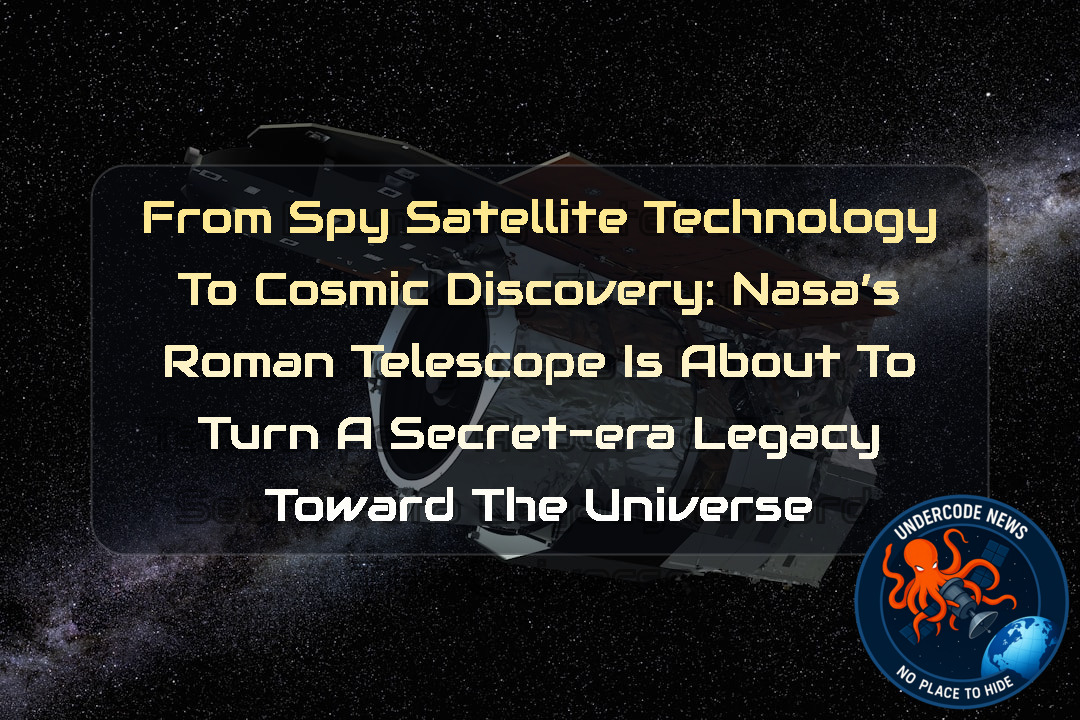
A Telescope With an Extraordinary Second Life
Some of the most remarkable scientific instruments do not begin their lives in laboratories built for science. The Nancy Grace Roman Space Telescope is one of the clearest examples.
NASA’s next major space observatory is scheduled to launch on August 30, 2026, aboard a SpaceX Falcon Heavy from Kennedy Space Center. As of August 28, NASA and SpaceX have completed the Launch Readiness Review and declared the mission “go” for launch, with liftoff targeted for 7:26 a.m. EDT.
NASA Science
+1
But Roman carries a history that makes its mission even more fascinating: its telescope hardware originated from technology developed for the U.S. National Reconnaissance Office, the intelligence agency responsible for the nation’s reconnaissance satellites.
NASA documents confirm that the agency obtained the telescope hardware from the NRO. The hardware was not simply taken from an operational spy satellite and pointed at the stars; rather, the NRO transferred unused, space-qualified telescope hardware to NASA, which then adapted it into the foundation of a completely new scientific observatory.
NASA Office of Inspector General
+1
The result is a remarkable technological transformation: hardware designed for extremely demanding Earth-observation applications became part of an observatory intended to study galaxies, exoplanets, black holes, dark matter and dark energy.
From Watching Earth to Studying the Cosmos
The story began more than a decade ago when the NRO informed NASA that residual spacecraft hardware was available.
NASA determined that the hardware could help fulfill scientific objectives identified in the Astro2010 decadal survey and accepted the transfer. NASA documentation from the period describes two space-qualified telescope systems with 2.4-meter apertures and sophisticated optical characteristics.
NASA Science
+1
The significance of that decision was enormous.
Instead of starting completely from scratch with a smaller telescope design, NASA gained access to powerful existing optical hardware that could be transformed into the basis of a wide-field astronomical observatory.
That hardware ultimately became central to what is now the Nancy Grace Roman Space Telescope.
The NRO Connection Is Real — But the Story Needs Context
The phrase “spy satellite telescope” can make Roman sound as though NASA simply acquired a finished intelligence satellite and repurposed it.
That is not quite what happened.
NASA received telescope hardware from the NRO, including the primary telescope assembly that forms the foundation of Roman. The rest of the Roman observatory required extensive engineering, new scientific instruments, spacecraft systems, electronics, thermal systems, software and other components.
NASA’s Office of Inspector General specifically states that NASA obtained Roman’s primary mirror telescope from the National Reconnaissance Office.
NASA Office of Inspector General
That distinction matters because Roman is not an intelligence satellite disguised as a scientific mission.
It is a NASA-built astrophysics observatory whose optical heritage includes hardware originally developed for intelligence purposes.
A Hubble-Sized Mirror With a Completely Different Mission
Roman’s primary mirror is 2.4 meters, or about 7.9 feet, across — essentially the same diameter as Hubble’s primary mirror.
But Roman is designed around a radically different observing strategy.
Rather than concentrating on relatively small regions of the sky, Roman will survey enormous areas rapidly. NASA says its field of view will be at least 100 times larger than Hubble’s, while maintaining highly capable imaging performance.
NASA Science
+1
This is the telescope’s defining advantage.
Hubble became famous partly because it could stare deeply into comparatively narrow regions of the sky.
Roman is being built to look broadly.
The Wide Field Instrument Changes the Scale
At the heart of Roman’s scientific capability is the Wide Field Instrument, a 300-megapixel infrared camera designed to capture enormous amounts of astronomical information.
NASA says Roman will be able to image large portions of the sky roughly 1,000 times faster than Hubble while maintaining comparable sharpness and sensitivity for the relevant observations.
NASA
That speed changes the scientific equation.
Astronomers will not have to choose between studying a handful of distant objects or spending years building a large statistical sample.
Roman is designed to gather the statistics.
And in modern astronomy, statistics can be just as powerful as spectacular individual images.
Mapping Billions of Galaxies
One of Roman’s central goals is to build enormous maps of the universe.
Its observations will help scientists investigate how galaxies formed and evolved, how matter is distributed across cosmic structures and how the universe expanded throughout its history.
NASA expects Roman to measure light from billions of galaxies over the course of its mission.
NASA Science
+1
This means Roman will not merely produce beautiful pictures.
It will create a massive scientific dataset that can be mined for patterns that individual observations cannot reveal.
The Dark Energy Mystery
Perhaps Roman’s most ambitious scientific objective involves one of the greatest mysteries in modern physics: dark energy.
The universe is expanding, and observations indicate that its expansion has been accelerating.
Scientists call the unknown driver behind this acceleration “dark energy,” but the name does not explain what dark energy actually is.
Roman will investigate the phenomenon through multiple observational techniques, including studies of cosmic structure and distant supernovae.
Its enormous survey capability could help scientists determine whether the behavior of dark energy has remained constant throughout cosmic history or whether our current models of the universe require revision.
Dark Matter Will Also Come Under the Microscope
Dark matter is another mystery Roman is designed to investigate.
Although dark matter cannot be directly seen with conventional telescopes, its gravitational influence can reveal its presence.
Roman will use techniques including weak gravitational lensing to study how matter is distributed throughout the cosmos.
Tiny distortions in the apparent shapes of distant galaxies can reveal the invisible gravitational structure between those galaxies and Earth.
In effect, Roman will help scientists create maps of something they cannot directly photograph.
A Giant Census of Other Worlds
Roman’s mission extends far beyond cosmology.
The telescope will also search for planets beyond our solar system.
One particularly important technique will be gravitational microlensing, which can reveal planets that are difficult or impossible to detect using conventional transit observations.
Microlensing can be especially valuable for finding planets at distances and orbital configurations that complement the worlds discovered by other observatories.
The result could be a much broader statistical picture of planetary systems throughout the Milky Way.
Roman Could Find Worlds We Cannot Easily See Today
The importance of Roman’s exoplanet mission is not simply the number of planets it might discover.
Its strength is population science.
Astronomers want to know not only whether planets exist, but how common different types of planetary systems are.
How frequently do stars have planets?
How many systems contain small worlds?
How common are planets in different orbital regions?
How frequently do planetary systems resemble our own?
Roman’s large-scale surveys can help answer those questions.
The Coronagraph Could Push Exoplanet Imaging Further
Roman will also carry a Coronagraph Instrument designed to demonstrate advanced technology for directly imaging planets around other stars.
The fundamental problem is enormous.
A planet can be billions of times fainter than the star it orbits.
Trying to see the planet is therefore similar to trying to photograph a tiny candle sitting directly beside a stadium floodlight.
Roman’s coronagraph uses sophisticated masks, mirrors and deformable optics to suppress starlight and make extremely faint nearby objects easier to detect. NASA says it will be capable of observing planets almost a billion times fainter than their host stars.
NASA Science
+1
The instrument is primarily a technology demonstration, but its importance could extend far beyond Roman itself.
Roman Will Look From L2
After launch, Roman will travel approximately 1.5 million kilometers, or about 930,000 miles, from Earth to the second Sun-Earth Lagrange point, known as L2.
This location offers an exceptionally useful observing environment.
At L2, the gravitational relationship between the Sun and Earth allows spacecraft to maintain stable orbits with relatively little propulsion, while the telescope can maintain a broad and unobstructed view of space.
NASA Science
+1
Roman will operate in the same general deep-space neighborhood as other major observatories designed for infrared astronomy.
Why the L2 Location Matters
For an observatory designed to study faint infrared signals, thermal stability is extremely important.
Roman’s location and spacecraft design help reduce unwanted heat and light that could interfere with sensitive observations.
NASA says the thermal stability available at L2 can provide a ten-fold improvement over Hubble in much of the data Roman gathers.
NASA Science
This is not simply about getting farther away from Earth.
It is about creating a cleaner environment in which extremely faint cosmic signals can be measured.
The Telescope Is Launching Earlier Than Originally Expected
Another remarkable part of Roman’s story is its accelerated launch schedule.
NASA had previously targeted a launch by May 2027, but the mission has moved forward substantially.
NASA now describes August 30, 2026, as the targeted launch date, approximately nine months ahead of the earlier schedule.
NASA Science
+1
As of August 28, NASA says the mission has passed its Launch Readiness Review and is officially “go” for launch, subject to the usual final launch conditions.
NASA Science
A Major Space Telescope Is Now Waiting on the Rocket
Roman arrived at Kennedy Space Center in June after completing construction, integration and testing at NASA’s Goddard Space Flight Center.
The nearly 18,000-pound observatory was transported from Maryland to Florida aboard NASA’s Pegasus barge before entering final launch preparations.
NASA Science
In August, the telescope was encapsulated inside its protective payload fairing.
That places the mission in one of the most dramatic phases of its development.
After years of engineering, testing and assembly, the telescope is now physically prepared for its journey into space.
From Classified Heritage to Public Science
There is something symbolically powerful about Roman’s history.
Technology associated with national intelligence was originally designed for observation from above Earth.
Now, related hardware heritage is being used to observe distant galaxies, stars and planetary systems.
The transformation illustrates an important principle of technological development: capabilities created for one purpose can sometimes become extraordinarily valuable when applied to another.
A telescope designed around the demands of surveillance can become an instrument for understanding the universe.
The Real Legacy May Be Bigger Than Roman
Roman itself is only one part of the story.
The NRO hardware transfer demonstrated that sophisticated government-developed technology can potentially find new life in civilian science.
Instead of leaving unused hardware in storage, NASA was able to incorporate its optical heritage into a completely different mission.
That does not mean the telescope was “free” in the sense that the entire Roman mission cost nothing.
NASA still had to design, build, test and integrate a highly sophisticated observatory around the inherited hardware.
But the transfer gave scientists an extraordinary starting point.
Why This Matters for Future Space Missions
The Roman model could influence how future government space programs think about technological reuse.
Highly specialized hardware often becomes obsolete for its original mission long before it becomes technically useless.
A component that is no longer optimal for military surveillance might still be exceptional for scientific research.
That creates an opportunity for governments to extract additional value from expensive technological investments.
Intelligence Technology Can Have an Unexpected Scientific Afterlife
The most fascinating aspect of Roman’s origin is not secrecy.
It is reuse.
Technology originally developed under the pressure of national security requirements has been transformed into infrastructure for public scientific discovery.
The telescope will ultimately be used by researchers seeking answers that have nothing to do with intelligence gathering.
Its targets will not be military facilities or strategic locations.
They will be galaxies, stars, planets and the structure of the universe itself.
The Difference Between Hubble, Webb and Roman
Roman is not intended to replace Hubble or the James Webb Space Telescope.
It complements them.
Hubble excels at high-resolution observations across a broad range of wavelengths.
Webb specializes heavily in deep infrared observations and can look extremely far back into cosmic history.
Roman adds something different: extraordinary survey speed and an enormous field of view.
Together, these observatories can provide something no single telescope could deliver.
Roman’s Greatest Weapon Is Data
The most important product of Roman may not be a single famous image.
It may be the enormous dataset produced over years of observations.
Astronomers will be able to examine huge populations of galaxies, stars and planetary systems.
Researchers who have not yet been born could potentially analyze Roman observations decades from now.
That is one of the hidden strengths of major scientific surveys.
The mission can continue producing discoveries long after its primary observations are complete.
The Universe May Not Look the Way We Expect
Large astronomical surveys have a history of producing surprises.
When scientists observe the universe at unprecedented scale, they sometimes discover that reality does not perfectly match existing theories.
Roman could identify unexpected relationships between galaxies, expose inconsistencies in cosmological models or uncover populations of planets that challenge assumptions about how planetary systems form.
The most important discovery may therefore be something nobody predicted.
Roman Could Become a Cosmological Discovery Machine
Its combination of wide-field imaging, infrared sensitivity, microlensing, gravitational lensing and large-scale surveys gives Roman an unusually broad scientific portfolio.
The telescope is not designed to answer just one question.
It is designed to create an enormous observational foundation from which scientists can investigate many questions simultaneously.
That makes it one of the most ambitious astronomy missions of the decade.
Deep Analysis: Why Roman’s Spy-Satellite Heritage Matters
Technology Reuse Is the Real Story
Roman’s history demonstrates how technology can outlive the mission for which it was originally created.
Classified Origins Can Produce Public Benefits
The hardware’s intelligence heritage is unusual, but its scientific application is now focused on publicly accessible research.
The NRO Transfer Was More Than a Hardware Donation
The transferred equipment gave NASA access to sophisticated optical technology that could significantly influence the eventual architecture of the mission.
NASA Science
+1
Existing Hardware Can Change Scientific Ambition
Once NASA had access to a larger telescope platform, scientists could consider scientific surveys that would have been much harder with a smaller system.
Roman Was Not Simply Taken From a Spy Satellite
This is an important correction to the popular version of the story.
The NRO transferred unused telescope hardware, while NASA developed the broader scientific observatory around it.
The Optical Heritage Is Still Significant
Even with extensive redesign and new systems, the inherited telescope hardware represents a direct connection between Roman and earlier intelligence technology.
The Mission Shows How Engineering Goals Can Overlap
Earth observation and astronomical observation require many of the same fundamental capabilities: high-quality optics, precision alignment, stability and efficient imaging.
Looking Down and Looking Up Are Technically Related
A telescope capable of resolving fine details from orbit can potentially become useful for studying distant astronomical objects when combined with appropriate instruments and mission architecture.
Wide-Field Astronomy Needs Exceptional Optics
Roman’s science depends heavily on being able to observe enormous regions of the sky without sacrificing image quality.
The 2.4-Meter Mirror Is Still a Major Asset
Roman’s primary mirror is the same diameter as Hubble’s, but Roman uses that aperture within a very different mission architecture.
NASA Science
+1
The Camera Makes the Difference
Roman’s 300-megapixel Wide Field Instrument turns the telescope into a massive astronomical survey platform.
Speed Can Be More Valuable Than Magnification
A telescope does not need to stare at one target forever if its mission is designed to study enormous populations.
Statistics Can Reveal Hidden Physics
Large samples of galaxies and supernovae allow scientists to identify patterns that would remain invisible in smaller datasets.
Dark Energy Requires Cosmic-Scale Evidence
Understanding the acceleration of the universe requires observations spanning enormous distances and periods of cosmic history.
Dark Matter Can Be Mapped Indirectly
Roman will investigate the distribution of invisible matter through its gravitational influence on visible objects.
Gravitational Lensing Is a Natural Cosmic Detector
Gravity itself becomes a tool for identifying structures that conventional imaging cannot directly reveal.
Exoplanets Add Another Dimension
Roman will not be limited to studying the universe as a whole; it will also investigate individual planetary systems.
Microlensing Expands the Search
Microlensing can reveal planetary systems through brief changes in the brightness of background stars.
Roman Will Help Build a Planetary Census
The mission can provide a broader statistical understanding of how common different kinds of planetary systems are.
Direct Imaging Remains Extremely Difficult
Separating a planet from the overwhelming brightness of its host star is one of astronomy’s hardest observational challenges.
The Coronagraph Is a Technology Pathfinder
Roman’s coronagraph is intended to demonstrate techniques that could become increasingly important for future missions.
NASA
+1
Future Habitable-World Missions Could Benefit
Technology demonstrated by Roman could contribute to the development of future observatories designed to study potentially habitable planets.
L2 Provides an Ideal Observatory Environment
Roman’s location about 1.5 million kilometers from Earth will help provide stable observing conditions and a broad view of the sky.
NASA Science
Thermal Control Is Critical
Infrared astronomy is extremely sensitive to unwanted thermal signals, making Roman’s spacecraft environment an important part of its scientific design.
Roman Is Built Around Survey Science
Its mission philosophy is fundamentally different from the classic image-by-image approach associated with Hubble.
Data Volume Will Become a Scientific Challenge
The observatory is expected to generate enormous quantities of information, meaning data processing and scientific analysis will be almost as important as collecting the observations.
Artificial Intelligence Could Become Increasingly Useful
Future researchers will likely rely heavily on automated classification, anomaly detection and machine-learning techniques to examine Roman’s huge datasets.
The Biggest Discoveries May Be Unexpected
A telescope that surveys such a large portion of the universe increases the chances of finding phenomena that scientists did not specifically anticipate.
Roman Could Challenge Existing Cosmology
If observations disagree with established models, researchers may need to reconsider fundamental assumptions about cosmic expansion and structure.
It Could Also Strengthen Current Theories
Not every major telescope overturns science. Sometimes the greatest achievement is confirming predictions with unprecedented precision.
Roman Complements Webb
Webb can investigate deep and detailed targets while Roman can survey much larger areas of the sky.
Roman Complements Hubble
Hubble’s extraordinary legacy can be extended through Roman’s ability to survey much larger regions rapidly.
The Three Observatories Create a Powerful Combination
Hubble, Webb and Roman approach the universe from different observational perspectives, making them stronger together than as isolated missions.
Government Technology Can Have a Second Life
Roman provides an unusually visible example of how hardware developed for one government purpose can later support civilian science.
Reuse Can Reduce Development Barriers
Existing advanced components can sometimes give researchers access to capabilities that would otherwise require a much longer development process.
The Cost Is Not the Whole Story
Even when inherited hardware reduces some barriers, adapting it to a completely new mission still requires extensive engineering and testing.
Roman Represents Institutional Collaboration
NASA, the scientific community, contractors and government agencies have all contributed to transforming the original hardware into a modern observatory.
The Mission Has Already Passed Major Tests
By August 28, 2026, NASA and SpaceX had completed the Launch Readiness Review and declared Roman ready to proceed toward launch.
NASA Science
The Countdown Is Now the Final Chapter Before Liftoff
The target is August 30, but spaceflight schedules always remain subject to weather, technical conditions and other launch constraints.
The Weather Still Matters
NASA reported a 60% chance of favorable weather conditions for the targeted launch opportunity.
NASA Science
The Story Has Come Full Circle
Hardware originally associated with watching Earth is about to begin an extraordinary journey toward observing the universe.
From Surveillance to Discovery
Roman’s story demonstrates that the boundary between military technology and civilian scientific innovation is sometimes less rigid than it appears.
From Secret Hardware to Public Knowledge
The ultimate output of Roman will not be classified intelligence.
It will be scientific knowledge shared with researchers around the world.
From Earth to the Edge of the Observable Universe
The
The Most Important Transformation Is Human
The technology itself is impressive, but the greater achievement is what scientists have done with it.
They took hardware built for one purpose and transformed it into a machine designed to answer some of humanity’s oldest questions.
What Undercode Say:
A Remarkable Example of Technological Reuse
Roman may be one of the most interesting examples of government technology being redirected toward civilian science. The NRO connection is genuine, but the story becomes even more impressive when the hardware’s transformation is understood correctly.
The “Spy Telescope” Label Needs Precision
Calling Roman a “spy telescope” is attention-grabbing, but incomplete. NASA did not simply launch a reconnaissance telescope under a new name. It inherited sophisticated telescope hardware and incorporated it into an extensively developed astrophysics mission.
NASA Office of Inspector General
+1
The Original Mission Was Fundamentally Different
The NRO’s hardware was created for Earth-observation requirements. Roman’s scientific mission points the technology toward the opposite direction, toward distant astronomical objects and cosmic structures.
That Contrast Makes the Story Powerful
Few technological transformations are as visually simple as this one: a system developed to observe Earth is being turned into an instrument for observing the universe.
Roman’s Real Advantage Is Its Scale
The telescope’s enormous field of view is arguably more important than the fact that its mirror matches Hubble’s diameter.
Survey Astronomy Is Entering a New Era
Astronomy is increasingly moving toward massive surveys in which researchers analyze millions or billions of objects instead of studying only a few famous targets.
Bigger Datasets Create New Scientific Possibilities
A large enough dataset can reveal correlations, populations and anomalies that would never become statistically obvious through individual observations.
Dark Energy Remains the Giant Question
If Roman improves our understanding of dark energy, it could influence some of the deepest questions in modern cosmology.
Dark Matter Is Equally Important
Understanding how invisible matter is distributed could improve our picture of how galaxies and the large-scale universe formed.
Exoplanet Science Gives the Mission a Human Dimension
The search for other planetary systems naturally connects Roman’s advanced engineering to one of humanity’s most enduring questions: how common are worlds beyond Earth?
Roman Could Find Entirely New Planetary Populations
Its microlensing capabilities are particularly valuable because they allow scientists to detect worlds that can be difficult for other planet-hunting techniques to find.
The Coronagraph Is a Glimpse of the Future
Directly imaging planets around other stars remains extremely difficult, but Roman will test technologies that could help future observatories push this capability much further.
The Launch Timing Is Significant
Roman’s acceleration to an August 2026 launch represents a major milestone for a mission that NASA had previously expected to launch no earlier than 2027.
NASA Science
+1
The Mission Is Ready for Its Most Dangerous Moment
Years of engineering now come down to a single launch sequence. Even a highly tested observatory must survive one of the most violent environments a machine can experience.
L2 Will Become
If launch and deployment proceed successfully, the telescope will travel toward L2, roughly 1.5 million kilometers from Earth.
Its Scientific Life Will Be Long
NASA describes
NASA Science
Its Data Could Outlive the Mission
The observations collected during
Future Astronomers May Make Discoveries We Cannot Predict
This is perhaps the most exciting part of large astronomical missions.
The discoveries that receive the most attention today may not be the discoveries that ultimately define Roman’s legacy.
Technology Transfer Should Be Taken More Seriously
Roman demonstrates why governments should consider whether advanced legacy hardware can serve scientific purposes before allowing it to become obsolete.
Scientific Infrastructure Can Come From Unexpected Places
A classified program, an intelligence agency and a warehouse of unused hardware might sound unrelated to cosmology, but Roman proves that these worlds can eventually intersect.
Roman Is More Than a Telescope
It is simultaneously a scientific observatory, a technology demonstration, a massive survey platform and a remarkable example of engineering reuse.
The Next Few Days Could Be Historic
With NASA now reporting Roman as “go” for launch, the mission is approaching the moment when its unusual terrestrial history will give way to its cosmic future.
NASA Science
The Ultimate Test Begins After Liftoff
The real achievement will not be simply reaching space. Roman must deploy, reach L2, activate its systems and begin collecting scientifically useful observations.
The Best Outcome Would Be More Questions
A successful telescope does not necessarily give scientists simple answers.
Sometimes it reveals that the universe is even stranger than expected.
That Is Why Roman Matters
The
But its ultimate value will be measured by what it reveals about the universe.
✅ The NRO connection is factual: NASA documentation confirms that Roman’s primary telescope hardware was obtained from the National Reconnaissance Office, while historical NASA material records the transfer of residual space-qualified telescope hardware.
NASA Office of Inspector General
+1
✅ The August 30, 2026 launch target is factual: NASA currently lists Roman for launch at 7:26 a.m. EDT aboard a SpaceX Falcon Heavy from Launch Complex 39A, and NASA reported on August 28 that the mission had passed its Launch Readiness Review.
NASA Science
+1
❌ It is misleading to say NASA simply turned an operational spy satellite into Roman: NASA received unused telescope hardware and subsequently developed and integrated a much larger scientific observatory around it. The NRO heritage is real, but Roman is a purpose-built NASA astrophysics mission.
NASA Technical Reports Server
+1
Prediction
(+1) Roman is likely to become one of the most scientifically productive astronomical surveys of the coming decade. Its enormous field of view and rapid imaging capability give it a unique position between narrow, deep observations and traditional wide-field surveys.
(+1) The mission is likely to significantly improve our understanding of dark energy and dark matter. Even if Roman does not completely solve either mystery, its measurements could substantially narrow the range of viable cosmological models.
(+1) Roman will probably produce a huge population of previously unknown exoplanets. Its microlensing survey will complement other planet-hunting missions and may reveal planetary systems that are difficult to detect through conventional transit methods.
(+1) The coronagraph technology could become one of Roman’s most important long-term contributions. Even if its direct exoplanet imaging demonstrations remain limited, the lessons learned could influence the design of future missions searching for potentially habitable worlds.
(+1) The NRO-to-NASA technology transfer may become a frequently cited example of successful government technology reuse. Roman demonstrates that advanced hardware can have an unexpected second life when its capabilities are redirected toward civilian science.
(+1) The biggest discoveries may be the ones nobody is predicting. Roman’s enormous survey volume will give astronomers an opportunity to find unusual galaxies, transient events, planetary systems and other phenomena that were not necessarily part of the original mission headlines.
(+1) If Roman reaches L2 and operates as planned, its scientific legacy could extend far beyond its nominal mission lifetime. The observatory’s datasets may continue generating new research long after the telescope stops collecting observations.
(+1) The most poetic part of Roman’s story may ultimately become its most memorable legacy: technology once associated with watching Earth will soon help humanity understand the universe beyond it.
▶️ Related Video (68% Match):
🕵️📝Let’s dive deep and fact‑check.
🎓 Live Courses & Certifications:
Join Undercode Academy for Verified Certifications
🚀 Request a Custom Project:
Secure, high-velocity infrastructure and disruptive technological engineering. Contact our engineering team for high-tier development and proprietary systems:
[email protected]
💎 Smart Architecture | 🛡️ Secure by Design | ⭐ Trusted by Thousands
References:
Reported By: x.com
Extra Source Hub (Possible Sources for article):
https://www.reddit.com/r/AskReddit
Wikipedia
OpenAi & Undercode AI
Image Source:
Unsplash
Undercode AI DI v2
🔐JOIN OUR CYBER WORLD [ CVE News • HackMonitor • UndercodeNews ]
📢 Follow UndercodeNews & Stay Tuned:
𝕏 formerly Twitter 🐦 | @ Threads | 🔗 Linkedin | 🦋BlueSky | 🐘Mastodon | 📺Youtube


