
Listen to this Post
 A Strange New Battle Between Humans and Machine Vision
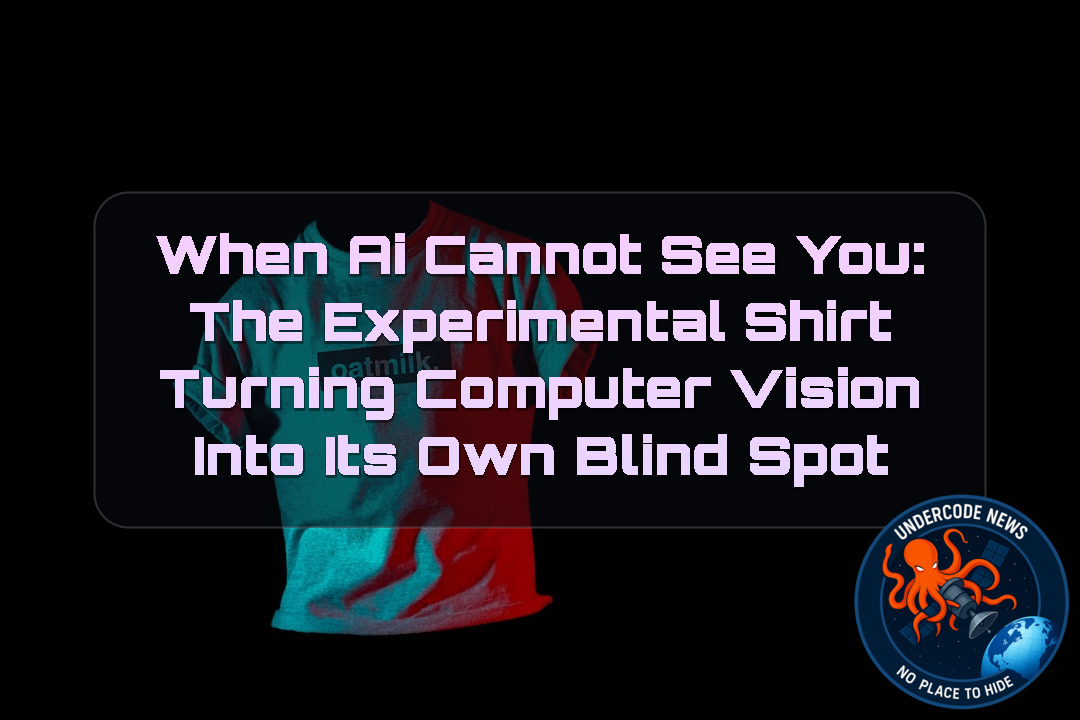
For most of us, clothing is about identity, fashion, comfort, or personal expression. But researchers and artists working at the intersection of artificial intelligence and surveillance are exploring a far more unusual possibility: clothing that deliberately interferes with the way machines recognize people.
Berlin-based artist Simon Weckert’s Digital Camouflage is a striking example. Rather than attempting to cover a face, obscure a body, or physically disappear from a camera, the experimental garment attacks a more fundamental stage of computer vision: the moment an AI system decides that a human being is present in the first place.
To a person standing nearby, the shirt remains perfectly visible. It looks unusual, heavily patterned, and intentionally designed. To a susceptible object-detection model, however, those patterns can interfere with the visual features used to classify a human figure.
That difference between what humans see and what machines interpret is at the heart of the experiment.
The Core Idea Behind Digital Camouflage
Digital Camouflage is based on a concept known in machine learning as an adversarial attack. Instead of damaging software or exploiting a conventional vulnerability, an adversarial attack manipulates an input so that an AI model produces an incorrect result.
In this case, the input is physical.
The unusual textile pattern is intended to interact with the visual characteristics that computer-vision systems use when identifying objects. The objective is not to make the wearer disappear from the camera itself. The camera still captures the person.
The objective is to make the
Humans See a Shirt, AI Sees a Problem
This is what makes adversarial clothing particularly fascinating.
A human observer can look directly at the wearer and immediately recognize a person wearing a patterned shirt. Human perception is remarkably adaptable. We can understand people under different lighting conditions, from different angles, partially obscured by objects, and surrounded by visual clutter.
Computer-vision models operate differently.
A neural network does not understand an image in precisely the same conceptual way a human does. It processes mathematical representations of visual patterns and learns statistical relationships that help it classify objects.
A pattern that appears meaningless to a human can therefore have an outsized influence on a machine-learning model.
The Demonstration With YOLO
Weckert demonstrated Digital Camouflage against a generic open-source YOLO object-detection system, according to the project description.
In the demonstration, pedestrians around the wearer could be detected as people while the person wearing the experimental garment was missed by the model.
That result illustrates the central concept, but it should not be misunderstood as evidence that the garment defeats computer vision universally.
A demonstration against one model under particular conditions is very different from defeating every modern surveillance system.
This Is Not An Invisibility Cloak
The most important qualification surrounding Digital Camouflage is also the easiest one to overlook.
The garment does not make a person literally invisible.
The camera can still capture the wearer. Human observers can still see the wearer. Other algorithms may still identify the wearer. A different object detector might produce a completely different result.
Lighting, camera resolution, distance, viewing angle, background conditions, movement, image compression, model architecture, training data and software updates can all influence the outcome.
A pattern that interferes with one model may have little or no effect on another.
Why Model Diversity Matters
Modern surveillance infrastructure rarely depends on one isolated neural network.
A real-world system could potentially combine multiple detection models, tracking algorithms, facial recognition, body-pose estimation, motion analysis, gait recognition, multi-camera correlation and other forms of sensor information.
Even if one model fails to classify someone as a person, another component might still identify the same individual.
This is why adversarial clothing should be understood primarily as a demonstration of machine-learning weaknesses rather than a guaranteed anonymity technology.
The Physical World Is Becoming An AI Attack Surface
Traditional cybersecurity focuses heavily on digital environments.
Servers can be attacked. Applications can contain vulnerabilities. Networks can be compromised. Credentials can be stolen.
Adversarial machine learning introduces another category of attack surface.
The attack can begin with something as ordinary as an image, sticker, road sign, object, piece of clothing, or physical texture.
That means the boundary between cybersecurity and the physical world is becoming increasingly difficult to define.
From Digital Exploits To Physical Adversarial Attacks
A conventional software exploit might manipulate memory, authentication, permissions, or application logic.
An adversarial machine-learning attack manipulates the input presented to an AI system.
The underlying computer may be functioning exactly as designed.
The camera may be functioning exactly as designed.
The neural network may also be functioning exactly as trained.
Yet the final interpretation can still be wrong.
That is a fundamentally different security problem.
Why Surveillance Makes This More Important
AI-powered video analysis is increasingly being incorporated into public-space monitoring, security systems, retail environments, transportation infrastructure and other physical settings.
The more decisions organizations delegate to automated visual systems, the more important model reliability becomes.
A human security operator might recognize that a detection system has made an obvious mistake.
An automated system may not have that same ability.
If a downstream process assumes that an AI classification is correct, an initial detection error could potentially propagate through the rest of the system.
Kottbusser Tor And The Surveillance Debate
Weckert documented the project at
That setting gives the artwork an additional layer of meaning.
Digital Camouflage is not simply an experiment involving computer vision. It is also a commentary on what happens when algorithmic systems increasingly mediate how people are observed in public.
The project asks an uncomfortable question.
If machines are watching us, what happens when people learn how those machines see?
The Difference Between Privacy And Evasion
There is an important distinction between challenging surveillance technology and guaranteeing anonymity.
Digital Camouflage can demonstrate that computer-vision systems are vulnerable to carefully designed physical inputs.
That does not mean someone wearing a similar garment could reliably evade identification.
A surveillance architecture may use several independent signals. Even if person detection fails, other systems could potentially detect movement, identify a vehicle, associate a device, analyze another camera angle, or flag unusual activity.
The broader lesson is therefore about AI robustness, not guaranteed invisibility.
Adversarial Machine Learning Is Not New
The underlying idea comes from a substantial body of academic research.
Researchers have demonstrated that carefully designed changes to inputs can cause machine-learning systems to make incorrect predictions.
In computer vision, these changes can sometimes be almost imperceptible to humans.
Physical-world adversarial attacks take that concept one step further by moving the manipulation outside the laboratory and into the environment where cameras and AI systems operate.
Clothing is particularly interesting because it moves with the target and can remain part of the visual scene across multiple frames.
Why Clothing Is Such An Interesting Attack Surface
A digital image can be modified precisely.
Physical objects cannot.
A shirt wrinkles. A person turns. Shadows move. The distance from the camera changes. The pattern becomes distorted by perspective.
For an adversarial garment to remain effective in the real world, it must contend with all of those variables.
That makes physical adversarial examples significantly more complicated than simply editing pixels in an image.
The Biggest Weakness: Generalization
One of the most important questions surrounding experiments like Digital Camouflage is whether the effect generalizes.
A pattern optimized against one particular model may not work against another.
A detector trained using one dataset may interpret the same pattern differently from a detector trained using another.
Even different versions of the same model family can behave differently.
This is why independent testing across multiple models, cameras and environments would be essential before making broad claims about effectiveness.
Could AI Simply Learn To Ignore The Shirt?
Potentially, yes.
If a detection system repeatedly encounters adversarial patterns designed to confuse it, developers can train models with adversarial examples and other challenging inputs.
This creates an ongoing technological arms race.
One side develops inputs designed to confuse the model.
The other side improves the model to recognize those inputs.
Then the attacker adapts again.
This cycle is already familiar in cybersecurity, where defensive systems continuously evolve in response to new attacks.
The AI Security Arms Race
The interesting part is that neither side necessarily needs to completely defeat the other.
A defender may only need to make an adversarial pattern unreliable.
An attacker may only need to reduce detection confidence enough to interfere with a particular automated process.
That difference matters.
In security, an attack does not always have to produce total failure to create operational consequences.
Computer Vision Does Not Equal Human Vision
Perhaps the deepest lesson from Digital Camouflage is philosophical as much as technical.
We often speak about AI seeing something.
But machine vision is not human vision.
A person does not normally identify a human being by calculating a probability distribution across millions of learned visual features.
A neural network does.
That means the machine can develop strange blind spots.
It can be exceptionally good at recognizing certain visual structures while remaining surprisingly vulnerable to patterns that humans barely notice.
The Paradox Of Modern AI
The paradox is almost beautiful.
The more sophisticated computer vision becomes, the more precisely researchers can understand the features those systems rely upon.
And once those features become understood, they can potentially be manipulated.
The same mathematical structure that gives AI its remarkable recognition capabilities can also expose unexpected weaknesses.
What This Means For AI Developers
For developers, projects like Digital Camouflage should not simply be dismissed as artistic experiments.
They can serve as reminders that benchmark performance does not automatically equal real-world robustness.
A model can achieve excellent accuracy on standard datasets and still behave unexpectedly when exposed to deliberately engineered physical inputs.
Testing should therefore include adversarial and out-of-distribution scenarios.
What This Means For Surveillance Operators
Organizations deploying computer vision should assume that detection systems can make mistakes.
That means automated classifications should not automatically become irreversible decisions.
Human oversight, multiple detection signals, confidence thresholds, audit mechanisms and continual model evaluation can all become important depending on the application.
The higher the consequence of a false positive or false negative, the more carefully the system should be designed.
What This Means For Privacy Advocates
Privacy advocates may see another lesson here.
Surveillance systems are not infallible machines that possess perfect knowledge.
They are statistical systems operating under technical constraints.
That does not eliminate the privacy risks created by surveillance.
Instead, it demonstrates that society must understand both sides of the technology: what these systems can accomplish and where they can fail.
What This Means For Ordinary People
For everyday users, the most realistic takeaway is not that everyone should buy an adversarial shirt.
It is that AI surveillance deserves more scrutiny as it becomes increasingly common.
People often assume that a camera simply records reality.
Increasingly, cameras record images that are interpreted by algorithms.
Those interpretations can influence what a system believes happened.
The Human Factor Remains Important
There is another limitation that technology cannot easily eliminate.
Humans remain part of many surveillance environments.
An AI detector might fail to classify a person correctly, while a human operator looking at the same video could recognize them immediately.
This is another reason why the word “invisible” can be misleading.
The experiment targets machine perception, not human perception.
Artistic Protest Meets Technical Research
Digital Camouflage occupies an unusual space between art, technology and security research.
It transforms an abstract concept from machine-learning literature into something physical and visible.
Instead of reading about adversarial examples in a research paper, people can see the idea represented by a garment.
That makes the concept accessible to a much wider audience.
The Bigger Question About Machine Surveillance
The most important question may not be whether one shirt can fool one detector.
The bigger question is how society should respond when AI systems become responsible for interpreting public life.
Who decides what counts as suspicious?
Who audits the models?
Who investigates false detections?
Who is responsible when an algorithm gets it wrong?
And how transparent should these systems be?
These questions become more urgent as computer vision moves from experimental technology into everyday infrastructure.
What Undercode Say:
AI Does Not Need To Be Hacked To Be Manipulated
The most important detail in Digital Camouflage is that nobody needs to compromise the surveillance computer.
The attack surface can exist entirely in the camera’s field of view.
That changes the traditional cybersecurity model.
Security teams normally protect systems against malicious code.
Adversarial machine learning forces them to think about malicious inputs.
A camera can receive a perfectly valid image.
The neural network can process that image normally.
The classification can still be wrong.
That creates an unusual form of security weakness.
The attacker is manipulating perception rather than computation.
The distinction is extremely important.
A successful adversarial input does not necessarily require privileged access.
It does not require malware.
It does not require stolen credentials.
It does not require exploiting an operating system vulnerability.
The physical environment itself becomes part of the attack.
That is why adversarial AI deserves attention from cybersecurity professionals.
The problem also becomes harder when multiple models are involved.
A pattern designed against YOLO may behave differently against another architecture.
A model update can eliminate
A different camera angle can change the result.
Lighting can completely alter the visual signal.
Compression can distort the pattern.
Distance can reduce its influence.
Movement can introduce additional uncertainty.
All of these variables make real-world adversarial attacks difficult to reproduce consistently.
But inconsistency does not make the research irrelevant.
Quite the opposite.
A weakness does not have to work everywhere to reveal something important about the system.
It only needs to demonstrate that the
This is especially significant for high-stakes automated systems.
When AI becomes responsible for security decisions, model confidence can become operationally important.
A false negative can be just as serious as a false positive.
Organizations therefore need testing methodologies that go beyond conventional accuracy benchmarks.
They need adversarial evaluation.
They need physical-world testing.
They need multiple environmental conditions.
They need model-version comparisons.
They need to understand how systems behave when inputs are deliberately designed to produce confusion.
And they need to assume that future attackers will understand these weaknesses better than today’s defenders.
The most interesting aspect of Digital Camouflage is therefore not the shirt.
It is the demonstration that the physical world can influence AI in unexpected ways.
A patterned surface can become an input.
An input can become an adversarial example.
An adversarial example can become a security problem.
And a security problem can eventually become a policy problem.
As computer vision becomes more deeply integrated into society, the ability to manipulate machine perception will become an increasingly important research area.
The future of AI security may not be limited to protecting models from hackers.
It may also involve protecting models from the world they are designed to understand.
Verification Results
✅ Digital Camouflage is a real experimental project by Berlin-based artist Simon Weckert, and the project explores physical adversarial patterns intended to interfere with computer-vision systems.
✅ The concept of adversarial clothing is grounded in real machine-learning research, including research into physical-world adversarial examples and object-recognition systems.
❌ The garment should not be described as universal invisibility or a guaranteed way to defeat surveillance. Its effectiveness depends on the model, environment, camera conditions and other technical factors, and the project itself does not establish that it defeats government surveillance systems.
Prediction
(+1) Adversarial AI Testing Will Become Standard
As AI-powered cameras and autonomous systems become more common, developers will increasingly test models against deliberately manipulated physical inputs.
(+1) Defensive Computer Vision Will Improve
Detection models will likely become better at recognizing adversarial patterns as researchers incorporate adversarial examples into training and evaluation.
(+1) Physical AI Security Will Become A Major Research Field
Security researchers will increasingly treat objects, clothing, signs, road markings and environmental textures as potential inputs capable of influencing machine-learning systems.
(-1) One Universal Anti-Surveillance Shirt Is Unlikely
It is unlikely that a single physical pattern will reliably defeat every future computer-vision architecture, especially as systems become more diverse and combine multiple sources of information.
(+1) The Debate Will Move Beyond Facial Recognition
Public discussions about AI surveillance will increasingly focus on broader machine perception, including person detection, object tracking, behavioral analysis and sensor fusion.
Deep Analysis
Inspecting A Computer-Vision Environment
For security researchers evaluating an AI vision system, the first step is understanding the software and model environment rather than assuming that one detector represents the entire surveillance stack.
uname -a
python3 --version
python3 -m pip list
Identifying Installed Machine-Learning Components
A controlled research environment can be inspected to determine which computer-vision libraries and frameworks are being used.
python3 -m pip list | grep -Ei 'torch|tensorflow|opencv|ultralytics'
Checking GPU And Driver Information
Hardware acceleration can affect how computer-vision workloads are deployed and tested.
nvidia-smi
Examining OpenCV Capabilities
Researchers can verify the installed OpenCV environment before beginning controlled computer-vision experiments.
python3 -c "import cv2; print(cv2.<strong>version</strong>)"
Inspecting Python And PyTorch
A controlled laboratory environment can also report the machine-learning framework version.
python3 -c "import torch; print(torch.<strong>version</strong>)"
Testing Model Robustness Safely
Rather than treating a single successful detection failure as proof of universal evasion, researchers should evaluate models across controlled conditions.
mkdir -p vision-test/{images,results,logs}
Recording Experimental Results
A simple experiment log can preserve model versions, environmental conditions and observations.
printf "model,lighting,distance,angle,result
" > vision-test/logs/results.csv
Comparing Model Versions
One of the most important defensive tests is determining whether an observed weakness survives a model update.
git status
git log --oneline -5
Monitoring Model Behavior
For legitimate defensive research, researchers should record confidence scores and detection outcomes rather than relying only on whether a bounding box appears.
tail -f vision-test/logs/results.csv
The Security Lesson
The deeper lesson is simple: AI perception must be treated as an attack surface.
A surveillance camera does not merely capture reality anymore.
It captures reality for a machine-learning system to interpret.
And when that interpretation can be influenced by something as ordinary as a pattern on a shirt, the boundary between physical security and cybersecurity becomes far less clear.
The Future Of Machine Vision
From Recognition To Resilience
Digital Camouflage represents a fascinating collision between art, artificial intelligence and security research.
Its greatest value may not be proving that a particular shirt can fool a particular detector.
Its real value is showing the public that machine vision has weaknesses that human observers may never notice.
That distinction matters enormously.
AI systems are becoming better at recognizing people, objects and environments, but greater capability does not automatically mean perfect reliability.
The next generation of computer vision will therefore need more than accuracy.
It will need resilience.
It will need adversarial testing.
It will need transparency.
And it will need engineers who understand that sometimes the most dangerous input is not malicious code.
Sometimes it is simply something standing in front of the camera.
▶️ Related Video (76% Match):
🕵️📝Let’s dive deep and fact‑check.
🎓 Live Courses & Certifications:
Join Undercode Academy for Verified Certifications
🚀 Request a Custom Project:
Secure, high-velocity infrastructure and disruptive technological engineering. Contact our engineering team for high-tier development and proprietary systems:
[email protected]
💎 Smart Architecture | 🛡️ Secure by Design | ⭐ Trusted by Thousands
References:
Reported By: x.com
Extra Source Hub (Possible Sources for article):
https://www.discord.com
Wikipedia
OpenAi & Undercode AI
Image Source:
Unsplash
Undercode AI DI v2
🔐JOIN OUR CYBER WORLD [ CVE News • HackMonitor • UndercodeNews ]
📢 Follow UndercodeNews & Stay Tuned:
𝕏 formerly Twitter 🐦 | @ Threads | 🔗 Linkedin | 🦋BlueSky | 🐘Mastodon | 📺Youtube


