
Listen to this Post
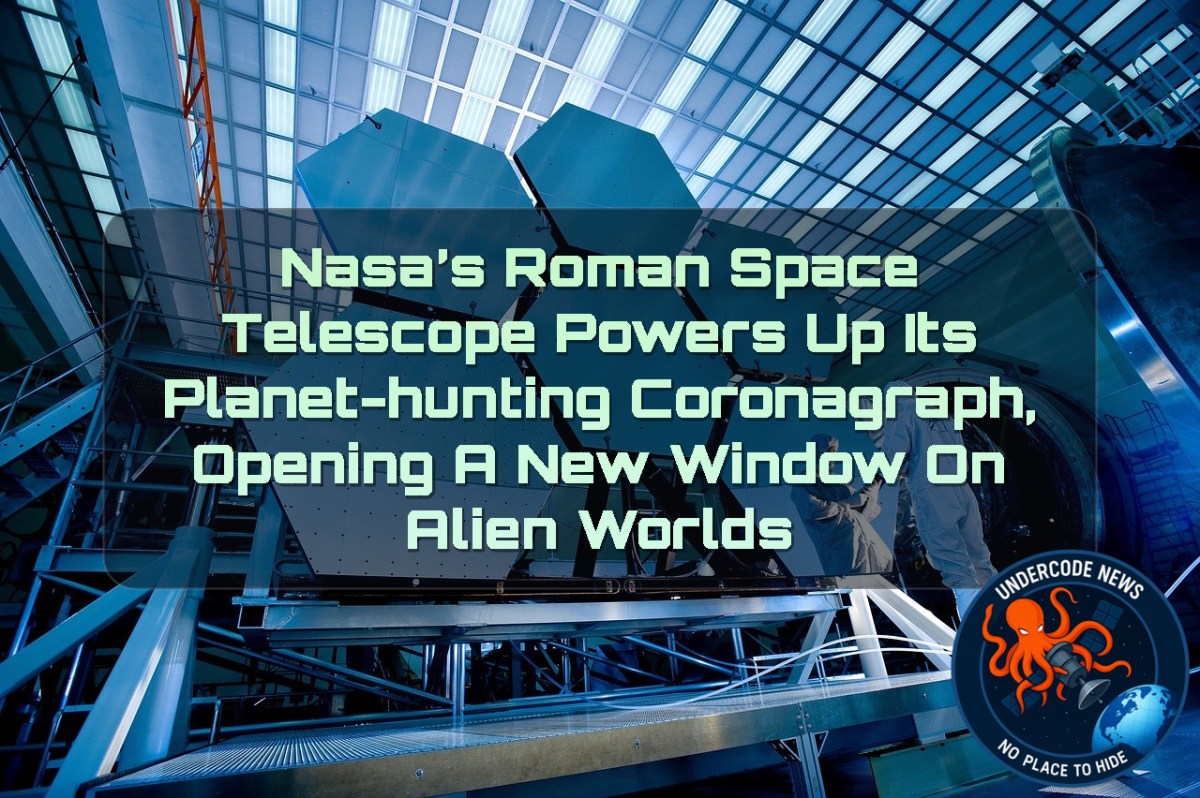
A Powerful New Chapter Begins
NASA’s Nancy Grace Roman Space Telescope has reached a major milestone in its journey to study worlds beyond our solar system. The mission team has successfully powered on the spacecraft’s Coronagraph Instrument, a sophisticated system designed to suppress the overwhelming glare of distant stars and reveal the faint light reflected by planets orbiting them.
The achievement may sound like a routine engineering step, but it represents something far more significant. Directly photographing an exoplanet is extraordinarily difficult because the planet is vastly dimmer than the star it orbits. Roman’s coronagraph has been designed to tackle precisely that problem, using an intricate combination of optics, masks, deformable mirrors, and sensors.
The instrument’s activation took place on September 1, beginning at 7:27 a.m. EDT and completing at 8:22 a.m. EDT. The successful power-on marks the beginning of a months-long commissioning process during which engineers and scientists will carefully calibrate and test the system before it enters full scientific operations.
Why This Moment Matters
The universe contains billions of stars, and astronomers now know that planets are common around them. Yet seeing those planets directly remains one of the hardest challenges in observational astronomy.
Most exoplanets have historically been discovered indirectly. Scientists can detect a planet when it causes a tiny dip in its star’s brightness, known as the transit method, or when its gravity produces measurable effects on the light from a background star through gravitational microlensing.
Direct imaging is different.
Instead of detecting a planet through its influence on something else, astronomers attempt to actually capture light coming from the planet itself.
That sounds simple. It is anything but.
The Star Is the Problem
A planet reflecting light from its host star can be billions of times fainter than the star itself. From Earth or space, the planet can effectively disappear inside the star’s overwhelming glare.
Imagine trying to photograph a tiny candle sitting directly beside a powerful searchlight from an enormous distance. The candle may be visible in principle, but the searchlight dominates the image.
Roman’s Coronagraph Instrument is engineered to suppress that stellar glare.
By blocking and manipulating the star’s light before it reaches the detector, the system attempts to isolate the much weaker signal coming from an orbiting planet or a surrounding disk of dust.
Inside Roman’s Coronagraph
The coronagraph is not simply a piece of glass placed in front of a camera. It is a complex optical system containing multiple technologies designed to work together with extraordinary precision.
Its architecture includes specialized optics, masks that block starlight, flexible or deformable mirrors capable of making extremely small adjustments, and sensors that monitor the resulting optical performance.
These components allow the instrument to actively control unwanted light.
That capability is particularly important because even microscopic imperfections in the optical system can create unwanted patterns that resemble faint planetary signals.
Deformable Mirrors Make the Difference
One of the most intriguing technologies aboard the coronagraph is its use of deformable mirrors.
Unlike conventional mirrors, these mirrors can change their shape by tiny amounts. The purpose is not to redirect the telescope dramatically but to make microscopic corrections to the optical wavefront.
Those adjustments can reduce residual starlight and improve the contrast between a star and the planet researchers are attempting to observe.
In other words, Roman is not simply taking a picture and hoping the planet appears.
The instrument is actively working to create an environment in which an extremely faint planetary signal can emerge from the noise.
A Technology Demonstration With Scientific Ambitions
NASA describes Roman’s Coronagraph Instrument as a demonstration of some of the most advanced direct-imaging technologies ever flown in space.
That distinction matters.
The coronagraph is intended not only to produce valuable observations but also to demonstrate techniques that could influence future missions.
If scientists can prove that these technologies work reliably in space, future telescopes could potentially build upon them to pursue even more ambitious direct observations of exoplanets.
The long-term goal is especially exciting: developing instruments capable of studying increasingly Earth-like worlds around other stars.
Looking Beyond Hot Super-Jupiters
Direct imaging has already produced remarkable discoveries, but the technique has generally been most successful with enormous, young, hot planets located relatively far from their host stars.
These planets emit substantial amounts of infrared radiation because they are still retaining heat from their formation.
Roman’s coronagraph is designed to push direct imaging into a different regime.
It will help researchers investigate older, colder giant planets and planets located closer to their host stars than many of the worlds previously photographed through direct imaging.
That could dramatically expand the scientific value of the technique.
Seeing the Light Reflected by Other Worlds
Roman’s coronagraph will observe planets in visible light.
That is particularly important because reflected visible light contains information about how a planet interacts with radiation from its star.
The brightness and color of a planet can potentially reveal clues about its atmosphere, clouds, surface properties, and surrounding environment.
A planet is not merely a point of light.
Its light can become a scientific fingerprint.
Dusty Disks Tell Another Story
The coronagraph will also observe dusty disks surrounding nearby stars.
These disks are important because they can reveal the environments in which planetary systems evolve.
Dust can be produced by collisions between asteroids and other small bodies, while larger structures within a disk can sometimes be influenced by unseen planets.
By studying these disks, astronomers may gain insight into how planetary systems change over time.
Roman Will Not Hunt Planets in Just One Way
The coronagraph is only one component of Roman’s broader exoplanet science program.
The telescope will also search for planets using microlensing and transits.
Each method provides a different perspective.
Transit observations look for tiny decreases in a star’s brightness when a planet crosses in front of it.
Microlensing takes advantage of Einstein’s theory of general relativity, using the gravity of a foreground star and its planets to temporarily magnify the light of a more distant background star.
Together, these techniques allow Roman to study a much broader population of planetary systems.
The Power of Combining Methods
One of Roman’s greatest scientific advantages may ultimately be the combination of different planet-finding techniques.
No single detection method reveals everything.
Transits are particularly useful for planets whose orbits happen to align with our line of sight.
Microlensing can reveal planets much farther from Earth and is sensitive to planetary systems that might otherwise remain difficult to detect.
Direct imaging provides something different again: the possibility of observing light coming directly from the planet.
Combining these approaches can create a far richer picture of planetary formation and evolution.
The Next Few Months Will Be Critical
The successful power-on does not mean Roman’s coronagraph is immediately ready for routine science.
Instead, the team is entering a long commissioning period.
Engineers will calibrate the instrument, test its various components, measure its optical performance, and verify that the system behaves as expected under actual spaceflight conditions.
The process is deliberately methodical.
Space telescopes cannot simply be repaired in the same way as equipment in a laboratory. Once the instrument is operating hundreds of thousands or millions of kilometers away, every critical behavior must be understood before researchers rely on it for high-value observations.
Three Months of Planned Observations
NASA plans to conduct a series of pre-planned coronagraph observations totaling approximately three months.
These observations will be distributed across the mission’s first year and a half of operations.
The strategy gives researchers time to test the technology under different conditions and evaluate how effectively the instrument can suppress starlight while preserving faint planetary signals.
This period should provide an important real-world assessment of the technology.
Why Direct Exoplanet Imaging Is So Difficult
The fundamental problem is contrast.
A star produces or reflects vastly more light than the planet orbiting it. Even when the planet is relatively bright, its proximity to the star makes separation extremely difficult.
Atmospheric turbulence makes this problem even harder for ground-based telescopes.
Roman has an enormous advantage because it operates above Earth’s atmosphere.
But space does not eliminate every challenge.
Optical imperfections, thermal effects, mechanical stability, detector behavior, and other sources of unwanted light can still interfere with observations.
Roman’s Place in the Exoplanet Revolution
The Nancy Grace Roman Space Telescope is designed to answer questions that go far beyond discovering individual planets.
Astronomers want to understand how planetary systems form, why some systems look radically different from our own, how common different types of planets are, and what environments allow planets to survive over billions of years.
Roman’s enormous field of view and advanced instruments make it especially valuable for large-scale astronomical surveys.
Its coronagraph adds another dimension by demonstrating technologies for seeing individual worlds more directly.
A Telescope Built for the Future
The importance of Roman’s coronagraph may ultimately extend beyond the Roman mission itself.
Space observatories are built over decades, and technological demonstrations today can become essential building blocks for missions launched many years later.
If Roman proves that high-contrast direct imaging can be performed reliably in space, engineers designing future observatories may be able to take those lessons and push the technology much further.
That could eventually bring astronomers closer to directly studying smaller planets around nearby stars.
The Bigger Dream: Earth-Like Worlds
There is an understandable temptation to connect every exoplanet mission directly to the search for extraterrestrial life.
The reality is more complicated.
Roman’s coronagraph is not primarily an Earth-twin detector. Its immediate role is to demonstrate advanced direct-imaging capabilities and study giant planets and dusty planetary environments.
But technological progress is cumulative.
The ability to suppress starlight and isolate a faint planet is one of the fundamental capabilities future missions would need to investigate potentially habitable worlds.
Every improvement in contrast brings astronomy another step closer to that future.
Deep Analysis
How Coronagraphy Works
At its simplest level, a coronagraph attempts to suppress the bright central source while preserving light arriving from nearby objects.
In Roman’s case, the central source is a star and the nearby object is an exoplanet.
The instrument combines physical masks and advanced optical processing to reduce the amount of stellar light reaching the detector.
The remaining image can then be analyzed for faint planetary signals.
A Simplified Optical Concept
A highly simplified conceptual pipeline looks like this:
Star + Planet
|
v
Telescope Optics
|
v
Starlight Suppression Masks
|
v
Deformable Mirrors
|
v
Wavefront Correction
|
v
High-Contrast Detector
|
v
Planetary Signal Analysis
This is not a representation of
Wavefront Control
The critical challenge is controlling the shape of the incoming light wave.
Even extremely small wavefront errors can produce residual starlight in the image.
A deformable mirror can introduce carefully calculated corrections to counteract those errors.
Conceptually, engineers are trying to minimize an error function:
Minimize:
Residual Starlight
Subject to:
Optical Stability
Detector Noise
Wavefront Error
Mechanical Constraints
The result is a carefully optimized optical environment in which the planet has a better chance of becoming detectable.
Image Processing Matters Too
Hardware alone does not solve the problem.
Once the data reaches the detector, sophisticated calibration and analysis techniques are required to distinguish a genuine planetary signal from instrumental artifacts.
A simplified computational workflow might resemble:
Conceptual workflow only
raw_image="roman_coronagraph_data.fits"
calibrate $raw_image
–dark-correction
–flat-field
–bad-pixel-mask
subtract_starlight
–reference-library
–wavefront-model
detect-companion
–contrast-threshold
–astrometric-validation
These commands are illustrative rather than official NASA commands.
Why False Positives Matter
A faint point of light near a star does not automatically mean astronomers have discovered a planet.
Instrumental artifacts, background stars, detector effects, diffraction structures, and imperfect calibration can produce misleading signals.
Researchers therefore need multiple checks before confirming an observation.
The scientific process is intentionally conservative.
A compelling signal must survive repeated analysis and independent validation.
Direct Imaging Versus Transit Detection
Transit detection asks:
Does the star become slightly dimmer when something crosses in front of it?
Direct imaging asks:
Can we isolate the faint light from the object itself?
The two approaches therefore provide fundamentally different information.
A transit can reveal a
Direct imaging can provide measurements of reflected or emitted light and the planet’s position relative to its star.
Neither technique replaces the other.
Why Microlensing Adds Another Dimension
Microlensing works through gravitational geometry rather than physical imaging.
When a foreground planetary system passes near the line of sight to a distant background star, the gravity of the foreground system can magnify the background star’s light.
A planet can create a characteristic perturbation in that magnification.
This method can detect planetary systems that are extremely difficult to observe through direct imaging or transit surveys.
Roman’s ability to combine multiple techniques makes its exoplanet program particularly powerful.
The Technology Could Matter More Than Any Single Discovery
The most important result from
The bigger achievement could be demonstrating that sophisticated high-contrast imaging systems can operate successfully in space.
Future observatories could use these lessons to develop larger and more capable coronagraphs.
In that sense, Roman is partly an astronomical observatory and partly a technological bridge to the next generation of space telescopes.
The First Images Will Be Watched Closely
Once commissioning advances far enough, the astronomical community will be watching the coronagraph’s performance carefully.
Researchers will want to know how closely the real instrument matches its theoretical performance.
They will examine contrast, stability, calibration accuracy, wavefront control, detector behavior, and the ability to distinguish faint objects from residual starlight.
Those measurements will determine how aggressively scientists can use the coronagraph for its planned observations.
A Broader View of Planetary Systems
The dusty disks Roman studies could also provide important context.
Planetary systems are dynamic environments.
Objects collide, planets migrate, dust is redistributed, and gravitational interactions reshape the architecture of a system.
Observing those structures around other stars allows scientists to compare them with the history of our own Solar System.
That comparison can reveal whether systems like ours are unusual or part of a broader cosmic pattern.
Why This Is an Emotional Scientific Milestone
There is something remarkable about the idea behind Roman’s coronagraph.
A spacecraft is being engineered to look at a star and deliberately remove its light from the picture so that something almost impossibly faint can be seen beside it.
That faint signal could belong to a planet orbiting another star.
A world that may be billions of kilometers away.
A world that humans will probably never visit.
And yet, with enough technology and patience, its light can cross interstellar space and reach a detector built by people on Earth.
The Road Ahead
Roman’s coronagraph has only just begun this next stage.
Power-on is the first major checkpoint.
Calibration comes next.
Then testing.
Then carefully planned observations.
And eventually, scientists will begin using the instrument to answer questions that have existed since the first exoplanets were discovered.
How diverse are planetary systems?
How do giant planets evolve?
What shapes dusty disks?
And how much closer can humanity get to directly seeing worlds beyond our Solar System?
What Undercode Say:
1. A Quiet Milestone With Huge Consequences
The
2. Roman Is Expanding the Exoplanet Toolbox
The mission is not dependent on one planet-hunting technique.
Its combination of direct imaging, microlensing, and transit observations gives researchers several complementary ways to study planetary systems.
3. Direct Imaging Changes the Conversation
Finding a planet indirectly tells us that something is there.
Direct imaging begins to tell us what that world looks like in terms of its observable light.
4. Contrast Is the Central Battle
The fundamental enemy is stellar brightness.
A coronagraph has to suppress enormous amounts of unwanted light without accidentally suppressing the planetary signal researchers need.
5. Tiny Errors Become Major Problems
At this level of precision, extremely small optical imperfections can become scientifically significant.
That makes calibration and wavefront control essential.
- Deformable Mirrors Are More Than Engineering Tricks
The flexible mirrors give the instrument an ability that traditional fixed optics cannot provide.
They allow engineers to compensate for imperfections dynamically.
7. Space Provides a Major Advantage
Roman does not have to look through
That removes an important source of distortion and instability.
8. But Space Is Not Perfect
Operating outside
The commissioning process exists to understand those challenges.
- The First Months Will Reveal the Reality
Laboratory testing can predict performance.
Space operations demonstrate whether those predictions survive the real environment.
10. The Three-Month Observation Program Matters
The planned observations should provide valuable evidence about what the coronagraph can realistically accomplish.
11. Older Planets Are Particularly Interesting
Direct imaging has historically favored young, hot planets.
Roman’s technology could expand observations toward colder and older giant planets.
12. Planetary Disks Are Cosmic Time Capsules
Dust around stars can reveal processes associated with planetary formation and evolution.
Those structures can act as clues to the invisible architecture of planetary systems.
- Roman Is Not Just Searching for Another Earth
It is important not to overstate the mission.
Roman’s coronagraph is not a magical device designed to immediately photograph Earth twins.
Its nearer-term role is technological demonstration and scientific observation of giant planets and dusty disks.
14. But Technology Builds on Technology
Today’s giant-planet observations can help enable tomorrow’s smaller-planet observations.
That is why technological demonstrations matter.
- The Future May Be More Important Than the First Results
The greatest legacy of
Future observatories may inherit its lessons.
- Direct Imaging Is a Difficult Form of Astronomy
Researchers are effectively trying to separate a tiny signal from a vastly brighter neighboring source.
That requires extraordinary control over both hardware and data.
17. Software Is Part of the Telescope
Modern astronomy does not end when photons hit the detector.
Data reduction, calibration, modeling, and statistical analysis are essential components of the scientific process.
18. False Positives Are Always a Concern
A faint signal must be carefully tested before scientists can confidently identify it as a planet.
19. Multiple Observations Increase Confidence
Repeated observations can help determine whether a candidate moves as expected for an orbiting object.
20. Spectral Information Could Become Extremely Valuable
As direct imaging technology improves, measurements of planetary light can potentially reveal information about atmospheric composition.
21. Clouds Could Become Scientific Evidence
The way a planet reflects light may contain clues about clouds, haze, and atmospheric structure.
22. Planetary Evolution Is a Long-Term Story
Astronomers want to understand not merely how planets form, but how they change over millions and billions of years.
23. Roman Can Help Connect Those Stages
Its broad exoplanet program provides multiple perspectives on planetary populations.
- Microlensing Sees What Other Surveys Can Miss
Because it relies on gravitational alignment, microlensing can reveal planets that are poorly suited to transit or direct-imaging searches.
25. Transit Surveys Remain Essential
The transit technique remains one of the most productive ways to discover and characterize exoplanets.
26. Direct Imaging Adds the Missing Perspective
Instead of relying entirely on the
27. The Coronagraph Is a Precision Instrument
Its value depends on maintaining extremely controlled optical conditions.
28. Commissioning Should Not Be Rushed
A rushed calibration process could undermine years of scientific work.
29. Every Successful Test Builds Confidence
Each verified subsystem reduces uncertainty about later scientific operations.
30. The Mission Represents Generational Engineering
Space telescopes often depend on technologies developed long before launch.
Roman is part of that same continuum.
31. Astronomy Is Moving Toward Characterization
The field is gradually moving beyond simply asking whether planets exist.
Scientists increasingly want to know what those planets are like.
32. The Difference Is Profound
Discovery tells us that a world exists.
Characterization begins to tell us what kind of world it is.
33. The Coronagraph Supports That Transition
Its ability to isolate faint planetary light is directly connected to this broader scientific evolution.
34. Nearby Stars Become More Interesting
The closer the planetary system, the more promising direct observations can become.
35. Dusty Disks Add Environmental Context
A planet should not be studied in isolation.
Its surrounding material can reveal clues about its formation and evolution.
36. Roman Could Strengthen Future Mission Designs
Engineers will learn not only from successful observations but also from limitations discovered during commissioning.
37. Even Imperfect Performance Can Be Valuable
A technology demonstration does not have to achieve every theoretical objective to influence future spacecraft.
Understanding limitations is itself useful.
38. The Scientific Payoff Could Take Years
Some of
39. Humanity Is Learning to See Further
Each generation of telescopes removes another layer of darkness between us and the distant universe.
40.
The successful power-on is not the end of the journey.
It is the moment the instrument begins proving whether humanity can make an increasingly difficult dream practical: seeing faint worlds orbiting distant stars.
✅ NASA’s Roman Coronagraph Has Been Powered On
The article states that NASA successfully activated the Nancy Grace Roman Space Telescope’s Coronagraph Instrument on September 1.
The reported power-on sequence began at 7:27 a.m. EDT and concluded at 8:22 a.m. EDT.
✅ The Coronagraph Is Designed to Suppress Starlight
The instrument uses masks, optics, deformable mirrors, and sensors to reduce the overwhelming brightness of stars.
This is necessary for attempting direct observations of much fainter objects orbiting those stars.
✅ Roman Will Use Multiple Exoplanet Detection Methods
The Roman mission is designed to study planets through direct imaging as well as microlensing and transit observations.
Those techniques complement one another and allow scientists to investigate different planetary populations.
✅ Commissioning Will Continue After Power-On
The activation is not equivalent to full scientific readiness.
The coronagraph must undergo calibration and testing before its planned scientific observations can proceed at full capability.
Prediction
(+1) Roman Will Become an Important Bridge to Future Exoplanet Observatories
The most likely long-term outcome is that Roman’s coronagraph will demonstrate valuable techniques for suppressing starlight and controlling optical wavefronts in space.
Even if its direct-imaging observations remain technically challenging, the experience gained from operating the instrument could influence the architecture of future telescopes.
The strongest legacy may therefore be technological rather than a single spectacular planetary photograph.
(+1) Direct Imaging Will Gradually Move Toward More Challenging Worlds
As coronagraph technology improves, astronomers will increasingly target planets that are colder, older, smaller, and closer to their host stars.
Roman’s work could become one of the stepping stones toward future missions capable of studying potentially habitable planets.
(+1) Exoplanet Research Will Shift Further Toward Characterization
The next major era of exoplanet science will not be defined only by discovering thousands of additional planets.
Researchers will increasingly focus on understanding atmospheres, clouds, temperatures, orbital environments, and planetary evolution.
Roman’s coronagraph is part of that transition.
(-1) Direct Imaging Will Remain Technically Limited
The contrast between stars and planets is an enormous physical challenge.
Even with sophisticated optics and deformable mirrors, residual starlight and instrumental noise may limit the number of planets Roman can directly observe.
That would not make the mission unsuccessful, but it could restrict the scope of its direct-imaging results.
(+1) The Biggest Discovery May Come From the Technology Itself
Roman’s coronagraph could ultimately prove that advanced high-contrast imaging techniques are practical enough to justify even more ambitious future space missions.
And if that happens, today’s seemingly modest power-on milestone could eventually be remembered as one of the steps that helped humanity get closer to directly studying distant planetary worlds.
▶️ Related Video (76% Match):
🕵️📝Let’s dive deep and fact‑check.
🎓 Live Courses & Certifications:
Join Undercode Academy for Verified Certifications
🚀 Request a Custom Project:
Secure, high-velocity infrastructure and disruptive technological engineering. Contact our engineering team for high-tier development and proprietary systems:
[email protected]
💎 Smart Architecture | 🛡️ Secure by Design | ⭐ Trusted by Thousands
References:
Reported By: science.nasa.gov
Extra Source Hub (Possible Sources for article):
https://www.twitter.com
Wikipedia
OpenAi & Undercode AI
Image Source:
Unsplash
Undercode AI DI v2
🔐JOIN OUR CYBER WORLD [ CVE News • HackMonitor • UndercodeNews ]
📢 Follow UndercodeNews & Stay Tuned:
𝕏 formerly Twitter 🐦 | @ Threads | 🔗 Linkedin | 🦋BlueSky | 🐘Mastodon | 📺Youtube


