
Listen to this Post
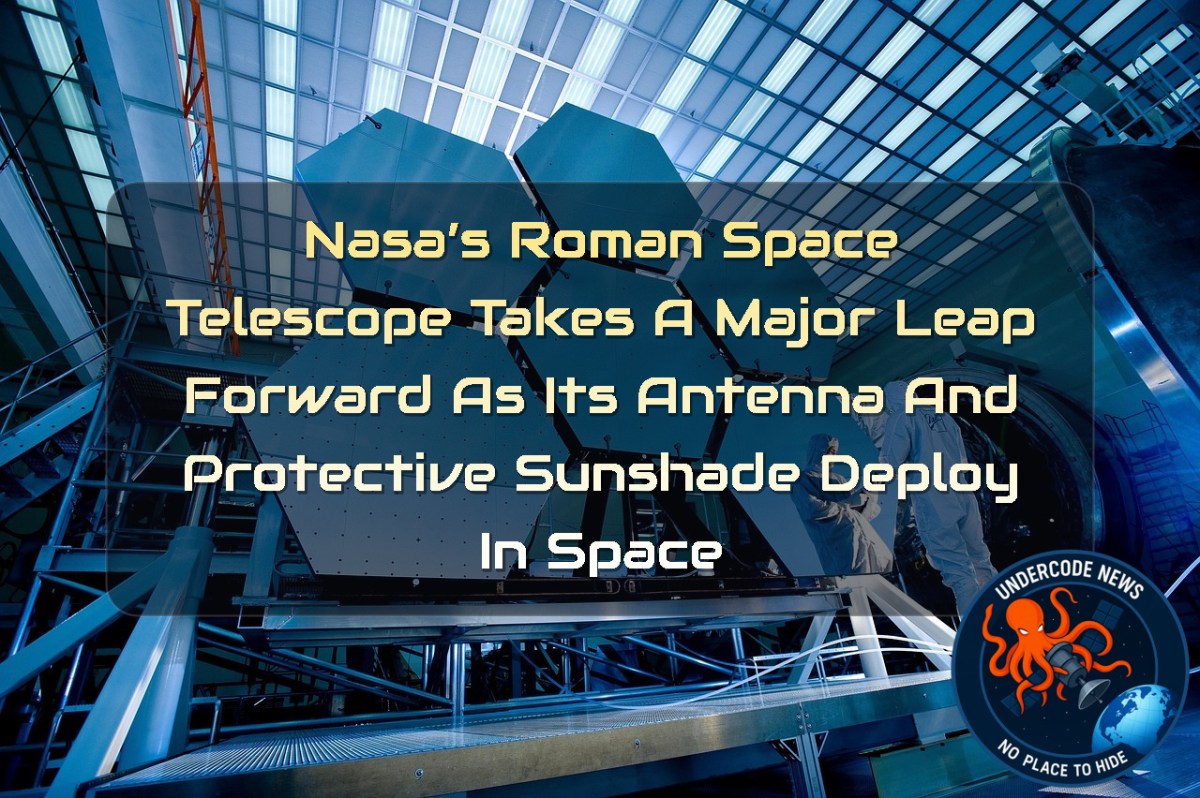 A New Chapter Begins for NASA’s Next Great Space Observatory
NASA’s Nancy Grace Roman Space Telescope has reached another critical milestone on its journey toward transforming our understanding of the universe. After years of development, testing, and preparation, the spacecraft has successfully deployed two essential pieces of hardware: its powerful high-gain communications antenna and its large, visor-like sunshade.
These deployments may not produce the spectacular photographs associated with a space telescope, but they represent something just as important: Roman is beginning to operate more like the sophisticated observatory it was designed to become.
The spacecraft will eventually survey enormous portions of the sky, producing an extraordinary volume of scientific data. To accomplish that mission, Roman needs a communications system capable of moving vast quantities of information across roughly a million miles of space. At the same time, its telescope must be protected from unwanted light and heat that could interfere with its extremely sensitive observations.
The successful deployment of the antenna and sunshade therefore marks much more than a mechanical achievement. It demonstrates that NASA is steadily bringing one of its most ambitious astrophysics missions closer to full scientific operation.
Roman’s Antenna Will Become the Spacecraft’s High-Speed Data Highway
At the centre of Roman’s communications architecture is a high-gain antenna measuring approximately 5.6 feet (1.7 metres) across. Despite its considerable size, the antenna weighs only about 24 pounds (11 kilograms), thanks in part to the use of lightweight carbon-composite materials.
That combination of size and low mass is particularly important for a spacecraft operating far from Earth.
Roman will experience significant temperature changes during its mission, meaning its components must remain structurally stable while moving between very different thermal environments. The antenna’s carbon-composite construction was selected to provide the necessary strength without imposing an excessive mass penalty.
In spacecraft engineering, every kilogram matters.
A heavier antenna would require more launch energy and could complicate spacecraft design. Roman instead uses a structure that is remarkably lightweight while still being capable of performing reliably in the harsh environment of deep space.
A Million-Mile Communications Challenge
Roman’s mission will require NASA to move enormous quantities of scientific information from space to Earth.
The spacecraft is expected to generate more data than any previous NASA astrophysics mission, making communication one of the mission’s most important technological challenges.
Roman’s large high-gain antenna is designed to transmit signals across approximately one million miles of intervening space.
That distance creates an obvious problem: radio signals weaken dramatically as they spread through space.
The solution is a combination of antenna size, carefully engineered communications frequencies, powerful ground infrastructure, and highly precise spacecraft pointing.
Roman will therefore function as both an astronomical observatory and an extraordinarily sophisticated long-distance communications platform.
Two Frequencies, Two Critical Jobs
Roman’s dual-band antenna is designed to perform different communication tasks using different frequencies.
One frequency will allow NASA to send commands to the spacecraft while also receiving important information about Roman’s health, position, and operational status.
Another frequency will handle the spacecraft’s enormous scientific data output.
NASA says Roman will be capable of transmitting data at speeds of up to 500 megabits per second to ground stations.
That is an impressive figure for a spacecraft operating so far from Earth, particularly when considering the complexity of transmitting reliable information across interplanetary distances.
The scientific observations collected by Roman will ultimately need to travel through this communications pipeline before researchers on Earth can analyse them.
A Global Ground Network Keeps Roman Connected
Roman will communicate with ground stations in New Mexico, Australia, and Japan.
This geographical distribution is not accidental.
Spacecraft communication depends heavily on
By distributing ground infrastructure across multiple regions, NASA can maintain more consistent communication opportunities with Roman.
The arrangement also provides operational flexibility.
If one station cannot communicate with the spacecraft at a particular moment, another location may be able to establish contact. For a mission expected to produce enormous quantities of data, that redundancy is extremely valuable.
The Antenna Deployment Was a Carefully Timed Operation
Roman’s antenna deployment took approximately four minutes.
According to NASA, the operation concluded at 2:03 p.m. EDT on August 31.
Although four minutes sounds brief, spacecraft deployments are among the moments mission teams treat with extreme caution.
A component folded tightly for launch must be released and positioned correctly after reaching space. There is no technician waiting nearby to manually repair a mechanism if something goes wrong.
Every spring, motor, hinge, cable, sensor, and locking mechanism has to perform as intended.
That is why a successful deployment can represent years of engineering work coming together in just a few minutes.
Roman’s Giant Sunshade Comes to Life
The antenna was only part of the story.
NASA then successfully deployed Roman’s deployable aperture cover, a large sunshade designed to prevent unwanted light from entering the telescope.
The structure resembles a giant visor extending around the telescope.
Its purpose is critical because astronomical instruments are extraordinarily sensitive to light. Even light that is not part of the desired observation can interfere with measurements if it reaches the wrong parts of the optical system.
The sunshade therefore acts as a form of environmental protection for Roman’s telescope.
Three Booms Powered the Sunshade Deployment
The aperture cover was deployed using three electronically triggered booms.
Once activated, the booms sprang upward, pulling the protective structure into its operational configuration.
The entire process lasted approximately eight minutes and was completed successfully at 6:05 a.m. EDT on September 1.
Again, the apparent simplicity of the operation hides a remarkable engineering challenge.
The sunshade had to survive launch vibrations and remain securely folded during the spacecraft’s journey. Once commanded to deploy, its mechanisms needed to operate in the correct sequence and reach their intended configuration.
NASA’s confirmation that the structure deployed successfully represents another major vote of confidence in Roman’s mechanical systems.
Why Blocking Unwanted Light Matters So Much
Roman is being built to study some of the universe’s most difficult scientific questions.
Among its objectives are investigations into dark energy, dark matter, exoplanets, galaxy formation, and the evolution of the cosmos.
Many of these investigations depend on detecting incredibly faint signals.
A stray source of light can therefore become more than a minor inconvenience.
It can contaminate measurements.
The deployable aperture cover is designed to reduce this unwanted illumination and help create the conditions necessary for Roman’s sensitive instruments to perform their observations.
In other words, the sunshade is not simply protecting the telescope.
It is helping protect the scientific value of the mission itself.
The Next Major Milestone Is the Coronagraph Instrument
With the antenna and aperture cover successfully deployed, Roman is moving toward another major phase of commissioning.
NASA’s next significant milestone is activation of the Coronagraph Instrument.
The coronagraph is particularly exciting because it is intended to demonstrate technologies that could eventually allow scientists to directly study planets orbiting other stars.
The instrument works by suppressing the overwhelming brightness of a star so that much fainter objects nearby can become detectable.
This is an extremely difficult observational challenge.
A planet can be dramatically dimmer than the star it orbits, making direct detection extraordinarily challenging. Roman’s coronagraph will help NASA test techniques for separating the faint planetary signal from the much brighter stellar source.
The Wide Field Instrument Will Follow
A few weeks later, NASA expects the Wide Field Instrument to power on.
This instrument will become one of Roman’s most important scientific tools.
The Wide Field Instrument is designed to observe enormous areas of the sky with remarkable sensitivity and efficiency.
That capability is central to Roman’s broader mission.
Rather than focusing exclusively on individual astronomical targets, Roman will conduct large-scale surveys capable of revealing patterns across huge populations of galaxies, stars, and other cosmic objects.
Three Months of Testing and Calibration
Roman is not going to switch on its instruments and immediately begin collecting final science data.
The spacecraft must first go through an extensive commissioning period.
During the approximately three-month commissioning phase, NASA teams will activate, test, calibrate, and characterize the observatory’s systems.
Calibration is particularly important for astronomy.
Scientists need to understand precisely how the telescope and instruments respond to different conditions before they can confidently interpret their observations.
Even tiny optical or electronic effects can influence scientific measurements.
Commissioning is therefore the bridge between “the spacecraft works” and “the spacecraft can produce scientifically trustworthy observations.”
First Roman Images Are Expected in Early 2027
NASA currently anticipates releasing Roman’s first images by early 2027.
That moment could become one of the most anticipated milestones in modern astronomy.
The first images from a major space telescope are more than public-relations events. They provide scientists with an early look at how the observatory is performing and allow engineers to evaluate the quality of the instrument data.
For the public, however, those images will carry a different kind of significance.
They will provide the first visual glimpse of what Roman can see.
And because Roman is designed to survey the universe at an enormous scale, those first images could offer only a small preview of what is to come.
Roman Is Designed for a Different Kind of Astronomy
The Nancy Grace Roman Space Telescope is not simply another version of the Hubble Space Telescope or James Webb Space Telescope.
Its scientific strategy is different.
Hubble became famous for deep, detailed observations of individual cosmic targets. Webb has pushed infrared astronomy into extraordinary territory, allowing researchers to study some of the earliest galaxies and examine planetary systems in unprecedented detail.
Roman complements these capabilities by combining a wide field of view with high sensitivity.
That means Roman can survey huge areas of the sky much faster than many traditional space observatories.
Its strength will not necessarily be taking the deepest picture of one object.
Its strength will be seeing the larger cosmic picture.
A Telescope Built to Map the Invisible
One of Roman’s most important goals is studying dark energy, the mysterious phenomenon associated with the accelerating expansion of the universe.
Scientists know that the universe is expanding.
They also know that this expansion has been accelerating.
What remains uncertain is the physical nature of dark energy and whether our current understanding of gravity and cosmology is complete.
Roman will collect enormous datasets that can help scientists investigate this problem from multiple directions.
Instead of relying on one measurement, researchers will be able to compare different cosmic signals and search for consistent patterns.
Dark Matter Will Also Be Under the Microscope
Dark matter is another major target.
Although dark matter does not appear to emit or reflect light in the ordinary way, scientists can infer its presence from its gravitational influence.
Roman’s large-scale observations can help map how matter is distributed across the universe.
This could reveal important clues about how galaxies and cosmic structures formed and evolved.
The telescope therefore has the potential to study not only what the universe looks like, but also the invisible framework shaping what we can see.
Exoplanets Add Another Dimension
Roman will also contribute to the rapidly expanding field of exoplanet research.
One technique involves gravitational microlensing.
When a star or planet passes in front of another distant star from our perspective, its gravity can temporarily magnify the background star’s light.
Tiny changes in that magnification can reveal planets that might otherwise remain extremely difficult to detect.
This method can help astronomers find planets at distances and orbital configurations that are difficult for other planet-hunting techniques to reach.
Roman could therefore expand our understanding of how common planetary systems are throughout the Milky Way.
Deep Analysis
The Antenna Is More Than a Communication Device
Roman’s antenna should be viewed as part of the mission’s scientific infrastructure rather than simply a radio component.
Every astronomical observation has value only if the resulting information can ultimately reach researchers.
A telescope that produces enormous quantities of data but cannot efficiently transmit them would have severely limited scientific usefulness.
Roman’s high-speed communications system addresses that bottleneck.
Data Volume Will Become a Mission-Critical Resource
At up to 500 Mbps, Roman has been engineered for a substantial data-transfer workload.
A theoretical 500 Mbps connection corresponds to roughly 62.5 megabytes per second before accounting for protocol overhead and real-world operational limitations.
That illustrates the scale of the communications challenge.
Even short observation sessions can generate large quantities of information.
Mission planners must therefore manage when Roman observes, when it communicates, how much data is stored onboard, and when that information can be transmitted to Earth.
Commands Must Remain Highly Reliable
The spacecraft also needs a dependable command channel.
Commands can include changes to observation schedules, instrument operations, spacecraft configuration, and emergency procedures.
Because Roman operates approximately a million miles from Earth, communication is fundamentally different from controlling a computer on a local network.
There is no immediate physical intervention.
Spacecraft operators must rely on carefully designed command sequences and extensive verification.
Example: Monitoring the Spacecraft
A simplified conceptual workflow for mission telemetry could look like:
Roman Space Telescope
|
v
Telemetry Sensors
|
v
Onboard Computer
|
v
High-Gain Antenna
|
v
Deep-Space Ground Station
|
v
Mission Operations
The important point is that scientific operations and spacecraft health are interconnected.
If engineers detect abnormal temperatures, power behaviour, pointing accuracy, or communications performance, scientific operations may need to be adjusted.
Example: Data Transmission Concept
A simplified command-line calculation for understanding theoretical throughput might be:
python3 -c "rate=500/8; print(f'{rate:.2f} MB/s theoretical throughput')"
The result is approximately:
62.50 MB/s theoretical throughput
This is a mathematical conversion, not a statement that Roman will continuously achieve that exact application-level throughput.
Actual spacecraft communications depend on modulation, coding, protocol overhead, link conditions, scheduling, antenna pointing, and other operational factors.
Why the Three Ground Stations Matter
The New Mexico, Australia, and Japan locations provide geographic diversity.
That helps accommodate
For a mission producing huge datasets, communication scheduling becomes a major part of mission planning.
The spacecraft may spend part of its operational timeline observing and another portion transmitting data.
This creates a continuous cycle:
Observe
↓
Store Data
↓
Establish Communication
↓
Transmit
↓
Verify
↓
Continue Science Operations
The Sunshade Protects Measurement Quality
The deployable aperture cover performs a different but equally important role.
Its job is to control the optical environment around the telescope.
Astronomical instruments are not simply cameras.
They are precision scientific measurement systems.
Their observations depend on carefully controlled light levels, thermal conditions, detector behaviour, and calibration.
A properly deployed sunshade contributes to that environment.
Deployment Is a One-Time Engineering Test in Space
The successful deployment of both structures is especially significant because these mechanisms cannot simply be tested again under identical launch conditions.
Engineers can test hardware extensively on Earth, but the actual space deployment is the definitive operational event.
The mechanisms had to survive launch and then operate in microgravity and vacuum.
That makes every successful deployment an important confidence-building milestone.
Commissioning Will Reveal the Real Performance
Passing deployment milestones does not mean the telescope is finished.
The coming weeks and months will be about discovering how the spacecraft performs as an integrated observatory.
Engineers will examine instrument behaviour.
They will calibrate detectors.
They will measure optical performance.
They will verify pointing.
They will test communication systems.
They will evaluate thermal behaviour.
Only after this process will Roman be ready for its full scientific campaign.
The Coronagraph Could Have Long-Term Consequences
The Coronagraph Instrument deserves particular attention because its technology extends beyond Roman.
Directly imaging exoplanets is difficult because the host star can overwhelm the planet’s faint light.
A successful coronagraph can suppress the
Even if Roman does not directly produce a catalogue of Earth-like worlds comparable to science-fiction expectations, the technology it demonstrates could influence future space telescopes.
Roman and the Future of Space Astronomy
The broader significance of Roman is that astronomy is increasingly becoming a data-intensive science.
Modern observatories are not only collecting spectacular images.
They are generating enormous datasets that can be searched for patterns, anomalies, transient events, gravitational effects, planetary signals, and changes over time.
Roman is designed around that reality.
Its wide-field capabilities could allow researchers to move from studying isolated cosmic objects toward analysing the universe statistically.
A Telescope That Can Change the Questions We Ask
When a new observatory becomes powerful enough, it does more than answer existing questions.
It can create new ones.
Roman could uncover unexpected populations of objects.
It could reveal previously unknown relationships between galaxies and dark matter.
It could identify unusual transient events.
It could provide measurements that challenge existing models of cosmic expansion.
The most exciting discoveries may therefore be the ones scientists cannot predict today.
Why the First Images Matter
The first images expected in early 2027 will represent a major public milestone.
But the real scientific revolution will occur after the first pictures.
Roman’s greatest value will come from repeated observations, large surveys, statistical analysis, and years of accumulated data.
A single image can inspire millions of people.
A massive scientific dataset can change our understanding of the universe.
Roman Is Building Momentum
The successful antenna and sunshade deployments indicate that Roman’s commissioning campaign is progressing through important mechanical milestones.
Next come instrument activation, calibration, testing, and performance verification.
Each successful stage reduces uncertainty.
By the time the first images arrive, the mission team will have spent months turning a newly deployed spacecraft into a precision astronomical observatory.
What Undercode Say:
1. A Quiet Milestone With Huge Consequences
The deployment of
2. Data Is the New Telescope Currency
Modern astronomy depends increasingly on how quickly and reliably observatories can move information.
- Roman Was Designed Around Massive Data Production
Its mission architecture anticipates a scientific workload far beyond simply taking occasional photographs.
4. Communications Are Part of the Science
Without a powerful downlink,
5. The
A 5.6-foot antenna weighing only about 24 pounds demonstrates how aggressively spacecraft designers must manage mass.
6. Carbon Composites Have Become Essential
Modern spacecraft increasingly depend on advanced materials that combine strength, stability, and low weight.
7. The Sunshade Is Equally Important
Protecting the telescope from unwanted light directly supports the quality of scientific measurements.
8. Spacecraft Deployment Is Never Routine
Every deployment carries some level of mechanical and operational risk.
9.
A spacecraft can only function when power, thermal control, computing, communications, propulsion, optics, and instruments work together.
10. Commissioning Is Where Reality Meets Engineering
Laboratory simulations can predict performance, but space ultimately provides the final test.
11. Roman Will Complement Webb
Webb excels at detailed infrared observations, while
12. Roman Will Complement Hubble
Hubble has delivered decades of detailed observations, while Roman is optimized for large-scale surveys.
13. Wide Surveys Can Reveal Hidden Patterns
Studying millions of objects can uncover relationships that individual observations cannot.
- Dark Energy Is One of the Biggest Targets
Roman could provide new evidence about why cosmic expansion is accelerating.
15. Dark Matter Is Another Major Mystery
Mapping gravitational effects across huge areas could improve our understanding of the universe’s invisible structure.
16. Exoplanet Science Will Benefit
Roman’s microlensing capabilities could reveal planets that other methods struggle to find.
17. The Coronagraph Is Especially Interesting
Its technology could contribute to future missions designed to directly image distant worlds.
- The Mission Is About More Than Pretty Pictures
Images will be important, but
19. Data Processing Will Become Critical
Scientists will need powerful computing systems to analyse the enormous information Roman generates.
20. Artificial Intelligence Could Become Useful
Machine-learning systems may help classify galaxies, identify transient events, and search for unusual patterns within Roman’s datasets.
21. Automation Will Matter
The scale of
22. Calibration Will Determine Scientific Confidence
Researchers must know how the instruments behave before interpreting subtle cosmic signals.
23. Reliability Matters More Than Speed
A fast communications system is valuable, but accurate and dependable data transmission is essential.
- Ground Infrastructure Is Part of the Mission
Roman is not an isolated spacecraft; it is one component of a global scientific network.
25. Geography Becomes a Space Technology
The location of ground stations on Earth directly affects how efficiently NASA can operate a spacecraft in space.
26. Redundancy Protects the Mission
Multiple communication locations reduce dependence on a single ground facility.
27. Every Successful Deployment Reduces Risk
The antenna and sunshade milestones remove uncertainty from important parts of Roman’s architecture.
- The Next Phase Is Even More Important
Instrument activation will begin revealing whether the telescope performs as expected.
- Early 2027 Could Be a Defining Moment
Roman’s first images will give the world its first direct look at the observatory’s capabilities.
- But the First Images Will Only Be the Beginning
The
31. Roman Could Find Things Nobody Expected
Astronomy repeatedly demonstrates that improved observation produces surprises.
32. Better Surveys Can Challenge Existing Models
If
33. The Mission Could Strengthen Current Theories
It could also provide independent confirmation of important cosmological measurements.
34. Either Outcome Is Scientifically Valuable
Science advances not only through confirmation but also through contradiction.
- Roman Represents a Shift Toward Cosmic Census-Taking
Instead of looking at a few objects, astronomers will increasingly study enormous populations.
36. The Data Could Outlive the Mission
Scientific datasets can continue producing discoveries long after spacecraft stop operating.
37. Future Researchers May Benefit Most
Some Roman discoveries may come from scientists who are not yet working in astronomy today.
- The Mission Shows How Complex Modern Astronomy Has Become
A space telescope is now a combination of optics, computing, communications, materials science, robotics, and advanced software.
39. These Milestones Deserve More Attention
The most important spaceflight achievements are not always the most visually spectacular.
- Roman Is Getting Ready to Rewrite Parts of the Cosmic Story
The antenna is deployed.
The sunshade is deployed.
The instruments are next.
And the scientific community is getting closer to receiving an entirely new view of the universe.
✅ Antenna Deployment
NASA’s reported milestone states that Roman’s high-gain antenna successfully deployed on August 31, with the operation lasting approximately four minutes and concluding at 2:03 p.m. EDT.
✅ Sunshade Deployment
The deployable aperture cover successfully deployed on September 1 using three electronically triggered booms. NASA reported that the process lasted approximately eight minutes and concluded at 6:05 a.m. EDT.
✅ 500 Mbps Data Rate
The article accurately identifies a maximum planned transmission rate of up to 500 megabits per second for Roman’s high-volume scientific communications.
✅ Global Ground Stations
New Mexico, Australia, and Japan are identified as locations for Roman’s ground communication infrastructure, providing geographically distributed opportunities to communicate with the spacecraft.
✅ Early 2027 First Images
NASA’s stated expectation is that Roman’s first images will be released by early 2027, following the commissioning period.
⚠️ Important Context
The 500 Mbps figure should be understood as a maximum system capability rather than a guarantee that Roman will continuously transmit at that rate under every operational circumstance. Real-world throughput depends on communications conditions, scheduling, coding, protocol overhead, and spacecraft operations.
Prediction
(+1) Roman’s First Images Will Trigger a New Wave of Public Interest
When Roman’s first images arrive in early 2027, public attention is likely to surge.
The telescope will not simply produce another collection of beautiful space photographs. Its images and scientific datasets will introduce the public to an observatory designed to study the universe on a massive scale.
The combination of dark-energy research, dark-matter mapping, exoplanet discoveries, and wide-field surveys could make Roman one of the defining astronomical missions of the next decade.
More importantly, the first images may only hint at what is coming.
As commissioning ends and full scientific operations begin, Roman could start generating discoveries that challenge existing ideas about how galaxies form, how planets populate the Milky Way, and why the universe is expanding faster than expected.
The most exciting possibility is not that Roman will simply confirm what astronomers already believe.
It is that it will find something nobody was expecting.
And that is often when astronomy becomes history.
▶️ Related Video (72% Match):
🕵️📝Let’s dive deep and fact‑check.
🎓 Live Courses & Certifications:
Join Undercode Academy for Verified Certifications
🚀 Request a Custom Project:
Secure, high-velocity infrastructure and disruptive technological engineering. Contact our engineering team for high-tier development and proprietary systems:
[email protected]
💎 Smart Architecture | 🛡️ Secure by Design | ⭐ Trusted by Thousands
References:
Reported By: science.nasa.gov
Extra Source Hub (Possible Sources for article):
https://stackoverflow.com
Wikipedia
OpenAi & Undercode AI
Image Source:
Unsplash
Undercode AI DI v2
🔐JOIN OUR CYBER WORLD [ CVE News • HackMonitor • UndercodeNews ]
📢 Follow UndercodeNews & Stay Tuned:
𝕏 formerly Twitter 🐦 | @ Threads | 🔗 Linkedin | 🦋BlueSky | 🐘Mastodon | 📺Youtube


