
Listen to this Post
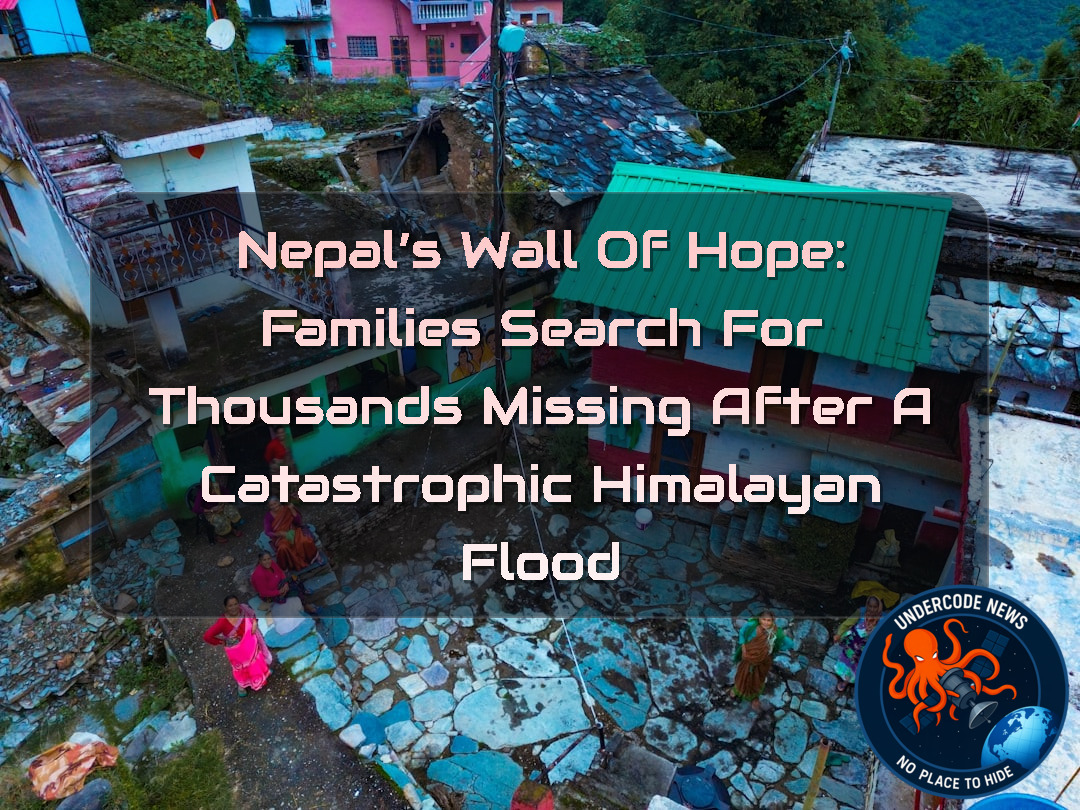 Introduction: A Wall Covered With Faces and a Nation Searching for Answers
In Kathmandu, one wall has become a symbol of heartbreak, hope, and unbearable uncertainty.
Outside Tribhuvan University Teaching Hospital, desperate families are covering a 25-metre wall with photographs of people who disappeared during Nepal’s devastating floods. Every image represents a missing son, daughter, parent, friend, tourist, worker, or loved one. Some families arrive carrying a single photograph. Others bring several. They stand before the growing collection of faces, searching for information and refusing to surrender hope.
The disaster began on August 26, when a catastrophic collapse involving ice, rock, and debris in the Himalayan region near the Nepal-China border triggered destructive flooding downstream. Communities, roads, bridges, homes, and critical infrastructure were overwhelmed by the force of the water and debris. The tragedy has since become one of the most devastating disasters to strike the region in recent years.
As of September 1, the death toll has surpassed 1,000, while roughly 4,000 people remain unaccounted for in Nepal. Rescue teams continue working across remote and heavily damaged areas, but landslides, destroyed roads, debris, and difficult mountain terrain have made the search extraordinarily difficult.
For thousands of families, however, the disaster is not measured only in statistics.
It is measured in photographs on a wall.
A 25-Metre Wall Becomes Nepal’s Last Place of Hope
Families Turn Photographs Into Missing-Person Notices
The wall outside Tribhuvan University Teaching Hospital has become an improvised center of grief and hope.
Families searching for missing relatives have pasted photographs across the long wall, creating a powerful visual record of the human cost of the floods. The faces belong to Nepalis and foreign nationals of different ages and backgrounds, all connected by the same terrifying uncertainty.
Some relatives study the photographs repeatedly, hoping to recognize someone who may have been found alive. Others wait for police updates, hospital information, or news from rescue teams operating hundreds of kilometers away.
The wall does not provide certainty.
But for families who have received no information, uncertainty is sometimes the only thing separating hope from grief. Reports from Kathmandu describe relatives gathering outside the hospital, registering missing persons and searching photographs and official information for any sign of their loved ones.
The Disaster That Changed Everything in Minutes
A Himalayan Collapse Triggered a Catastrophic Flood
The devastating floods began after a major collapse involving Himalayan ice, rock, and debris near the Nepal-China border.
The sudden event sent enormous volumes of water and debris through valleys and river systems, devastating settlements and infrastructure downstream. Early investigations and reporting described an ice-rock avalanche and major landslide activity that rapidly transformed into catastrophic flooding.
In mountainous environments, disasters of this kind can become deadly with extraordinary speed.
A collapse high in the mountains may initially appear distant from populated communities. But once debris blocks, redirects, or suddenly releases water into narrow valleys, the force of the resulting flood can accelerate dramatically.
Villages downstream may have only minutes to react.
Roads can disappear.
Bridges can collapse.
Communication networks can fail.
And rescue teams can suddenly find themselves unable to reach the places where survivors need them most.
More Than 1,000 Lives Lost
The Death Toll Continues to Reveal the Scale of the Tragedy
Nepal’s death toll has now passed 1,000, according to the latest reporting, while thousands remain missing.
The numbers are expected to remain difficult to interpret in the immediate aftermath of such a large disaster because rescue operations are continuing and many affected areas remain difficult to access. Authorities and international rescue teams are still working to locate survivors, recover victims, and identify the dead.
The disaster has also affected foreign nationals.
Tourists, pilgrims, and workers from several countries were in the region when the floods struck, adding an international dimension to the search and rescue operation. Earlier reports documented large numbers of foreign visitors among those initially reported missing.
Behind every revised number is another family waiting for an answer.
And in Kathmandu, those answers are often still painfully absent.
Thousands Remain Missing
The Search Has Become a Race Against Geography
Around 4,000 people remain missing, making the search operation one of enormous complexity.
Nepal’s geography is already among the most challenging in the world. The affected region includes steep mountains, narrow valleys, unstable terrain, and remote communities where transportation and communication can be limited even under normal circumstances.
After catastrophic flooding, those difficulties become far worse.
Roads have been destroyed.
Bridges have been swept away.
Landslides have blocked critical routes.
Debris has buried areas that rescue teams must carefully search.
Reports indicate that helicopters, heavy equipment, search dogs, and international assistance are being used to reach isolated communities and continue rescue efforts.
The problem is no longer simply finding people.
It is physically reaching the places where they may be.
Remote Communities Are Still Difficult to Reach
Destroyed Infrastructure Is Slowing Rescue Operations
Rescue teams are continuing to push toward remote areas, but damaged infrastructure has created a dangerous logistical barrier.
In a major flood disaster, infrastructure is not merely an economic asset.
It becomes part of the rescue system.
A destroyed bridge can prevent ambulances from reaching survivors.
A blocked road can delay food and medicine.
A collapsed communication network can prevent families from reporting missing relatives.
A damaged power system can shut down hospitals, water pumps, and emergency facilities.
The Nepal disaster demonstrates how quickly a natural event can become a wider humanitarian crisis when essential infrastructure fails at the same time. Reports have documented extensive damage to roads, bridges, communities, and other critical facilities throughout the affected region.
The Hospital Has Become a Center of Grief
Families Search for Survivors and the Unidentified Dead
Tribhuvan University Teaching Hospital has become one of the most emotionally charged locations in Kathmandu.
Families arrive searching for missing relatives.
Authorities are also attempting to identify recovered victims.
Photographs, names, missing-person reports, and other identifying information have become critical tools in connecting families with survivors or victims.
The emotional burden is enormous.
Some people arrive hoping their relatives survived.
Others arrive fearing they may need to identify a body.
And many remain trapped between those two possibilities.
Reports from the disaster response indicate that authorities have struggled with large numbers of unidentified victims and overwhelmed facilities, making identification efforts an urgent humanitarian priority.
For the families standing before the wall, information itself has become a form of survival.
A Photograph Can Become the Most Important Evidence
Images Are Helping Families Search for Loved Ones
In large-scale disasters, photographs can become unexpectedly important tools.
A picture may help someone recognize a missing person.
It may help authorities connect reports from different locations.
It may allow a survivor to be identified when documents have been lost.
It may help relatives share information through social media and international networks.
The wall in Kathmandu represents a deeply human version of disaster response.
There is no sophisticated technology in a photograph taped to concrete.
Yet in moments of chaos, something that simple can connect a family to information they desperately need.
The photographs outside the hospital have therefore become more than missing-person notices.
They have become symbols of resistance against disappearance.
The Human Cost Cannot Be Reduced to Numbers
Every Missing Person Represents an Entire Family in Crisis
A disaster headline may say that thousands are missing.
But a family does not experience a disaster as a number.
They experience an empty chair.
An unanswered phone.
A room that remains untouched.
A photograph that suddenly becomes something they carry everywhere.
The psychological damage caused by uncertainty can be especially severe.
Families often struggle between hope and acceptance.
They may receive rumors from survivors.
They may hear conflicting reports.
They may wait days without confirmation.
And as time passes, every silence becomes heavier.
The wall in Kathmandu captures this emotional reality more clearly than any official statistic.
Thousands of faces are not simply evidence of a disaster.
They are thousands of unfinished stories.
Climate Risks Are Increasing in the Himalayas
A Warming Mountain Environment Creates New Dangers
The Himalayan region is experiencing increasing environmental pressure as temperatures rise and glaciers continue to change.
Scientists and disaster experts have repeatedly warned that warming temperatures can destabilize high mountain environments. Glacier retreat, melting snow, unstable slopes, landslides, and rapidly changing water systems can create new and unpredictable hazards for communities living downstream.
Climate change does not mean every individual flood can be explained by a single factor.
But it can increase the conditions that make certain extreme disasters more likely or more dangerous.
In mountain regions, that risk is particularly serious.
Ice and rock can become unstable.
Glacial lakes can expand.
Heavy rainfall can trigger landslides.
Rapid melting can alter river systems.
And communities located far below the mountains may suddenly face disasters originating many kilometers away.
The Nepal catastrophe is therefore also a warning about the growing vulnerability of high-altitude regions.
Hydropower Infrastructure Faces a Growing Challenge
Mountain Development Must Adapt to New Environmental Risks
Hydropower is extremely important for Nepal and other Himalayan countries.
Mountain rivers provide enormous energy potential, and hydropower projects support economic development and electricity generation.
However, the same valleys that provide powerful water resources can also become dangerous during extreme floods.
Reports from the disaster indicate that hydropower sites and workers were among the areas heavily affected, with rescue operations focusing on difficult locations including tunnels and project sites.
This creates a difficult question for governments and engineers.
How should infrastructure be designed when environmental conditions are changing faster than historical disaster models predicted?
The answer may require stronger early-warning systems, improved monitoring of glaciers and slopes, safer evacuation planning, and infrastructure designed to withstand more extreme events.
International Rescue Cooperation Is Becoming Essential
Nepal Cannot Face a Disaster of This Scale Alone
The scale of the tragedy has required assistance beyond Nepal’s own emergency services.
International teams and neighboring countries have contributed support, equipment, rescue capabilities, and humanitarian assistance.
Reports indicate that specialized rescue resources, helicopters, heavy machinery, and international support have been mobilized as operations continue.
Mountain disasters do not respect national borders.
The rivers cross borders.
Tourists come from many countries.
Environmental changes affect entire regions.
And rescue operations often require international technology and expertise.
The Nepal disaster demonstrates why regional cooperation between Himalayan countries may become increasingly important in the coming decades.
Technology Could Transform Future Disaster Response
Early Warning Systems May Save Thousands of Lives
One of the most important lessons from this tragedy is the value of time.
Even a few minutes of warning can save lives.
A functioning early-warning system could automatically send alerts to mobile phones.
River sensors could detect sudden changes in water levels.
Satellite imagery could monitor unstable glaciers and landslides.
Artificial intelligence could analyze environmental data for unusual patterns.
Drones could inspect inaccessible valleys.
Emergency communication networks could continue operating after normal infrastructure fails.
Technology cannot stop every natural disaster.
But it can provide something incredibly valuable.
Time.
And in a rapidly developing flood, time may be the difference between evacuation and catastrophe.
What Undercode Say:
The Real Disaster Is Not Only the Flood, It Is the Collision Between Nature and Vulnerability
The tragedy in Nepal shows how quickly a natural event can become a national humanitarian catastrophe.
The initial collapse may have occurred in a remote Himalayan environment.
But its consequences traveled far beyond the mountains.
Water carried destruction into communities.
Debris destroyed infrastructure.
Infrastructure failures slowed rescue teams.
Delayed access increased uncertainty.
And uncertainty created a second crisis for thousands of families.
This is why disaster preparedness cannot focus only on the moment of impact.
Governments must prepare for everything that happens afterward.
They need communication systems that survive infrastructure failures.
They need backup transportation routes.
They need distributed emergency supplies.
They need reliable missing-person databases.
They need systems capable of operating when roads and electricity disappear.
The photographs on the wall outside the hospital reveal another important issue.
Information management is part of disaster response.
A missing person may be reported to local police.
A survivor may be found by a military unit.
A hospital may receive an unidentified victim.
A family may post information online.
If these systems are disconnected, critical information can remain trapped inside separate databases.
Modern disaster response should connect these systems securely.
A centralized platform could allow authorized responders to compare missing-person reports, hospital records, photographs, DNA information, and rescue updates.
Privacy protections would be essential.
But the technology already exists.
The challenge is coordination.
Satellite monitoring should also become a higher priority across vulnerable Himalayan regions.
Remote sensing can identify landscape changes that may indicate increasing danger.
River-level sensors can detect sudden surges.
Automated alerts can distribute warnings immediately.
Machine learning models can help identify patterns across weather, terrain, and environmental data.
Technology should not replace human judgment.
It should strengthen it.
The disaster also exposes the limits of relying entirely on historical data.
Climate and environmental conditions are changing.
Infrastructure designed around the past may not always be prepared for the future.
Risk models must therefore be continuously updated.
Hydropower projects need stronger emergency planning.
Mountain communities need better evacuation routes.
Tourism operators need faster emergency communication systems.
Cross-border information sharing must improve.
Another major issue is redundancy.
A single road should never be the only connection to a major community.
A single communication network should not be the only emergency channel.
A single hospital should not become the only identification center.
Disaster resilience means assuming that systems will fail.
Then building alternatives before they do.
The emotional images from Kathmandu also remind the world that cybersecurity and digital infrastructure have a role in humanitarian response.
Missing-person databases must remain available.
Emergency websites must resist outages.
Communication networks must be protected from disruption.
Sensitive personal and biometric information must be secured.
A disaster can create opportunities for cybercriminals and scammers who exploit desperate families.
False donation campaigns can appear.
Fake missing-person pages can collect personal information.
Fraudsters can impersonate aid organizations.
That means humanitarian response must include digital security.
Verified communication channels are essential.
Official updates must be easy to identify.
Public information must be protected against manipulation.
Nepal’s tragedy should therefore be studied not only as a natural disaster.
It should be studied as a systems failure under extreme pressure.
Nature triggered the event.
But human preparedness determines how much resilience exists afterward.
The greatest lesson is simple.
Disasters cannot always be prevented.
But their consequences can often be reduced.
The wall of photographs in Kathmandu should become a reminder to governments around the world.
Early warnings matter.
Infrastructure matters.
Data coordination matters.
Emergency communication matters.
Climate resilience matters.
And every minute saved before a disaster can mean lives saved afterward.
Deep Analysis
How Data, Monitoring, and Open-Source Intelligence Can Support Disaster Response
Modern disaster analysis can combine satellite data, weather information, public reports, and infrastructure monitoring to build a clearer picture of rapidly changing events.
Researchers and emergency teams can begin by monitoring trusted official data sources and verifying information before sharing it publicly.
Check network connectivity before collecting emergency data
ping -c 4 1.1.1.1
Retrieve HTTP headers from an official emergency information source
curl -I https://example.gov
Download a publicly available emergency data file
wget https://example.gov/disaster-data.csv
Search a structured log for missing-person related updates
grep -i "missing" emergency_updates.log
Count unique locations mentioned in verified reports
grep -i "location" emergency_updates.log | sort | uniq -c
Monitor system logs during emergency infrastructure operations
journalctl -f
Satellite imagery can also be compared over time to identify major landscape changes.
Organize downloaded satellite metadata
mkdir -p satellite_data/{before,after}
Compare file hashes to verify downloaded files
sha256sum satellite_data/before/
sha256sum satellite_data/after/
Data integrity is particularly important during humanitarian crises.
Create a checksum for an emergency dataset
sha256sum missing_persons_database.csv
Encrypt sensitive humanitarian data locally
gpg -c missing_persons_database.csv
The goal of technology should not be surveillance or exploitation.
It should be faster rescue coordination, accurate information, secure communication, and better protection for affected communities.
The Core Facts Behind Nepal’s Humanitarian Crisis
✅ The flooding followed a catastrophic Himalayan collapse near the Nepal-China border on August 26, with reporting describing an ice-rock avalanche and debris-driven flooding that devastated downstream communities.
✅ Families have posted photographs of missing relatives outside Tribhuvan University Teaching Hospital in Kathmandu, creating a highly visible wall of missing-person notices.
✅ The latest reports indicate that the death toll has exceeded 1,000 while roughly 4,000 people remain missing, although these figures may continue changing as rescue and identification operations progress.
Prediction
What May Happen Next
(+1) Nepal’s rescue operations will likely continue expanding into previously inaccessible areas as roads are reopened, helicopters reach isolated communities, and international assistance strengthens search capabilities.
The number of confirmed survivors and identified victims may continue to change significantly as authorities connect missing-person reports with hospital, rescue, and identification records.
The disaster is likely to increase pressure for stronger Himalayan early-warning systems, satellite monitoring, cross-border information sharing, and climate-resilient infrastructure.
The humanitarian and psychological consequences may continue for months, especially for families whose relatives remain missing and whose communities have lost homes, roads, livelihoods, and essential services.
The photographs on Kathmandu’s wall may eventually be removed.
But the lesson behind them should not be forgotten.
Every face represents a reason to prepare before the next disaster arrives.
Tighten repetitive disaster descriptions
Clarify confirmed facts versus analysis
▶️ Related Video (80% Match):
🕵️📝Let’s dive deep and fact‑check.
🎓 Live Courses & Certifications:
Join Undercode Academy for Verified Certifications
🚀 Request a Custom Project:
Secure, high-velocity infrastructure and disruptive technological engineering. Contact our engineering team for high-tier development and proprietary systems:
[email protected]
💎 Smart Architecture | 🛡️ Secure by Design | ⭐ Trusted by Thousands
References:
Reported By: www.euronews.com
Extra Source Hub (Possible Sources for article):
https://www.quora.com/topic/Technology
Wikipedia
OpenAi & Undercode AI
Image Source:
Unsplash
Undercode AI DI v2
🔐JOIN OUR CYBER WORLD [ CVE News • HackMonitor • UndercodeNews ]
📢 Follow UndercodeNews & Stay Tuned:
𝕏 formerly Twitter 🐦 | @ Threads | 🔗 Linkedin | 🦋BlueSky | 🐘Mastodon | 📺Youtube


