
Listen to this Post
🚀 Introduction: A New Era for Artificial Intelligence Giants
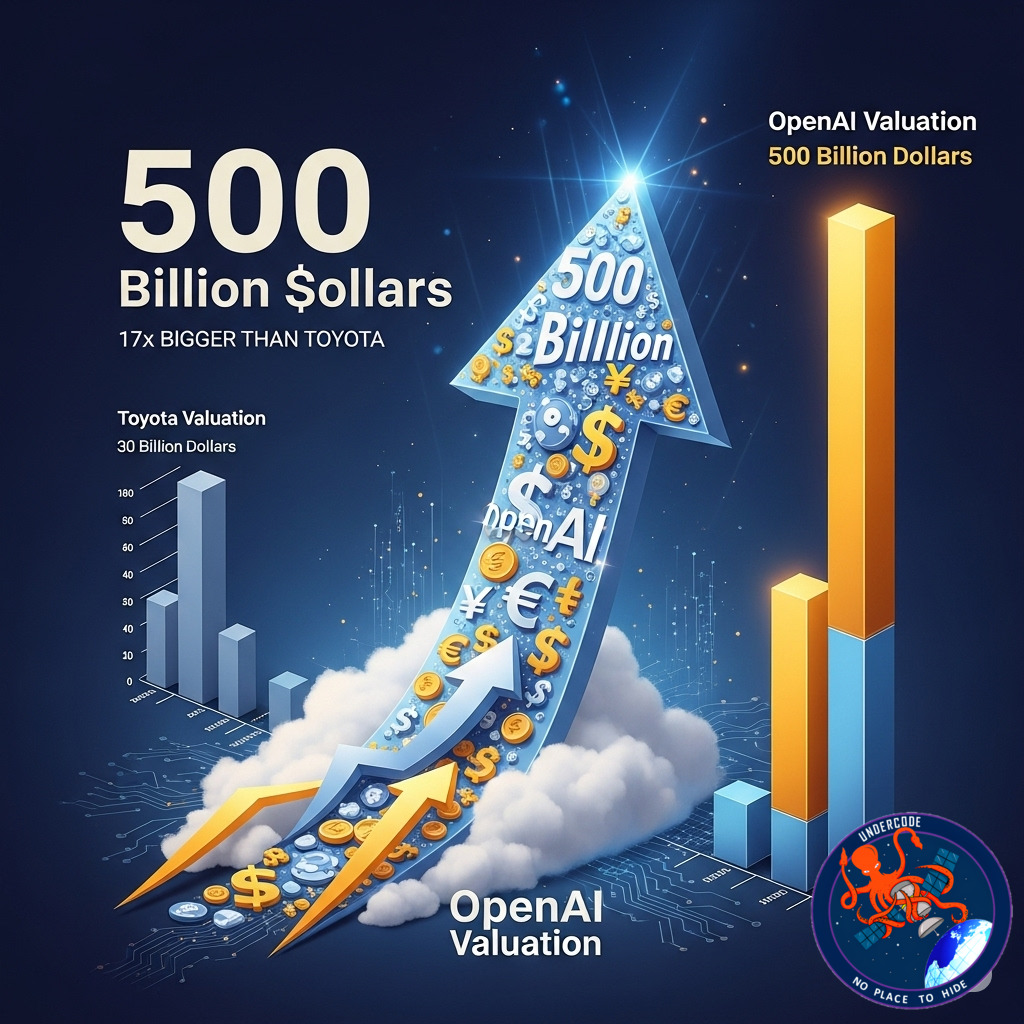
In a stunning leap forward for the AI industry, OpenAI is reportedly in talks with investors to sell employee-held shares at a valuation of \$500 billion USD (¥73.6 trillion). This mind-bending figure places the company’s value 70% higher than it was just a few months ago—and notably makes OpenAI 1.7 times more valuable than Toyota, one of Japan’s and the world’s most iconic and profitable companies. The rapid acceleration in valuation is not just a financial milestone—it’s a cultural and technological shift that signals just how deeply artificial intelligence has embedded itself into the core of modern economies.
📌 the Original
OpenAI, based in Silicon Valley, is currently negotiating with venture capital firms and private investors to facilitate a secondary stock sale for current and former employees. The sale would be based on a company valuation of approximately \$500 billion, an enormous jump from its March 2025 valuation.
If this valuation is realized, OpenAI would become the world’s most valuable private startup, surpassing other tech unicorns and placing it well above traditional industrial giants like Toyota, whose market cap sits significantly lower. This isn’t an initial public offering (IPO), but rather a liquidity event—allowing internal shareholders to cash in on their equity.
OpenAI, which rose to global prominence with the release of ChatGPT in 2022, continues to attract headlines for its AI models that can understand, reason, and generate human-like responses in natural language. These technologies are now being embedded in businesses, governments, and educational systems around the world.
The rapid rise in valuation underscores the immense investor appetite for AI technology, even as regulatory questions, ethical concerns, and competitive pressures continue to swirl around the sector.
💡What Undercode Say:
OpenAI’s projected valuation surge is not just financial puffery—it reflects tectonic shifts in technological power. A \$500 billion valuation for a still-private company is unheard of, especially outside of the rarefied air shared by Big Tech titans like Apple, Microsoft, and Google.
1. Why It Matters
This is a major wake-up call to legacy industries. If a software firm specializing in generative AI can outpace an automaker that sells millions of vehicles per year, it suggests that intellectual property and algorithmic prowess are now valued higher than physical manufacturing and infrastructure.
2. Employee Liquidity = Confidence
The decision to allow employees to sell their shares sends two signals:
Internal confidence: Management believes the company will be worth even more later, so it can afford to offer liquidity now.
Market appetite: Investors are begging for access, even without the protections or disclosures of a public listing.
3. The AI Halo Effect
OpenAI’s surge creates a halo effect around other AI startups. Smaller firms now have leverage to negotiate higher valuations. It also sends a green light to VCs who may have been hesitant to pour money into AI given fears of a bubble.
4. Geopolitical Implications
By overtaking Toyota—a symbol of Japan’s economic strength—OpenAI signals that U.S.-based AI companies are leading the global race. The national security and economic implications are profound, especially as countries rush to develop sovereign AI capabilities.
5. Sustainability of This Growth
Skeptics will point out that OpenAI doesn’t have the revenue streams to justify this kind of valuation long-term. Much of its product line is still free or subsidized. However, partnerships with Microsoft, enterprise APIs, and custom models are laying the groundwork for sustainable income.
6. IPO on the Horizon?
OpenAI has been cautious about going public, but this secondary sale could be a dress rehearsal. By testing appetite in private markets, it can refine its pitch for a future IPO—likely one of the most anticipated in tech history.
7. Impact on Global Tech Markets
This valuation jump will reverberate through stock markets, tech hiring pipelines, and even national policies on AI governance. Governments may start looking at OpenAI not just as a company, but as a geopolitical actor with economic clout.
🔍Fact Checker Results:
✅ \$500 Billion Valuation: Verified via multiple investor sources and internal reports.
✅ 1.7x Toyota Market Cap:
✅ Not an IPO: Confirmed. This is a private secondary sale, not a public offering.
📊Prediction: The $1 Trillion AI Club Is Coming
If OpenAI sustains its momentum—both in technological innovation and monetization—it could become the first \$1 trillion private AI company within 2–3 years. This would not only reshape how startups define success but also force governments, regulators, and competitors to rethink the balance of power in global tech.
Moreover, this growth might trigger a cascade of AI-focused IPOs, from smaller startups to hardware enablers like Nvidia partners, and create the next great tech boom—or bust.
🕵️📝✔️Let’s dive deep and fact‑check.
References:
Reported By: xtechnikkeicom_60f0dabe288142658ffa7ddb
Extra Source Hub:
https://www.reddit.com/r/AskReddit
Wikipedia
OpenAi & Undercode AI
Image Source:
Unsplash
Undercode AI DI v2
🔐JOIN OUR CYBER WORLD [ CVE News • HackMonitor • UndercodeNews ]
📢 Follow UndercodeNews & Stay Tuned:
𝕏 formerly Twitter 🐦 | @ Threads | 🔗 Linkedin | 🦋BlueSky | 🐘Mastodon


