
Listen to this Post
Introduction
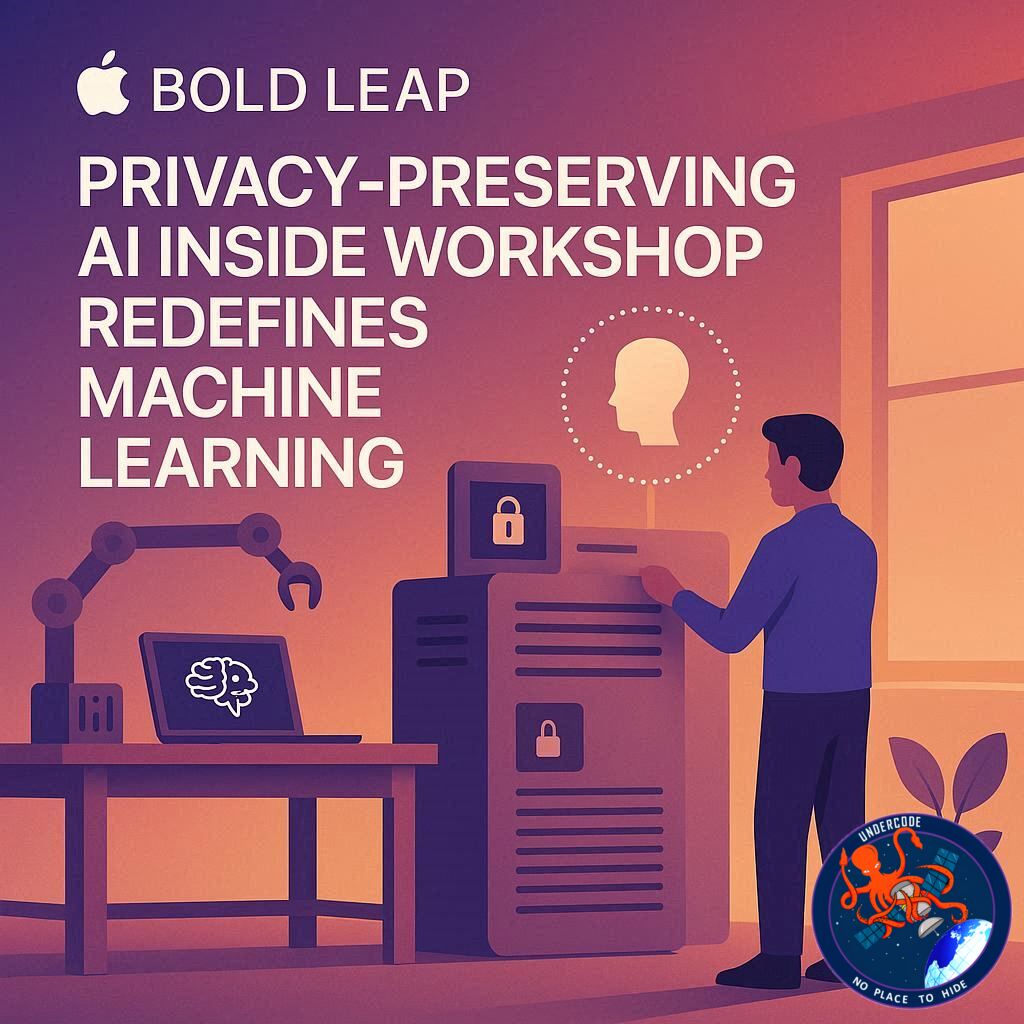
In an era where artificial intelligence drives nearly every digital experience, the balance between innovation and user privacy has never been more critical. Apple, known for its strong stance on privacy, recently hosted the Workshop on Privacy-Preserving Machine Learning (March 20–21, 2025). This event brought together experts from Apple, Microsoft, Google, and top universities to discuss groundbreaking methods of securing user data while still advancing AI capabilities. Now, with the presentations made public, we gain valuable insights into how the next generation of machine learning will be shaped.
the Workshop Highlights
Apple has officially released the presentations from its privacy-focused machine learning workshop, similar to how it shared insights from its 2024 Human-Centered ML Workshop.
At the heart of the discussions was differential privacy—a concept Apple has championed for years. In simple terms, differential privacy adds “noise” to user data before it leaves a device, ensuring that even if data is intercepted, it cannot be traced back to an individual. Over time, patterns emerge from the collective dataset, but personal details remain hidden.
Local Pan-Privacy for Federated Analytics
Presented by Guy Rothblum (Apple), this research extends older privacy theories to modern devices. It proposes ways to prevent data leakage even if personal devices are accessed multiple times. Using advanced encryption, companies can still collect statistics without ever exposing individual behaviors.
Scalable Private Search with Wally
In another standout presentation, Apple researchers Rehan Rishi and Haris Mughees introduced Wally, a system designed for large-scale private searches. Imagine taking a photo of a landmark—Apple’s servers need to identify it, but how can they do so privately? Wally sends the real query along with decoys. As more users query the system simultaneously, the noise required for privacy decreases, making the process faster, cheaper, and safer at scale.
Differentially Private Synthetic Data via Foundation Model APIs
Sivakanth Gopi from Microsoft Research presented a fascinating approach to creating synthetic datasets that mirror real-world data but protect privacy. Through Private Evolution (PE), foundation models can generate realistic data for AI training—without accessing or risking personal information. Surprisingly, this method often outperforms traditional privacy-preserving approaches.
Expansive Study List
In total, 25 papers were shared, ranging from AirGapAgent for conversational privacy, user inference attacks on large language models, to efficient noise generation techniques. Contributions came from Apple, Microsoft, Google, MIT, Carnegie Mellon, UC Berkeley, and others, proving that privacy-preserving AI is not just Apple’s vision—it’s a global movement.
Bonus: Mac Deals
Alongside academic insights, Apple highlighted current Mac discounts on Amazon, featuring notable price cuts on the Mac mini M4, Studio Display, MacBook Air, and MacBook Pro.
What Undercode Say: 🔎
The release of these workshop materials paints a bigger picture of Apple’s strategy. The company isn’t just talking about privacy as a marketing term—it’s embedding it into the fabric of machine learning research. Here’s what stands out when analyzing the broader implications:
Apple’s Branding Through Privacy
Apple consistently markets itself as the tech giant that “cares about your data.” By openly publishing privacy-first research, it strengthens consumer trust and sets a higher benchmark for competitors.
Differential Privacy as a Foundation
The repetition of differential privacy across nearly every study shows Apple’s commitment to scaling this method. However, critics argue it can reduce data accuracy. Apple’s challenge is proving that noise doesn’t dilute insights.
The Wally Advantage
Encrypted search is notoriously expensive at scale. Wally’s ability to maintain privacy while cutting costs could revolutionize cloud-based AI services—not just at Apple, but industry-wide. If successful, it might influence Google Search and Microsoft Bing to adopt similar systems.
Synthetic Data as the Future of AI Training
The Microsoft research presented is crucial. AI models rely heavily on user-generated data, but privacy laws are tightening. Synthetic data that behaves like real data—without exposing users—could become the lifeblood of future AI development.
Collaboration Over Competition
Despite Apple and Microsoft being rivals, their presence at the same workshop signals a rare alignment: privacy is bigger than competition. Even Google and top universities contributed, showing this is a shared global challenge.
Why It Matters to You
For everyday users, these developments mean your photos, messages, and queries will increasingly be protected, even as AI services become smarter. The future promises less fear of being tracked, profiled, or exploited by data brokers.
Apple’s Strategic Timing
Hosting this workshop in 2025, just as regulators worldwide tighten rules around AI ethics and privacy, positions Apple as a leader not just in technology—but in shaping AI policy and public perception.
Fact Checker Results ✅❌
✅ Apple did host the Privacy-Preserving ML Workshop in March 2025.
✅ Differential privacy remains Apple’s core strategy, confirmed across multiple studies.
❌ Privacy-preserving AI isn’t flawless—critics highlight trade-offs in accuracy and cost.
Prediction 🔮
Within the next two years, privacy-preserving AI will move from academic theory into everyday applications. Apple is likely to integrate Wally-powered private search into Siri and Photos, while Microsoft will push synthetic datasets for cloud-based AI training. By 2027, expect governments to adopt similar methods for public data, making privacy-preserving machine learning not just a tech trend—but a legal and ethical standard worldwide.
🕵️📝✔️Let’s dive deep and fact‑check.
References:
Reported By: 9to5mac.com
Extra Source Hub:
https://www.instagram.com
Wikipedia
OpenAi & Undercode AI
Image Source:
Unsplash
Undercode AI DI v2
🔐JOIN OUR CYBER WORLD [ CVE News • HackMonitor • UndercodeNews ]
📢 Follow UndercodeNews & Stay Tuned:
𝕏 formerly Twitter 🐦 | @ Threads | 🔗 Linkedin | 🦋BlueSky | 🐘Mastodon


