
Listen to this Post
The Rising Tide of Cyber Assaults
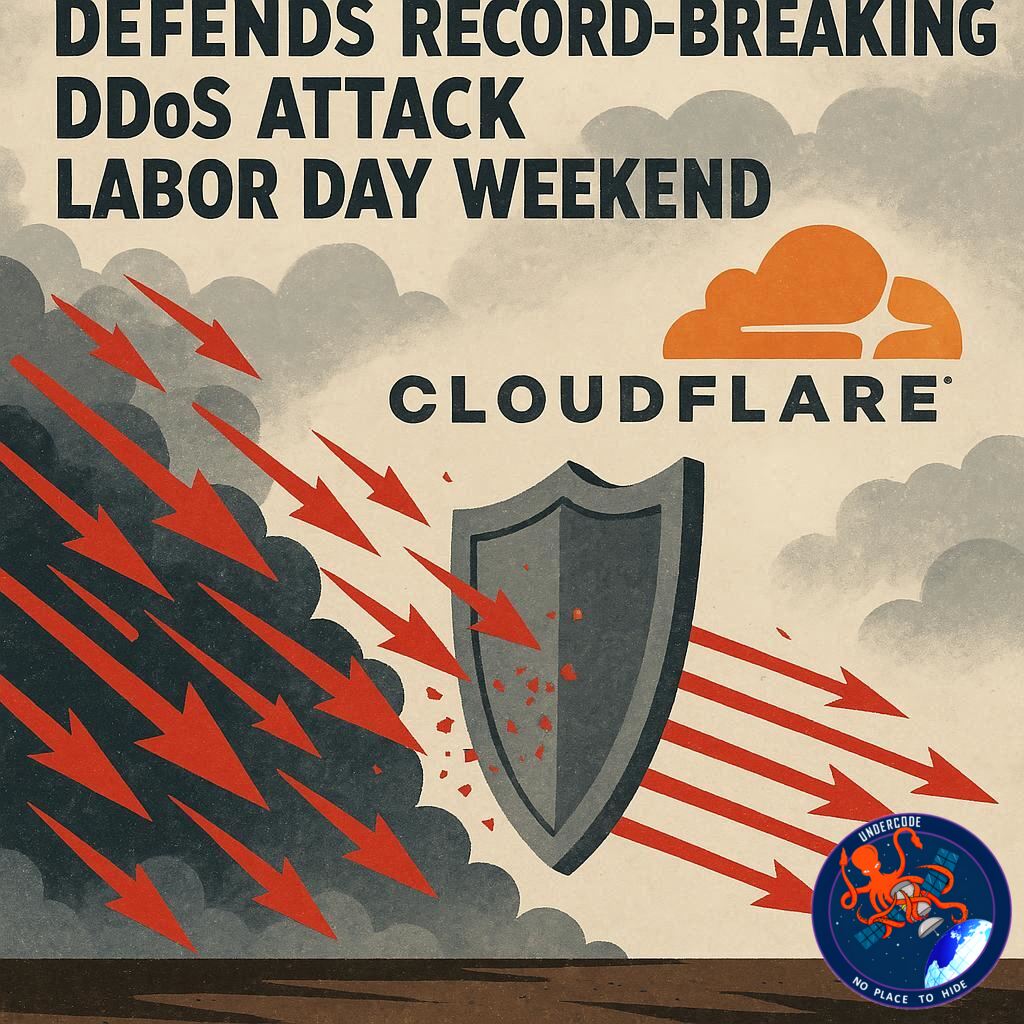
The digital world is no stranger to denial-of-service attacks, but the Labor Day weekend of 2025 marked a turning point in cyber defense. Cloudflare, a global leader in internet security, successfully thwarted the largest recorded distributed denial-of-service (DDoS) attack in history. Peaking at a staggering 11.5 terabits per second (Tbps), the assault showcased the evolving scale of cyberwarfare and the resilience of modern mitigation systems.
The Attack in Detail
Over the holiday weekend, Cloudflare reported an unprecedented hyper-volumetric User Datagram Protocol (UDP) flood attack. Lasting only about 35 seconds, the barrage unleashed more than 5.1 billion packets per second, overwhelming in both speed and volume. While brief, such concentrated force can cripple networks, saturate bandwidth, and exhaust computing resources within moments.
Interestingly, a large portion of the traffic stemmed from compromised Google Cloud accounts, although the attack also drew power from other cloud providers and IoT-based botnets. This highlights the growing trend of attackers leveraging legitimate cloud infrastructure for malicious campaigns.
Hyper-volumetric UDP floods exploit the simplicity of UDP itself—flooding targets with endless packets that force systems to respond or collapse. Even unused ports trigger automatic responses, amplifying the drain on network resources. The goal is always the same: take a target offline by brute force.
The intended victim of this attack has not been publicly named. However, Cloudflare confirmed that its globally distributed DDoS mitigation network automatically detected and neutralized the strike in real time. Customers remained largely unaffected, with no manual intervention required.
Cloudflare’s Broader Findings
The Labor Day attack was not an isolated incident but part of a sharp upward trend. Cloudflare revealed that hyper-volumetric DDoS attacks have skyrocketed in 2025. In the second quarter alone, the company blocked more than 6,500 such strikes—averaging 71 per day.
Even more alarming is the cumulative figure: by mid-2025, Cloudflare had already stopped 27.8 million DDoS attacks, a 130% increase compared to the entirety of 2024. This exponential growth suggests that attackers are not only escalating their tactics but also accelerating the pace of assaults.
The warning is clear: organizations without active DDoS protection are at extreme risk. Alongside Cloudflare, industry leaders such as Akamai, Radware, F5, Fortinet, and Imperva are stepping up efforts to provide robust security solutions.
What Undercode Say:
The Labor Day weekend attack is a chilling reminder that cybercrime is no longer just about breaching systems but about overwhelming them at scale. A 60% increase over the previous record in just a few months is not just alarming—it’s revolutionary in terms of attack capability.
From a strategic perspective, this attack highlights three critical realities:
1. Cloud Dependency as a Double-Edged Sword
Cloud infrastructure has democratized global business but simultaneously armed attackers with powerful resources. The use of compromised Google Cloud accounts illustrates how easily legitimate services can be weaponized.
2. The Rise of Hyper-Volumetric Strikes
Short, high-intensity bursts of traffic are replacing prolonged DDoS campaigns. Attackers now prioritize velocity and peak damage over endurance. This makes defenses reliant on speed and automation rather than manual intervention.
3. The Expanding Attack Surface via IoT
Every smart device connected to the internet is a potential soldier in a botnet. As IoT adoption accelerates, so does the scale of potential attacks. Millions of unsecured devices are fueling this cyber arms race.
For businesses, the lesson is urgent: traditional firewalls and basic server protections are not enough. Without dedicated DDoS mitigation services, organizations face existential threats to uptime, reputation, and revenue.
On the flip side, Cloudflare’s successful defense offers a glimpse into the future of cybersecurity—automated, self-learning, globally distributed systems capable of responding in milliseconds. The company’s use of real-time packet fingerprinting and intelligence-sharing is setting a new industry benchmark.
However, the arms race is far from over. Attackers are already experimenting with new vectors, such as reflection-amplification methods, AI-assisted traffic generation, and hybridized assaults combining DDoS with data exfiltration attempts.
Ultimately, the cloud will remain both battlefield and shield. Security providers must anticipate attacks that may one day dwarf even the 11.5 Tbps assault seen this year. Businesses, on their part, must shift from reactive to proactive defense—treating DDoS protection not as an add-on but as a core operational necessity.
🔍 Fact Checker Results
✅ Cloudflare confirmed the 11.5 Tbps record-breaking attack.
✅ Attack originated from both IoT devices and compromised cloud accounts.
✅ Cloudflare reported over 27.8 million blocked DDoS attacks by mid-2025, surpassing 2024 totals.
📊 Prediction
Looking ahead, hyper-volumetric attacks will continue to rise, with 20–15 Tbps assaults likely by 2026. Attackers will increasingly weaponize AI to craft adaptive traffic patterns, making detection harder. At the same time, cloud security providers will respond by deploying AI-driven defense networks capable of neutralizing threats in microseconds. The next battleground will be automation vs. automation, with businesses caught in the middle.
🕵️📝✔️Let’s dive deep and fact‑check.
References:
Reported By: www.zdnet.com
Extra Source Hub:
https://www.stackexchange.com
Wikipedia
OpenAi & Undercode AI
Image Source:
Unsplash
Undercode AI DI v2
🔐JOIN OUR CYBER WORLD [ CVE News • HackMonitor • UndercodeNews ]
📢 Follow UndercodeNews & Stay Tuned:
𝕏 formerly Twitter 🐦 | @ Threads | 🔗 Linkedin | 🦋BlueSky | 🐘Mastodon


