
Listen to this Post
Introduction
The United States is facing yet another painful government shutdown, with hundreds of thousands of federal employees either furloughed or forced to work without pay. While political battles between Republicans and Democrats keep Washington paralyzed, a surprising twist has emerged: tariffs imposed by former President Donald Trump are generating record-breaking revenues. Yet despite these billions flowing into the Treasury, the money sits idle, unable to soften the immediate blow of the shutdown. The big question remains — can tariffs actually provide relief, or are they only deepening the economic pain for ordinary Americans?
Shutdown Crisis and Tariff Revenues Explained
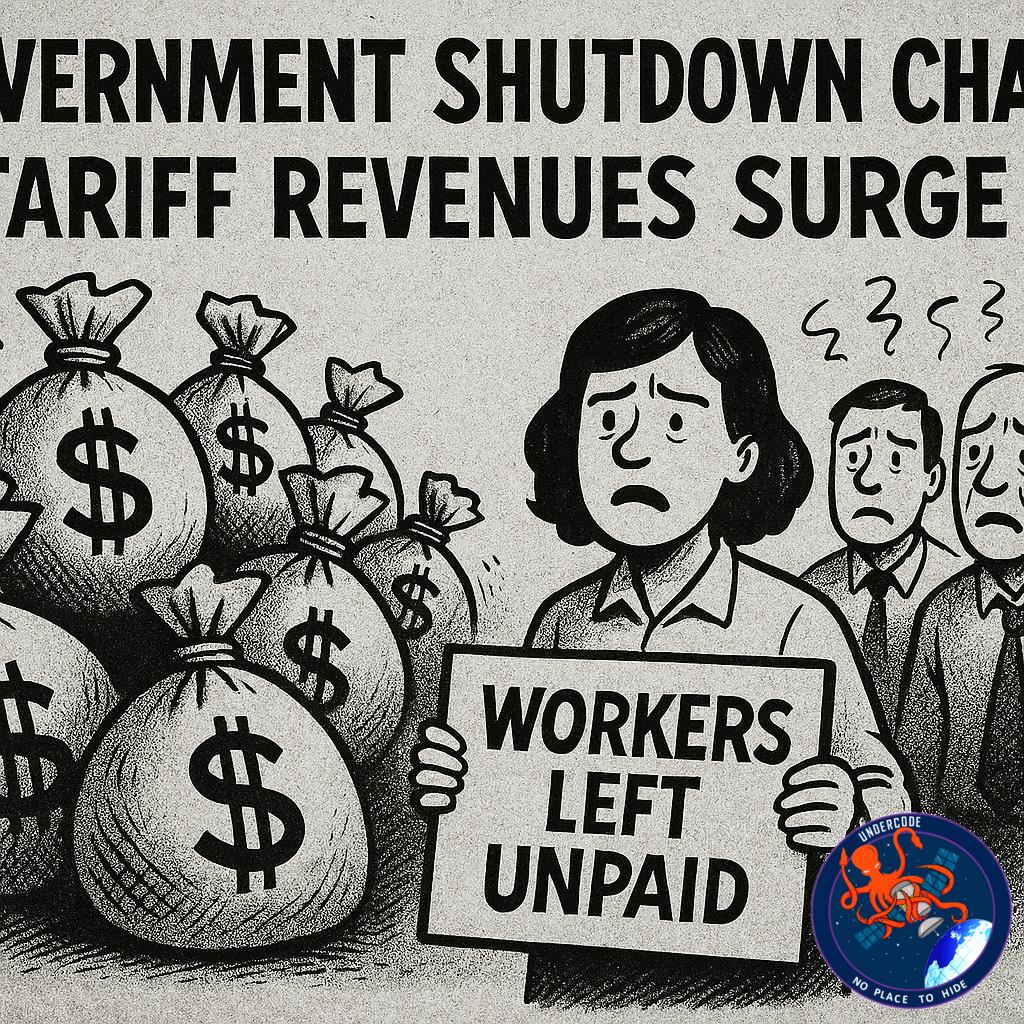
The ongoing shutdown has disrupted core government functions, halting services such as food and drug inspections. This political standoff is not only delaying critical operations but also putting financial strain on more than 750,000 federal workers. Their combined daily compensation — around $400 million — far exceeds the $315 million in tariffs collected on just the first day of the shutdown.
The Treasury Department reported $31.7 billion in tariff revenue last month alone, bringing the total to $190 billion this year — a staggering 160% increase compared to last year. President Trump frequently touts these numbers as proof of his successful trade policies. However, the funds sit locked inside the Treasury’s general account, often called “America’s checkbook,” which is frozen until lawmakers pass a funding bill.
While theoretically, Congress could earmark tariffs to pay furloughed workers, neither party supports this move. Republicans argue Democrats should simply pass a clean resolution to reopen the government, while Democrats criticize Trump’s tariffs as a hidden tax on Americans, raising prices on goods while offering only a fraction of the funding needed for essential services.
Senator Ron Wyden, a leading Democrat, labeled the tariffs a “bloated scheme,” insisting they are more of a problem than a solution. He warned that the billions raised through tariffs cannot cover the massive costs of running the military, maintaining national parks, funding highways, or supporting federal law enforcement. In his view, Americans are paying higher prices while receiving no real relief from the shutdown.
The political standoff highlights the core issue: tariffs, though lucrative, cannot replace stable funding sources. The revenue may look impressive, but it is only a drop in the bucket compared to the massive expenses of running the federal government.
What Undercode Say: 🔎
The government shutdown is not merely a budgetary dispute — it reveals the fragility of America’s financial framework and the misuse of economic tools like tariffs. Here are deeper insights into the crisis:
Tariffs as Illusionary Relief
While $190 billion in tariff revenue sounds like a lifeline, the reality is stark. Tariffs are not free money — they are taxes passed on to consumers and businesses. Higher prices on goods mean Americans are effectively footing the bill. This makes tariffs less of a solution and more of a burden disguised as revenue.
Workers as Political Pawns
The shutdown exposes how federal workers are being used as bargaining chips. With $400 million in daily wages frozen, families face rent struggles, missed bills, and economic insecurity. The comparison between tariff revenue and unpaid wages highlights the absurdity — money exists, but politics blocks its use.
Economic Ripple Effect
Beyond workers, the shutdown disrupts food inspections, border security, law enforcement, and even national parks. These interruptions ripple across industries, hurting tourism, supply chains, and public safety. Every day the shutdown continues, the hidden costs multiply.
The Political Chess Game
Both parties are entrenched. Republicans blame Democrats for not reopening the government, while Democrats accuse Trump of weaponizing tariffs. This stalemate reveals not just policy differences, but a calculated battle for leverage before voters.
Tariffs as a Political Weapon
Trump leveraged tariffs to exert pressure on foreign nations, but they now function as a political talking point domestically. The sharp rise in collections offers bragging rights, but it’s hollow. Tariffs cannot substitute for a functioning budget system.
The Bigger Picture of National Funding
Running the U.S. government requires trillions. Compared to this, tariff revenue is minimal. For example, defense spending alone exceeds $800 billion annually. Even record tariffs cannot sustain such enormous obligations.
Strain on Consumer Confidence
When Americans face higher prices on everyday goods, from electronics to groceries, their confidence in the economy weakens. This adds another layer of instability, especially during times of political uncertainty.
The False Narrative of Self-Funding
Supporters of tariffs often claim they make the U.S. less dependent on foreign adversaries. However, in practice, the costs are absorbed by American importers and consumers. The idea of tariffs funding government operations is more political theater than fiscal reality.
Long-Term Impact on Global Trade
The increase in tariffs may also spark trade retaliation. Foreign nations can impose their own tariffs on American exports, harming industries like agriculture, manufacturing, and technology. This creates a lose-lose scenario.
The Human Cost
At its heart, the shutdown is about people. Behind every number is a family struggling to pay bills while politicians trade blame. The longer this drags on, the harder it will be to restore faith in government accountability.
Fact Checker Results ✅❌
✅ Fact: Tariff revenues hit $190 billion this year, up 160% from the previous year.
❌ Misconception: Tariffs are paid by foreign governments — in reality, they are paid by American businesses and consumers.
✅ Fact: Shutdown halted essential services and left more than 750,000 workers without pay.
Prediction 🔮
If the shutdown continues, economic pain will deepen — both for federal employees and everyday Americans facing higher costs from tariffs. In the long run, this crisis may force Congress to reconsider how tariff revenues are managed, potentially creating a new framework for redirecting them during emergencies. However, unless bipartisan cooperation emerges, tariffs will remain a political weapon rather than a financial solution.
🕵️📝✔️Let’s dive deep and fact‑check.
References:
Reported By: edition.cnn.com
Extra Source Hub:
https://www.medium.com
Wikipedia
OpenAi & Undercode AI
Image Source:
Unsplash
Undercode AI DI v2
🔐JOIN OUR CYBER WORLD [ CVE News • HackMonitor • UndercodeNews ]
📢 Follow UndercodeNews & Stay Tuned:
𝕏 formerly Twitter 🐦 | @ Threads | 🔗 Linkedin | 🦋BlueSky | 🐘Mastodon


