
Listen to this Post
The Rise of a New AI Era
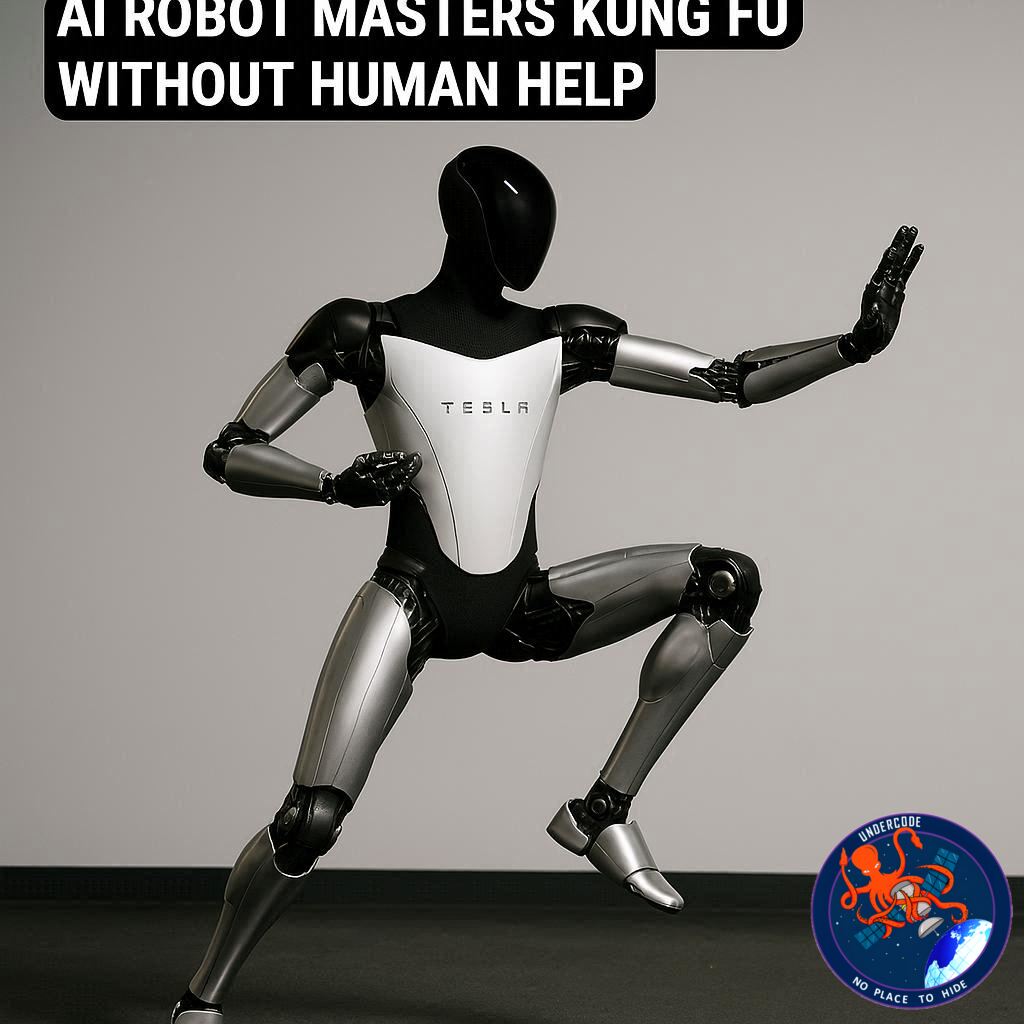
Tesla’s humanoid robot, Optimus, has stunned the world once again—this time by performing Kung Fu with astonishing precision. A recent video posted by Elon Musk on X (formerly Twitter) shows Optimus mirroring a human trainer’s martial arts movements flawlessly. The robot performs complex blocks, stances, and transitions while maintaining perfect balance, leaving viewers wondering just how close we are to AI-driven robots mastering human-like agility.
This demonstration represents far more than a cool party trick. It’s a milestone in the evolution of autonomous robotics, proving that machines can now learn, adapt, and execute intricate movements without any human assistance. Earlier versions of Optimus required heavy supervision—even for simple gestures—but the new iteration demonstrates independent learning through AI algorithms and advanced motion systems.
The video begins with a simple greeting gesture before transitioning into an intense Kung Fu session. Optimus mirrors its trainer with synchronized movements—blocking, striking, and shifting stances with smooth fluidity. The most impressive part is its stability; where most humanoid robots stumble, Optimus holds its balance with grace, resembling a disciplined martial artist.
Elon Musk later confirmed on X that the demonstration was fully AI-driven, with no remote control or teleoperation. This statement set the tech community abuzz. Unlike the earlier Tesla diner popcorn demo—where the robot’s actions were remotely guided—this performance was entirely autonomous. Optimus wasn’t just executing pre-programmed steps; it was learning by observation, mimicking human behavior much like a student learning from a master.
Musk has long claimed that Optimus can acquire new skills by simply watching humans or even online videos. Tesla’s engineers have equipped it with vision-based learning, allowing it to recognize, imitate, and refine tasks over time. The robot has already displayed abilities like vacuuming, sorting objects, and navigating rooms—all without explicit programming. This process, known as observational learning, is one of AI’s most sophisticated frontiers.
Musk envisions a world where humanoid robots like Optimus become everyday companions, workers, and assistants. Tesla plans to scale production to 5,000 units by 2025, aiming to integrate Optimus into factories, homes, and commercial spaces. According to Musk, robotics could eventually account for up to 80% of Tesla’s total value, surpassing even its electric car division.
This Kung Fu display isn’t merely a technical feat—it’s a symbol of Tesla’s vision for the future of human-robot interaction. Optimus’ balance, awareness, and adaptability show that the age of practical, intelligent robots isn’t science fiction anymore—it’s unfolding right before our eyes.
What Undercode Say:
The Real Meaning Behind the Kung Fu Demo
Tesla’s demonstration of Optimus practicing Kung Fu is more than a viral video; it’s a strategic statement. By choosing Kung Fu—a discipline rooted in precision, balance, and adaptability—Tesla symbolically highlights the capabilities that separate Optimus from other humanoid robots. The video visually communicates that Optimus can not only move but also learn, embodying AI’s transition from mechanical execution to cognitive understanding.
From Programmed to Perceptive
Previous robots could perform pre-coded actions—walk, lift, turn—but they lacked contextual learning. Optimus represents a major shift: it’s learning through vision and experience, similar to how humans acquire skills. This approach means the robot can improve continuously, adapting to different environments without rewriting code. It’s a foundation for true general-purpose robotics, something no company has fully achieved yet.
Tesla’s AI Architecture in Action
Under the hood, Optimus operates on Tesla’s Dojo neural network, the same infrastructure powering the company’s self-driving vehicles. This allows the robot to process massive amounts of visual data, predict motion paths, and adjust balance in real time. Each movement Optimus performs is not pre-recorded—it’s calculated dynamically, using sensors and feedback loops to replicate human biomechanics.
The Competitive Edge
By integrating its automotive AI systems into robotics, Tesla gains an enormous advantage. Competitors like Boston Dynamics focus on mechanical precision, while Tesla merges AI cognition with mechanical motion. This creates a robot that not only moves like a human but also thinks like one—at least in terms of pattern recognition and adaptive response.
The Business Implications
Musk’s projection that 80% of Tesla’s future value could come from robotics isn’t an exaggeration—it’s foresight. As global labor costs rise and automation becomes essential, humanoid robots like Optimus could fill industrial roles, perform repetitive tasks, and even provide domestic assistance. Tesla’s scalability gives it the infrastructure to mass-produce robots far faster than traditional robotics companies.
Philosophical and Ethical Impact
Optimus also raises philosophical questions: what happens when robots can learn faster than humans? When machines begin mastering physical and intellectual skills simultaneously, society will need to redefine productivity, ethics, and employment. Tesla’s AI evolution hints at a future where human labor and machine intelligence coexist—but not without tension.
The “Kung Fu Moment” as a Cultural Turning Point
Just as IBM’s Deep Blue defeating Kasparov in chess marked a turning point for AI cognition, Optimus performing Kung Fu could become a landmark for AI embodiment. This was not a simulation, nor a computer output—it was a robot physically executing learned behavior. It shows the boundary between digital and physical intelligence is blurring fast.
Potential Challenges Ahead
Despite its brilliance, Tesla still faces hurdles. Energy efficiency, material durability, and ethical deployment remain open questions. The company must also ensure safety protocols to prevent misuse or malfunction. Autonomous robots with human-like reflexes will require advanced governance models before mass adoption becomes feasible.
The Bigger Picture
Tesla isn’t just building a robot—it’s crafting the next industrial revolution. Optimus could reshape how factories operate, how services are delivered, and even how humans view labor. The Kung Fu demonstration, in essence, is Tesla’s way of saying: our robots no longer just obey—they understand.
Fact Checker Results
✅ AI Autonomy Confirmed: Elon Musk verified that Optimus operated without remote control or teleoperation.
✅ Observational Learning Proven: The robot successfully mimicked human movement, validating Tesla’s vision-based learning system.
⚠️ Mass Production Pending: Tesla’s plan for 5,000 units by 2025 remains ambitious and not yet realized.
Prediction
By 2027, Optimus could transition from laboratory showcases to real-world deployment in Tesla factories and logistics centers. As software updates expand its learning capabilities, Optimus may evolve into a self-teaching workforce assistant, blurring the line between human skill and machine intelligence. If successful, this could mark the dawn of the AI labor revolution—where robots no longer just assist humans, but collaborate with them in every field.
🕵️📝✔️Let’s dive deep and fact‑check.
References:
Reported By: timesofindia.indiatimes.com
Extra Source Hub:
https://www.discord.com
Wikipedia
OpenAi & Undercode AI
Image Source:
Unsplash
Undercode AI DI v2
🔐JOIN OUR CYBER WORLD [ CVE News • HackMonitor • UndercodeNews ]
📢 Follow UndercodeNews & Stay Tuned:
𝕏 formerly Twitter 🐦 | @ Threads | 🔗 Linkedin | 🦋BlueSky | 🐘Mastodon


