
Listen to this Post
🎯 Introduction
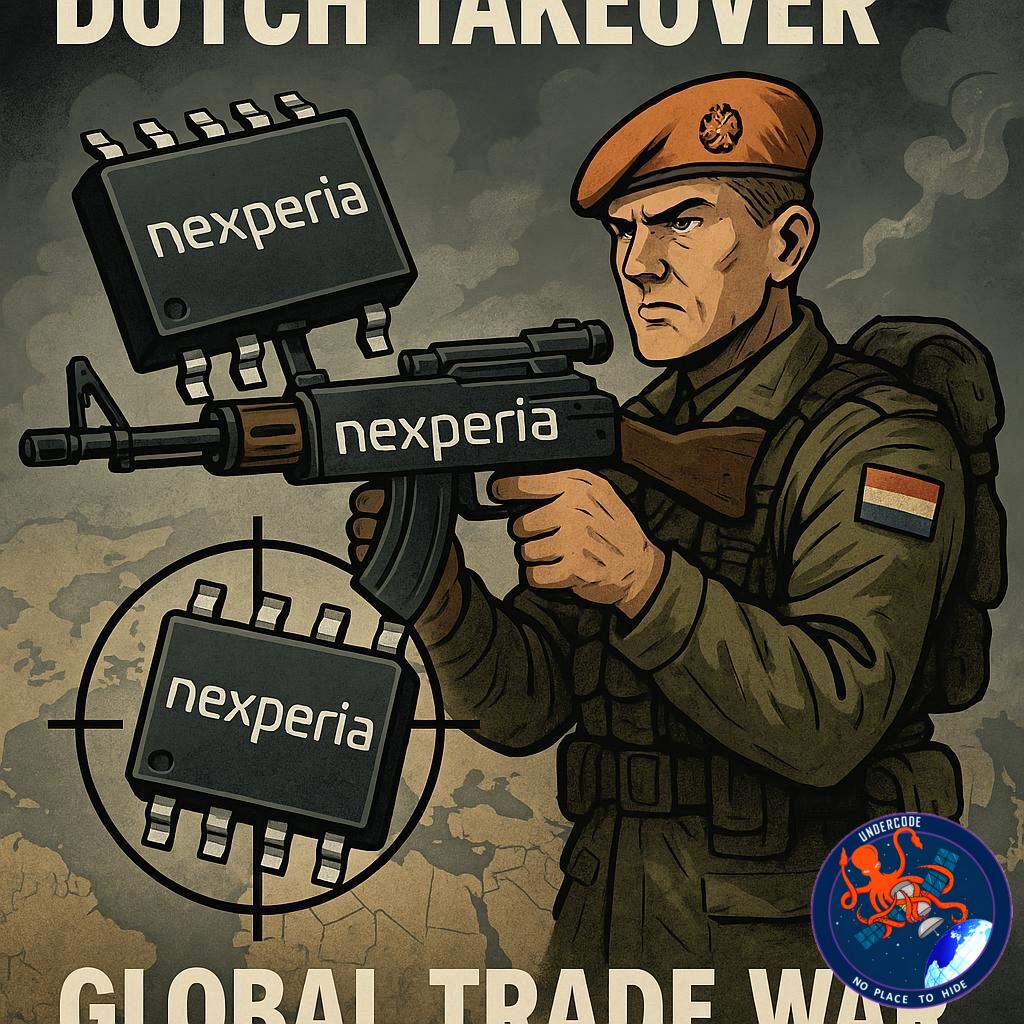
In a world increasingly defined by silicon and geopolitics, semiconductors have become the new oil. Nations that once competed over energy and territory are now battling for control over chips that power everything from electric cars to artificial intelligence. The Netherlands, a seemingly neutral trading hub, has just thrown itself into the heart of this digital war. Its decision to seize control of Nexperia—a major chipmaker owned by China’s Wingtech Technology—marks not just an economic move, but a geopolitical statement echoing across the Atlantic and the Pacific.
The Dutch Move That Shocked the Tech World
The Dutch government’s sudden takeover of Nexperia signals a seismic shift in Europe’s stance toward Chinese ownership of critical technologies. By invoking the Goods Availability Act, the Dutch Ministry of Economic Affairs effectively placed Nexperia under state control, citing “serious governance shortcomings” that could endanger Dutch and European technological sovereignty.
Nexperia, headquartered in Nijmegen, is no small player. Known for producing essential chips—diodes, transistors, and cutting-edge “wide gap” semiconductors—it serves as a backbone for Europe’s electric vehicle, charging infrastructure, and AI data center industries. The government’s statement made it clear: losing Nexperia’s capabilities would pose a risk not just to national security but to the entire European economy.
The intervention, described by officials as “highly exceptional,” took effect in September, designed to safeguard chip availability during global disruptions. The timing, however, raised eyebrows worldwide.
The Shadow of Washington
Analysts quickly pointed to Washington. Former U.S. President Donald Trump had recently reignited his trade crusade against China, threatening to impose 100% tariffs on Chinese exports. While Dutch officials publicly denied U.S. involvement, claiming the move was “purely coincidental,” the parallels were too striking to ignore.
For years, the Netherlands has worked hand-in-hand with the United States on export restrictions related to semiconductor technology, particularly targeting China. With Beijing already tightening its grip on rare earth minerals and magnetic materials—crucial to Europe’s automotive industry—this latest event could deepen the economic divide between China and the West.
Adding fuel to the fire, Wingtech was placed on the U.S. “entity list” in December 2024 for allegedly helping Beijing acquire sensitive chip-making capabilities. The Dutch seizure of Nexperia now appears as part of a broader, coordinated Western effort to contain China’s technological ascent.
Beijing’s Backlash and Market Fallout
Beijing did not stay silent. Wingtech lashed out in a WeChat post—later deleted but archived by Pekingnology—calling the Dutch decision an “excessive intervention driven by geopolitical bias.” The Chinese parent company argued it had complied with all European laws since acquiring Nexperia in 2019, employing thousands across Europe.
Nexperia’s own spokesperson told CNBC that the firm continues to comply with all legal obligations and maintains regular communication with regulators but refused further comment.
Following the announcement, Wingtech’s shares plunged 10%—the maximum daily trading limit—on the Shanghai Stock Exchange. A filing dated October 13 confirmed that Nexperia is now under temporary external management for up to one year, with restrictions on changes to its assets, leadership, or operations. Wingtech’s chairman, Zhang Xuezheng, has been suspended, though production remains ongoing.
This move follows a series of earlier tensions: the Netherlands had already scrutinized Nexperia’s 2023 acquisition of Dutch startup Nowi, ultimately approving it, but not without political discomfort. Combined with export bans on ASML’s advanced lithography machines to China, the seizure underscores a broader European realignment away from Chinese tech influence.
The Global Stakes: Chips as National Shields
The Dutch government’s takeover is about more than one company—it’s about control of a strategic resource that defines modern civilization. Semiconductors are not just components; they are the foundation of every digital system, from missiles to medical equipment. By nationalizing a key chipmaker, the Netherlands is effectively declaring that chips are no longer just commodities but national assets.
In this new era, governments are treating chip firms as extensions of national defense. Europe, once hesitant to take sides, is now aligning with the U.S. in what could become a decades-long economic standoff with China.
What Undercode Say:
The Nexperia takeover is not an isolated event—it is a symptom of a tectonic geopolitical shift. The semiconductor industry, once a space for innovation and collaboration, is being carved up into spheres of influence. The Netherlands’ move reveals that “technological sovereignty” has become Europe’s new mantra, echoing America’s “strategic decoupling” rhetoric.
From an analytical standpoint, the Dutch decision reflects both fear and foresight. Fear of economic dependence on China’s industrial ecosystem, and foresight in securing a domestic foothold in semiconductor production before the next global crisis strikes. It also shows how smaller nations, like the Netherlands, are now pivotal players in global politics. Through ASML and now Nexperia, this small country holds disproportionate power in the world’s chip supply chain.
China’s response, though indignant, will likely be strategic rather than emotional. Beijing knows that full retaliation could jeopardize its European trade interests. Yet it will undoubtedly accelerate its “chip independence” campaign, pouring billions into local fabrication and material supply chains.
The U.S., meanwhile, benefits indirectly. Every European action that distances itself from China strengthens Washington’s position as the global coordinator of semiconductor policy. In this sense, the Dutch move might look domestic on paper, but in reality, it echoes Washington’s playbook almost perfectly.
Economically, the short-term impact may be minimal—Nexperia will continue operating, its employees will remain in place—but symbolically, it’s a watershed moment. It tells every investor and policymaker that Europe is no longer neutral in the tech cold war. The continent is choosing sides, and the consequences will ripple for years.
For the Netherlands, the gamble is high. If the decision stabilizes chip access, it will be hailed as visionary. If it drives away foreign investment or triggers Chinese retaliation, it could backfire, dragging Europe deeper into the U.S.-China rivalry.
The world is witnessing the birth of a new doctrine: Tech Sovereignty through Control. Chips are no longer merely traded; they are guarded, regulated, and weaponized.
🔍 Fact Checker Results
✅ The Dutch Ministry officially confirmed invoking the Goods Availability Act in September 2025.
✅ Nexperia’s temporary management and chairman suspension were disclosed in an October 13 filing.
❌ No verified evidence supports U.S. direct involvement, despite parallel policies aligning with American interests.
📊 Prediction
⚙️ Expect tighter European screening of Chinese tech acquisitions in the next 12 months.
🌐 China will fast-track semiconductor self-reliance projects, expanding domestic chip plants.
💼 Nexperia may eventually be restructured into a semi-state European entity, symbolizing a permanent shift in global tech ownership.
🕵️📝✔️Let’s dive deep and fact‑check.
References:
Reported By: timesofindia.indiatimes.com
Extra Source Hub (Possible Sources for article):
https://www.reddit.com/r/AskReddit
Wikipedia
OpenAi & Undercode AI
Image Source:
Unsplash
Undercode AI DI v2
Bing
🔐JOIN OUR CYBER WORLD [ CVE News • HackMonitor • UndercodeNews ]
📢 Follow UndercodeNews & Stay Tuned:
𝕏 formerly Twitter 🐦 | @ Threads | 🔗 Linkedin | 🦋BlueSky | 🐘Mastodon


