
Listen to this Post
A Bold Decision That Changed Everything
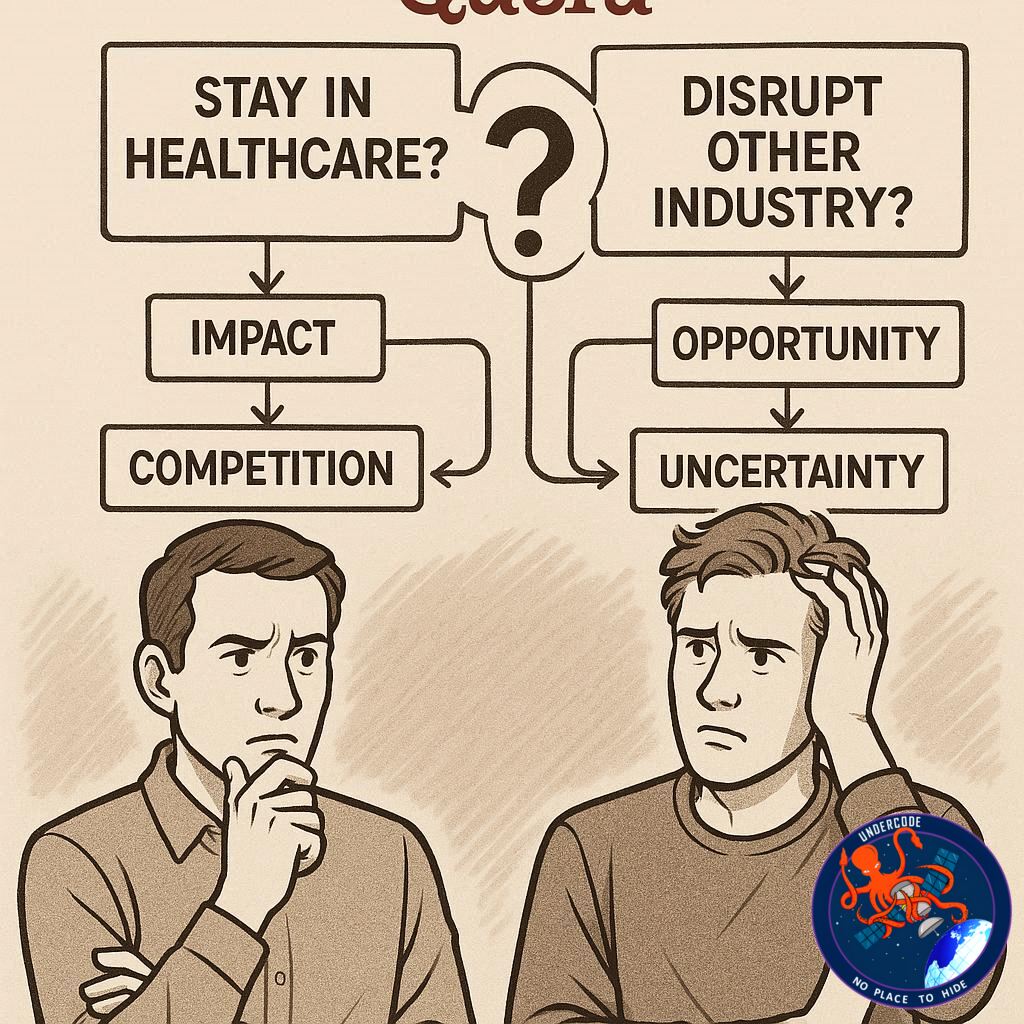
In the mid-2010s, Ankit Modi stood at a major crossroads. With a job offer from Epic Systems in the United States secured through a successful H-1B visa application, his future seemed set. Yet, at the same time, he had co-founded Qure.ai with Prashant Warier and Preetham Putha. Faced with the dilemma of pursuing a safe career in Wisconsin or building something new and uncertain in India, Ankit chose the latter. His guiding thought was “reversibility” — the US could always wait, but opportunities to build transformative ventures with a talented team could not.
Qure.ai was officially founded in 2016 by Prashant, Preetham, Ankit, and Bhargava Reddy with a clear vision: leverage artificial intelligence to make healthcare diagnostics accessible to everyone. The team focused on developing deep learning models capable of analyzing medical imaging like X-rays, MRIs, and CT scans. This innovation aimed at early detection and treatment support for critical illnesses such as tuberculosis, lung cancer, and stroke.
Ankit recalls that his first real connection to Prashant came through an unexpected flat-hunting interaction. Prashant had already exited a company, Imagna Analytics, and Ankit saw in him the entrepreneurial experience he admired. What began as brainstorming quickly evolved into something much bigger.
Breakthroughs and Recognition
One of Qure.ai’s first milestones was becoming the first AI company globally to get published in The Lancet. This recognition opened doors within the medical community and boosted credibility. The COVID-19 pandemic further highlighted the relevance of their technology. Hospitals in Lombardy, Italy, approached Qure for its chest X-ray algorithm to aid in diagnosing COVID cases, followed soon after by Mumbai’s municipal corporation. This global exposure pushed the company into the spotlight.
By 2021, the World Health Organization (WHO) formally recommended Qure.ai’s solutions, particularly in areas with limited access to radiologists. This endorsement unlocked worldwide adoption, especially in developing countries where medical infrastructure was limited. Nations like Malawi, with only two radiologists for the entire country, found Qure’s AI indispensable for scaling diagnostics.
Big Pharma Partnerships
Qure.ai’s impact extended beyond diagnostics when AstraZeneca saw its potential to identify lung cancer patients earlier. With their drug Tagrisso requiring patients in the first stages of cancer, Qure.ai’s AI algorithms became the funnel to connect treatments with those who needed them most. Following AstraZeneca’s lead, other pharmaceutical giants such as Merck, Johnson & Johnson, Pfizer, and Medtronic began collaborating with Qure. Today, at least 10 of the top 20 pharma and medical device companies are on its client list.
Tuberculosis and lung cancer solutions form nearly 90% of Qure.ai’s revenue, driven by the fact that these diseases continue to be widespread and often underdiagnosed in poorer regions. WHO has also provided funding pathways for countries to adopt such AI solutions alongside diagnostic equipment.
Innovating Beyond the Curve
From the beginning, Qure.ai pushed the boundaries of AI. Starting with convolutional neural networks, the company evolved into using transformers and other deep learning architectures. One striking innovation came when the team realized that their algorithm performed better on men’s X-rays due to biased datasets. Long before ChatGPT existed, Qure.ai built a generative AI system to create synthetic data for underrepresented groups like women, ensuring accuracy across populations.
To adapt further, Qure’s models were fine-tuned for different geographies. For instance, X-rays from regions like Kenya, Bihar, or Australia presented unique differences, requiring contextual adjustments. The company’s clinicians traveled globally to validate and refine these tools. Today, Qure employs nearly 280 people across India, the US, the UK, Dubai, and Africa.
Expanding Beyond Imaging
The company’s vision has broadened beyond radiology. Qure launched AIRA, an AI-powered assistant that listens to doctor-patient interactions, suggests better questions, diagnoses issues, and even auto-fills electronic medical records. Currently, they are developing solutions for COPD and early-stage heart failure, expanding their footprint into chronic conditions.
With over $120 million in funding and a valuation above $500 million, Qure expects to break even by the next fiscal year. Ankit confidently states that funding will now fuel expansion rather than survival, signaling stability in a competitive health-tech landscape.
What Undercode Say:
Qure.ai’s journey represents a rare blend of timing, technology, and execution in the healthcare sector. Unlike many AI startups that fail to bridge the gap between theory and clinical application, Qure demonstrated early the importance of grounding algorithms in real-world medical contexts. Their work reflects not only technical brilliance but also a practical awareness of healthcare inequities across geographies.
Ankit’s initial decision not to move to the US might appear small in hindsight, but it defined the trajectory of an entire company. This is a reminder that some of the greatest innovations come from founders willing to take uncertain, high-risk paths. His principle of “reversibility” holds immense weight for entrepreneurs — opportunities in established firms will always exist, but the chance to create something world-changing does not wait.
The WHO endorsement in 2021 was perhaps the company’s most crucial milestone. Unlike venture capital validation, WHO recognition provides credibility and a structured pathway to adoption across developing countries. This unique position allowed Qure to address tuberculosis on a scale that conventional healthcare systems could never manage alone. The statistic that Malawi has only two radiologists illustrates how AI can effectively fill gaps that no policy reforms could fix fast enough.
Another striking aspect is Qure’s early entry into generative AI for dataset balancing. While much of the global AI conversation in 2022 and beyond focused on ChatGPT, Qure had already solved practical issues years earlier by generating synthetic data. This reflects the fact that necessity often drives innovation faster in healthcare than in consumer-facing industries.
Strategically, Qure’s partnerships with pharmaceutical companies represent a smart alignment of incentives. Pharma companies struggle with patient recruitment for clinical trials or treatment funnels, while Qure provides them with a wider net of diagnosed patients. This symbiotic relationship has elevated Qure’s standing beyond being a “tech vendor” into being a strategic enabler for global pharma.
Looking ahead, Qure’s expansion into COPD and heart disease suggests a pivot towards preventive and chronic care, aligning with the future of healthcare where early detection and continuous monitoring will define outcomes. The launch of AIRA positions the company in a unique space — bridging diagnostics, patient engagement, and workflow automation. If executed well, this could establish Qure not just as an imaging AI company but as a comprehensive healthcare AI ecosystem.
Finally, Ankit’s observation that “funding is now for expansion, not survival” highlights maturity. In a sector where most startups burn capital chasing scale without profitability, Qure stands out as an example of disciplined growth. The combination of strong distribution networks in primary healthcare, WHO endorsement, and pharma partnerships form a moat that will be difficult for competitors to replicate.
Fact Checker Results
✅ WHO recommendation for Qure.ai in 2021 is accurate.
✅ Partnerships with AstraZeneca, Merck, J&J, and others are documented.
✅ Qure’s valuation above $500 million with $120 million raised is verified.
Prediction
Qure.ai will likely emerge as one of the top three global leaders in AI-driven healthcare diagnostics within the next five years. 🌍 Its expansion into chronic care, combined with strong international partnerships, could make it a billion-dollar company by 2030. 💡 If adoption scales as predicted, Qure may redefine how developing nations handle diseases like TB, cancer, and heart failure. 🚀
🕵️📝✔️Let’s dive deep and fact‑check.
References:
Reported By: timesofindia.indiatimes.com
Extra Source Hub:
https://www.twitter.com
Wikipedia
OpenAi & Undercode AI
Image Source:
Unsplash
Undercode AI DI v2
🔐JOIN OUR CYBER WORLD [ CVE News • HackMonitor • UndercodeNews ]
📢 Follow UndercodeNews & Stay Tuned:
𝕏 formerly Twitter 🐦 | @ Threads | 🔗 Linkedin | 🦋BlueSky | 🐘Mastodon


