
Listen to this Post
Introduction
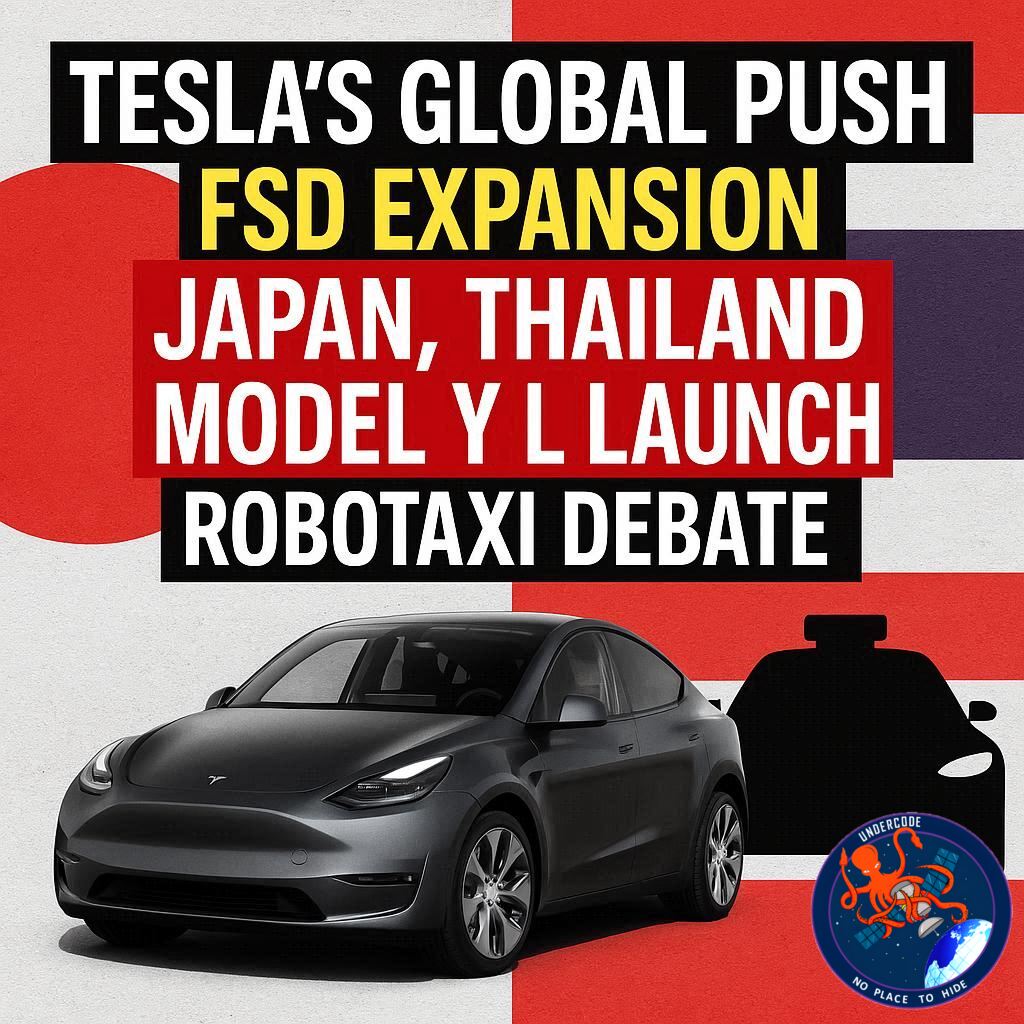
Tesla continues to dominate global EV headlines with its rapid technological advancements, bold product launches, and ambitious expansion strategies. From bringing its Full Self-Driving (FSD) system to Asia, unveiling the stretched and luxurious Model Y L in China, to facing criticism over its Robotaxi project, Elon Musk’s company is moving aggressively in multiple directions. Each development highlights Tesla’s determination to lead not just in electric vehicles but in autonomous driving and mobility services worldwide.
Tesla’s Expanding FSD Ambitions in Asia
Recent reports confirm that Tesla is preparing to introduce its Full Self-Driving (FSD) system to Japan and Thailand. The company has already begun testing FSD on public roads in Japan, where safety monitors remain in the driver’s seat while the AI system handles actual driving. Pending regulatory approval, FSD will soon be available to both new and existing Tesla owners in the country.
In Thailand, anticipation is high. Elon Musk confirmed on X (formerly Twitter) that Tesla is actively working on bringing FSD to Thai roads, though the company is awaiting government clearance. Bangkok’s notorious traffic congestion will serve as a real-world test for the system’s capabilities.
Model Y L: Tesla’s New Family-Oriented EV in China
China has officially welcomed the Model Y L, a longer and more versatile version of Tesla’s best-selling SUV. Priced at \$47,180, the Model Y L comes with a six-seat configuration, extended wheelbase, premium interior upgrades, and a remarkable range of 467 miles under CLTC standards.
Key highlights include:
Extended Wheelbase: More space and comfort for passengers.
Luxury Interiors: Electrically adjustable heated seats, premium finishes, and a black headliner.
Family-Centric Design: Captain’s chairs in the second row, added air vents, and powered reclining seats.
Performance: 0-100 km/h in 4.5 seconds, 210 km/h top speed.
Deliveries are set to begin in September 2025, positioning the Model Y L as a potential best-seller in China’s EV-dominant market.
Robotaxi Under Fire
Tesla’s Robotaxi service, operating in Austin and the San Francisco Bay Area, has sparked mixed reactions. Former Waymo CEO John Krafcik criticized it, comparing it to “just another Uber experience.” His skepticism centers on Tesla’s continued use of in-car safety monitors, which, according to him, disqualifies it as a true Robotaxi.
Despite criticism, Tesla insists on strict safety protocols, especially since one high-profile incident could slow global FSD adoption for years. Musk emphasized that being “paranoid about safety” is intentional and necessary for the brand’s long-term credibility.
What Undercode Say: 🔍
Tesla’s current trajectory showcases a company balancing innovation, regulation, and perception. On one hand, the expansion of FSD into markets like Japan and Thailand demonstrates Tesla’s technological confidence. Japan’s rigorous regulatory environment will test Tesla’s ability to comply with strict safety standards, while Thailand’s chaotic urban traffic will reveal the robustness of the system in unpredictable conditions.
The Model Y L launch underscores Tesla’s ability to adapt products for local demand. In China, where large families and long-distance travel are common, a spacious, high-range EV was inevitable. The Model Y L not only strengthens Tesla’s portfolio but also sets new standards in passenger comfort among compact electric SUVs.
However, the Robotaxi criticism highlights the biggest challenge Tesla faces: trust. While Elon Musk envisions a future of driverless cars generating passive income for owners, regulators and industry veterans remain skeptical. Keeping safety monitors inside cars, even temporarily, suggests Tesla knows it isn’t fully ready for mass deployment.
Strategically, Tesla is moving fast in three parallel tracks:
- Global FSD rollout to secure first-mover advantage before competitors scale.
- Market-specific vehicle innovation like the Model Y L to dominate EV sales.
- Robotaxi ecosystem building, despite regulatory pushback, to secure leadership in autonomous ride-hailing.
This trifecta approach positions Tesla as both a car manufacturer and a mobility-tech giant. But it also raises questions: Can Tesla deliver FSD globally before regulators slow it down? Will Model Y L cannibalize standard Model Y sales or create a new market segment? And most importantly, can Tesla prove to skeptics that Robotaxi is more than just a high-tech Uber?
The answers will determine not only Tesla’s future but also the global direction of autonomous driving.
Fact Checker Results ✅❌
✅ Tesla is testing FSD in Japan with safety monitors onboard.
✅ Elon Musk confirmed FSD is coming to Thailand, pending approval.
❌ Robotaxi is not yet a fully driverless fleet, as critics correctly noted.
Prediction 🔮
Tesla will likely achieve regulatory clearance for FSD in Japan by 2026, with Thailand following soon after. The Model Y L will emerge as a major success in China, potentially outselling the standard Model Y in family-focused markets. Robotaxi, however, will face the slowest adoption curve—expect gradual rollout expansions rather than a sudden global launch. Tesla’s next two years will hinge on balancing bold innovation with cautious regulation.
🕵️📝✔️Let’s dive deep and fact‑check.
References:
Reported By: www.teslarati.com
Extra Source Hub:
https://www.reddit.com/r/AskReddit
Wikipedia
OpenAi & Undercode AI
Image Source:
Unsplash
Undercode AI DI v2
🔐JOIN OUR CYBER WORLD [ CVE News • HackMonitor • UndercodeNews ]
📢 Follow UndercodeNews & Stay Tuned:
𝕏 formerly Twitter 🐦 | @ Threads | 🔗 Linkedin | 🦋BlueSky | 🐘Mastodon


