
Listen to this Post
Introduction: The Silent Cost of the AI Boom
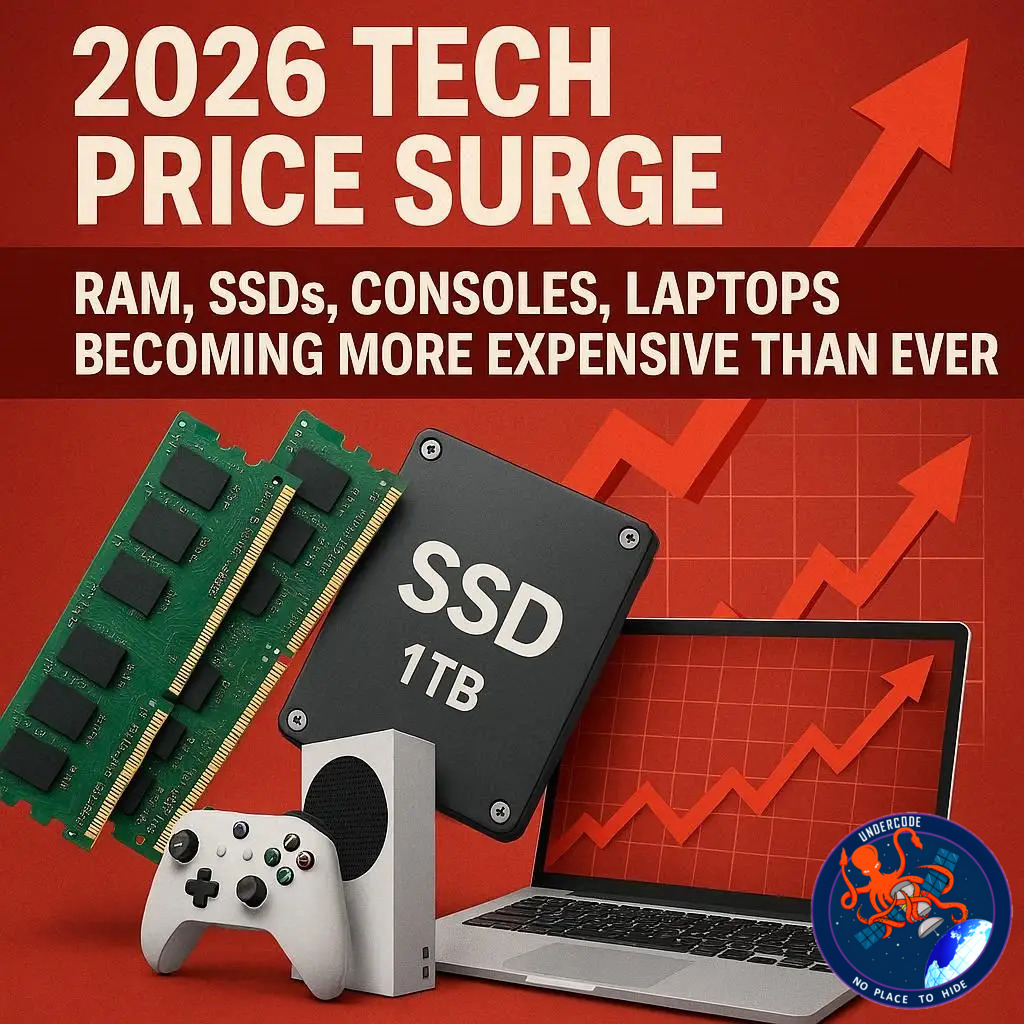
The next time you browse for a laptop, gaming console, or even a simple USB drive, the price tag may feel like a shock. What once seemed like gradual inflation has turned into something sharper, faster, and far more disruptive. Behind the scenes, a surge in AI-driven data center demand is consuming vast supplies of memory and storage chips, squeezing the consumer market in the process. DDR5 memory now costs roughly four times what it did in mid-2025, and many SSDs have doubled in price. This is not a temporary fluctuation. It is a structural shift in the technology supply chain that could define pricing trends through 2027 and beyond.
The AI Data Center Effect on Consumer Hardware
The root of the price explosion lies in hyperscale data centers. AI training clusters require enormous quantities of high-performance RAM and storage. When enterprise buyers lock in massive chip contracts, they reshape the global supply curve. Consumer hardware becomes secondary. As manufacturers redirect capacity toward higher-margin enterprise clients, everyday buyers pay the difference. This imbalance has pushed DRAM and NAND flash prices upward at a pace rarely seen outside of crisis cycles.
DDR5 and SSD Inflation Reshaping the Market
Memory pricing tells the clearest story. DDR5, the modern standard for PCs and gaming systems, has surged to around four times its 2025 pricing. SSDs, particularly higher-capacity NVMe drives, have seen price jumps of up to 100 percent. Some brands have retreated from the consumer segment entirely, unable to compete in a market dominated by large enterprise contracts. What was once an affordable performance upgrade now feels like a premium investment.
Prebuilt PCs and Laptops Absorbing the Shock
Prebuilt desktops, laptops, Mini PCs, and even compact development boards are feeling the pressure. Entry-level and mid-range machines, which operate on tight margins, are passing cost increases directly to consumers. Many systems that previously offered 32GB of RAM and 1TB SSDs as standard configurations now ship with 16GB and 512GB, often at the same price. In some cases, 8GB RAM configurations have reappeared in devices marketed as mid-range.
Retail pricing patterns add another twist. Because inventory is purchased in batches, prices can jump suddenly rather than gradually. Buyers may see sharp increases when retailers restock under new supplier costs.
Consoles and Gaming Systems Under Pressure
Gaming consoles have long operated near break-even manufacturing margins. Rising memory and storage costs threaten that balance. Sony has acknowledged that while current inventory has softened the blow, price adjustments could reach consumers. Analysts predict potential increases for next-generation consoles in 2026. Accessory pricing, particularly expansion SSDs for platforms like PlayStation and Xbox, has already crept upward.
Bundle deals may temporarily buffer the impact, as manufacturers preserve perceived value by packaging games or controllers. Still, the underlying hardware economics suggest upward pricing pressure is not finished.
GPUs, Delays, and Component Market Volatility
Graphics cards are another casualty. Beyond higher memory costs, industry signals suggest potential delays in next-generation GPU launches. Nvidia has hinted at uncertainty around gaming GPU releases in 2026, and rumors indicate that AMD may increase prices or adjust memory configurations on certain models.
Enthusiast builders face a new reality: standalone components often rise in price faster than complete systems. Ironically, large OEM brands with high production volumes may sometimes offer better relative value than smaller boutique builders.
Smartphones and Portable Devices Facing Spec Stagnation
The impact on smartphones and tablets is more subtle but growing. Affordable Android brands, operating with slim margins, are likely to pass along rising component costs quickly. Premium manufacturers with stronger supply chain leverage may delay visible price hikes, but stagnating specifications could become the norm. Devices that once increased RAM or storage year after year may plateau, or even step backward in base configurations.
For buyers, the value equation may temporarily favor higher-end devices, where margins allow manufacturers to absorb some cost volatility.
Everyday Storage: The Hidden Price Climb
SD cards and USB drives have quietly become more expensive. After years of declining prices, SD cards have surged by as much as 50 percent in recent months, with larger capacities climbing even higher. Some USB flash drives now cost twice what they did a year ago. Even traditional hard drives have risen by up to 50 percent due to demand for bulk storage in data centers.
Shrinkflation has entered the storage world. Bundled devices such as dash cams or consoles may now include lower-capacity cards without reducing the retail price.
Displays, Audio, and Secondary Components at Risk
Market intelligence firms warn that display panels for TVs and monitors are trending upward in cost. Combined with increased global demand, this may push retail prices higher in 2026. Audio equipment, from soundbars to high-resolution DACs, is also exposed due to embedded memory and control chips. Even small controller microchips in everyday appliances and chargers are becoming more expensive as production lines shift toward advanced fabrication processes.
Navigating the 2026 Buying Landscape
Consumers must adapt strategically. First, prioritize sufficient RAM. A minimum of 16GB is increasingly essential for long-term usability. Storage can sometimes be scaled back, as cloud services may offer a cost-effective alternative to paying inflated SSD prices upfront.
Second, examine specifications closely. Reduced display resolution, slower memory speeds, or downgraded components may be hiding behind stable price tags. Third, compare prebuilt systems to DIY builds. In certain scenarios, OEM systems may offer better cost efficiency due to bulk procurement advantages.
Timing also matters. Existing inventory built under older pricing structures may represent temporary value opportunities. Once replaced with new stock, price jumps can be immediate.
The Timeline of Rising Prices
Forecasts suggest elevated memory pricing could persist through 2027. Even if supply expands, normalization may take years. Geopolitical factors compound uncertainty. Taiwan remains central to global chip production, and any disruption could send shockwaves through the industry. Trade policies and tariffs further destabilize supply chains.
At the same time, China is expanding its domestic semiconductor production. Emerging suppliers may introduce competition, though immediate price relief appears unlikely.
What Undercode Say:
The current pricing crisis is less about scarcity and more about priority. AI has become the dominant consumer of high-performance silicon. When hyperscalers order chips in volumes measured by the container ship, consumer demand becomes secondary. This is not a temporary distortion but a structural reallocation of resources.
The real concern is not just higher prices. It is the normalization of reduced specifications. Shrinkflation in technology creates a quiet downgrade cycle where consumers pay more for less. Over time, this erodes innovation at the mainstream level. Manufacturers may prioritize enterprise-grade memory modules and data center SSDs while consumer-grade products stagnate.
Another dimension lies in market psychology. Fear of future price hikes can trigger accelerated buying behavior. That surge in demand reinforces supply strain, pushing prices even higher. In effect, expectation becomes fuel for inflation. We are witnessing a feedback loop where speculation and precaution amplify structural supply issues.
There is also the question of competition. If alternative memory manufacturers successfully scale production, competitive pressure could stabilize pricing. Yet scaling advanced semiconductor fabrication is capital intensive and slow. Even with aggressive investment, meaningful relief may lag by years.
Strategically, buyers should think in lifecycle terms rather than short-term savings. Investing in adequate RAM now may prevent forced upgrades later at even higher prices. However, overspending on peak storage capacity in a volatile market may not deliver proportional value.
Large OEM brands may temporarily benefit from procurement leverage, but boutique builders and smaller brands face thinner margins. This could reshape the PC ecosystem, consolidating power among fewer manufacturers with stronger supply contracts.
The broader implication is philosophical. Consumer technology once thrived on rapid improvement at stable or declining prices. That era may be shifting. AI’s hunger for silicon has altered the hierarchy of demand. Unless fabrication capacity expands dramatically or AI investment cools, elevated hardware pricing could become the new normal.
Fact Checker Results
✅ DDR5 memory prices have increased dramatically compared to mid-2025 levels.
✅ SSD and storage device prices have seen significant year-over-year rises.
❌ There is no confirmed universal console price hike yet, though strong indications suggest possible increases.
Prediction
📊 AI-driven chip demand will keep consumer memory and storage prices elevated through at least 2027.
📊 Console and GPU makers may introduce higher MSRPs or reduced base specs in 2026 refresh cycles.
📊 Competitive pressure from emerging chip manufacturers could stabilize, but not drastically lower, prices within two to three years.
▶️ Related Video (76% Match):
🕵️📝✔️Let’s dive deep and fact‑check.
References:
Reported By: www.techradar.com
Extra Source Hub (Possible Sources for article):
https://www.facebook.com
Wikipedia
OpenAi & Undercode AI
Image Source:
Unsplash
Undercode AI DI v2
Bing
🔐JOIN OUR CYBER WORLD [ CVE News • HackMonitor • UndercodeNews ]
📢 Follow UndercodeNews & Stay Tuned:
𝕏 formerly Twitter 🐦 | @ Threads | 🔗 Linkedin | 🦋BlueSky | 🐘Mastodon


