
Listen to this Post
Introduction: The Rise of Digital Co-Workers
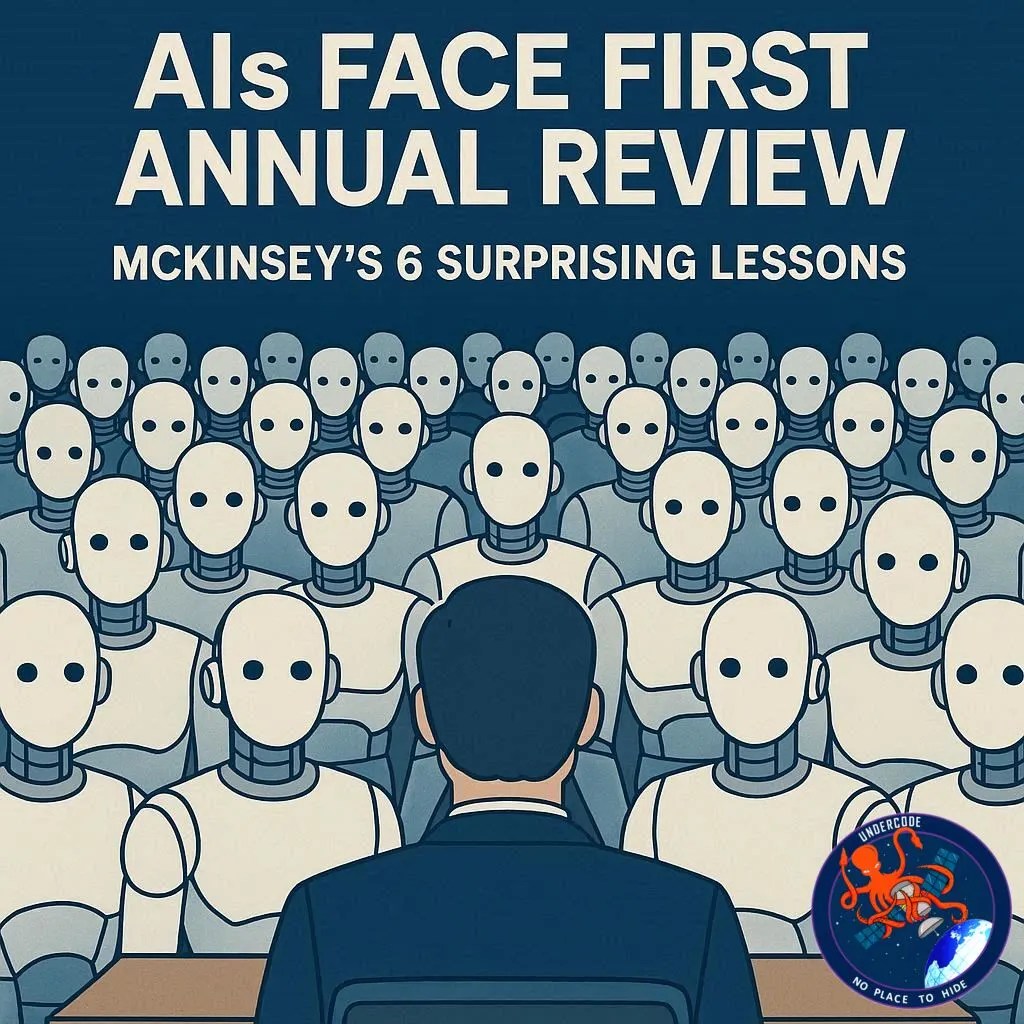
Artificial intelligence is no longer a futuristic concept—it is already sitting in the office cubicles, figuratively speaking. Companies are increasingly treating AI agents as digital co-workers, deploying them to manage workflows, process data, and support employees in day-to-day operations. But just like human workers, these digital employees need evaluation. McKinsey, one of the world’s leading consulting firms, conducted a one-year review of more than 50 AI agents to assess their real-world performance. The results provide eye-opening lessons for organizations racing to implement AI at scale.
McKinsey’s Findings: Six Lessons From a Year of AI Agents
McKinsey’s team of experts, including Lareina Yee, Michael Chui, and Roger Roberts, studied dozens of AI builds across various industries. Their conclusions reveal both opportunities and limitations in this rapidly evolving field.
AI Works Best When Integrated Into Workflows
The first lesson is clear: simply installing AI agents for the sake of novelty is a mistake. AI delivers meaningful value only when embedded deeply into workflows. Companies that use agents to solve pressing user pain points—such as handling document-heavy processes in insurance or legal firms—see the most success.
Agents Aren’t Always the Right Tool
McKinsey cautions against treating AI agents as a universal fix. Just as managers evaluate employees for their unique strengths, companies must evaluate whether AI is truly the right solution. In some cases, traditional automation or predictive analytics may be more cost-effective and reliable.
Low-Quality Outputs Create “AI Slop”
A recurring frustration among users is poor-quality output—what McKinsey calls “AI slop.” While these agents may shine in demos, they often disappoint in real workflows, eroding user trust. The solution? Treat digital agents like employees by giving them training, clear roles, and regular feedback loops.
Scaling Agents Brings Hidden Challenges
Managing a handful of agents is easy, but scaling into the hundreds introduces major complications. Mistakes multiply and tracing errors becomes a challenge. McKinsey stresses the need for robust monitoring and observability tools to maintain reliability as companies scale.
Reusable Agents Unlock Efficiency
Instead of creating new agents for every individual task, organizations should focus on building reusable agents. Many workflows share common functions like searching, extracting, or analyzing, and a single well-designed agent can handle multiple contexts. This prevents waste and lowers costs.
Human Oversight Remains Essential
Finally, McKinsey emphasizes that AI agents will never work in total isolation. Human employees must continue to supervise outputs, ensure compliance, and step in during complex edge cases. True success lies in human-AI collaboration, not full replacement.
What Undercode Say:
McKinsey’s evaluation of AI agents mirrors what many insiders have been quietly acknowledging—AI is powerful, but it’s not magic. The hype often oversells the idea that AI agents can instantly transform workflows with minimal oversight. In practice, digital employees require just as much training, refinement, and structure as human hires.
One key insight is the parallel between onboarding human workers and onboarding AI systems. Just as a new employee cannot be thrown into the deep end without guidance, an AI agent cannot be expected to deliver flawless results without careful integration. The notion of “AI slop” underscores a widespread industry issue: overconfidence in demo-stage capabilities. This is where many organizations stumble, mistaking surface-level performance for long-term value.
Scalability also deserves deeper attention. Companies are often blindsided by the hidden costs of scaling AI agents. While it may be tempting to deploy hundreds at once, the complexity of managing them grows exponentially. The analogy here is running a company where half the employees don’t follow instructions and no one can trace where the mistakes originated. Without proper monitoring, agentic AI quickly turns from an asset into a liability.
Reusable agents are perhaps the most underappreciated solution highlighted by McKinsey. In software engineering, modularity is a fundamental principle—reusing code saves time and reduces errors. The same logic applies to AI agents. Creating flexible, multi-purpose agents could significantly lower costs and improve adoption rates. Companies that ignore this lesson risk ballooning budgets and unsustainable complexity.
Another critical point is the misconception that AI can replace humans entirely. This belief fuels both unrealistic expectations and unnecessary fears. McKinsey’s findings affirm a more balanced reality: AI thrives when augmenting human judgment, not replacing it. For example, an insurance agent might use AI to sift through thousands of claims in seconds, but the final decision on high-value or ambiguous cases still requires human expertise.
The long-term takeaway is that AI agents should be positioned as co-pilots, not as pilots. Their role is to assist, accelerate, and expand what humans can do—not to operate without supervision. Organizations that embrace this mindset will see smoother adoption and fewer disappointments.
Finally, the performance review highlights a cultural challenge. Many employees resist AI because of mistrust or poor early experiences. “AI slop” damages credibility, and once users lose faith, regaining it becomes difficult. Just as managers must earn the trust of their teams, AI systems must consistently prove their reliability to gain user acceptance.
In short, AI agents represent a groundbreaking shift in digital labor, but they come with baggage. Companies that rush adoption without strategy will suffer from inefficiencies, wasted investments, and frustrated employees. Those that carefully align AI with workflows, invest in monitoring, and maintain human oversight will unlock transformative potential.
Fact Checker Results
✅ McKinsey did review over 50 AI agents across one year.
✅ Six clear lessons were documented, covering workflows, scalability, and human oversight.
❌ AI agents are not flawless replacements for human workers and require significant effort to integrate.
Prediction
AI agents will continue to evolve, but their future lies not in replacing the workforce outright, but in reshaping how work is performed. By 2028, we are likely to see organizations adopting hybrid systems where reusable agents become standard tools across multiple functions, supported by structured monitoring frameworks. The companies that balance ambition with discipline will lead the AI-powered workplace revolution.
🕵️📝✔️Let’s dive deep and fact‑check.
References:
Reported By: www.zdnet.com
Extra Source Hub:
https://www.quora.com/topic/Technology
Wikipedia
OpenAi & Undercode AI
Image Source:
Unsplash
Undercode AI DI v2
🔐JOIN OUR CYBER WORLD [ CVE News • HackMonitor • UndercodeNews ]
📢 Follow UndercodeNews & Stay Tuned:
𝕏 formerly Twitter 🐦 | @ Threads | 🔗 Linkedin | 🦋BlueSky | 🐘Mastodon


