
Listen to this Post
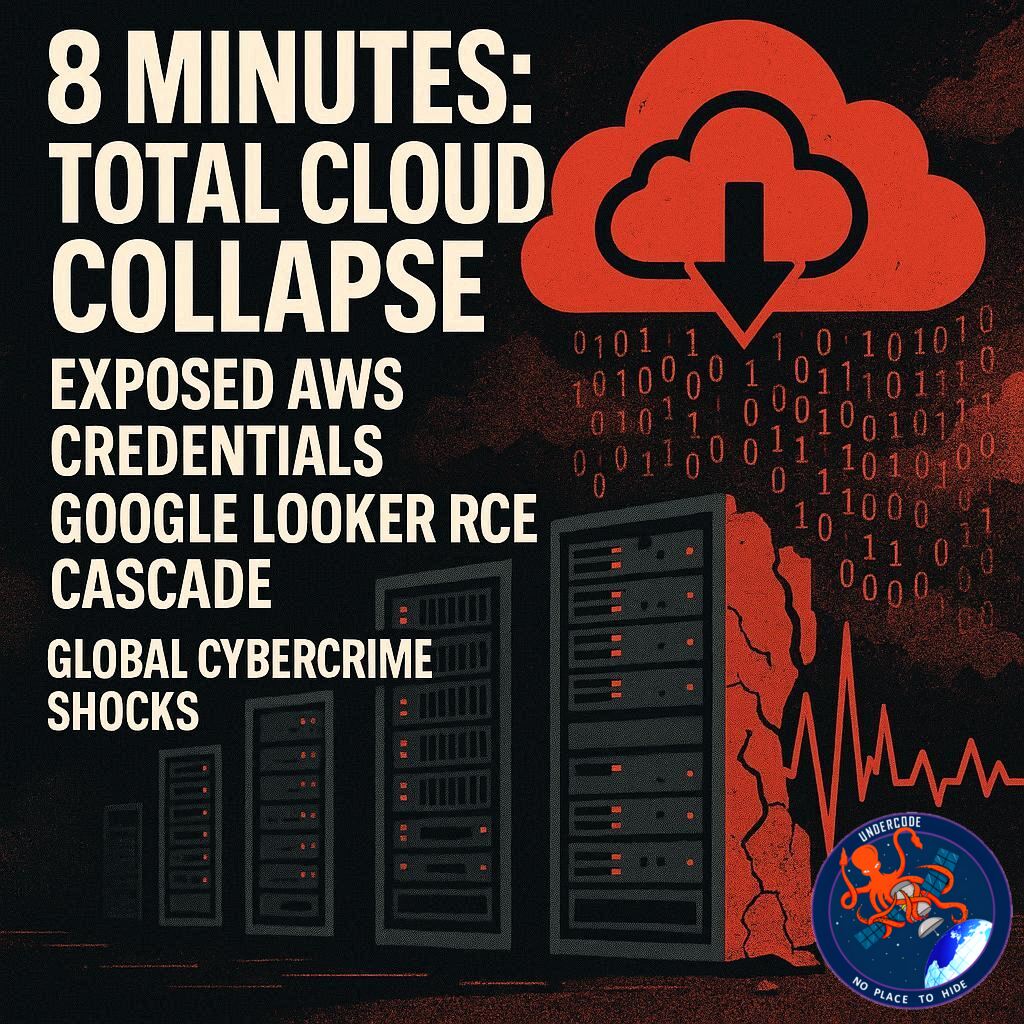
Introduction: A Single Tweet That Exposed a Massive Security Reality
A brief social media post from a cybersecurity monitoring account has managed to capture the brutal speed and scale of today’s digital threats. In just a few lines, it outlined how exposed test credentials led to a full Amazon Web Services (AWS) administrative takeover in under ten minutes, how vulnerabilities in Google Looker enabled remote code execution and data theft, how a Harvard Alumni breach was linked to the infamous ShinyHunters group, and how the operator of the Incognito Market finally received a 30-year prison sentence. Together, these incidents paint a stark picture: modern cyberattacks are fast, automated, and increasingly unforgiving, while law enforcement responses, though slow, are becoming more decisive.
the Original Report: A Rapid-Fire Breakdown of Major Cyber Incidents
The original post highlights a sequence of high-impact cybersecurity events that unfolded almost simultaneously. One of the most alarming incidents involved exposed test credentials that allowed attackers to gain full AWS administrative access in just eight minutes. By abusing AWS Lambda functions, the attackers reportedly injected malicious code, escalated privileges, and effectively took over the entire cloud environment. This case underscores how even non-production credentials, when poorly secured, can become a direct path to total infrastructure compromise.
Another major point in the report focuses on Google Looker, a widely used business intelligence and analytics platform. Security flaws within Looker were allegedly exploited to achieve remote code execution (RCE), allowing attackers to run arbitrary commands and exfiltrate sensitive data. Given Looker’s deep integration with enterprise databases, this vulnerability dramatically increases the potential blast radius, turning a single flaw into a gateway for large-scale data theft.
The tweet also references a data breach involving Harvard Alumni, which investigators have linked to ShinyHunters, a well-known cybercriminal collective with a long history of high-profile breaches. This connection suggests that even prestigious academic networks are not immune to organized cybercrime groups that specialize in credential harvesting and data resale.
Rounding out the report is a law enforcement milestone: the operator behind the Incognito Market, a notorious dark web marketplace, was sentenced to 30 years in prison. This sentencing represents one of the harsher penalties imposed on darknet market operators and signals a growing willingness by authorities to pursue long-term consequences for large-scale cyber-enabled crime.
Together, these events illustrate the full lifecycle of modern cyber threats, from initial credential exposure and vulnerability exploitation to data breaches and eventual legal accountability. The post may be short, but it captures an entire ecosystem of risk, exploitation, and response in the digital age.
The Speed Factor: Why Eight Minutes Is the New Nightmare
The AWS takeover described in the report is especially chilling because of its speed. Eight minutes is barely enough time for a human to notice an alert, let alone respond. Automated scanning tools constantly search public repositories, misconfigured servers, and leaked credentials. Once discovered, attackers no longer need hours or days; scripts can validate access, escalate privileges, and deploy persistence mechanisms almost instantly.
This incident reinforces a hard truth for cloud security teams: there is no such thing as “low-risk” credentials. Test keys, temporary tokens, and development accounts often have broader permissions than intended, and attackers know this. The moment those credentials leak, the clock starts ticking.
Cloud Misconfigurations: The Silent Enabler of Total Takeovers
AWS Lambda injection is not a new technique, but its effectiveness depends on misconfigurations. Over-permissive IAM roles, lack of monitoring on function changes, and insufficient logging all contribute to an attacker’s success. Once Lambda functions are compromised, they can be used to execute code across environments, access sensitive secrets, and even disable security controls.
This case highlights how cloud-native services, while powerful, can amplify mistakes. A single exposed credential can cascade through serverless components, storage buckets, and identity systems, turning a small oversight into a full administrative breach.
Google Looker RCE: When Analytics Becomes an Attack Vector
The reported Google Looker flaws raise serious concerns for enterprises that rely on analytics platforms as trusted internal tools. Remote code execution vulnerabilities are among the most dangerous because they effectively hand control of the system to an attacker. In environments where Looker connects directly to production databases, RCE can mean unrestricted access to customer records, financial data, and proprietary insights.
This incident serves as a reminder that third-party platforms, even those from major technology providers, must be treated with the same scrutiny as internal applications. Patch management, network segmentation, and strict access controls remain essential, regardless of vendor reputation.
Academic Targets: Why Harvard Alumni Data Attracts Criminal Groups
The link between the Harvard Alumni breach and ShinyHunters is telling. Alumni databases often contain a rich mix of personal, professional, and financial information, making them highly valuable on underground markets. For groups like ShinyHunters, such data can be monetized through identity theft, targeted phishing, or resale to other criminal actors.
Academic institutions frequently operate complex, decentralized IT environments, which can make consistent security enforcement difficult. Attackers exploit this complexity, knowing that legacy systems and third-party integrations often lag behind modern security standards.
Dark Web Accountability: The Significance of the Incognito Market Sentence
The 30-year sentence handed to the Incognito Market operator marks a notable moment in cybercrime enforcement. Dark web marketplaces have long thrived on the perception of anonymity and impunity. A sentence of this magnitude sends a clear message that operating large-scale criminal platforms carries severe personal risk.
While such legal outcomes do not eliminate cybercrime, they do disrupt ecosystems, deter some actors, and demonstrate that persistence in international investigations can eventually pay off.
What Undercode Say: The Bigger Picture Behind These Headlines
The most important takeaway from this cluster of incidents is not any single breach or vulnerability, but the pattern they reveal. Cybersecurity failures today are rarely the result of one catastrophic flaw; they emerge from chains of small, often overlooked weaknesses. Exposed test credentials, delayed patching, excessive permissions, and blind trust in third-party platforms collectively create an environment where attackers can move faster than defenders.
The eight-minute AWS takeover is a perfect example of how automation has shifted the balance. Attackers no longer need deep, manual exploration of a network. Instead, they rely on pre-built playbooks that execute the moment access is confirmed. Defensive strategies that depend on human reaction times are simply no longer sufficient.
Equally important is the role of visibility. Many organizations still lack real-time insight into how their cloud resources are being used. Without continuous monitoring and anomaly detection, malicious activity blends in with normal operations until the damage is already done.
The Looker vulnerability also highlights a growing blind spot in enterprise security: business intelligence and analytics tools. These platforms often sit at the intersection of data, users, and infrastructure, making them ideal targets. Yet they are frequently excluded from rigorous security testing because they are seen as “internal” or “read-only,” an assumption attackers are happy to exploit.
On the enforcement side, the Incognito Market sentencing shows that consequences are catching up, but slowly. Cybercriminals operate at internet speed, while investigations take years. Bridging this gap requires not only better technical defenses but also stronger international cooperation and faster legal frameworks.
Ultimately, these stories point to a future where cybersecurity success depends on reducing exposure time. Credentials must be rotated and scoped tightly, misconfigurations must be detected automatically, and trust in any system, internal or external, must always be conditional. The cost of complacency is no longer measured in days or weeks, but in minutes.
Fact Checker Results 🔍
✅ Exposed cloud credentials have repeatedly led to full AWS account compromises in real-world incidents.
✅ Remote code execution flaws in analytics platforms are considered critical due to their access to sensitive data.
❌ There is no public evidence confirming the exact technical details beyond what was summarized in the original post.
Prediction 📊
Based on current trends, cloud credential exposure and third-party platform vulnerabilities will continue to dominate breach reports in the near future. Organizations that fail to automate cloud security monitoring and restrict non-production access will face increasingly rapid compromises, while law enforcement will likely pursue more high-profile, long-sentence cases to deter large-scale cybercrime.
🕵️📝✔️Let’s dive deep and fact‑check.
References:
Reported By: x.com
Extra Source Hub (Possible Sources for article):
https://www.pinterest.com
Wikipedia
OpenAi & Undercode AI
Image Source:
Unsplash
Undercode AI DI v2
Bing
🔐JOIN OUR CYBER WORLD [ CVE News • HackMonitor • UndercodeNews ]
📢 Follow UndercodeNews & Stay Tuned:
𝕏 formerly Twitter 🐦 | @ Threads | 🔗 Linkedin | 🦋BlueSky | 🐘Mastodon


