
Listen to this Post
The Growing Doubt Around AI Hype
There’s a growing cloud of skepticism surrounding artificial intelligence. Many business leaders are quietly wondering whether AI is truly the next industrial revolution—or just another overinflated tech bubble ready to burst. MIT’s recent report didn’t help ease those fears: only 5% of AI projects currently deliver measurable business value. Behind the headlines of “AI success stories,” thousands of companies are struggling to turn experiments into profit.
But amid the uncertainty, some digital pioneers are proving that AI’s promise is real—if approached with precision. One of them is Fausto Fleites, vice president of data intelligence at Scotts Miracle-Gro, a 150-year-old brand best known for helping lawns grow green and healthy. Fleites isn’t chasing hype. Instead, he’s showing that AI’s magic lies not in grand visions but in tactical execution, disciplined iteration, and a clear focus on results.
How Scotts Miracle-Gro Brought AI Down to Earth
When Fleites joined Scotts in early 2023—after senior roles at Sears and Accenture—he faced a classic challenge: how to make AI practical in a legacy company. He started by building the right foundations. Partnering with AWS and Google, his team created a data architecture capable of supporting deep-learning models that could surface decision-making insights for executives.
Once the groundwork was solid, he began identifying use cases that truly mattered. Instead of sprawling, years-long projects, Fleites pushed for quick iterations and small wins. Each success became a story that helped convince executives and business units to trust the technology. The results? A company once rooted in traditional processes is now quietly transforming itself with modern intelligence.
Six Proven Tactics to Extract Real Value From AI
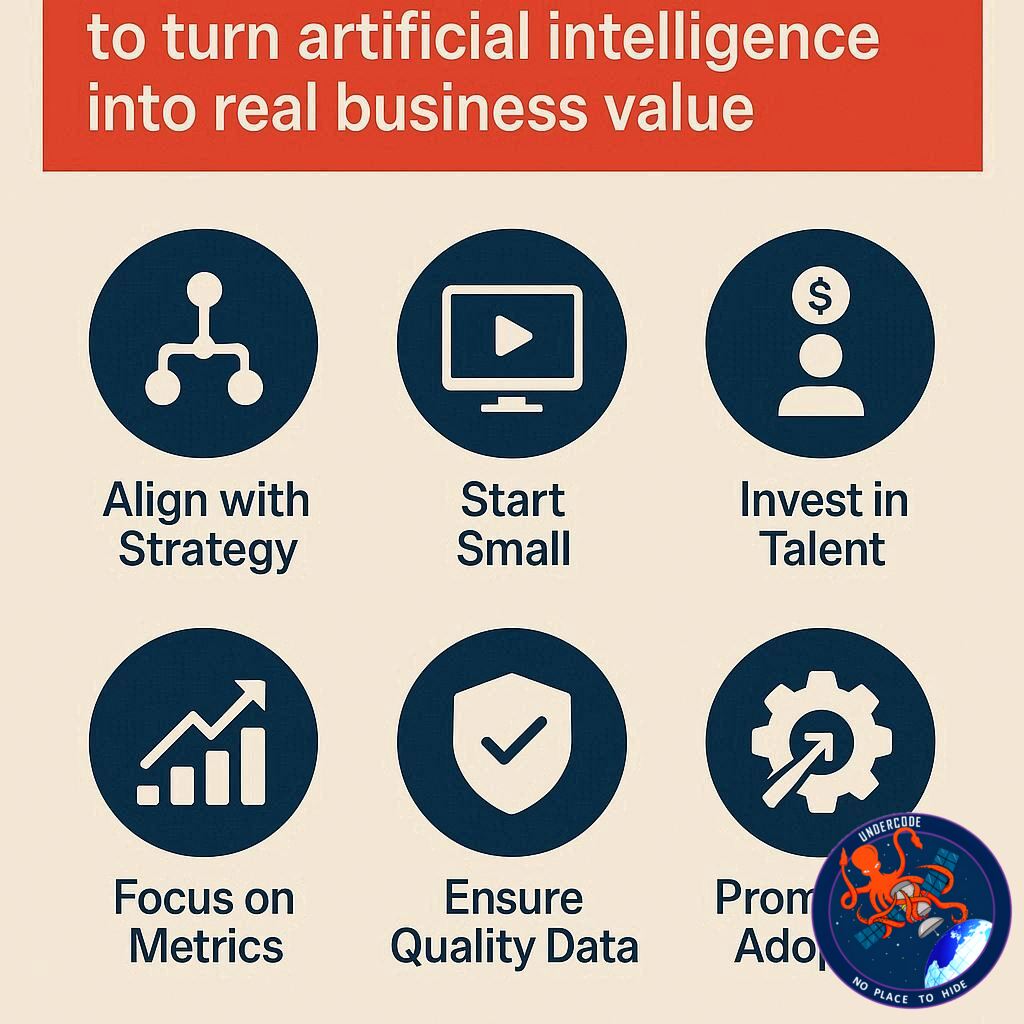
Fleites distills his experience into six lessons that any organization can follow to move from buzz to business value:
Iterate Fast and Learn from Mistakes: Build prototypes quickly using available tools like ChatGPT or Gemini. Test, fail, pivot, and repeat. Fleites says, “That culture of rapid iteration, learning, and failing fast is key to success.”
Start Small and Trust the Experts: Avoid massive, multi-year AI programs with vague outcomes. The field changes too fast for rigid planning. Flexibility beats size.
Align AI With Business Strategy: AI for the sake of AI is a trap. Every use case should have clear KPIs and measurable business impact.
Empower Cross-Functional Teams: Create startup-like squads that break silos and foster collaboration. The goal is to make the entire organization agile and data-driven.
Invest in Your Foundations: Quality data and robust infrastructure are non-negotiable. At Scotts, decades of product knowledge were reformatted to make AI interactions faster and smarter.
Show Early Wins and Drive Change: Fleites emphasizes change management as the bridge between innovation and adoption. Small victories in consumer services became the proof needed to expand into back-office automation.
Customer Service, Reimagined by AI
Scotts Miracle-Gro’s consumer-facing AI experiments have already delivered tangible wins. The company’s AI search system, powered by Google Vertex AI, allows customers to use natural language to find products and advice. Before, users had to know the exact term—like “fertilizer.” Now, they can simply ask, “How can I make my lawn greener?” and receive accurate, conversational results.
The same principle drives their AI chat agent, developed with the startup Sierra. The chatbot doesn’t just spit out generic replies. It understands intent, asks follow-up questions, and gives specific product recommendations based on user needs and local conditions. For example, if a customer asks about fertilizer, the system tailors its response to their region’s restrictions and soil type—something even many human agents would struggle to do consistently.
This personalized approach not only boosts engagement but also builds trust, giving customers a sense that they’re having a real, knowledgeable conversation, not interacting with a lifeless bot.
Automation in the Back Office
While chatbots steal the spotlight, Fleites believes the real ROI of AI lies behind the scenes. His team developed an “Email Rewrite” tool using agentic AI, which transforms raw internal notes into polished customer emails in under 30 seconds. The result? Faster responses, consistent brand tone, and higher-quality communication.
Using data from Salesforce knowledge articles, the system generates several response versions so staff can choose the best tone before sending. What once took several minutes per email now takes seconds—while maintaining a human touch.
This initiative is part of a larger effort known as X-Ray Analysis, designed to uncover repetitive tasks across departments that can be automated by AI agents. These small but powerful shifts are slowly redefining how work gets done at Scotts, freeing up employees for creative and strategic work instead of routine manual tasks.
What Undercode Say:
AI’s problem isn’t potential—it’s misalignment. Companies rush to deploy impressive-sounding models before defining what “success” actually means. Scotts Miracle-Gro’s approach reveals a blueprint for sustainable AI adoption: start with strategy, not spectacle.
What makes Fleites’ method stand out is his hybrid philosophy—combining old-school business logic with new-school data science. By linking AI directly to KPIs and measurable business outcomes, he avoids the “AI theater” that plagues many corporate projects. The company’s shift toward small, high-impact use cases reflects a growing trend: practical AI over performative AI.
Another key insight is psychological. Fleites understands that AI transformation is cultural, not just technical. His emphasis on collaboration, agile teams, and internal evangelism turns AI from a distant concept into an everyday ally. This mirrors what successful organizations like Amazon and Netflix have already mastered—embedding AI into processes, not just products.
The dual focus on customer experience and back-office automation is equally strategic. While flashy front-end bots may capture headlines, it’s the quiet automation behind the scenes that delivers real financial returns. Automating communication, data processing, and routine decision-making often yields greater efficiency gains than customer-facing apps.
Finally, Fleites’ acknowledgment of “failure as feedback” deserves special attention. In a field obsessed with perfection, the idea that fast iteration beats flawless planning is liberating. AI isn’t a one-time deployment; it’s an evolving ecosystem. Those who learn faster, win faster.
🔍 Fact Checker Results
✅ MIT’s report confirming that only 5% of AI projects deliver value is accurate.
✅ Scotts Miracle-Gro has publicly partnered with Google and AWS for AI infrastructure.
✅ Sierra AI provides personalized agents for brands, verified as part of Scotts’ chatbot system.
📊 Prediction
💡 As organizations mature, AI ROI will shift from customer chatbots to internal automation, unlocking hidden productivity in back offices.
📈 Within the next three years, companies that adopt agile AI models and fast iteration cycles could see up to a 40% boost in process efficiency.
🌍 The “AI bubble” won’t burst—it will evolve, leaving only those who can translate data into decisions standing strong.
🕵️📝✔️Let’s dive deep and fact‑check.
References:
Reported By: www.zdnet.com
Extra Source Hub (Possible Sources for article):
https://www.reddit.com/r/AskReddit
Wikipedia
OpenAi & Undercode AI
Image Source:
Unsplash
Undercode AI DI v2
Bing
🔐JOIN OUR CYBER WORLD [ CVE News • HackMonitor • UndercodeNews ]
📢 Follow UndercodeNews & Stay Tuned:
𝕏 formerly Twitter 🐦 | @ Threads | 🔗 Linkedin | 🦋BlueSky | 🐘Mastodon


