
Listen to this Post
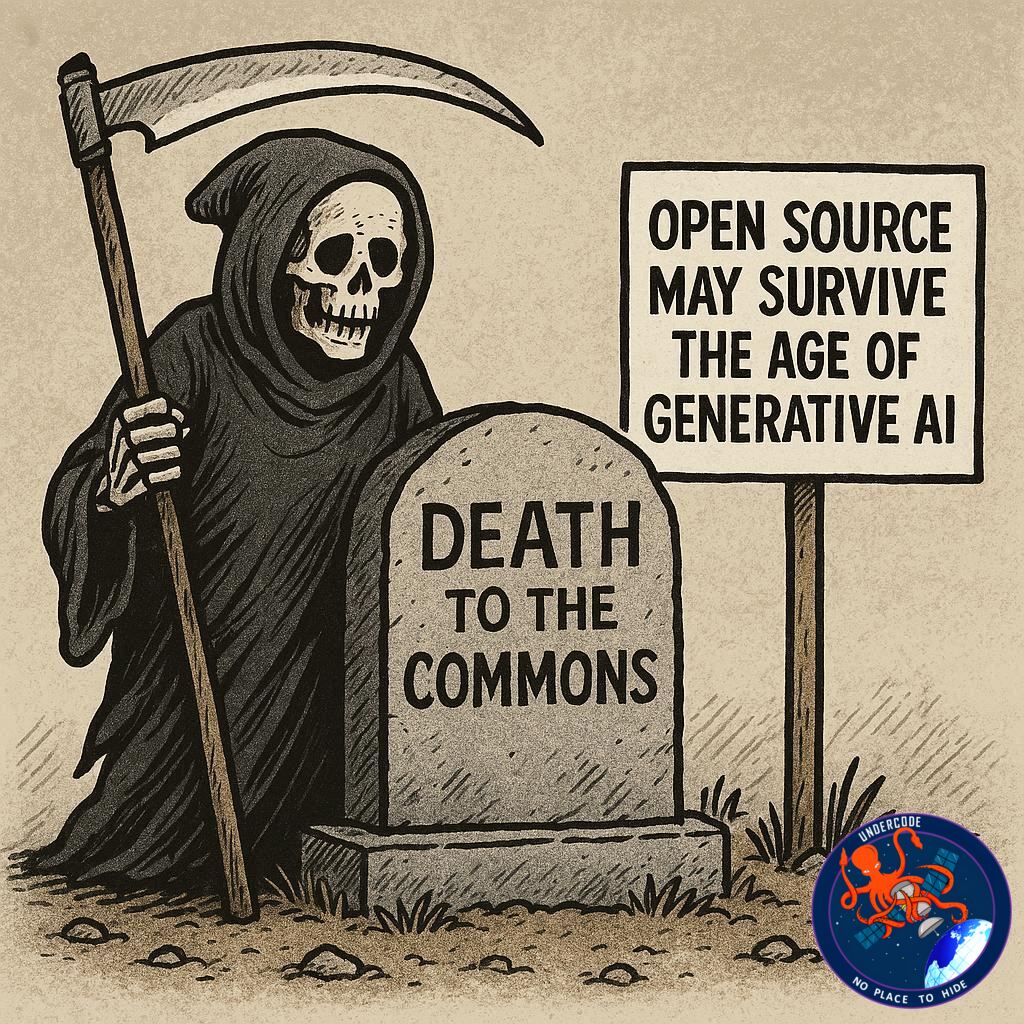
🌍 Introduction: When the Code That Built the Future Begins to Vanish
We live in a world powered by invisible code. From the systems that secure our banks to the algorithms that generate the words you’re reading, software forms the beating heart of civilization. For decades, free and open-source software (FOSS) has been the invisible scaffolding holding up that world—a global commons built on collaboration, reciprocity, and transparency. But as generative AI rises to dominance, that delicate ecosystem faces an existential threat.
The irony is painful: the very AI systems transforming the world were born from the open-source movement. Yet those same systems are now eroding the principles that made them possible. Attribution is vanishing, ownership is blurring, and the cycle of give-and-take that sustained open software for decades is collapsing. What happens when the commons that built AI becomes its first casualty?
💻 The Collapse of Provenance
Nearly every aspect of modern technology—networks, security protocols, financial systems, even generative AI—rests on open-source code. FOSS thrives on the principle of reciprocity: you use, you improve, you give back. This cooperative loop is made possible by provenance—the ability to trace every line of code to its originator.
Enter generative AI. Systems trained on massive datasets now produce code snippets derived from unknown sources, some likely from FOSS projects governed by strict “copyleft” licenses. These licenses require that any modifications or reuse must remain open and credited. But when AI churns out code fragments divorced from their lineage, those legal and moral agreements dissolve into nothing.
⚖️ Copyleft vs. Code Laundering
Sean O’Brien of Yale Privacy Lab warns that AI-generated code creates a legal and ethical “black hole.” Developers can no longer determine whether a code fragment originated from a GPL-licensed project or a proprietary system. Without provenance, license compliance becomes impossible. The AI effectively “launders” code—stripping away identifiers, history, and obligations.
This leads to what O’Brien calls “license amnesia.” Developers unknowingly use fragments of open-source code but can’t trace them back, can’t attribute them, and therefore can’t contribute back. The reciprocity that sustained open source—the very lifeblood of FOSS—dries up.
🧩 The Legal Gray Zone
Current U.S. copyright law compounds the issue. Only human-created works are copyrightable, while AI-generated works default to the public domain. At the same time, anyone deploying AI-generated outputs bears responsibility for potential infringement. It’s a legal paradox: AI can’t own what it creates, yet it can still produce infringing material.
For open-source communities, this gray zone is disastrous. Copyleft licenses depend on human traceability and responsibility. If provenance disappears, so does accountability. The result? A growing ocean of “ownerless” code—usable by corporations, untraceable by communities, and untethered from the principles that built the modern software world.
🧠 From Commons to Commodity
For decades, open-source software functioned like a renewable ecosystem. Developers built upon shared resources, improved them, and returned the benefits upstream. Security improved, usability expanded, and innovation thrived. But generative AI upends this balance. It consumes FOSS at scale, training on decades of communal labor, then regurgitates code stripped of origin and context.
As O’Brien puts it, AI systems are mining a nonrenewable resource—the global digital commons. Once that commons is depleted, future generations won’t inherit a shared infrastructure; they’ll inherit a privatized landscape of “public domain” fragments owned and controlled by corporate AI pipelines.
🔒 Irony of Progress
The ultimate irony is that every generative AI model, every LLM, every deep learning framework rests on open-source foundations—Linux, Python, GCC, TensorFlow. Thousands of unpaid maintainers and hobbyist coders built the tools that made AI possible. Now, those same tools are being weaponized to strip open-source of its legal protection.
Corporations that once relied on the commons to thrive are now using it as training data, effectively dismantling the very system that gave them life. If that continues, the open-source ethos—“freedom to build together”—may vanish, replaced by privatized code silos and AI models that treat public data as raw material for profit.
🕳️ The Future of Attribution
When provenance disappears, so does trust. Developers won’t know whether their AI-generated code violates licenses or ethics. Without attribution, collaboration halts. And without collaboration, innovation stagnates.
If AI continues to ingest and output open-source code without mechanisms for traceability, we risk building a digital world where no one truly “owns” or understands its foundation. The commons become a casualty of convenience, its value consumed by the machines it helped create.
💡 What Undercode Say:
The decline of open source in the face of generative AI isn’t just a technical concern—it’s a cultural and philosophical one. The open-source movement was never merely about free access; it was about shared stewardship. It represented a social contract among creators—a belief that transparency fuels progress, that innovation belongs to everyone, not just corporations with the biggest compute clusters.
Generative AI challenges that belief at its core. These models absorb everything: licensed code, creative commons projects, even private repositories leaked online. They digest the collective human effort of decades and spit out derivative works that no one can legally or ethically trace. It’s digital colonialism disguised as innovation.
Open-source communities thrive on accountability. If AI breaks that chain of accountability, it transforms a cooperative ecosystem into a lawless expanse. In essence, it replaces the commons with a marketplace—where ownership is unclear, credit is diluted, and community becomes irrelevant.
However, the solution doesn’t lie in abandoning AI. It lies in reimagining open source for an AI-driven era. Developers, policymakers, and AI researchers must collaborate to build traceable AI pipelines—systems that tag, audit, and attribute the origins of every data fragment used in model training.
Blockchain-based provenance systems could anchor transparency. New “AI-aware” licenses might explicitly define how open-source code can be used in machine learning models. And perhaps, most importantly, the next generation of coders must be educated to treat open-source ethics not as optional, but as foundational.
If we fail to do so, we’ll lose more than a licensing model. We’ll lose the moral framework of collaboration that made the digital revolution possible.
🔍 Fact Checker Results
✅ FOSS (Free and Open Source Software) underpins most modern digital infrastructure.
✅ Generative AI systems often blur or erase code provenance and attribution.
❌ There are currently no universal laws or tools ensuring AI code provenance compliance.
📊 Prediction
🔮 Over the next five years, expect a major clash between open-source advocates and AI corporations. Governments may step in to enforce digital provenance laws, while developers build new ethical AI ecosystems rooted in transparency. 🌐
💥 If reform fails, open-source software could fragment into private, corporate-controlled ecosystems—turning the “commons” into a memory of what collaboration once meant.
Something went wrong while generating the response. If this issue persists please contact us through our help center at help.openai.com.
Retry
🕵️📝✔️Let’s dive deep and fact‑check.
References:
Reported By: www.zdnet.com
Extra Source Hub (Possible Sources for article):
https://www.quora.com/topic/Technology
Wikipedia
OpenAi & Undercode AI
Image Source:
Unsplash
Undercode AI DI v2
Bing
🔐JOIN OUR CYBER WORLD [ CVE News • HackMonitor • UndercodeNews ]
📢 Follow UndercodeNews & Stay Tuned:
𝕏 formerly Twitter 🐦 | @ Threads | 🔗 Linkedin | 🦋BlueSky | 🐘Mastodon


