
Listen to this Post
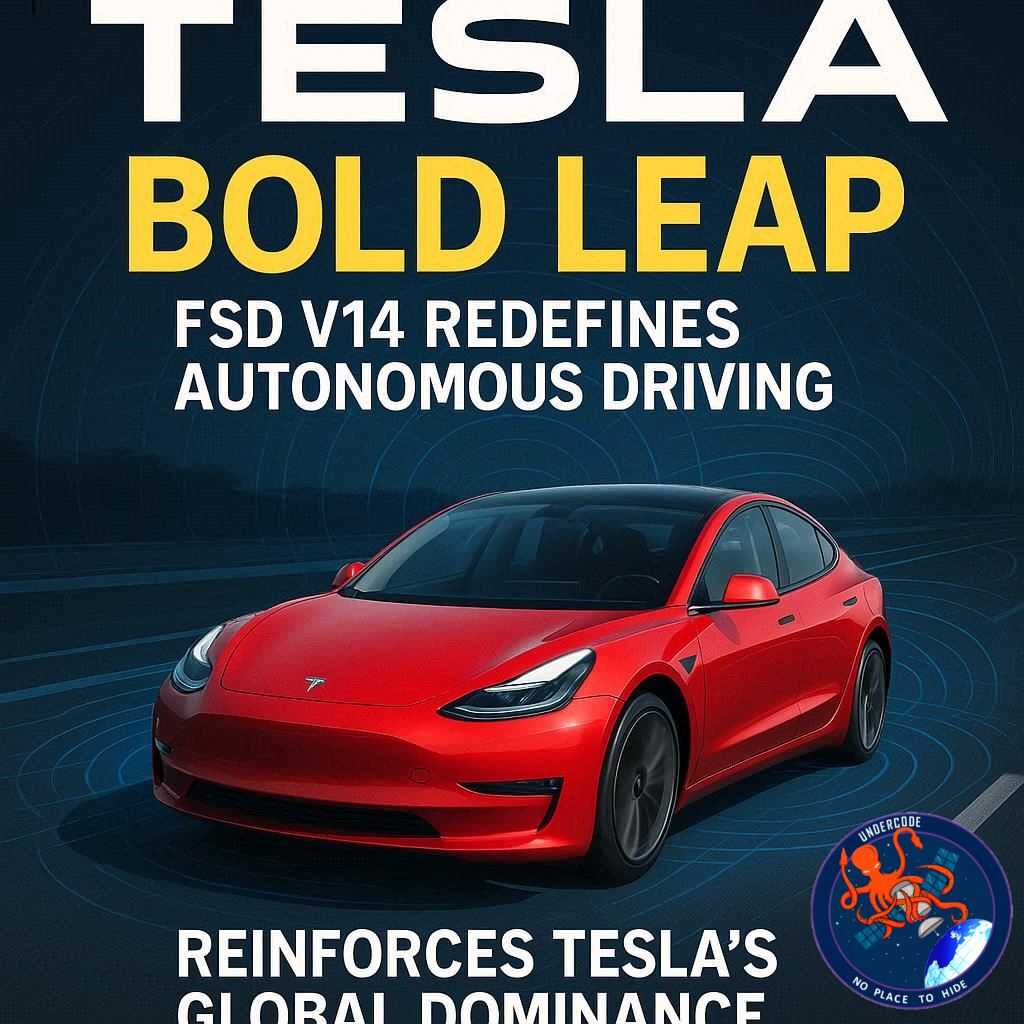
In the ever-evolving world of autonomous technology, Tesla has once again shifted gears — not just figuratively, but literally. With the release of Full Self-Driving (Supervised) v14, the company has reached a new chapter in its journey toward a future where cars drive with more intuition, awareness, and confidence than ever before. But that’s not the only frontier Tesla is conquering — from reclaiming sales titles to satellites in orbit, the Musk empire is in full acceleration mode.
A Smarter, Smoother Tesla: The Big Leap from FSD v13 to v14
Tesla’s latest Full Self-Driving (Supervised) update, version 14, has rolled out over the past few weeks — and for many owners, it’s a game-changer. This marks the fourth major evolution of Tesla’s semi-autonomous software, and it’s clear that the company is closing in on a new level of refinement. The latest build, v14.1.4, even fine-tunes smaller annoyances like the notorious “brake-stabbing” issue that plagued v14.1.3, delivering a smoother, more natural ride.
Owners report that most of the frustrations from v13 are gone, replaced by smoother behavior, more human-like decisions, and an overall sense that the car “thinks” better on the road. Some of the most impressive updates include smarter lane changes, better handling of merging traffic, more confident navigation around slow-moving vehicles, and superior obstacle avoidance.
Improved Lane Switching
The “Hurry” speed profile, once criticized for lingering too long in the fast lane, now behaves more like a considerate driver. Instead of “camping” in the left lane, FSD v14 moves back to the right after passing — a small change that makes a big difference in real-world driving courtesy and flow.
Merging Traffic Awareness
Tesla’s neural networks seem sharper than ever at reading the flow of traffic. FSD now courteously allows merging cars to enter during heavy congestion — a moment of mechanical empathy many human drivers could learn from.
Handling the Unusual
From Amish buggies to mail trucks in rural Pennsylvania, the software now navigates these unpredictable scenarios with surprising confidence. Where owners once took over manually, v14 now handles overtaking calmly and safely.
Object Avoidance That Feels Alive
In earlier versions, the system occasionally made odd prioritizations — steering around horse droppings but ignoring fallen branches. Now, the car’s vision and prediction systems are smarter. It recognizes and smoothly maneuvers around real hazards, such as carcasses or road debris, without alarming swerves.
Speed Consistency Revamped
Gone are the jittery accelerations and decelerations. Tesla axed the “Max Speed” toggle and replaced it with a simpler scroll-wheel adjustment, making the speed profile feel more organic. The result: a driving experience that’s more predictable, smoother, and genuinely closer to a seasoned human driver.
In short, FSD v14 feels less like software and more like intuition in motion.
SpaceX and Tesla: The Twin Engines of the Musk Machine
Meanwhile, SpaceX’s Starlink program is reaching for the stars — literally. Having launched over 10,000 satellites since 2019, the project has revolutionized global internet access. More than 5 million subscribers now depend on Starlink for high-speed connectivity, spanning 150 countries and even commercial flights. With approval for 12,000 more satellites — and ambitions to exceed 30,000 — SpaceX is building the digital backbone of a connected planet.
This incredible feat not only reinforces Elon Musk’s technological reach but also gives Tesla a strategic advantage. Seamless over-the-air updates, live telemetry, and real-time FSD data depend on the kind of low-latency connectivity Starlink provides. Together, they form an ecosystem that’s self-sustaining — rockets that launch satellites, satellites that improve cars, and cars that gather data for smarter AI.
Model Y: Tesla’s Quiet Comeback King
In the competitive electric vehicle market, Tesla’s Model Y has once again proven that dominance isn’t just about innovation — it’s about consistency. Despite the influx of cheaper EVs from Europe and China, the Model Y reclaimed its “best-selling” crown across the European market in September, with 25,938 sales.
Even with an 8.6% year-over-year decline, it outpaced rivals like the Renault Clio, Dacia Sandero, and Volkswagen T-Roc. Globally, the Model Y remains one of the most popular cars — electric or otherwise — for the second consecutive year. In the U.S. and China, where Tesla faces fierce local competition, its allure endures thanks to its design, reliability, and tech features powered by FSD’s ongoing evolution.
Tesla’s Q3 delivery record of nearly half a million cars solidifies one truth: even when challenged, Tesla thrives under pressure.
A Miracle on the Highway: Tesla and the Plane Crash Avoidance
In Oklahoma, a Tesla captured a jaw-dropping moment on dashcam: a small military aircraft crash-landed across a highway, and the Tesla — possibly running on FSD — executed a perfect evasive maneuver. While unconfirmed whether FSD was truly in control, the reaction was so quick and precise that it reignited debate over the technology’s true capabilities.
The “Jump to Event” alert seen in the footage hints that autonomous mode might have been active, though Tesla and the driver have not confirmed this. Either way, the event underscores how advanced Tesla’s reflexive driving intelligence has become — responding faster than most humans could.
What Undercode Say:
Tesla’s ecosystem isn’t just evolving — it’s maturing. FSD v14 feels like the company’s first major step from “assistive automation” to “behavioral automation.” The car is no longer merely following rules; it’s reading context, predicting human intent, and adapting dynamically.
From a technical standpoint, this suggests huge leaps in Tesla’s neural network inference and edge computing optimization. Each real-world encounter — whether it’s a slow mail truck or a falling plane — feeds millions of new data points into Tesla’s AI learning loop. This feedback creates a virtuous cycle: the more people drive with FSD, the faster it learns and improves.
Moreover, Tesla’s design philosophy — to remove unnecessary settings like “Max Speed” — reflects a deeper vision of frictionless interaction. The driver’s relationship with the machine is becoming intuitive, nearly subconscious. You no longer “command” the car; you collaborate with it.
When viewed alongside SpaceX’s Starlink expansion, it’s clear Musk isn’t just building companies — he’s constructing an interconnected network of intelligence. The satellites that beam internet to rural Africa are the same ones helping Teslas download high-fidelity driving maps in real time.
The Model Y’s resurgence in sales isn’t just about affordability; it’s about trust. Drivers feel Tesla’s software edge. Competitors may offer cheaper EVs, but few can match Tesla’s AI-driven refinement or its data-driven reliability.
As the Oklahoma plane incident shows, Tesla’s automation might already be entering the domain of instinct — the elusive human element machines have long lacked. Whether accidental or deliberate, the car’s reaction felt “alive.”
The key question now is not whether Tesla can perfect FSD — but how soon regulators will allow it to drive without supervision.
Fact Checker Results
✅ FSD v14 rollout confirmed with multiple user reports and performance documentation.
✅ SpaceX surpassed 10,000 Starlink satellites launched, verified via official trackers.
✅ Tesla Model Y ranked Europe’s best-selling car in September 2025 according to Automotive News.
Prediction 🔮
By mid-2026, Tesla’s FSD v15 could introduce near-autonomous driving with limited human oversight, thanks to continuous neural data feedback and Starlink’s low-latency global network. Expect Tesla vehicles to soon communicate in real-time — car to car, car to satellite — forming the world’s first “thinking traffic ecosystem.”
🕵️📝✔️Let’s dive deep and fact‑check.
References:
Reported By: www.teslarati.com
Extra Source Hub (Possible Sources for article):
https://www.linkedin.com
Wikipedia
OpenAi & Undercode AI
Image Source:
Unsplash
Undercode AI DI v2
Bing
🔐JOIN OUR CYBER WORLD [ CVE News • HackMonitor • UndercodeNews ]
📢 Follow UndercodeNews & Stay Tuned:
𝕏 formerly Twitter 🐦 | @ Threads | 🔗 Linkedin | 🦋BlueSky | 🐘Mastodon


