
Listen to this Post
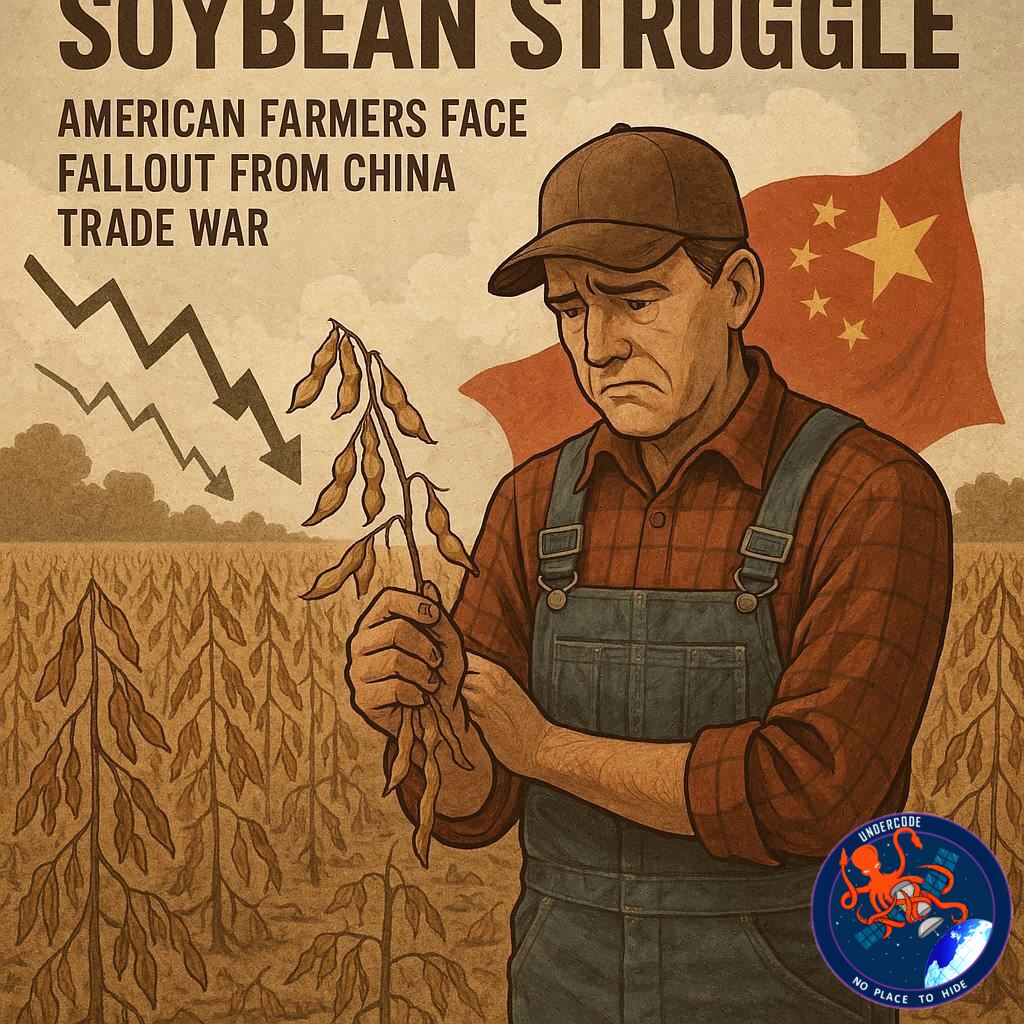
The ongoing trade war between the United States and China has sent shockwaves through the agricultural sector, leaving hundreds of thousands of American soybean farmers grappling with an economic squeeze unlike any they’ve faced before. Once a cornerstone of international agricultural trade, U.S. soybeans have seen demand from China—a historic buyer—plummet due to skyrocketing tariffs imposed in retaliation for U.S. import levies. While headlines often focus on policymakers and corporate interests, the real human cost is felt on farms across the Midwest, where generations of families face uncertainty and shrinking profits.
Over the past several months, China has effectively ceased purchasing American soybeans, drastically curtailing what used to be the largest export market for U.S. farmers. Treasury Secretary Scott Bessent, who also happens to be a soybean and corn farmer in North Dakota, acknowledged the impact in a recent ABC News interview, emphasizing that he “has felt this pain too.” However, the extent of the financial blow differs sharply depending on a farmer’s wealth and reliance on crop income. Bessent, for instance, owns farmland valued between $5 million and $25 million, producing revenue through a price-linked sharing agreement that adds $100,000 to $1 million annually. In contrast, smaller family farms rely almost entirely on soybean sales to sustain livelihoods, leaving them vulnerable to market disruptions.
Since May, when President Donald Trump’s tariffs on Chinese imports triggered China’s retaliatory tariffs on U.S. soybeans, sales have effectively stalled. This trade standoff has led to difficult decisions for farmers like Jake Benike of Elgin, Minnesota, who grows corn and soybeans with his father on their 1,700-acre family farm. Despite a decent harvest mitigating some losses, Benike faces an existential question: is it worth continuing to grow soybeans if access to China remains blocked? His uncertainty mirrors a broader anxiety across the Midwest, where soybean prices have declined, and the market outlook depends heavily on diplomatic negotiations between the U.S. and China.
Bessent, meanwhile, faces a unique situation due to his dual role as a public official and a farmer. He has been required by the Office of Government Ethics to divest from farmland and other potential conflict-of-interest assets by December 15. Though the divestiture process has been slowed by the depressed trade environment, Treasury officials emphasize that his financial losses, approaching $100 million in opportunity costs, underscore the severity of market conditions—even for the wealthy.
The story of these American soybean farmers highlights the disparate impact of the trade war. Wealthier farmers like Bessent may absorb losses, while smaller operations confront existential threats. As the world watches high-level negotiations between U.S. and Chinese leaders, the uncertainty for farmers extends beyond financial loss—it touches on heritage, identity, and the future of farming communities. Families that have cultivated soybeans for decades now face the very real possibility that their children and grandchildren may never see the same markets they once relied upon, potentially shifting production to South America or other regions better positioned to meet global demand.
What Undercode Say: The Unequal Toll of Trade Conflicts on American Agriculture
The current soybean predicament exposes the deep inequalities within U.S. agriculture and demonstrates how global trade policies can create uneven consequences. While Treasury Secretary Bessent frames the problem through a lens of personal sacrifice, his situation is not representative of most farmers. Wealth, diversified assets, and partial income reliance insulate him from the worst effects, creating a stark contrast with multi-generational family farms that depend entirely on crop sales to survive.
Trade wars are often abstracted in political discourse as strategic maneuvers, yet their real impact is profoundly local. Farmers like Jake Benike face both financial and emotional stress as they weigh the risk of planting soybeans in an uncertain market. The potential permanent loss of the Chinese market introduces strategic questions: should U.S. farmers pivot to other crops, invest in storage and local processing, or even consider leaving agriculture entirely? These decisions are not merely economic—they reshape communities, traditions, and the identity of rural America.
Moreover, the case highlights the lag between policy decisions and on-the-ground realities. While high-level meetings between the U.S. and China may eventually restore trade channels, farmers must make planting decisions months in advance. This temporal gap intensifies risk and uncertainty, creating a fragile environment where even small market fluctuations can have outsized effects.
The U.S. government’s support mechanisms, including subsidies and emergency relief programs, help buffer some losses, but they do not address the underlying vulnerability created by reliance on a single export market. The concentration of agricultural exports to China has made the sector highly sensitive to geopolitical tensions, exposing structural weaknesses in supply chains, market diversification, and crop planning. In essence, the trade war has revealed that American agriculture, despite its technological sophistication and productivity, remains tightly bound to global political currents beyond farmers’ control.
Long-term implications could be profound. Should the U.S. fail to regain stable access to Chinese markets, we may witness a reconfiguration of global soybean production, with South American nations capturing permanent market share. American farmers may pivot to alternative crops, invest in domestic processing to insulate from export volatility, or consolidate operations to survive financially. For policymakers, the lesson is clear: trade negotiations are not abstract—they have real, measurable consequences on rural livelihoods, community stability, and the continuity of agricultural heritage.
Ultimately, the soybean trade saga is a cautionary tale about the intersection of wealth, policy, and vulnerability. It underscores that resilience in agriculture is not just about technology and yield, but also about market access, diversification, and equitable protections that can safeguard all farmers, not just the affluent few. The choices made in the next diplomatic and economic cycles will resonate for decades, shaping the face of American farming in ways that extend far beyond the balance sheet.
Fact Checker Results
✅ China increased tariffs on U.S. soybeans in May, halting significant purchases.
✅ Treasury Secretary Bessent owns soybean and corn farmland in North Dakota valued at $5–25 million.
❌ The impact of the trade war is not equal—wealthy farmers are insulated compared to family-owned operations.
Prediction
🌱 If the U.S.-China trade deal stabilizes, soybean farmers may recover partially, but market share lost to South America may remain permanent.
📉 Without a new trade resolution, U.S. soybean acreage could decline, and smaller family farms may face consolidation or exit from the market.
💡 Policymakers may increasingly emphasize crop diversification and domestic processing to mitigate future trade disruptions.
🕵️📝✔️Let’s dive deep and fact‑check.
References:
Reported By: edition.cnn.com
Extra Source Hub (Possible Sources for article):
https://www.stackexchange.com
Wikipedia
OpenAi & Undercode AI
Image Source:
Unsplash
Undercode AI DI v2
Bing
🔐JOIN OUR CYBER WORLD [ CVE News • HackMonitor • UndercodeNews ]
📢 Follow UndercodeNews & Stay Tuned:
𝕏 formerly Twitter 🐦 | @ Threads | 🔗 Linkedin | 🦋BlueSky | 🐘Mastodon


