
Listen to this Post
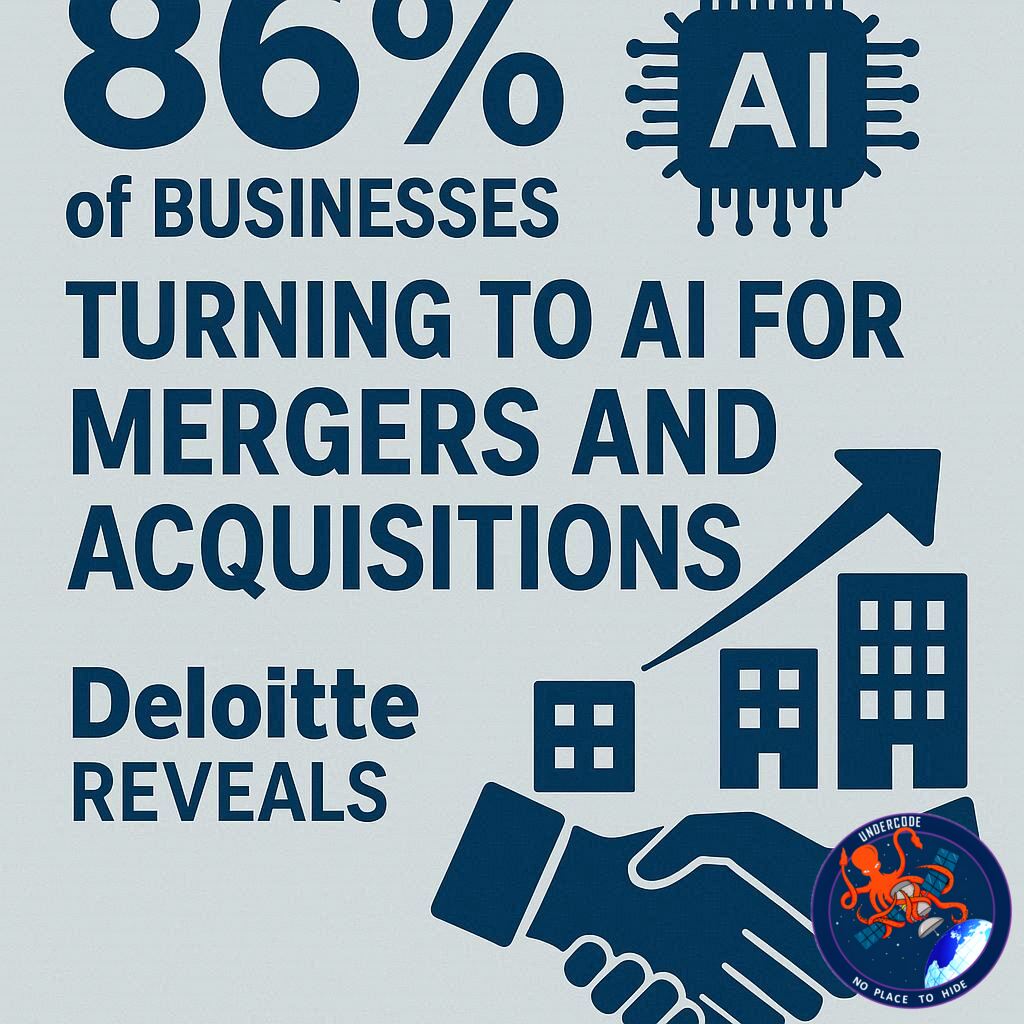
In an era where artificial intelligence (AI) is transforming the business landscape, a surprising trend is emerging: companies are increasingly relying on generative AI to navigate complex mergers and acquisitions (M&A). While AI is often associated with marketing, customer service, or data analytics, its role in high-stakes financial and corporate strategy is now becoming undeniable. According to a recent Deloitte study, a staggering 86% of surveyed businesses have integrated AI into their M&A processes, signaling a rapid shift toward automated intelligence in areas once reserved for human expertise.
How Businesses Are Using AI in M&A
Deloitte’s survey of 1,000 senior business leaders found that 65% of companies only began using generative AI for M&A within the past year, highlighting the speed at which organizations are embracing these tools. The technology is primarily applied in the early stages of the M&A lifecycle, including strategy development, market assessment, and drafting preliminary legal documents. Roughly 40% of respondents reported using AI for strategy and market analysis, while 48% leveraged AI to create initial legal drafts. However, AI adoption drops in later stages like deal valuation and negotiation, where human judgment and nuanced expertise remain critical.
Despite the benefits, executives acknowledge several risks. Data security topped concerns, with 67% of respondents citing it as a major issue. Other worries included data quality (65%), model reliability (64%), and ethical or bias-related problems (62%). To mitigate these challenges, 57% of organizations are investing in upskilling programs, ensuring teams are equipped to use AI responsibly and effectively.
The study highlights that businesses are transitioning from pilot experiments to full-scale AI integration in M&A, reflecting a strategic push to realize tangible productivity gains. Yet, while AI can manage complex financial, legal, and operational tasks, no system currently handles every facet of M&A independently, limiting its role to augmentation rather than replacement of human expertise.
What Undercode Say: Analytical Insight
The Deloitte findings reveal more than just statistics—they signal a fundamental shift in corporate strategy. The early-stage dominance of AI usage indicates that businesses see the greatest value in leveraging AI for information gathering and initial analysis. This is consistent with AI’s core strengths: rapid data processing, pattern recognition, and document generation. Companies are not yet relying on AI for deal closing or valuation, which require judgment, negotiation skills, and contextual understanding—areas where AI still struggles with reliability and nuance.
Data security and AI reliability remain major barriers. Generative AI’s tendency to fabricate or “hallucinate” information introduces risk into processes where accuracy is paramount. Without strong governance frameworks, businesses could inadvertently base strategic decisions on flawed AI outputs. Yet the proactive upskilling efforts suggest organizations understand this risk and are preparing human-AI hybrid teams capable of balancing efficiency with oversight.
The trajectory also points toward regulatory intervention. As AI adoption in M&A grows, governments may impose standards for data protection, AI auditing, and bias mitigation. This would not only safeguard sensitive corporate information but also increase confidence in AI-driven decision-making. Additionally, the role of AI in decision intelligence—forecasting market trends and simulating outcomes—could transform how boards and executives evaluate potential acquisitions, making strategies more predictive and less reactive.
The adoption of AI in M&A is emblematic of a broader enterprise trend: companies no longer view AI as experimental. Instead, it is becoming an operational necessity, integrated into high-stakes processes where speed, accuracy, and insight are critical. The next frontier may involve deeper AI integration in valuation and risk assessment, particularly as models improve and regulatory frameworks mature. Generative AI could eventually become a co-pilot in complex deal-making, not replacing human judgment but amplifying it.
Moreover, the competitive advantage conferred by AI in M&A is likely to widen the gap between early adopters and laggards. Firms that harness AI effectively could identify market opportunities faster, structure deals more efficiently, and reduce operational friction. Conversely, businesses slow to adopt may find themselves disadvantaged, unable to compete with AI-enhanced strategic insight.
Fact Checker Results
✅ Deloitte survey confirms 86% of businesses are using AI in M&A processes.
✅ 67% of respondents cited data security as their top concern.
❌ AI is not yet capable of handling every aspect of M&A independently.
Prediction
📊 Over the next five years, AI’s role in M&A will expand beyond early-stage analysis. Improved governance, model reliability, and regulatory oversight will likely enable AI to contribute meaningfully to valuation, due diligence, and risk assessment. Organizations that invest in robust AI-human collaboration frameworks will gain a decisive edge, turning generative AI into a strategic partner in corporate growth.
🕵️📝✔️Let’s dive deep and fact‑check.
References:
Reported By: www.zdnet.com
Extra Source Hub (Possible Sources for article):
https://www.reddit.com
Wikipedia
OpenAi & Undercode AI
Image Source:
Unsplash
Undercode AI DI v2
Bing
🔐JOIN OUR CYBER WORLD [ CVE News • HackMonitor • UndercodeNews ]
📢 Follow UndercodeNews & Stay Tuned:
𝕏 formerly Twitter 🐦 | @ Threads | 🔗 Linkedin | 🦋BlueSky | 🐘Mastodon


