
Listen to this Post
A Nation on Edge as Rivers Swell and Storms Collide
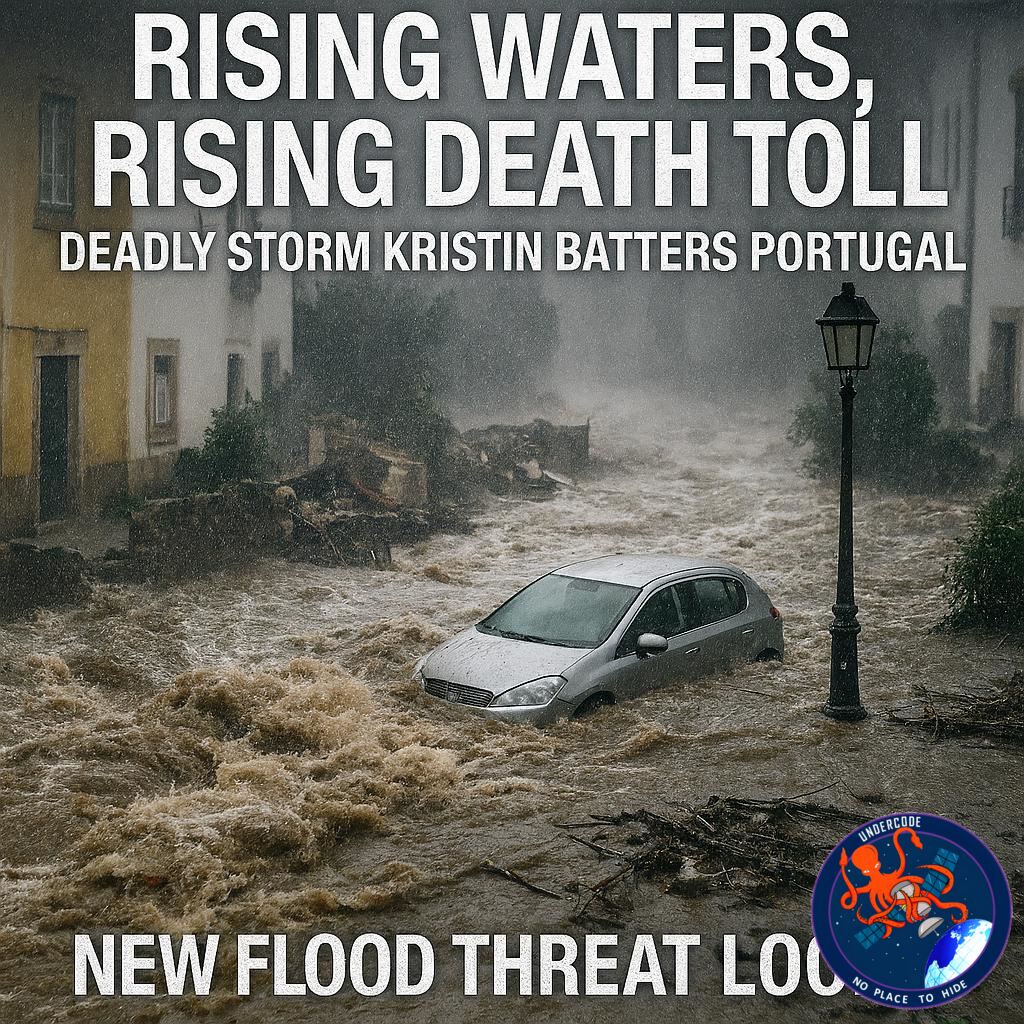
Portugal is facing one of its most dangerous weather episodes in recent years as storm Kristin unleashes widespread destruction across the country. From flooded riverbanks near Lisbon to crippled industrial zones in central regions, the storm has pushed emergency services to their limits. With rivers overflowing, power grids damaged, and lives already lost, authorities are now bracing for an even darker scenario as another storm system, Leonardo, approaches the Iberian Peninsula. The situation is evolving fast, and the risks are far from over.
the Original Report: Floods, Power Outages, and Mounting Losses
Rising water levels along the Tagus River have forced local authorities to shut down riverside roads and pedestrian walkways in Vila Franca de Xira, a municipality north of Lisbon. The closures come as a preventive measure amid fears that the river could overflow into nearby low-lying neighborhoods. Officials have placed the area under high alert, citing a dangerous mix of high tides, persistent heavy rainfall, and water releases from upstream dams in Spain, all converging to raise water levels rapidly.
Civil Protection authorities have issued clear warnings to residents, urging them not to park vehicles near the riverbanks, as sudden surges could sweep cars away with little warning. Emergency teams remain on standby as conditions remain unstable and difficult to predict.
Beyond flooding, storm Kristin has severely damaged Portugal’s electricity infrastructure. More than 115,000 customers were still without power on Tuesday after strong winds and torrential rain tore through power lines and substations. Utility crews have been working around the clock, but ongoing bad weather has slowed restoration efforts.
The industrial park of Marinha Grande has been among the hardest-hit economic zones. Several industrial buildings were left partially destroyed, with roofs ripped off and walls collapsed under the force of the storm. As a result, industrial activity in the area has been suspended, and businesses are now reporting significant financial losses, many of which are still being assessed.
The human cost has been devastating. Storm Kristin has already claimed at least six lives in Portugal, according to authorities, underscoring the storm’s severity. Emergency responders have dealt with flooded homes, fallen trees, and dangerous road conditions nationwide.
Adding to the concern, meteorological services have warned that another storm system, named Leonardo, is expected to strike Portugal and Spain in the coming days. Officials fear that saturated ground, swollen rivers, and weakened infrastructure could amplify the damage, increasing the risk of further flooding, power outages, and casualties.
What Undercode Say: A Dangerous Pattern Is Emerging
Storm Kristin is not just another seasonal weather event; it is a clear signal of how vulnerable Portugal has become to compound climate threats. What makes this situation particularly alarming is not a single factor, but the convergence of multiple stressors hitting the country at the same time. High tides alone are manageable. Heavy rainfall alone is disruptive. Dam releases alone are predictable. Combined, they form a cascading risk that overwhelms urban planning and emergency response systems.
The Tagus River situation highlights a long-standing structural problem. Many riverside communities have expanded into flood-prone zones over decades, often protected by infrastructure designed for milder, more predictable weather patterns. When extreme events stack up, as they did with Kristin, those protections reach their limits very quickly. Road closures and parking warnings are necessary, but they are reactive measures, not long-term solutions.
The power outages affecting over 115,000 customers expose another critical weakness: grid resilience. Portugal’s electricity network, like many across Europe, was not designed for repeated, high-intensity storms in short succession. As climate volatility increases, outages risk becoming more frequent and longer-lasting, with knock-on effects for hospitals, businesses, and digital infrastructure.
Marinha Grande’s industrial park tells a broader economic story. Industrial zones are often built for efficiency, not resilience. Lightweight roofing, wide-span structures, and cost-optimized materials can fail catastrophically under extreme wind conditions. When production halts, the damage goes beyond broken walls—it disrupts supply chains, contracts, and employment. For small and medium-sized enterprises, a single storm can mean the difference between recovery and permanent closure.
The death toll linked to storm Kristin underscores a hard truth: early warnings do not always translate into safe outcomes. Whether due to warning fatigue, underestimation of risk, or lack of resources, fatalities during storms suggest gaps in communication and preparedness that need urgent attention.
The looming arrival of storm Leonardo is what truly raises the stakes. Saturated soil cannot absorb more rain efficiently, rivers already near capacity have little margin left, and damaged infrastructure is more likely to fail under renewed stress. This is how secondary disasters happen—not because the next storm is stronger, but because the system is already weakened.
From a broader perspective, Portugal’s experience mirrors a growing European trend. Extreme weather is becoming less about isolated events and more about sequences. Storms now arrive in clusters, leaving little time for recovery in between. Policy responses must evolve accordingly, shifting from event-based emergency management to scenario-based resilience planning.
Fact Checker Results
All reported impacts, including flooding along the Tagus River, power outages affecting over 115,000 customers, and industrial damage in Marinha Grande, are consistent with official statements from local authorities.
The reported death toll of at least six people aligns with emergency response updates during storm Kristin.
Warnings about the incoming storm Leonardo reflect standard meteorological forecasts issued for Portugal and Spain.
Prediction: More Disruption Ahead Unless Conditions Stabilize
If storm Leonardo delivers heavy rainfall as forecast, Portugal is likely to see expanded flooding zones, particularly in river basins already under stress.
Power restoration efforts may be delayed further, increasing economic losses and public frustration.
Without rapid improvement in weather conditions, emergency services could face compounded crises, turning a severe storm season into a prolonged national emergency.
🕵️📝✔️Let’s dive deep and fact‑check.
References:
Reported By: www.euronews.com
Extra Source Hub (Possible Sources for article):
https://www.quora.com
Wikipedia
OpenAi & Undercode AI
Image Source:
Unsplash
Undercode AI DI v2
Bing
🔐JOIN OUR CYBER WORLD [ CVE News • HackMonitor • UndercodeNews ]
📢 Follow UndercodeNews & Stay Tuned:
𝕏 formerly Twitter 🐦 | @ Threads | 🔗 Linkedin | 🦋BlueSky | 🐘Mastodon


