
Listen to this Post
Introduction
Samsung has expanded its affordable 5G portfolio in India with the launch of the Galaxy A07, targeting users who want long-term software support and solid hardware without stepping into the mid-range price bracket. The Galaxy A-series has traditionally focused on reliability, clean software, and balanced specifications, and the A07 follows the same philosophy with a large display, a massive battery, and a bold promise of extended Android updates.
At the same time, Xiaomi continues to dominate the budget segment with aggressive pricing and feature-packed devices. The Redmi 15C enters as a strong alternative, offering a smoother display, faster charging, and more configuration options at a lower starting cost. Both smartphones are powered by the same MediaTek Dimensity 6300 chipset, making this comparison less about raw performance and more about long-term value, usability, and ecosystem advantages.
Main Summary: Galaxy A07 5G vs Redmi 15C 5G
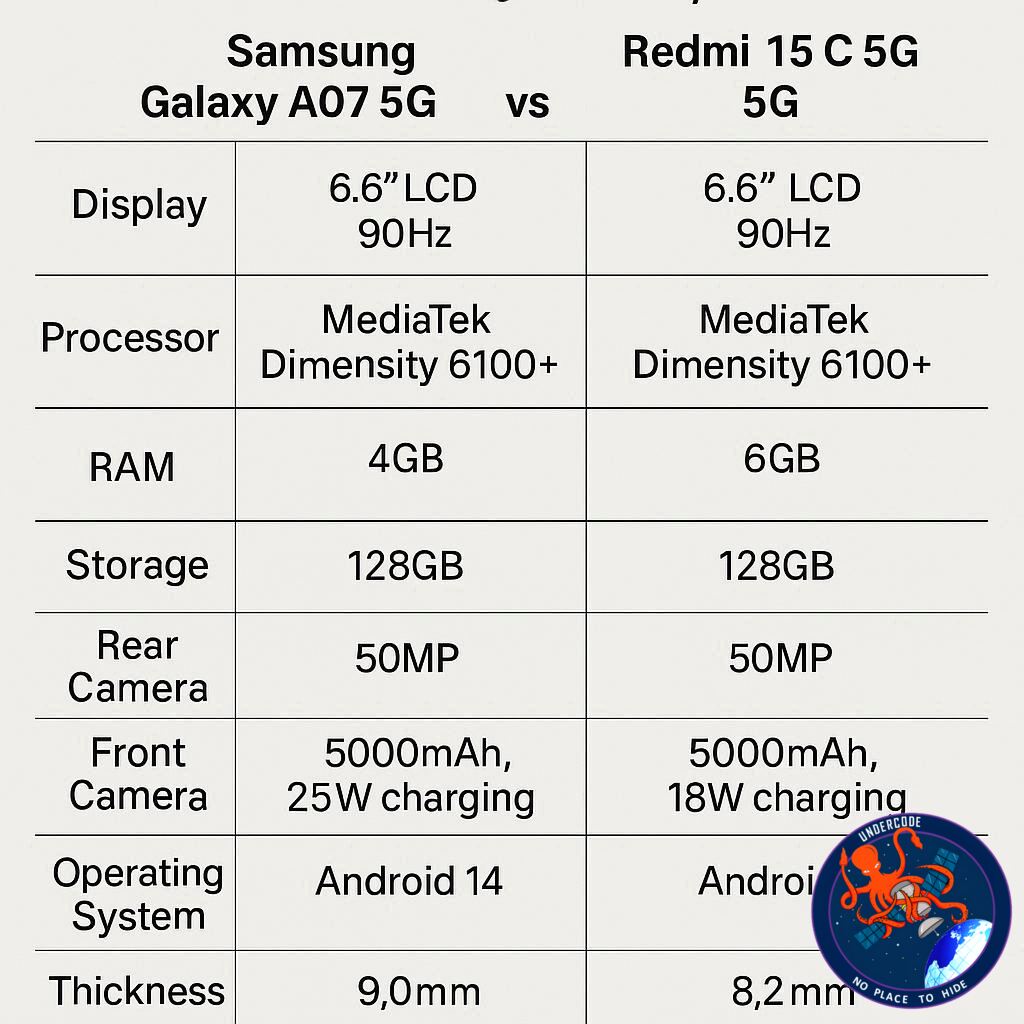
Samsung Galaxy A07 positions itself as a dependable budget 5G smartphone with a focus on software longevity and battery endurance. It features a 6.7-inch HD+ LCD panel with a peak brightness of up to 800 nits, making it reasonably visible outdoors. While the resolution remains standard for the segment, Samsung’s color tuning and brightness management help deliver a consistent viewing experience.
Under the hood, the Galaxy A07 is powered by the MediaTek Dimensity 6300 chipset built on a 6nm process. The octa-core processor is paired with up to 6GB of LPDDR4X RAM, ensuring smooth performance for daily tasks, social media, streaming, and light gaming. Storage is fixed at 128GB but can be expanded up to 1TB via a microSD card, although the hybrid SIM slot forces users to choose between a second SIM and storage expansion.
One of Samsung’s strongest selling points is software support. The Galaxy A07 runs Android 16 with One UI 8 and comes with a promise of up to seven years of operating system updates, a rare commitment in the budget category. This positions the device as a long-term companion rather than a short upgrade cycle phone.
In terms of photography, the Galaxy A07 features a 50MP primary camera paired with a 2MP depth sensor. The setup focuses on basic photography with portrait support, while the 8MP front camera handles selfies and video calls. Security is managed via a side-mounted fingerprint scanner.
Durability is another highlight, with an IP54 rating that offers protection against dust and light splashes. The phone is backed by a 6000mAh battery with 25W fast charging support, prioritizing endurance over charging speed. The device weighs 199 grams and maintains a solid in-hand feel.
On the other side, the Redmi 15C takes a more aggressive approach. It features a larger 6.9-inch HD+ LCD display with a 120Hz refresh rate, delivering smoother scrolling and animations. Despite slightly lower typical brightness, its high brightness mode peaks higher than Samsung’s panel, and TÜV Rheinland certifications enhance eye comfort.
The Redmi 15C uses the same Dimensity 6300 processor but offers more RAM options, going up to 8GB. Storage remains at 128GB with UFS 2.2 support, giving it an edge in read and write speeds. Unlike Samsung, Xiaomi provides a dedicated microSD slot alongside dual SIM support, improving flexibility.
Software-wise, the Redmi 15C runs Android 15 with HyperOS 2. While Xiaomi’s interface is feature-rich and customizable, long-term update commitments are less clearly defined. The camera setup mirrors Samsung with a 50MP main sensor and an 8MP front camera, though Xiaomi focuses more on software processing than depth effects.
The Redmi 15C stands out with an IP64 rating, offering better dust and water resistance. It also supports 33W fast charging for its 6000mAh battery, reducing downtime significantly. The trade-off comes in weight, as the device tips the scale at 211 grams.
In terms of pricing, the Galaxy A07 starts at approximately $193 USD, while the Redmi 15C undercuts it with a starting price of around $150 USD, making Xiaomi’s offering more aggressive in pure value terms.
What Undercode Say:
Samsung Galaxy A07 and Redmi 15C reflect two very different philosophies within the same hardware foundation. Samsung is clearly betting on trust, longevity, and software stability rather than headline-grabbing specs. The promise of seven years of Android updates alone shifts the conversation from short-term savings to long-term ownership cost. For users who keep their phones for four to five years, this commitment could outweigh faster charging or higher refresh rates.
The Galaxy A07 also benefits from Samsung’s mature One UI ecosystem, which tends to age better over time with consistent optimization. While the hardware may not excite spec-focused buyers, the experience remains predictable and stable, something many budget users quietly value.
Redmi 15C, however, plays to Xiaomi’s strengths. The 120Hz display immediately makes the phone feel more premium in daily use, even if the resolution stays modest. Faster 33W charging directly improves daily convenience, especially for heavy users. The availability of an 8GB RAM variant further future-proofs performance for multitasking.
From a durability standpoint, Xiaomi’s IP64 rating is a practical advantage, especially in regions with unpredictable weather or dusty environments. Storage speed also favors Redmi due to UFS 2.2, which impacts app loading times and system responsiveness.
The real dividing line is software philosophy. Samsung offers clarity and long-term assurance, while Xiaomi offers features and flexibility right now. HyperOS can feel more dynamic but may also introduce inconsistencies over time. For users who frequently change devices, Redmi 15C delivers better immediate value. For those who prefer stability and extended support, Galaxy A07 becomes the safer investment.
Ultimately, this comparison shows that performance parity does not mean identical value. The choice depends on whether the buyer prioritizes longevity and ecosystem trust or display smoothness and faster charging at a lower upfront cost.
Fact Checker Results
✅ Both smartphones use the MediaTek Dimensity 6300 chipset and a 6000mAh battery
✅ Samsung Galaxy A07 officially promises extended Android update support
❌ Redmi 15C does not match Samsung’s long-term OS update commitment
Prediction
📊 Samsung Galaxy A07 is likely to appeal to long-term users focused on software support and reliability
📊 Redmi 15C is expected to dominate sales among value-driven buyers seeking better specs per dollar
📊 Competition in the budget 5G segment will increasingly shift toward update policies, not just hardware specs
▶️ Related Video (78% Match):
🕵️📝✔️Let’s dive deep and fact‑check.
References:
Reported By: timesofindia.indiatimes.com
Extra Source Hub (Possible Sources for article):
https://stackoverflow.com
Wikipedia
OpenAi & Undercode AI
Image Source:
Unsplash
Undercode AI DI v2
Bing
🔐JOIN OUR CYBER WORLD [ CVE News • HackMonitor • UndercodeNews ]
📢 Follow UndercodeNews & Stay Tuned:
𝕏 formerly Twitter 🐦 | @ Threads | 🔗 Linkedin | 🦋BlueSky | 🐘Mastodon


