
Listen to this Post
Introduction: A Quiet Power Shift in Enterprise AI
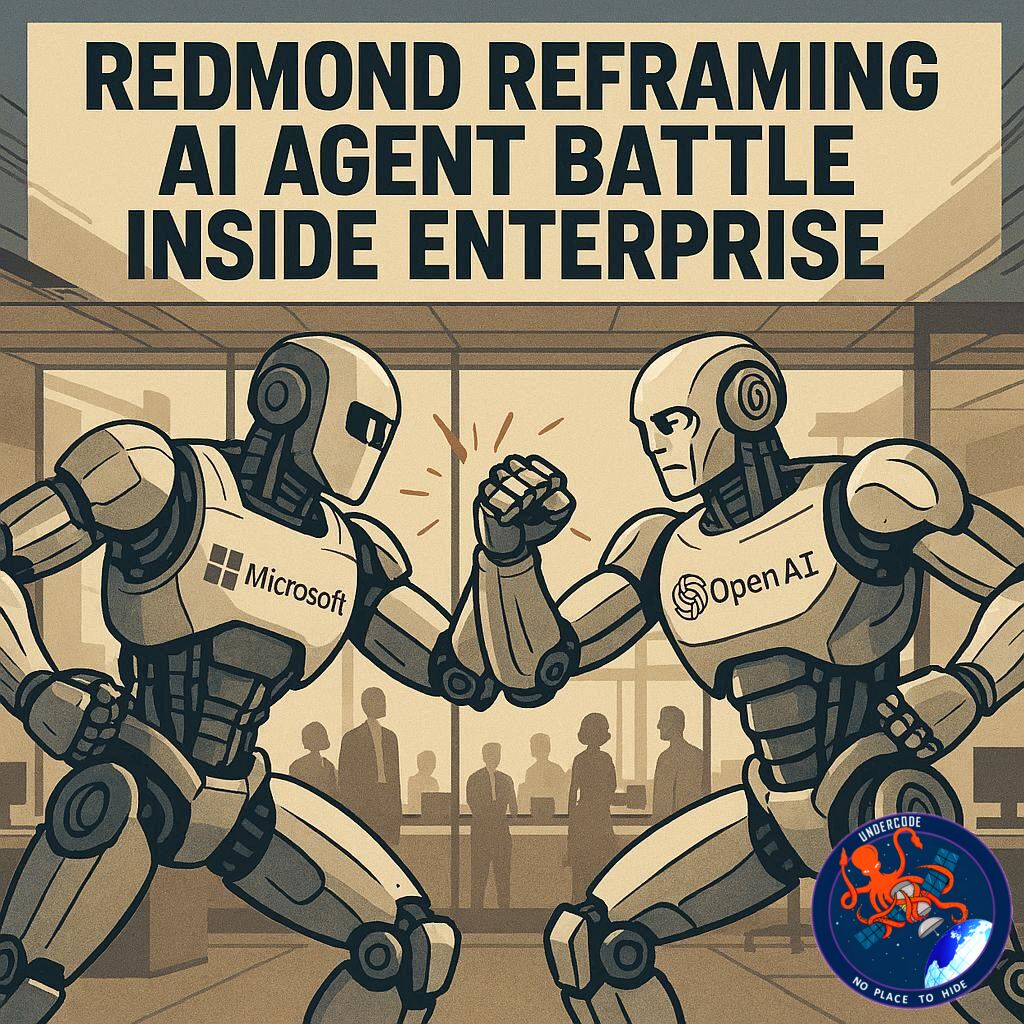
Behind the scenes at Microsoft, a strategic recalibration is underway. As artificial intelligence agents move from experimental tools to core enterprise infrastructure, competition between Microsoft and its longtime partner OpenAI is becoming more direct and more complex. An internal email from Microsoft Chief Commercial Officer Judson Althoff reveals how the company is preparing its sales force to compete head-to-head with OpenAI’s newest enterprise-focused AI products, while reinforcing Microsoft’s long-term vision of AI as a platform-driven ecosystem rather than a single-model race.
Main Summary: Microsoft Repositions Itself as the AI Control Layer
Microsoft Chief Commercial Officer Judson Althoff recently circulated internal guidance instructing sales teams on how to position Microsoft’s AI agent management tools against OpenAI’s newly released Frontier product. Frontier, developed by the Microsoft-backed startup OpenAI, is designed to help enterprises automate office work across multiple applications, including Microsoft’s own software. According to reporting by The Information, the message emphasized respect for OpenAI as a competitor while clearly outlining why Microsoft believes it holds structural advantages in the enterprise AI market.
Althoff highlighted Microsoft’s identity as a platform company, contrasting it with OpenAI’s role as a model developer without independent infrastructure. He stressed that OpenAI relies heavily on cloud providers, particularly Microsoft Azure, to operate its technology. Azure already provides enterprises with access to multiple AI models from OpenAI, Anthropic, Mistral, and xAI, positioning Microsoft as a central hub for orchestrating AI agents rather than a single-vendor solution.
The email also underscored Microsoft’s long-standing experience with enterprise security, compliance, and large-scale customer relationships. These factors, Althoff argued, give Microsoft a decisive edge when businesses deploy AI agents across sensitive systems and regulated environments. This message comes amid investor anxiety that AI agents from OpenAI and Anthropic could erode the value of traditional enterprise software, triggering recent sell-offs in public software stocks.
The competitive pressure intensified following Anthropic’s release of Cowork, an AI product capable of autonomously operating a user’s computer like a human employee. Microsoft leadership quickly evaluated Cowork against its own offerings, including Microsoft 365 Copilot, which already integrates AI models from both OpenAI and Anthropic to automate tasks in Office and Outlook.
CEO Satya Nadella has repeatedly stated that Microsoft’s strategy centers on “application scaffolding,” software layers that connect AI models to enterprise apps and data. In this vision, AI models become interchangeable commodities, while lasting value accrues to companies that manage integration, orchestration, and governance. Despite investing approximately 13 billion USD in OpenAI, Microsoft increasingly finds itself competing with the startup as both sell overlapping AI products to enterprise customers.
While AI agents remain error-prone and vulnerable to security risks, industry leaders such as Nvidia CEO Jensen Huang foresee a future where agents routinely operate enterprise software on behalf of humans. To stay ahead, Microsoft is launching tools like Agent 365, designed to monitor, coordinate, and direct multiple AI agents across different providers. The company is also developing Windows-based AI agents capable of interacting with desktop applications in a human-like manner.
OpenAI, for its part, is pushing Frontier as a system for deploying multiple “AI coworkers” that collaborate across enterprise data sources. Though it has not specified which enterprise apps Frontier integrates with, its architecture places AI agents above established “systems of record” such as Microsoft and Salesforce platforms. This positioning has raised concerns among traditional enterprise software executives about OpenAI’s growing influence over how businesses consume and pay for software.
What Undercode Say: Microsoft’s Real Advantage Is Control, Not Models
Microsoft’s messaging reveals something more important than competitive talking points. It signals a deeper belief that the AI war will not be won at the model layer. Models evolve too fast, costs decline too quickly, and differentiation erodes faster than most vendors expect. Microsoft understands this, and Althoff’s internal guidance quietly reflects a shift from admiration to strategic containment.
The real battleground is orchestration. Whoever controls how AI agents are deployed, monitored, secured, and audited inside enterprises will own the economic value. Microsoft’s Azure-first positioning allows it to act as the air traffic controller for AI agents, regardless of who built the underlying model. This is a fundamentally different game than OpenAI’s current approach, which still assumes customers will accept a vertically influenced AI workflow.
Frontier’s promise is powerful, but it implicitly depends on enterprise systems that Microsoft already dominates. By placing itself between AI agents and systems of record, Microsoft ensures that even OpenAI-powered workflows ultimately run through Microsoft-controlled infrastructure, compliance layers, and identity systems. That is not accidental. It is architectural leverage.
Another critical factor is trust. Enterprises do not just buy AI capabilities, they buy risk management. Microsoft’s decades-long history with regulated industries gives it credibility that AI-native startups struggle to replicate. When AI agents begin touching financial data, customer records, and operational systems, trust becomes a purchasing decision, not a feature checkbox.
The partnership paradox with OpenAI is now unavoidable. Microsoft benefits from OpenAI’s innovation while simultaneously preparing for a future where OpenAI could attempt to bypass platform intermediaries. Althoff’s email suggests Microsoft is no longer assuming permanent alignment. Instead, it is building insurance through multi-model support, agent governance tools, and deep integration into enterprise workflows.
Anthropic’s Cowork and OpenAI’s Frontier both point toward a future where software becomes something AI uses rather than something humans operate directly. If that vision materializes, traditional application vendors face margin pressure and relevance risk. Microsoft’s response is to become the operating system for AI labor itself. Not the worker, but the manager.
This strategy does not eliminate risk for Microsoft. If AI agents become truly autonomous and vendor-agnostic, even platform control could weaken. But today, complexity favors incumbents. Microsoft is betting that enterprises will choose stability, compliance, and integration over speed alone. That bet aligns with how large organizations actually buy technology, not how startups imagine they will.
Fact Checker Results
✅ Microsoft is actively positioning its AI agent tools against OpenAI’s Frontier, confirmed by internal communications reported by The Information.
✅ Azure does provide access to multiple AI models, including OpenAI and Anthropic, supporting Microsoft’s platform narrative.
❌ There is no public evidence yet that Frontier can fully replace enterprise application workflows without heavy customization.
Prediction: The Rise of AI Managers Over AI Workers
📊 Microsoft will increasingly market itself as the command center for AI agents, not just an AI provider.
📊 OpenAI will push deeper into enterprise consulting and integration to compensate for its lack of platform control.
📊 The next phase of competition will focus on governance, compliance, and orchestration, not raw model intelligence.
▶️ Related Video (80% Match):
🕵️📝✔️Let’s dive deep and fact‑check.
References:
Reported By: timesofindia.indiatimes.com
Extra Source Hub (Possible Sources for article):
https://www.facebook.com
Wikipedia
OpenAi & Undercode AI
Image Source:
Unsplash
Undercode AI DI v2
Bing
🔐JOIN OUR CYBER WORLD [ CVE News • HackMonitor • UndercodeNews ]
📢 Follow UndercodeNews & Stay Tuned:
𝕏 formerly Twitter 🐦 | @ Threads | 🔗 Linkedin | 🦋BlueSky | 🐘Mastodon


