
Listen to this Post
Introduction
A new supply-chain attack has shaken the developer community, exposing how even trusted software packages can become powerful attack vectors. Hackers managed to compromise a widely used Python SDK, silently embedding malware inside what appeared to be normal updates. The attack highlights a growing trend in cybersecurity where attackers exploit developer ecosystems rather than traditional endpoints, turning everyday tools into stealthy weapons.
Summary of the Incident
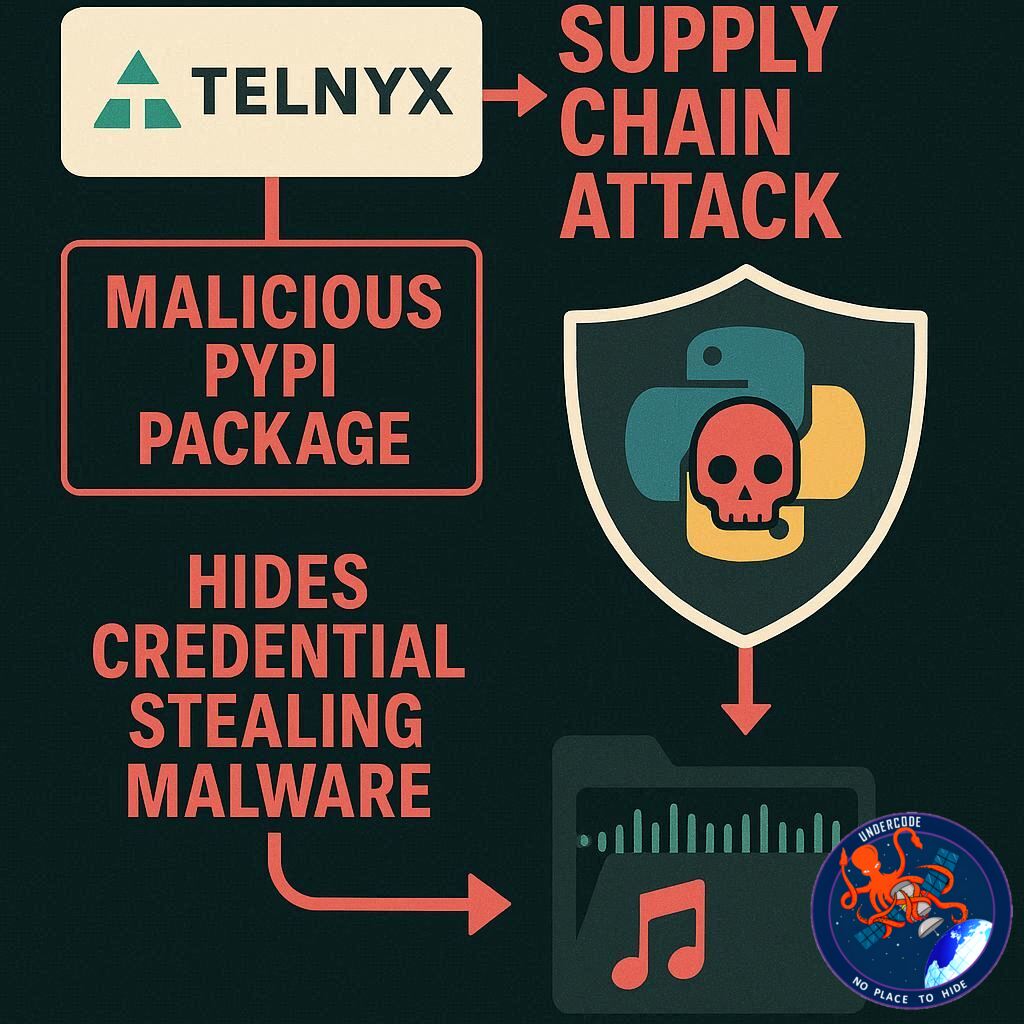
A threat group known as TeamPCP successfully compromised the Telnyx package hosted on the Python Package Index (PyPI), releasing malicious versions 4.87.1 and 4.87.2. These versions were designed to deliver credential-stealing malware while appearing legitimate to developers. The attack was identified by multiple security firms, including Aikido, Socket, and Endor Labs, all of which linked the activity to TeamPCP through consistent exfiltration patterns and reused cryptographic keys.
Telnyx’s Python SDK is widely used for integrating communication services such as VoIP, messaging, and IoT connectivity into applications. With over 740,000 monthly downloads, it represents a highly attractive target for attackers seeking broad impact. By gaining access to the package’s publishing credentials, the attackers were able to upload tampered versions directly to PyPI, making them available to unsuspecting developers.
Initially, version 4.87.1 contained a flawed malicious payload that failed to execute properly. However, within roughly an hour, the attackers corrected the issue and released version 4.87.2, which contained a fully functional attack chain. The malicious code was embedded in a specific file within the package and triggered automatically when the SDK was imported into a project, allowing it to execute without disrupting the normal functionality of the software.
On Linux and macOS systems, the malware executed a background process that downloaded a second-stage payload disguised as a WAV audio file. This file contained hidden malicious code using steganography techniques, allowing it to bypass detection while maintaining the appearance of a harmless audio file. The embedded code was decrypted and executed in memory, enabling it to extract sensitive data such as SSH keys, cloud credentials, cryptocurrency wallets, and environment variables.
On Windows systems, a slightly different approach was used. The malware downloaded another WAV file, which extracted an executable disguised as a legitimate system file. This executable was placed in the Startup folder, ensuring persistence by running every time the user logged in. A lock mechanism prevented repeated execution within short time intervals, reducing the chances of detection.
The malware also targeted advanced environments. If Kubernetes was detected on the infected machine, it attempted to enumerate secrets and deploy privileged containers across the cluster, potentially compromising entire infrastructures. This demonstrated a high level of sophistication and a clear focus on enterprise environments.
Security researchers concluded that any system that installed or imported the malicious versions should be considered fully compromised. They strongly recommended rolling back to version 4.87.0, which remains clean, and immediately rotating all credentials and secrets.
What Undercode Say:
This attack is a textbook example of how the software supply chain has become one of the most dangerous battlegrounds in cybersecurity. Instead of targeting users directly, attackers now aim for the tools developers trust the most. Once compromised, these tools act as distribution channels, spreading malware at scale without raising immediate suspicion.
What makes this incident particularly concerning is the level of stealth involved. The malicious payload did not break the SDK’s functionality. Developers could continue using the library normally, completely unaware that sensitive data was being exfiltrated in the background. This kind of “invisible compromise” is far more dangerous than traditional malware, which often reveals itself through system instability or unusual behavior.
The use of steganography inside WAV files represents a clever evolution in evasion techniques. Security tools often rely on detecting suspicious binaries or network behavior, but embedding payloads within seemingly harmless media files allows attackers to bypass many detection layers. This approach suggests that attackers are increasingly thinking like defenders, anticipating how security systems work and designing around them.
Another critical aspect is the speed of the attack. The attackers identified and fixed their own deployment issue within an hour, showing a high level of operational maturity. This is not opportunistic hacking. It is structured, deliberate, and well-resourced activity that mirrors the workflows of professional software teams.
The Kubernetes targeting capability also signals a shift toward cloud-native exploitation. Instead of focusing solely on individual machines, attackers are now aiming to compromise entire clusters and infrastructure layers. This dramatically increases the potential damage, especially for organizations relying heavily on containerized environments.
The root cause appears to be compromised publishing credentials. This highlights a recurring weakness in the ecosystem: insufficient protection of developer accounts. Multi-factor authentication, strict access controls, and monitoring of publishing activities are still not universally enforced, leaving critical infrastructure exposed.
From a defensive standpoint, this incident reinforces the importance of verifying dependencies, not just trusting them. Developers and organizations must adopt practices like dependency pinning, integrity verification, and continuous monitoring of third-party packages. Relying solely on reputation or popularity is no longer enough.
The broader implication is clear. Open-source ecosystems are under active attack, and the scale of potential impact is massive. A single compromised package can affect thousands of organizations within hours. This makes supply-chain security not just a technical issue, but a strategic priority for any organization that builds or deploys software.
Fact Checker Results
✅ The malicious Telnyx versions 4.87.1 and 4.87.2 were confirmed to contain hidden malware.
✅ The attack leveraged stolen publishing credentials to distribute compromised packages via PyPI.
❌ There is no evidence that version 4.87.0 was affected or altered in any way.
Prediction
🔮 Supply-chain attacks targeting developer ecosystems will increase in frequency and sophistication.
🔮 Steganography and fileless malware techniques will become more common to evade detection systems.
🔮 Security enforcement on package repositories will tighten, with mandatory authentication and verification becoming standard.
🕵️📝✔️Let’s dive deep and fact‑check.
References:
Reported By: www.bleepingcomputer.com
Extra Source Hub (Possible Sources for article):
https://www.linkedin.com
Wikipedia
OpenAi & Undercode AI
Image Source:
Unsplash
Undercode AI DI v2
Bing
🔐JOIN OUR CYBER WORLD [ CVE News • HackMonitor • UndercodeNews ]
📢 Follow UndercodeNews & Stay Tuned:
𝕏 formerly Twitter 🐦 | @ Threads | 🔗 Linkedin | 🦋BlueSky | 🐘Mastodon


