
Listen to this Post
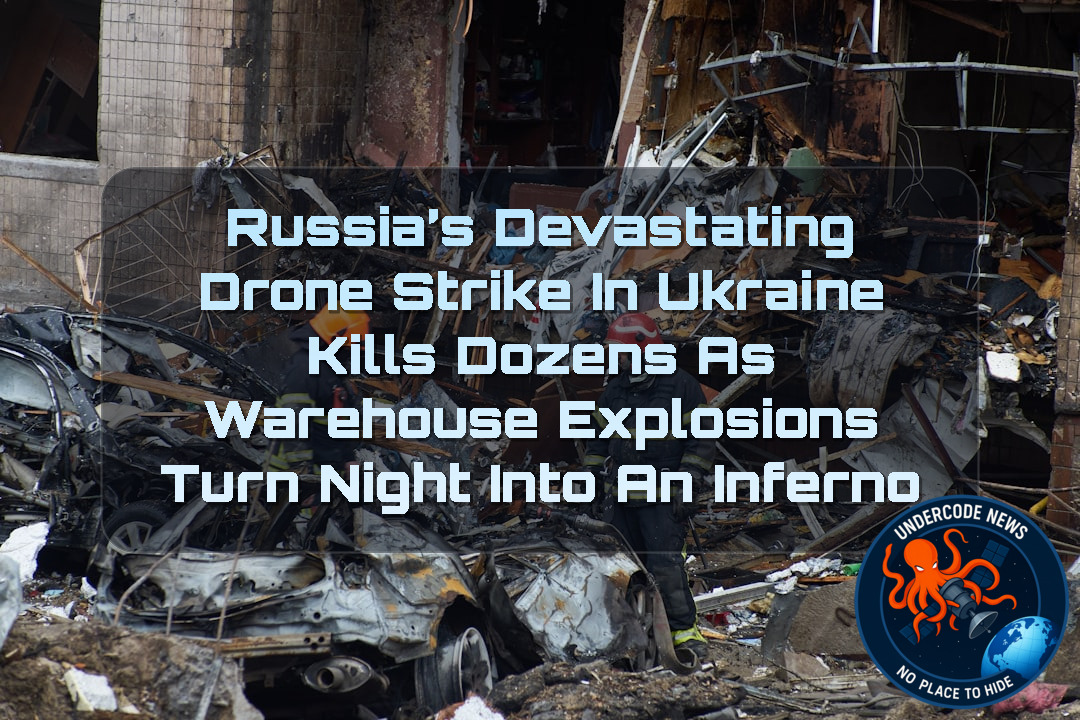 Introduction: A Night of Fire, Explosions, and Human Loss
A devastating Russian drone strike has left Ukraine facing another tragic reminder of how quickly modern warfare can transform an ordinary location into a scene of destruction. What began as an overnight attack against the Kyiv region escalated into a massive fire, repeated explosions, collapsing infrastructure, and a desperate evacuation operation involving hundreds of people.
At least 37 people were killed after the strike hit an area in the village of Myla, while dozens more, including children, were injured. The attack triggered a large-scale blaze that spread beyond the initial site and reached nearby residential buildings and local businesses.
But the disaster has also raised serious questions about the warehouse itself. Ukrainian prosecutors have opened a pre-trial investigation into whether explosive materials were legally stored at the facility and whether negligence may have contributed to the scale of the catastrophe.
The tragedy represents more than another entry in the long list of attacks carried out during the Russia-Ukraine war. It highlights the dangerous intersection of military strikes, civilian infrastructure, industrial storage, logistics networks, and explosive materials located close to populated communities.
A Russian Drone Strike Turns Myla Into a Disaster Zone
According to Ukrainian authorities, the overnight Russian attack caused a major fire and a series of explosions at a warehouse in the village of Myla.
Tymur Tkachenko, head of the Kyiv Oblast Military Administration, said the attack created an emergency situation that required an extensive response from firefighters, rescue teams, medical personnel, and local authorities.
At least 37 people were reported killed in the disaster.
Another 42 people were injured, including four children.
The human cost forced authorities to evacuate approximately 381 people from the surrounding area as emergency teams worked to contain the fire and prevent additional casualties.
The attack did not remain limited to the original warehouse site.
The resulting blaze spread to nearby private homes, placing civilians directly in danger and forcing emergency responders to battle fires across multiple locations.
Authorities reported that fires affecting five residential houses and a catering establishment were eventually extinguished.
However, rescue and emergency operations continued as officials worked through the aftermath of the explosions.
The Warehouse Fire Was Accompanied by Powerful Explosions
One of the most alarming elements of the attack was the scale of the explosions that followed.
According to local officials, the massive fire was accompanied by repeated blasts, suggesting that dangerous or explosive materials may have been present inside or near the warehouse.
Videos circulating on social media appeared to show an enormous explosion illuminating the night sky.
A huge fireball rose above the area, creating a dramatic and terrifying scene visible from a considerable distance.
Such explosions can significantly complicate emergency operations.
Firefighters cannot simply approach a burning industrial or storage facility when there is a possibility of secondary explosions.
Rescue teams must establish safety zones, evacuate civilians, assess structural damage, and determine whether additional explosive materials could still detonate.
This can turn a conventional fire response into a highly dangerous disaster-management operation.
Prosecutors Investigate Possible Negligence at the Warehouse
Ukraine’s Prosecutor General’s Office has opened a pre-trial investigation into possible negligence connected to storage conditions at the warehouse.
The investigation will examine whether explosive objects or materials were legally placed and stored on the territory of the enterprise.
Officials will also investigate whether the facility possessed the necessary permits and approvals.
Another major focus will be the decisions made by officials responsible for authorizing the storage of potentially dangerous materials.
The investigation does not change the fact that the disaster followed a Russian attack.
Instead, it seeks to determine whether improper storage conditions may have increased the scale of the explosions and the resulting civilian casualties.
This distinction is important.
Military attacks can trigger disasters, but poor industrial safety practices can sometimes multiply the destructive consequences of those attacks.
If explosive materials were stored improperly, too close to civilian areas, or without appropriate safety measures, investigators will need to determine whether those conditions contributed to the severity of the incident.
Civilian Homes and Businesses Caught in the Fire
The consequences of the warehouse disaster extended beyond the original strike location.
The spreading fire reached private residential buildings, creating a second layer of danger for people who may not have been directly connected to the warehouse.
Homes are particularly vulnerable during industrial explosions.
Windows can shatter under blast pressure.
Roofs can catch fire.
Debris can travel across large distances.
Secondary fires can spread through residential neighborhoods, especially when emergency services are already focused on a major industrial blaze.
The evacuation of 381 people demonstrates the scale of the danger facing the local community.
For residents, evacuation means leaving homes behind without knowing whether they will still be standing hours later.
For emergency services, every additional evacuation zone requires transportation, coordination, medical support, and communication.
Emergency Teams Continue Working Through the Aftermath
Emergency and rescue teams continued working at the scene after the initial explosions and fires.
Large incidents involving warehouses and potentially explosive materials require multiple stages of response.
The first priority is saving lives.
The second is preventing the disaster from spreading.
Firefighters must contain flames before they reach additional buildings or hazardous materials.
Medical teams must treat injured civilians and responders.
Police and local authorities must secure the surrounding area.
Investigators must preserve evidence while emergency operations continue.
This creates an extremely complex environment.
A single drone strike can therefore evolve into a multi-agency disaster operation involving military authorities, firefighters, medical workers, prosecutors, engineers, and local government officials.
Kherson Also Suffers Deadly Russian Drone Attacks
The deadly events in the Kyiv region were not the only attacks reported.
On Saturday, Russian drone strikes also killed two people in Kherson, southern Ukraine.
Another person, aged 44, suffered blast injuries and shrapnel wounds to the chest.
Kherson has remained one of the most dangerous areas of Ukraine because of its proximity to the front and its continued exposure to artillery, drones, and other forms of long-range attack.
Drone warfare has made civilian areas increasingly vulnerable.
Unlike traditional military aircraft, drones can be launched in large numbers and directed toward cities, infrastructure, logistics routes, and other targets.
Their relatively low cost compared with advanced missiles has also changed the economic balance of long-range warfare.
Food Trucks Destroyed in Odesa Region
Another Russian attack in
Authorities said one person was killed and three others were injured.
Eight trucks transporting food were reportedly set ablaze.
Attacks against logistics infrastructure can create consequences far beyond the immediate destruction.
Food transportation networks are essential to keeping cities supplied.
Destroying trucks does not only cause financial losses.
It can disrupt deliveries, increase transportation costs, damage supply chains, and create pressure on already vulnerable communities.
Logistics has become one of the most important battlegrounds of the war.
Roads, warehouses, railways, ports, fuel facilities, and transport vehicles are all part of the infrastructure that allows a country to function during wartime.
Kyiv’s Sviatoshynskyi District Also Comes Under Attack
Authorities also reported injuries in
Two people were injured during another attack targeting the Ukrainian capital.
The repeated attacks demonstrate that Russia continues to maintain pressure across multiple regions simultaneously.
Ukraine must therefore divide its air-defense resources between major cities, industrial areas, military infrastructure, logistics facilities, and critical energy systems.
This creates an enormous defensive challenge.
Even when air defenses successfully intercept the majority of incoming drones, a small percentage reaching their targets can still cause major destruction.
The warehouse disaster demonstrates how a single successful strike can trigger secondary explosions and dramatically increase the consequences of an attack.
Russia Launches Hundreds of Drones and Missiles
Ukraine’s air force said Russia launched a large wave of weapons against the country beginning Friday evening.
The reported attack included an Onyx anti-ship missile, an Iskander ballistic missile, and 267 drones.
Ukrainian air defenses reportedly shot down or neutralized 233 of the drones by Saturday morning.
The figures demonstrate both the scale of
Stopping hundreds of aerial threats requires constant surveillance.
Radar systems must identify incoming objects.
Command centers must determine which threats are the most dangerous.
Air-defense units must conserve expensive interceptors while still protecting major population centers.
Electronic warfare systems may also be used to disrupt navigation and communications.
The modern battlefield is therefore increasingly becoming a contest between inexpensive unmanned systems and expensive defensive technologies.
The Long-Range War Is Expanding
Russia and Ukraine have both increased their use of long-range strikes in recent months.
Logistics facilities and energy infrastructure have become particularly important targets.
These facilities are critical because they support the broader ability of a country to continue military and economic operations.
Destroying a warehouse can interrupt supply chains.
Damaging an energy facility can affect industry and civilian life.
Striking transport infrastructure can slow military movement and commercial activity.
Long-range warfare allows both sides to reach far beyond traditional front lines.
This means civilians living hundreds of kilometers away from active combat zones can still experience the effects of war.
The front line is no longer the only place where danger exists.
Zelenskyy Calls for More Ukrainian Deep Strikes
Ukrainian President Volodymyr Zelenskyy has also called for an expansion of Ukraine’s long-range strike capabilities.
He urged Ukrainian forces to intensify deep strikes inside Russia.
According to his stated objective, Ukraine wants to dramatically increase the number of long-range drone operations.
Zelenskyy said Ukraine currently averages more than 300 long-range operations and argued that the number must increase significantly.
The Ukrainian strategy reflects a broader transformation in warfare.
Drones have become tools for intelligence gathering, surveillance, precision attacks, infrastructure disruption, and psychological pressure.
Ukraine has increasingly invested in domestically developed drone technology because unmanned systems can be produced faster and in larger quantities than many traditional weapons.
However, an increase in deep strikes also means the conflict could continue expanding geographically.
Both sides are attempting to reduce the
The Human Cost Behind the Numbers
Behind every casualty figure is an individual life.
The number 37 represents families, friends, colleagues, parents, and children who may never return home.
The injured include people facing physical trauma, psychological shock, and potentially long recovery periods.
The evacuation of hundreds of residents also reveals another side of modern warfare.
Not everyone killed by war is a soldier.
Not every person harmed by war is standing near a battlefield.
Civilians can become victims because a warehouse catches fire, because an apartment is hit by debris, because a truck carrying food is attacked, or because a drone reaches a populated neighborhood.
The destruction spreads through communities in ways that statistics cannot fully describe.
The Investigation Could Reveal Critical Safety Failures
The Ukrainian investigation into the warehouse may become an important part of understanding why the disaster became so deadly.
Investigators are expected to examine the legality of storing explosive objects and materials at the enterprise.
They will also look at permits, approvals, safety procedures, and decisions made by responsible officials.
If violations are discovered, the case could expose weaknesses in wartime industrial safety regulations.
Ukraine has faced enormous pressure to maintain logistics, industry, military supply networks, and essential services during constant attacks.
However, wartime necessity does not eliminate the dangers of storing hazardous materials.
In fact, it may make proper safety procedures even more important.
A facility containing explosive materials becomes a potentially catastrophic target if it is struck.
Authorities will therefore need to determine whether the storage arrangements followed appropriate legal and safety standards.
Deep Analysis: How Drone Warfare and Hazardous Infrastructure Create Secondary Disasters
The Myla disaster demonstrates a critical problem in modern warfare: the first explosion is not always the most destructive event.
A drone strike may be the initial trigger.
But secondary explosions, industrial fires, hazardous materials, and structural failures can dramatically increase casualties.
Security and emergency-response specialists must therefore think beyond the initial impact point.
A warehouse containing flammable or explosive materials requires special risk management.
A basic security assessment could begin by identifying hazardous services and exposed systems:
systemctl list-units --type=service --state=running
Organizations should also maintain detailed inventories of critical infrastructure and connected systems:
lsblk
Network administrators can identify listening services that could expose industrial systems:
ss -tulpn
Security teams should continuously review authentication activity:
journalctl -p warning
Critical logs should also be monitored for unusual behavior:
tail -f /var/log/syslog
Firewall rules can be reviewed using:
sudo iptables -L -n -v
On modern Linux environments, administrators may instead use:
sudo nft list ruleset
File integrity monitoring can help identify unauthorized changes:
find /etc -type f -mtime -1
Disk capacity should be monitored because overloaded systems can affect logging and emergency operations:
df -h
Network connections can be examined through:
ss -antp
These commands cannot stop a military drone strike.
However, they represent part of a broader resilience mindset.
Modern critical infrastructure must prepare for physical attacks and cyber incidents at the same time.
A warehouse, energy facility, transport hub, or industrial enterprise may face both digital threats and physical destruction.
The strongest security model is therefore one that combines cyber defense, physical security, emergency planning, redundant communications, and strict hazardous-material management.
What Undercode Say:
The tragedy in Myla shows how modern warfare is increasingly defined by cascading consequences rather than isolated explosions.
The initial strike may last only seconds.
The consequences can continue for hours, days, or even months.
A drone can hit one building, but the resulting fire can spread through an entire community.
If hazardous materials are present, secondary explosions can transform a targeted facility into a major disaster zone.
This is why critical infrastructure must be analyzed as a connected ecosystem.
Warehouses are not simply buildings containing products.
They can contain fuel, chemicals, batteries, industrial equipment, ammunition, or other dangerous materials.
When war reaches those facilities, the consequences can become unpredictable.
The investigation into possible negligence is therefore extremely important.
It is possible for two realities to exist at the same time.
A Russian attack can be the direct trigger of a disaster.
Unsafe storage conditions can potentially increase the severity of that disaster.
Understanding this distinction is essential for accurate analysis.
Ukraine’s emergency authorities must defend against attacks while also maintaining industrial safety standards.
That is an incredibly difficult challenge during a large-scale war.
However, hazardous infrastructure cannot become invisible simply because a country is at war.
Every storage location containing dangerous materials should be treated as a potential secondary disaster site.
Authorities should know what is stored there.
They should know how much is stored there.
They should understand what happens if the facility catches fire.
They should also know how close civilians are to the location.
The massive drone attack reported by Ukraine also highlights another strategic reality.
Quantity is becoming a weapon.
Launching hundreds of drones can overwhelm defenders through saturation.
Even highly effective air defenses face enormous pressure when multiple threats arrive from different directions.
A defense rate that appears successful on paper can still leave room for devastating individual strikes.
The attack also demonstrates why logistics has become central to modern warfare.
Food trucks are logistics.
Warehouses are logistics.
Energy facilities are logistics.
Transport routes are logistics.
The ability to sustain a country depends on these systems remaining operational.
The future of the conflict will likely involve even greater investment in drones, electronic warfare, air defense, and long-range precision systems.
Both Russia and Ukraine are adapting their strategies around these technologies.
The dangerous result is that geographical distance provides less protection than it once did.
Cities far from the traditional front line can still be attacked.
Civilian infrastructure can suddenly become part of the battlefield.
The greatest lesson from this tragedy is that resilience must be designed before an attack occurs.
Emergency plans must already exist.
Hazardous materials must be identified.
Evacuation routes must be prepared.
Fire suppression capabilities must be available.
Communication systems must remain operational.
Cybersecurity must protect critical infrastructure.
Physical security must protect facilities.
And governments must prepare for the possibility that one strike can create a chain reaction far larger than the original attack.
The Myla disaster is therefore not only a story about one terrible night.
It is a warning about the future of long-range warfare.
✅ Ukrainian authorities reported at least 37 deaths and dozens of injuries following the major strike and resulting warehouse disaster described in the article.
✅ Ukraine’s Prosecutor General’s Office opened a pre-trial investigation into possible negligence involving the storage of explosive objects and materials at the facility.
❌ The investigation into warehouse safety does not automatically prove that negligence caused the casualties. Its purpose is to determine whether unsafe or illegal storage conditions contributed to the scale of the disaster.
Prediction
(+1) The growing use of large-scale drone attacks will likely force Ukraine and other countries to invest more heavily in layered air defenses, electronic warfare, decentralized storage facilities, and stronger emergency-response systems.
Critical warehouses and logistics facilities may increasingly move toward dispersed storage models to reduce the risk of catastrophic secondary explosions.
Drone production and counter-drone technologies are likely to become even more important as both sides attempt to overwhelm or defeat increasingly sophisticated air-defense systems.
Civilian infrastructure will remain vulnerable as long-range weapons continue allowing attacks far beyond traditional front lines.
Large industrial fires and secondary explosions may become a growing risk wherever hazardous materials are stored near populated areas.
▶️ Related Video (76% Match):
🕵️📝Let’s dive deep and fact‑check.
🎓 Live Courses & Certifications:
Join Undercode Academy for Verified Certifications
🚀 Request a Custom Project:
Secure, high-velocity infrastructure and disruptive technological engineering. Contact our engineering team for high-tier development and proprietary systems:
[email protected]
💎 Smart Architecture | 🛡️ Secure by Design | ⭐ Trusted by Thousands
References:
Reported By: www.euronews.com
Extra Source Hub (Possible Sources for article):
https://www.quora.com/topic/Technology
Wikipedia
OpenAi & Undercode AI
Image Source:
Unsplash
Undercode AI DI v2
🔐JOIN OUR CYBER WORLD [ CVE News • HackMonitor • UndercodeNews ]
📢 Follow UndercodeNews & Stay Tuned:
𝕏 formerly Twitter 🐦 | @ Threads | 🔗 Linkedin | 🦋BlueSky | 🐘Mastodon | 📺Youtube


