
Listen to this Post
Introduction: A New Era of Phishing-as-a-Service
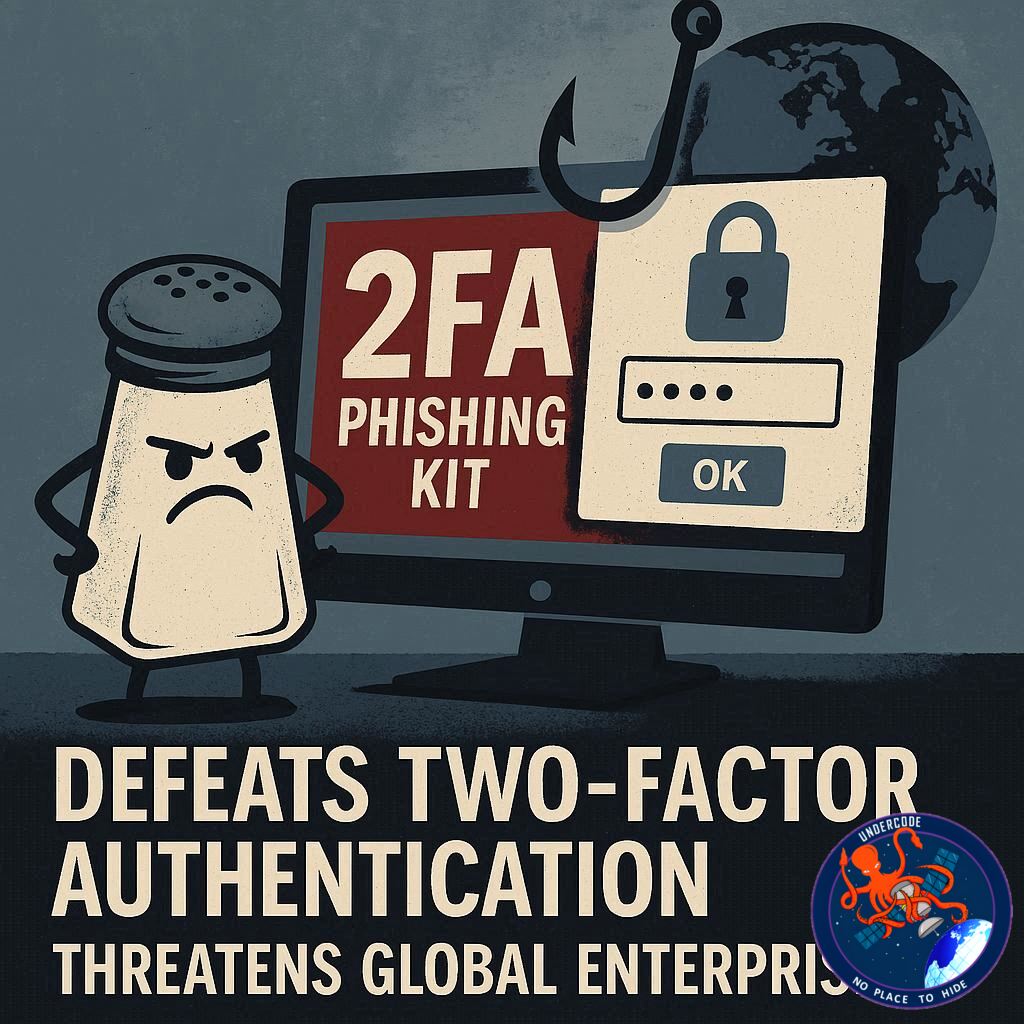
Cybercrime has entered a dangerous new phase with the rise of Phishing-as-a-Service (PhaaS) platforms, giving attackers prebuilt, automated tools to compromise businesses worldwide. The latest discovery, Salty2FA, is a sophisticated phishing kit capable of bypassing multiple forms of two-factor authentication (2FA). Security researchers warn it has already been deployed in active campaigns across the United States and Europe, targeting industries from finance to energy. Its emergence highlights the speed at which cybercriminals are evolving and the urgent need for enterprises to rethink their defenses.
Salty2FA: A the Threat Landscape
Salty2FA has quickly become one of the most dangerous phishing frameworks of 2025. Unlike traditional kits, it can bypass push notifications, SMS codes, and even voice-based verification, directly enabling account takeovers. Its attacks have been spotted across finance, telecom, energy, logistics, and healthcare sectors, with the US and EU hit the hardest.
Research shows the campaign likely began in March–April 2025, gaining full momentum by June, and continuing aggressively into late July onward. Dozens of fresh attacks are detected daily.
A real-world case revealed just how convincing these attacks can be. Victims received an urgent email titled “External Review Request: 2025 Payment Correction.” Once clicked, it redirected to a fake Microsoft login page cloaked with Cloudflare checks to bypass detection. After credentials were entered, Salty2FA stole them instantly and then intercepted 2FA codes, ensuring complete access to the victim’s account.
Security teams using ANY.RUN sandboxing were able to watch the entire attack chain unfold: from the fake business lure to credential theft and 2FA bypass. This visibility is critical since attackers rotate domains and malware signatures daily, making static indicators ineffective.
To counter Salty2FA, experts recommend shifting to behavioral detection rather than static IOCs, detonating suspicious emails in sandboxes, enforcing stronger MFA (like app-based tokens), and enhancing employee training to recognize financial lures. Enterprises that integrate sandbox results into SIEM/SOAR workflows can dramatically cut response times, reduce analyst workloads, and improve SOC efficiency.
The rise of Salty2FA underscores how phishing-as-a-service is no longer just about stealing credentials — it’s about breaking the very defenses enterprises rely on to secure accounts.
What Undercode Say:
The discovery of Salty2FA is more than just another entry in the cybercrime toolkit — it’s a warning sign that traditional defenses are failing. Here’s what it really means:
Shift from traditional phishing to PhaaS ecosystems
Salty2FA shows how phishing has become a service industry. Attackers no longer need technical expertise; they can simply rent a kit with built-in evasion techniques, making global-scale attacks cheaper and faster.
Why bypassing 2FA is revolutionary for cybercriminals
Most enterprises rely heavily on 2FA as a final barrier. By neutralizing SMS, push, and voice-based methods, Salty2FA undermines confidence in one of the most common security layers. This forces companies to adopt stronger, hardware-based solutions like YubiKeys or authenticator apps.
Industries at maximum risk
Finance and energy sectors are high-value targets because of their direct monetary and infrastructure impact. A single account compromise in these industries can trigger millions in losses, reputational damage, and even national security risks.
Why behavioral detection is the future
Indicators like malicious domains or email headers can change within minutes. Behavioral traits, such as how fake login portals interact with users or how verification flows are intercepted, remain consistent. That’s why sandboxes and AI-driven monitoring are becoming non-negotiable.
SOC performance metrics matter
Organizations that integrate sandbox automation report up to 3× efficiency boosts and 50% faster investigations. This not only reduces costs but also keeps junior analysts engaged while freeing senior analysts for more critical cases.
Global expansion of PhaaS
The campaign’s spread from the US and EU to India, Canada, LATAM, and France signals a broader global strategy. Attackers are no longer focused on just wealthy nations — they’re targeting emerging markets where cybersecurity maturity may lag.
Psychological lures remain effective
The “payment correction” tactic is a classic psychological trigger. Employees dealing with financial documentation daily are less likely to question such requests. This highlights why cybersecurity training must go beyond technical awareness to address human psychology and decision-making under pressure.
Corporate urgency in 2025
CISOs can no longer rely solely on firewalls, email filters, or static threat feeds. The Salty2FA campaign shows that live behavioral monitoring and real-time detection systems are essential. Companies slow to adapt may suffer breaches with devastating consequences.
✅ Fact Checker Results
Salty2FA is confirmed real by ANY.RUN researchers.
Active attacks are ongoing in the US and EU across multiple industries.
Its ability to bypass SMS, push, and voice-based 2FA makes it uniquely dangerous.
🔮 Prediction
Over the next 12–18 months, phishing kits like Salty2FA will become mainstream in the cybercrime ecosystem. Attackers will bundle 2FA-bypass features into subscription-based services, making them as easy to access as cloud software. Companies that fail to adopt hardware-based MFA and sandbox-driven behavioral detection will face an explosion of account takeovers, insider breaches, and ransomware incidents.
Enterprises that act early, however, can turn this challenge into a competitive advantage — building stronger defenses that not only protect their data but also earn customer trust in a digital world under constant attack.
🕵️📝✔️Let’s dive deep and fact‑check.
References:
Reported By: thehackernews.com
Extra Source Hub:
https://www.digitaltrends.com
Wikipedia
OpenAi & Undercode AI
Image Source:
Unsplash
Undercode AI DI v2
🔐JOIN OUR CYBER WORLD [ CVE News • HackMonitor • UndercodeNews ]
📢 Follow UndercodeNews & Stay Tuned:
𝕏 formerly Twitter 🐦 | @ Threads | 🔗 Linkedin | 🦋BlueSky | 🐘Mastodon


