
Listen to this Post
Introduction: A Sector Under Pressure
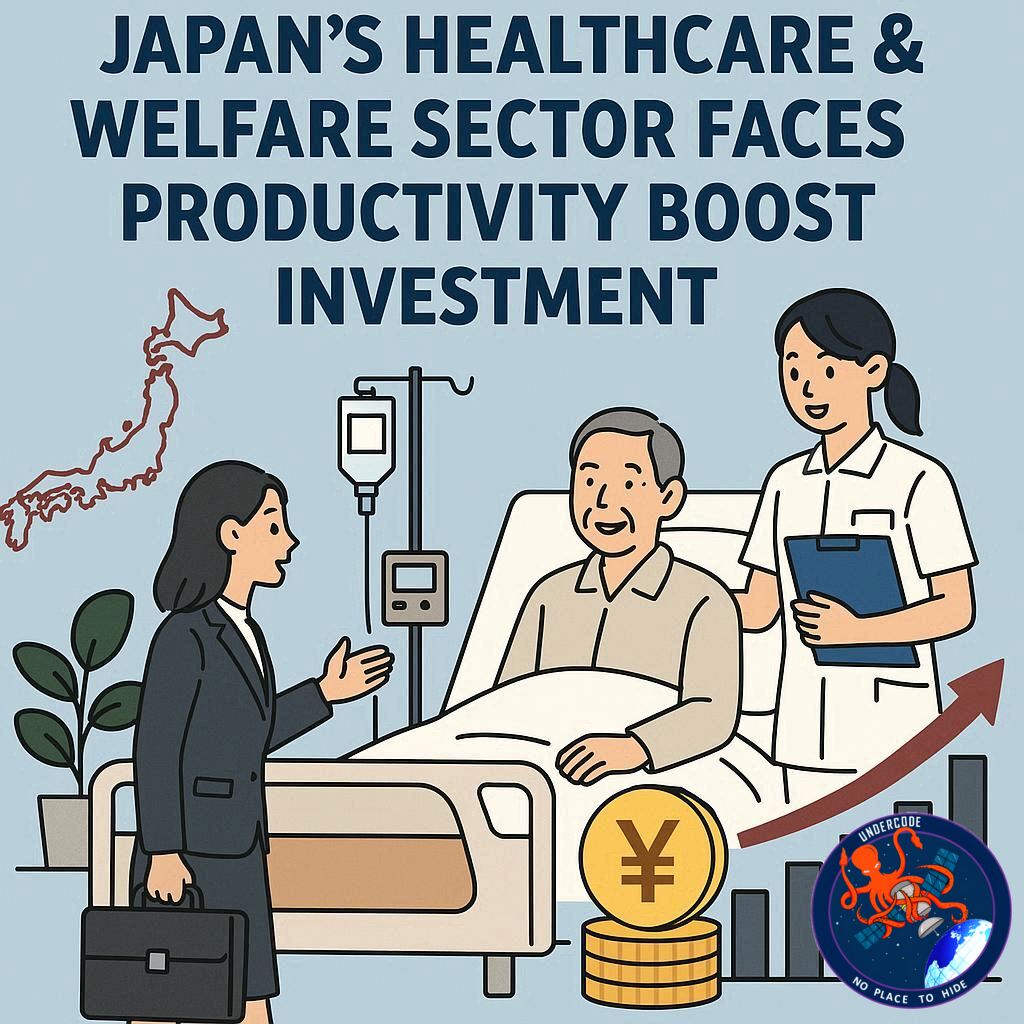
Japan’s healthcare and welfare system is standing at a crossroads. With a rapidly aging population and rising demands on medical and caregiving services, the sector is under immense strain. The Ministry of Health, Labour and Welfare recently released its 2025 Labor Economy White Paper, shedding light on the direct link between IT investment and productivity growth. The findings are striking: for every 1-point increase in digital and AI-related investment, productivity in healthcare and welfare could rise by 0.5 points. In a field where efficiency and speed can literally save lives, this correlation carries profound meaning.
Productivity Impact of IT Investments
The Ministry’s analysis covers data from 2001 to 2019, focusing on how “intangible asset investments” — software, digital tools, and R&D — affect productivity. A 1-point rise in such investments leads to different outcomes across industries. Manufacturing sees the largest push, with an 0.81-point productivity lift. Healthcare and welfare, though not as high, still rival sectors like wholesale and retail (0.53) and information and communications (0.49).
Japan’s Lag in Global IT Investment
One of the most concerning revelations is Japan’s underperformance compared to other advanced economies. While the United States (5.69%), United Kingdom (6.64%), and Germany (5.24%) all report annual average increases in intangible investments, Japan lags at just 0.87%. This gap is not only slowing national productivity but also widening the competitive distance between Japan and its peers.
The Urgency of Healthcare Digitalization
The white paper emphasizes that with an aging society, productivity in healthcare and welfare is no longer optional — it is essential. The sector is projected to absorb more workers as elderly care demands rise, yet without digital support, this workforce will struggle under unsustainable pressure. IT investments can help fill the productivity gap, enabling staff to provide better care without burning out.
Real-World Examples of AI in Care
The report also highlights tangible examples of technology already making a difference. In nursing homes, AI-powered sensors are being used to remotely monitor the health of elderly residents. These systems detect abnormalities early, reducing emergency interventions and improving safety. Such technologies also cut down on night-shift patrols, freeing caregivers from repetitive tasks while still ensuring vigilance.
Broader Implications for National Growth
Beyond healthcare, the report links Japan’s sluggish intangible investments to the nation’s broader economic slowdown. As other countries move ahead with digital-first strategies, Japan risks falling further behind unless decisive steps are taken. Healthcare and welfare represent not only a moral imperative but also an economic one: a chance to boost national productivity by solving a growing social challenge.
What Undercode Say:
Hidden Leverage in Healthcare IT
What stands out in this analysis is not just the numbers, but the leverage they represent. A 0.5-point productivity boost from a 1-point investment increase might appear modest, but in a labor-heavy sector like healthcare, the compounding effect is massive. Small efficiency gains ripple across thousands of facilities, millions of patients, and billions in national healthcare spending.
Comparison with Manufacturing and Retail
It’s tempting to dismiss healthcare’s numbers as weaker than manufacturing’s 0.81-point boost, but that’s a flawed lens. Manufacturing benefits from decades of automation and optimization. Healthcare, on the other hand, starts from a far more analog baseline. Even modest digital adoption has transformative potential, not just for output but for the quality of care delivered.
Cultural Resistance to Technology
One underexplored angle is cultural resistance. Japan’s healthcare workforce is built on tradition, trust, and human interaction. Introducing AI tools can sometimes feel like replacing empathy with algorithms. Overcoming this barrier requires reframing IT not as a replacement but as an augmentation of human care. Successful case studies, like AI-assisted night monitoring, prove that technology can enhance dignity and safety rather than diminish them.
Global Productivity Gap and Its Warning
The international comparison is especially alarming. Japan’s 0.87% growth in intangible investments is not just a number; it is a red flag. While Western economies are embedding digital solutions into their DNA, Japan risks entrenching inefficiency. Healthcare, with its swelling workforce, is the worst place for such a gap. Without bold investments, the system could collapse under demographic weight.
Aging as a Catalyst, Not a Burden
Interestingly, aging is often painted as a looming crisis. But in this case, it could be the very catalyst for innovation. The sheer necessity of handling more patients with fewer hands creates pressure to innovate. Japan’s demographic challenge may actually force the sector to accelerate digital adoption, creating breakthroughs that could later be exported worldwide.
The Cost of Delay
Every year of hesitation adds to the burden. Caregivers burn out, costs rise, and opportunities are lost. The white paper is essentially a wake-up call: delaying IT investments in healthcare is no longer financially or socially sustainable. If Japan waits until the system breaks, recovery will be far more expensive.
The Strategic Importance of Healthcare IT
Healthcare IT is not just about efficiency. It’s also about resilience. Remote monitoring systems, AI diagnostics, and digital workflows make healthcare less dependent on human availability — a crucial factor in pandemics, disasters, or labor shortages. In that sense, IT investments serve as a form of national security.
The Role of Policy and Incentives
While the private sector can adopt technologies, government policy will be the real driver here. Subsidies, tax breaks, and nationwide digital infrastructure are needed to accelerate adoption. Without a coordinated push, progress will remain fragmented, and productivity gains will be diluted.
Lessons from Other Sectors
The parallels with retail and information technology are instructive. These sectors already demonstrate how digitalization can scale efficiency without sacrificing service quality. Healthcare can learn from these models, especially in managing data flows, automating routine tasks, and integrating AI into decision-making.
A Potential Export Advantage
If Japan manages to overcome its cultural and institutional inertia, it could create globally competitive healthcare IT solutions. With its reputation for quality and precision, Japanese-developed AI care systems could become exportable assets, generating economic growth beyond domestic boundaries.
Fact Checker Results
✅ The Ministry’s white paper confirms the 0.5-point productivity gain per 1-point IT investment increase.
❌ Japan’s IT investment pace is far behind peers, limiting near-term gains.
✅ Real-world AI care systems in nursing homes are already functioning and delivering results.
Prediction
Japan’s healthcare and welfare sector is on the brink of a digital transformation. If IT investment accelerates by even a fraction of the levels seen in the U.S. or U.K., productivity could surge, care quality could rise, and Japan may turn its demographic challenge into an innovation opportunity. 🚀
🕵️📝✔️Let’s dive deep and fact‑check.
References:
Reported By: xtechnikkeicom_c983f1a6736d6970993d65bb
Extra Source Hub:
https://www.twitter.com
Wikipedia
OpenAi & Undercode AI
Image Source:
Unsplash
Undercode AI DI v2
🔐JOIN OUR CYBER WORLD [ CVE News • HackMonitor • UndercodeNews ]
📢 Follow UndercodeNews & Stay Tuned:
𝕏 formerly Twitter 🐦 | @ Threads | 🔗 Linkedin | 🦋BlueSky | 🐘Mastodon


