
Listen to this Post
Introduction
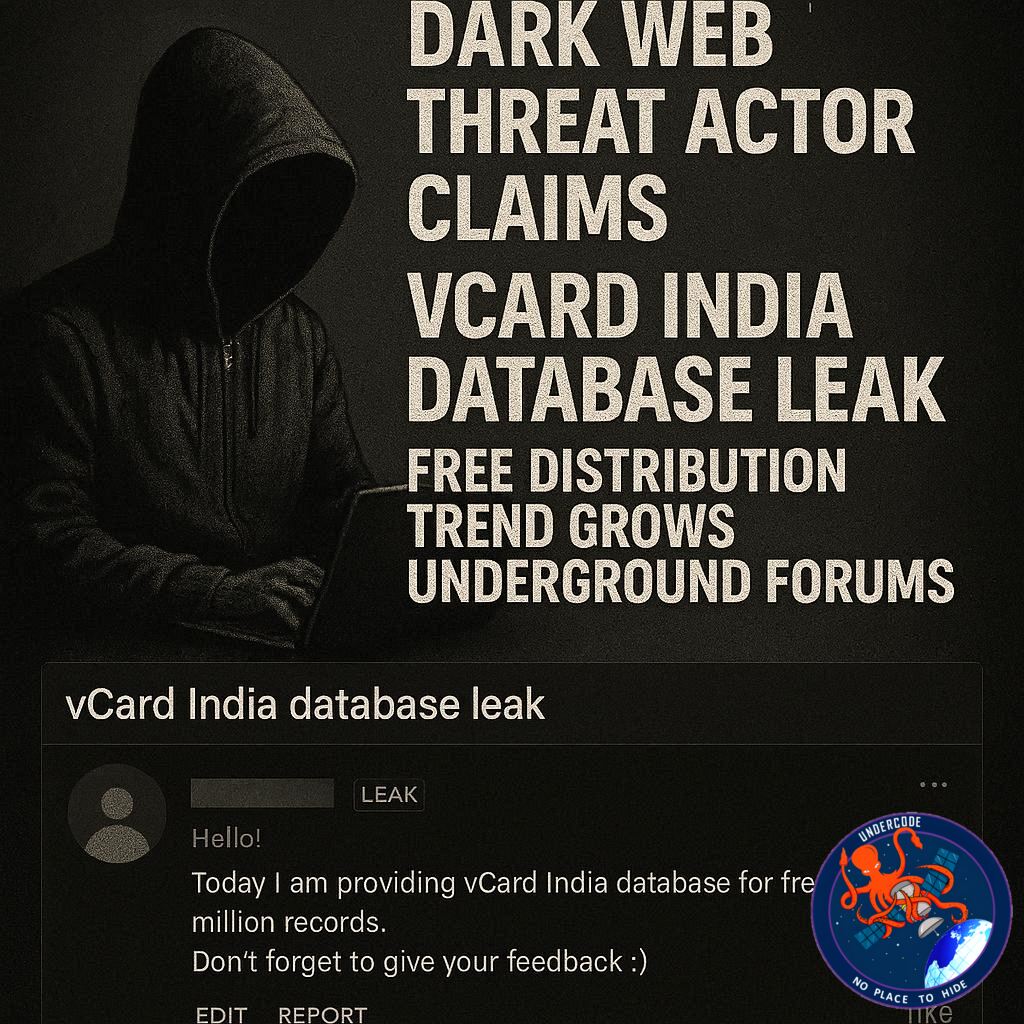
A new alleged database leak targeting Indian SaaS infrastructure is drawing attention across underground cybercrime communities. According to claims circulating on dark web channels, a threat actor has publicly released what is said to be the database of vCarrd, an India-based digital business card and profile management platform. Unlike traditional ransomware-style extortion or private database auctions, this incident reportedly follows a newer underground tactic where stolen data is distributed freely to maximize exposure and downstream abuse.
The alleged leak has not yet been officially verified by the company. However, cybersecurity analysts are increasingly warning that publicly shared databases often become far more dangerous than privately sold breaches because they spread quickly across Telegram groups, cybercrime forums, credential-sharing communities, and automated phishing ecosystems.
Digital identity platforms such as vCarrd hold structured professional information that can become extremely valuable for cybercriminal operations. Even if passwords are absent or encrypted, exposed business intelligence can still be weaponized for phishing, impersonation, business email compromise campaigns, and identity correlation attacks.
Alleged vCarrd Database Leak Raises Concerns Across India’s SaaS Ecosystem
The dark web post claims that the database linked to vCarrd is being distributed publicly through underground channels rather than offered as an exclusive sale. This distinction matters because public releases often reach thousands of low-level threat actors within hours.
Cybercriminals increasingly prefer mass distribution strategies because leaked information can rapidly enter automated attack pipelines. Once mirrored across multiple platforms, containment becomes nearly impossible.
According to the claims, the exposed dataset may contain several categories of sensitive information commonly managed by digital business-card and profile-management services, including:
Professional identity records
Business contact information
Email addresses
Social profile references
Authentication-related data
Branding metadata
Customer relationship details
This type of information is especially attractive for social engineering operations because it provides attackers with detailed organizational visibility.
Threat actors can potentially use structured identity information to build convincing phishing campaigns targeting employees, executives, or business partners. Modern phishing attacks no longer rely on generic spam. Instead, attackers use curated intelligence to create highly personalized messages capable of bypassing user suspicion.
Why Public Database Releases Are Becoming More Dangerous
One of the biggest cybersecurity shifts observed during 2025 and 2026 is the rise of “free-release” breach culture inside underground communities.
Traditionally, stolen databases were sold privately to selected buyers. Today, many attackers publish datasets publicly to gain reputation, attract followers, increase influence, or damage organizations more aggressively.
Once databases become freely available, several risks emerge almost immediately:
Rapid redistribution across underground forums
Integration into combo lists used for credential stuffing
Automated phishing list generation
Identity impersonation campaigns
Long-term intelligence aggregation
Credential stuffing remains one of the most common attack methods following database leaks. Attackers test leaked usernames and passwords against hundreds of other platforms, betting that users reused the same credentials elsewhere.
Even limited data exposure involving usernames, emails, weak password hashes, or session metadata can support broader account takeover campaigns.
Structured OSINT Data Creates Additional Risks
Another major concern involves OSINT-ready datasets.
Digital profile-management platforms naturally organize information in ways that are extremely useful for threat intelligence gathering. Cybercriminals value this structure because it simplifies identity mapping.
Even if passwords are not included, exposed records may still reveal:
Corporate hierarchies
Executive contact relationships
Employee naming conventions
Department structures
Vendor relationships
Marketing intelligence
Threat actors frequently combine such datasets with other intelligence sources like:
Infostealer malware logs
Older breach collections
LinkedIn scraping archives
Social media intelligence
Credential marketplaces
The result is a much larger identity intelligence repository capable of supporting sophisticated fraud operations.
Cybercrime groups increasingly operate like intelligence agencies. Their objective is no longer limited to stealing passwords. Instead, they seek comprehensive visibility into people, companies, workflows, and business ecosystems.
India Continues to Face Growing Cybercriminal Attention
India has become one of the fastest-growing targets for cybercriminal operations due to its rapidly expanding digital economy.
Several factors contribute to this growing attention:
Explosive SaaS adoption
Expanding fintech infrastructure
Massive SME digitalization
API-driven business ecosystems
Accelerated cloud transformation
As more Indian businesses migrate toward cloud-based services and interconnected platforms, the attack surface expands significantly.
Many small and medium-sized businesses still lack mature cybersecurity defenses. Threat actors understand this imbalance and increasingly focus on scalable SaaS ecosystems where one breach may expose thousands of users simultaneously.
Additionally, India’s booming startup ecosystem creates large amounts of professional identity data stored across cloud applications, CRM systems, collaboration platforms, and digital networking tools.
What Undercode Says:
Underground Communities Are Shifting Toward Visibility Warfare
The alleged vCarrd incident reflects a broader evolution happening across dark web communities. Threat actors are no longer focused only on financial monetization. Reputation building inside underground ecosystems now plays a central role.
Free database releases function almost like propaganda campaigns. Attackers gain visibility, followers, credibility, and influence by distributing large datasets publicly. In many cases, the psychological impact becomes just as valuable as direct financial profit.
SaaS Platforms Are Becoming Prime Intelligence Targets
Business-oriented SaaS platforms have become highly attractive because they centralize structured professional information. Attackers understand that professional identity datasets provide long-term strategic value.
Unlike random consumer databases, business platforms contain relationship intelligence that can be weaponized for corporate targeting.
A single employee directory can reveal:
Organizational structures
Executive chains
Business partnerships
Communication patterns
Internal naming standards
This intelligence dramatically improves phishing precision.
Credential Reuse Remains a Global Cybersecurity Disaster
One of the recurring problems highlighted by incidents like this is credential reuse.
Many users continue using identical passwords across:
SaaS dashboards
Email services
CRM systems
Cloud collaboration platforms
Financial services
This creates cascading compromise risks. Even when one platform experiences only a partial leak, attackers may pivot into entirely different ecosystems using reused credentials.
Credential stuffing operations remain extremely profitable because user behavior has not fundamentally improved.
Public Leaks Cause Long-Term Damage
Private breach sales usually limit exposure to a smaller number of criminal buyers. Public leaks completely change the equation.
Once data becomes free:
Mirrors spread globally
Telegram redistribution accelerates
Secondary criminals gain instant access
Smaller threat actors join exploitation campaigns
This dramatically increases the lifespan of abuse opportunities.
Some leaked datasets remain active inside underground ecosystems for years.
Professional Identity Data Is the New Goldmine
Cybercriminals increasingly value identity intelligence more than passwords themselves.
Why?
Because identity data supports:
AI-generated phishing
Voice impersonation
Business email compromise
Social engineering
Executive fraud schemes
As artificial intelligence improves phishing realism, structured professional datasets become even more dangerous.
Attackers can now automate personalized attacks at scale using leaked corporate intelligence.
API Ecosystems Introduce Hidden Exposure Risks
Modern SaaS applications rely heavily on APIs and third-party integrations.
Even when a core database remains protected, weak integrations may expose:
Access tokens
Session metadata
OAuth permissions
Synchronization records
Connected service information
This interconnected architecture means one weak platform can create cascading exposure across multiple business services.
Organizations Must Treat OSINT Exposure Seriously
Many companies underestimate the value of seemingly harmless professional information.
However, attackers view:
Job titles
Employee emails
Branding details
Contact structures
Social profile links
as operational intelligence.
OSINT-driven attacks are becoming more dangerous because modern cybercriminal groups combine automation with intelligence analysis techniques previously associated with nation-state operations.
Defensive Security Culture Is Still Lagging
The rapid digital transformation happening across emerging SaaS markets often outpaces cybersecurity awareness.
Many startups prioritize:
Growth speed
User acquisition
Platform expansion
while underinvesting in:
Security auditing
Access monitoring
Threat detection
Incident response planning
This imbalance creates ideal conditions for underground actors.
Deep analysis :
Check whether leaked emails appear in breach databases
curl -X GET "https://haveibeenpwned.com/api/v3/breachedaccount/[email protected]"
Monitor suspicious login attempts in Linux authentication logs
grep "Failed password" /var/log/auth.log
Identify exposed OAuth tokens in application configs
grep -Ri "oauth|token|apikey" /var/www/
Detect reused credentials inside local datasets
python3 credential_audit.py --check-reuse leaked_users.txt
Monitor Telegram scraping activity indicators
tcpdump -i eth0 port 443 | grep telegram
Analyze leaked hashes format
hashid leaked_hashes.txt
Check exposed endpoints
nmap -sV target-domain.com
Review suspicious API activity
cat api_logs.json | jq '.requests[] | select(.status=="401")'
Search employee exposure through OSINT
theHarvester -d company.com -b all
Audit MFA status across enterprise users
python3 mfa_audit.py --export-report
Fact Checker Results
🔍 ✅ The alleged vCarrd breach has not been independently verified by official public disclosures at the time of reporting.
🔍 ✅ Cybersecurity experts widely agree that publicly distributed leaks increase phishing, credential stuffing, and identity-correlation risks significantly.
🔍 ❌ There is currently no confirmed evidence proving the full scale, authenticity, or exact contents of the alleged leaked dataset.
Prediction
📊 Cybercriminal groups will continue shifting toward free public leak strategies to maximize visibility and large-scale exploitation opportunities.
📊 Indian SaaS and fintech ecosystems will likely face increasing targeting due to rapid cloud adoption and expanding SME digital infrastructure.
📊 AI-assisted phishing campaigns powered by structured identity leaks are expected to become one of the dominant cybercrime trends through 2026 and beyond.
▶️ Related Video (72% Match):
🕵️📝Let’s dive deep and fact‑check.
References:
Reported By: x.com
Extra Source Hub (Possible Sources for article):
https://www.quora.com
Wikipedia
OpenAi & Undercode AI
Image Source:
Unsplash
Undercode AI DI v2
Bing
🔐JOIN OUR CYBER WORLD [ CVE News • HackMonitor • UndercodeNews ]
📢 Follow UndercodeNews & Stay Tuned:
𝕏 formerly Twitter 🐦 | @ Threads | 🔗 Linkedin | 🦋BlueSky | 🐘Mastodon | 📺Youtube


